Where are you from, and what sparked your interest in STEM and, ultimately, your decision to apply for the Department of War SMART Scholarship?
I’m from Davenport, Iowa. From a young age, I was fascinated by mathematics and its role in explaining the world. I chose electrical engineering to maximize my use of math. I applied for the SMART Scholarship because I wanted to apply my skills in a practical, meaningful way.
Tell me about your educational journey. What are you studying (university and major), and was there a specific class, project, or mentor that solidified your passion for your field?
I graduated from Davenport West High School in Davenport, Iowa, in June of 2023. In August 2023, I enrolled at Iowa State University in Ames, Iowa, to study electrical engineering with an emphasis in electromagnetics. My high school engineering professor convinced me to go into engineering after he explained how big a role math plays in electrical engineering. When I learned that there was an engineering path that had such a strong need for math, I knew it was for me. I plan to graduate from Iowa State University with my bachelor’s in 2027 and my master’s degree in 2029.
What are some things that have surprised you—maybe a challenge you didn't expect or an aspect of the Army's engineering and testing mission that you found uniquely interesting?
I initially thought my job assignment would be selected for me. I was surprised to learn I could explore different areas within the Army’s engineering and testing mission to find the best fit for my interests. I believe this flexibility will be invaluable in determining where I belong.
Can you describe a specific project or task you've worked on at ATEC that you're particularly proud of? What was your role, and what did you learn from it about real-world engineering or test and evaluation?
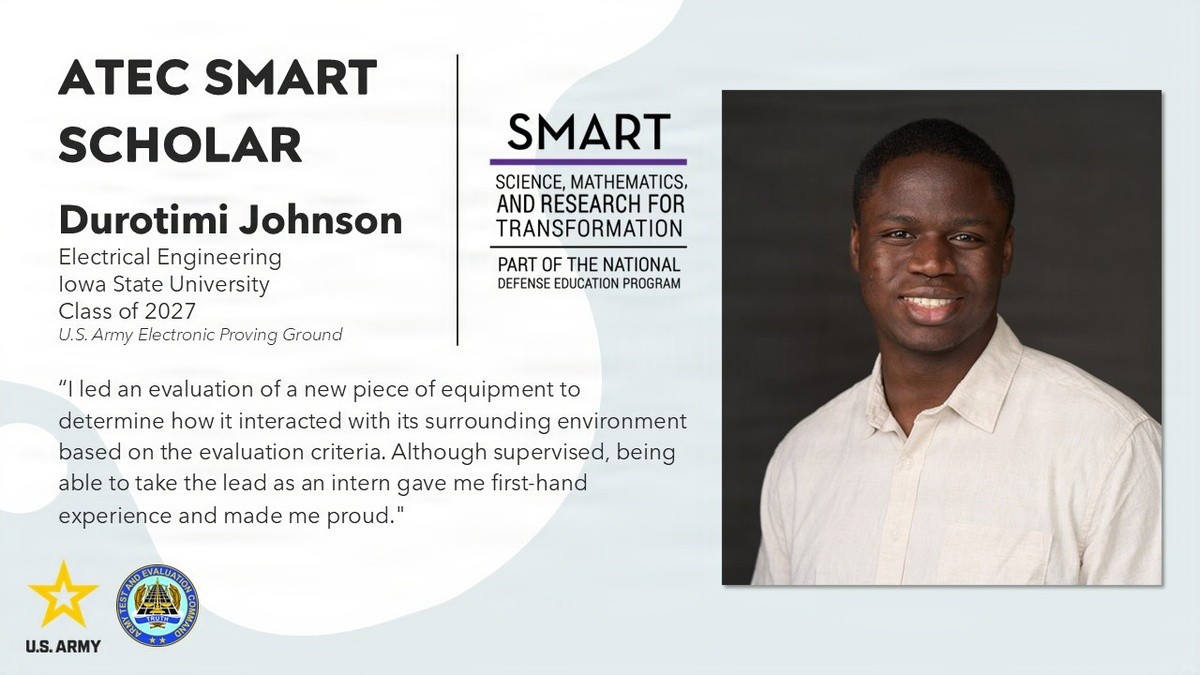
I gained first-hand experience by participating in a supervised evaluation of a new piece of equipment to determine how it interacted with its surrounding environment based on the evaluation criteria.
How has your academic training prepared you for your work at ATEC, and conversely, how has your hands-on ATEC experience informed your approach to your studies?
Since I have a focus in electromagnetics and I take related courses, I would say my academics have prepared me very well for my work at ATEC. It has aided me in understanding the processes that occur when I evaluate a given electronic device’s electromagnetic radiation. It has also helped me understand a lot of the scientific words being used. The hands-on experience allowed me to advance in my studies and made it easier to switch from application to theory as opposed to switching from theory to application. The hands-on experience I gained working with devices and gauging their reactions to outside interference allowed me to relate it back to the theories I learned in school, which solidified my understanding.
Looking ahead to your post-graduation career with ATEC, what are you most excited about? Is there a specific technology, problem set, or mission area you're eager to contribute to?
I’m really excited about evaluating new military equipment and pushing it to its limits. But I’m most excited to see for myself how electromagnetic radiation affects it.
If you could give one piece of advice to a student considering the SMART Scholarship or a career in test and evaluation, what would it be?
My advice to SMART Scholarship applicants would be to build their skills by participating in a broad range of projects, which will help them stand out during the application process.
To learn more about the SMART Scholarship program, including how to apply, visit https://www.smartscholarship.org.
Social Sharing