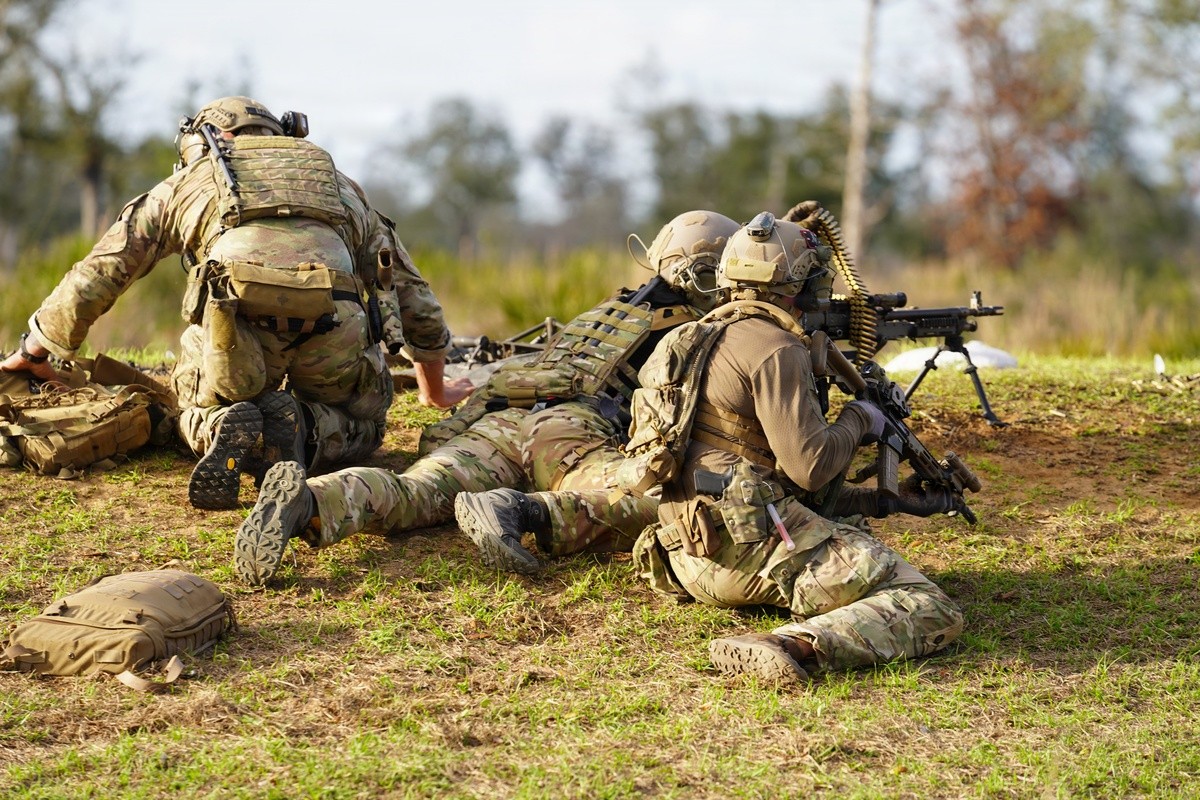
WASHINGTON — To support Secretary of War Pete Hegseth’s “peace through strength” priorities, at a recent AUSA coffee series speaking event, an Army leader outlined how the service built its $253 billion budget request for fiscal year 2027, which includes investments in housing, training and recruiting.
Army Maj. Gen. Rebecca McElwain, the service’s budget director, said the proposal centers on three lines of effort:
- Modernizing through the continuous transformation initiative, expediting how the service fights, equips and trains, while getting new technologies into the hands of Soldiers.
- Delivering combat-ready forces, including investments in next-generation weapons systems.
- Strengthening the profession, investing in quality-of-life improvements for Soldiers and their Families.
To deliver combat-ready forces while aligning with the War Department’s priority to rebuild the military, the Army’s proposal includes $7.3 billion for munitions expansion, $3.8 billion for its organic industrial base and $1.3 billion for warfighter end-strength growth.
Army vehicles currently in development include the XM-30 Mechanized Infantry Combat Vehicle, the Army’s replacement for the Bradley Fighting Vehicle and the M1E3 Abrams, and the service’s next-generation battle tank.
Lisa Salazar, who attended the event from the office of the assistant secretary of the Army for acquisition, logistics and technology, said the next steps for the XM-30 and M1E3 will be to finish the prototype stage and begin fielding pilot programs. The Army recently revealed its first M1E3 prototype at the North American International Auto Show in Detroit earlier this year.
McElwain noted that technology is changing exponentially faster than ever before.
“We can't control the pace of which that's happening, but we can try to keep up,” she said. “So, as we deliver combat-ready forces, we're trying to make sure the budget ensures that units are properly equipped and trained.”
The Army plans to add 18,300 Soldiers, raising its total personnel by 5.3%. The increase includes 15,000 active-duty troops and another 3,300 National Guard members. The service also proposed a 5 to 7% pay raise for Soldiers, earmarked $2.5 billion for recruiting and retention efforts and requested a 9.6% increase for operations and maintenance.
The Army proposed spending $295 million for increased essential combat unit training and $432 million for critical repair parts.
McElwain said improving housing for Soldiers aligns with the War Department’s priority of restoring the warrior ethos by allowing Soldiers to focus on the mission.
The service will invest $4 billion in family housing, child development centers and quality-of-life improvements, and an additional $2.9 billion will go toward barracks upgrades.
“Investment in Soldiers also means investment in families,” McElwain said, adding that the foundation of the Soldiers starts with ensuring their families are cared for.
One significant funding increase is 12.9% toward research, development, test and transformation, including the development of the Army’s next-generation command and control. McElwain said NGC2 will provide layers of technology, including data, infrastructure, applications and transport — giving commanders a wider view of multiple platforms and domains.
Finally, regarding the War Department’s priority of reestablishing deterrence, the Army plans to spend $1.1 billion to defend the southern border, $1.9 billion on counter-unmanned aircraft systems, and invest in a nuclear energy resilience program.
“It really is a budget that strategically balances present readiness with what we need for future dominance,” McElwain said.
Social Sharing