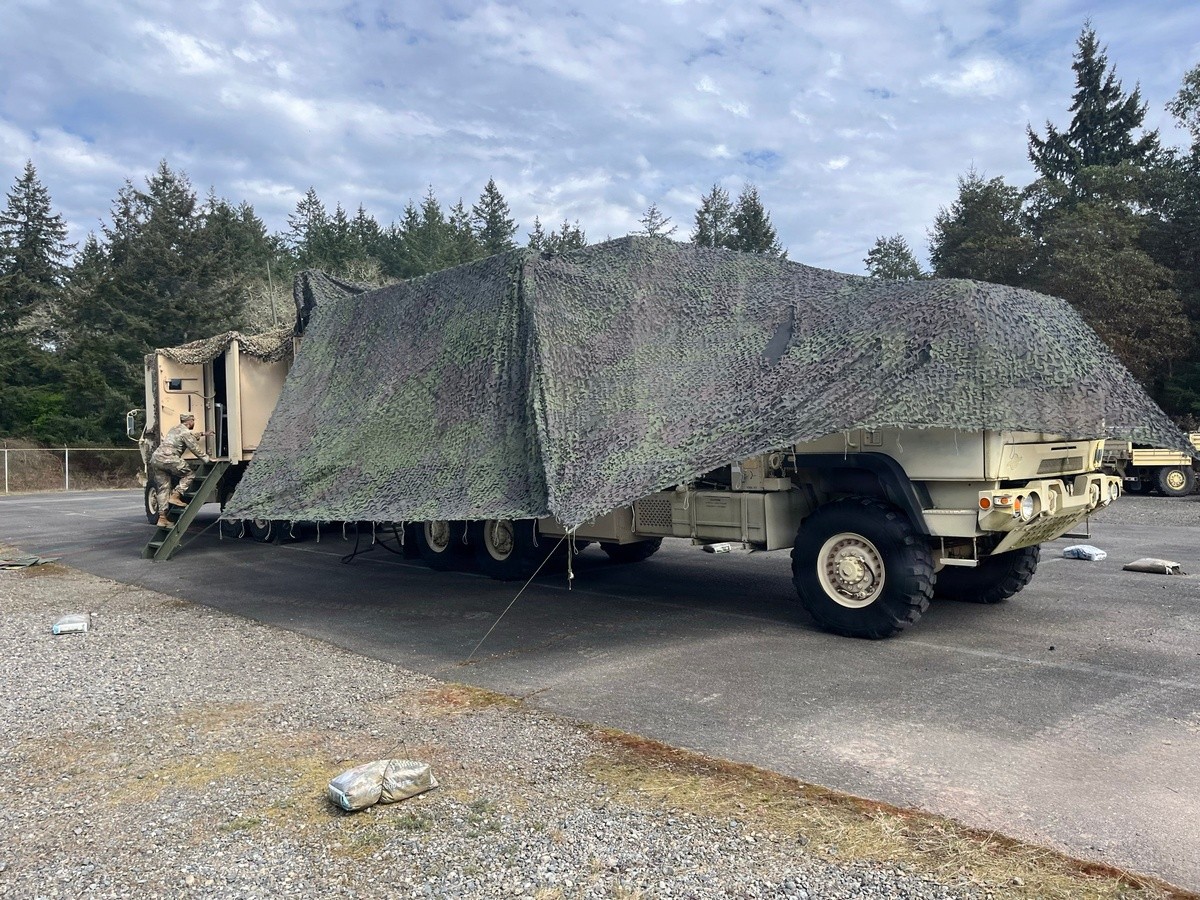
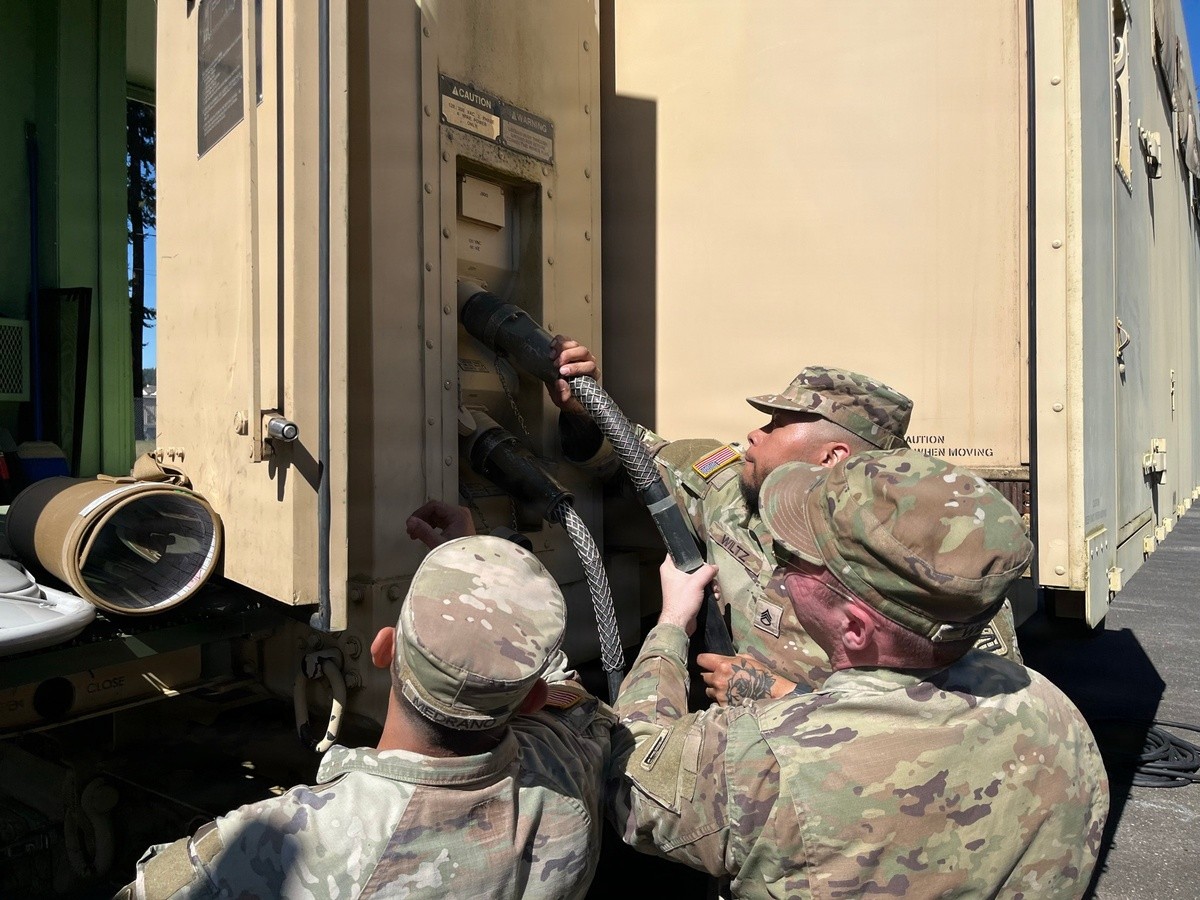

CAMP MURRAY, Wash. –Soldiers from the 81st Mobile Brigade Combat Team’s Fire Effects Cell demonstrated advanced fire control capabilities and seamless integration with active-duty forces during a fire control exercise conducted April 8-22, as part of I Corps’ Courage Lethality exercise.
The training served as a technical rehearsal for the brigade’s ability to plan, synchronize and execute multi-domain lethal and nonlethal fires in a complex operational environment spanning Joint Base Lewis-McChord and Yakima Training Center.
Courage Lethality 2026 was designed to enhance readiness and interoperability across formations, ensuring units are prepared to operate effectively in large-scale combat operations. Throughout the exercise, the 81st FEC embedded with an active-duty brigade executed the military decision-making process and conducted current operations fire control while contributing to planning efforts at the corps level.
“Our ability to plug into an active-duty formation and immediately contribute at the operational level shows how ready and capable the National Guard is in a large-scale combat environment,” said Chief Warrant Officer 2 Jack Androski, FEC chief.
Soldiers integrated multiple command-and-control systems, enabling real-time collaboration and synchronization across echelons. Their participation in corps-level planning conferences, working groups and briefs ensured the unit maintained a continuous presence in shaping targeting efforts.
A key achievement during the exercise was the validation of long-distance fire mission processing using Starshield communications, linking operations between JBLM and Yakima Training Center. The demonstration showcased the brigade’s capability to execute distributed fires over extended distances while maintaining responsiveness and accuracy.
The FEC also emphasized survivability and adaptability by conducting a tactical operations center jump into an ad hoc underground location. Following the displacement, Soldiers rapidly reestablished fire control systems and resumed operations, reinforcing the importance of command post survivability in contested environments.
Before the TOC jump, the unit executed digital fires operations from expeditionary platforms, further showcasing its ability to operate in dispersed and resource-constrained conditions.
By the end of the exercise, the FEC had successfully integrated with active-duty counterparts, developed a synchronized targeting plan and executed fires in support of I Corps across a complex battlespace.
“The environment we trained in forced us to operate across distance, under pressure and alongside multiple partners,” said Androski. “That’s exactly how we’ll fight, and this exercise proved we’re ready.”
In addition to tactical training, the exercise included leader engagements and professional development opportunities, strengthening relationships across the joint force and with regional partners.
Related Links
The Official Website of the National Guard | NationalGuard.mil
State Partnership Program | NationalGuard.mil
The National Guard on Facebook | Facebook.com/TheNationalGuard
The National Guard on Flickr | Flickr.com/TheNationalGuard
The National Guard on Instagram | Instagram.com/us.nationalguard
The National Guard on X | X.com/USNationalGuard
The National Guard on YouTube | YouTube.com/TheNationalGuard
Social Sharing