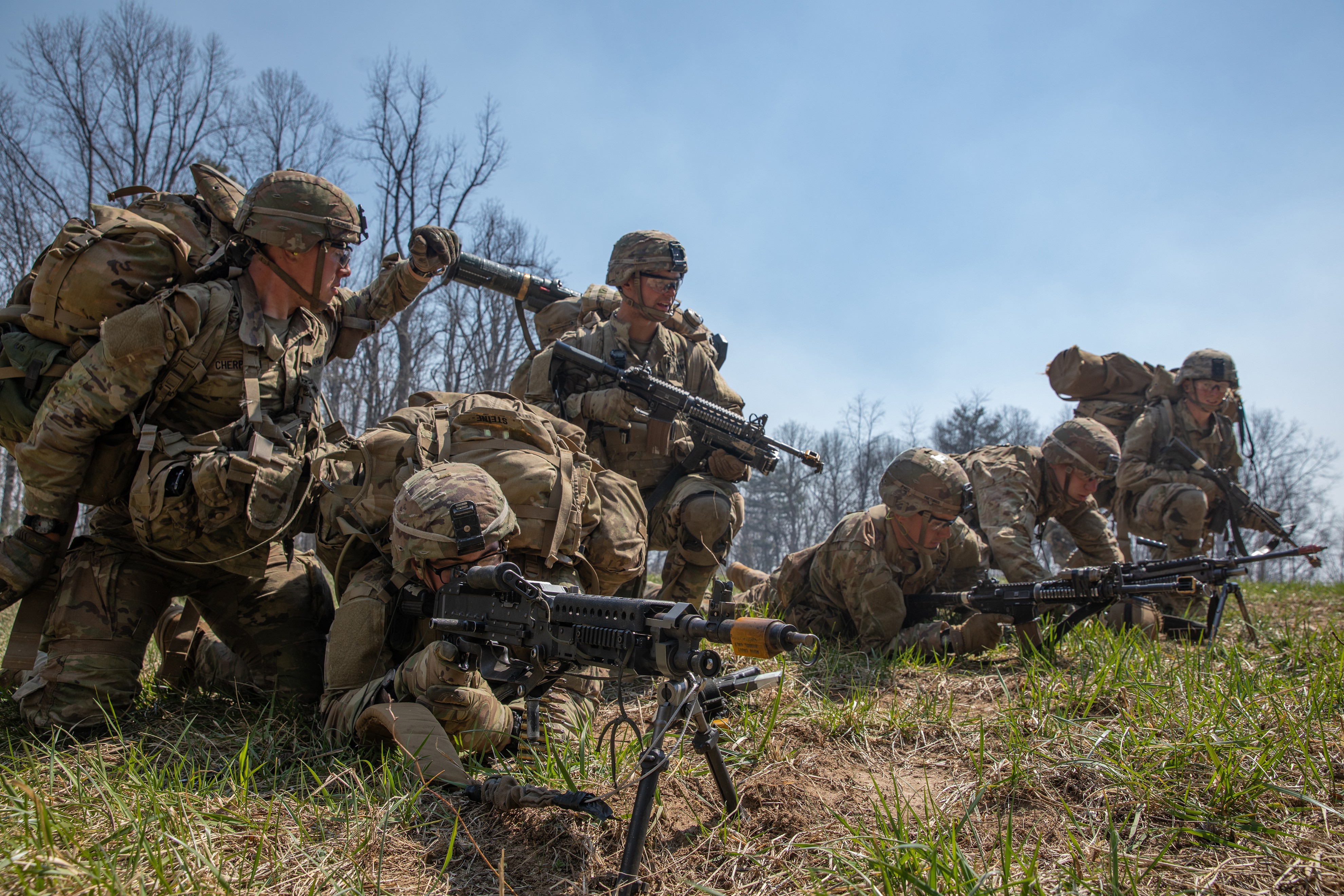
How do we best prepare light infantry forces for employment in large-scale combat? By organizing, equipping, and training our light units to conduct successful infiltration operations. These forces must be capable of maneuvering behind enemy forces and conducting decentralized operations by gaining and maintaining contact, providing accurate and responsive fires, sustaining forces behind enemy lines, and providing uninterrupted command and control.
Large-scale combat has often seen light infantry forces used advantageously by moving undetected to the rear of an enemy force to conduct special purpose attacks or establish defensive positions. The Russia-Ukraine war continues to highlight light infantry units that can infiltrate, causing serious dilemmas for adversary forces. These operations have the effect of disrupting enemy logistics, turning the enemy out of their positions, and forcing them to fight in a manner for which they are unprepared. For light infantry forces to be successful in this type of operation, they must organize their combat power to avoid being surprised by the enemy’s maneuver through intelligence and prevent the enemy from massing combat power at a decisive point through fires. They must also prevent culmination of their forces through sustainment and synchronize operations through continuous command and control. Several organizational, equipment, and training modifications can be made to optimize light infantry forces to effectively accomplish infiltration missions.
The U.S. Army’s 5307th Composite Unit, also known as Merrill’s Marauders, was a light infantry regiment designed to execute infiltrations in Burma during World War II. Marching and fighting in severely restrictive jungle terrain against elements of the Japanese 18th Division, the three infantry battalions of the 5307th operated in the rear of enemy forces, disrupting their operations so that the Chinese Army could advance and defeat Japanese forces to recover northern Burma. Each battalion had two subordinate “combat teams,” which included not only infantry platoons but also a heavy weapons platoon with 81mm mortars, an intelligence and reconnaissance platoon, headquarters personnel trained to coordinate and receive aerial resupply, and communications specialists for short- and long-range radio communications. Despite the grueling environment and an experienced enemy force, Merrill’s Marauders succeeded in their missions largely due to their ability to use their intelligence and reconnaissance platoons to maintain contact with the enemy and use internal indirect fires to break enemy attacks on their positions. To do this, they relied on well-planned and coordinated aerial resupply and communications architecture which provided both short- and long-range tactical radio communications.
Similar capabilities are still required of light infantry forces in large-scale combat, and these skills must be sharpened at home stations and in our combat training center exercises. As brigade combat teams deploy to their intermediate staging base (ISB), battalions should immediately establish their main command posts in field configuration to validate functionality and form. As battalions execute reception, staging, onward movement, and integration tasks at the ISB, they should focus on critical capability training. For the intelligence warfighting function, this should include small unmanned aerial system (sUAS) operator training and One System Remote Video Terminal (OSRVT) training in the S-2 section. For the fires warfighting function, units should test their digital fires capability from the platoon Precision Fires - Dismounted (PF-D) through company Lightweight Forward Entry Devices (LFED) to battalion Advanced Field Artillery Tactical Data Systems (AFATDS) up to brigade or down to the battalion mortar platoon and company mortar section lightweight handheld mortar ballistic computers (LHMBCs). For sustainment, battalions should conduct night-vision goggle driver’s training and begin to configure low cost, low altitude (LCLA) bundles for aerial resupply.
As part of a brigade’s forcible entry, infantry battalions transport troops by aircraft, vehicle serials, or dismounted marches to establish the brigade foothold in the initial portion of the area of operations (AO). After establishing a foothold, battalions must expand the brigade’s lodgment by conducting movements to contact to defeat enemy forces in their respective AOs. Enemy forces construct robust obstacle belts in depth along main avenues of approach and position themselves to overwatch engagement areas along the choke points on the routes (low water crossings, bridges, and culverts). Companies should observe and report obstacles and defeat small enemy reconnaissance elements along these routes as battalions maneuver through their AOs. Approaching enemy strongpoints in their AOs, battalions should infiltrate, isolate, and defeat enemy forces with fires. A successful infiltration requires the ability to sustain companies by aerial resupply until the battalion can maneuver to defeat enemy forces and secure a ground line of communication for ground resupply.
After successfully defeating an enemy force, infantry battalions must quickly regain contact with enemy forces and continue to maneuver to establish defensive positions on advantageous terrain in anticipation of a larger counterattack. Battalions must control key terrain while establishing depth for their defense. Establishing a defense in depth is critical because light infantry forces which lack depth can be easily penetrated, allowing the enemy to pass combat power into the brigade’s rear. Depending on the terrain, a technique to achieve depth could include placing two rifle companies abreast within the battalion AO, each focused on preventing penetration along enemy ground avenues of approach. The companies can each have multiple section-sized anti-armor ambushes within engagement areas that are well-developed with obstacles, indirect fire targets, and multiple anti-armor weapon systems to defeat enemy exploitation forces. To their front, a third rifle company can establish vanguard anti-armor ambushes with dismounted security to defeat enemy infantry and armor fix and assault forces. Light infantry battalions that can execute the defense in depth in this decentralized manner will be most survivable and effective in defeating adversaries. Enemy forces can be severely disrupted by robust obstacles and then destroyed by lethal loitering unmanned systems (LUS), Dual Purpose Improved Conventional Munition (DPICM), 120mm fire missions, and direct fire anti-tank systems as they maneuver through multiple engagement areas throughout the depth of the AO.
To successfully enable light infantry companies in infiltration operations, infantry battalions must organize, equip, and train their intelligence assets to gain and maintain contact. These assets generally include sUAS, the scout platoon, and potentially a higher headquarters reconnaissance element to the front. During high operational tempo battle periods, companies may fail to operate with enough awareness to fly their sUAS in managed airspace to make contact on advantageous terms. Despite sUAS’s limited range in dense, high- canopy wooded terrain, it may be beneficial to consolidate company sUAS operators and systems with the battalion S-2 section, enable this information collection team with transportation, and then move them to launch sites to fly and collect on battalion priority intelligence requirements (PIRs). The battalion staff has enough personnel and cognitive bandwidth to manage and deconflict airspace for sUAS operations.
Additionally, battalion scout platoons are often challenged to move to named areas of interest and observe and report PIRs based on their sustainment requirements and proximity to support vehicles. During the most extreme heat, scout platoons sustain themselves out of their support vehicles but often only end up moving a few kilometers dismounted due to their continual need for water resupply. Reporting from the scout teams to the support vehicles is primarily via mesh radio network, while scouts communicate from the support vehicle to the battalion main command post primarily via the Joint Battle Command-Platform (JBC-P). Scout platoons are often challenged in maintaining situational awareness on company locations and actions due to lack of JBC-P reporting from the main command post to the scouts. Finally, many battalions are challenged to maintain clear reporting, situational awareness, and integrated rehearsals with brigade reconnaissance forces to maintain a common operating picture. Infantry battalions must incorporate a more deliberate integration of reconnaissance and surveillance capabilities into planning, rehearsals, and battle rhythm events to support timely and accurate reporting and situational awareness.
To successfully fight light infantry companies in infiltration operations, the battalion must provide accurate and responsive fires. The battalion’s mortar platoon must be lethal and survivable throughout the operation by always maintaining a section in position and ready to fire while conducting survivability displacements. Company fire support officers must plan and execute company-level fire support efforts and enable effective battalion fire support. Company fire support teams must place forward observers within the rifle platoons to provide effective observation to support company and battalion fire support plans. Additionally, battalion fires architectures are most successful when they include robust and redundant communications architecture. Digital fires within an Integrated Tactical Network architecture begin with sUAS operators or forward observers with PF-Ds sending targets to company fire support teams via mesh radio network. Companies then send missions using LFED via mesh radio network to the battalion fire support element (FSE) AFATDS. The battalion FSE then determines which delivery asset to provide lethal effects on the target. If mortars are utilized, the battalion AFATDS sends the mission digitally via frequency modulation (FM) to the mortar platoon’s LHMBCs. If LUS are utilized, the battalion FSE directs the LUS platoon leader via mesh radio network to employ the system and strike the target.
Successful light infantry infiltration operations require battalions to sustain companies in perpetual enemy contact. While maintaining contact with the enemy, light infantry companies are severely challenged in reporting updated logistics status (LOGSTAT) and personnel status (PERSTAT). Typical brigade- and battalion-mandated reporting periods are often insufficient to keep updated logistics and combat power common operating pictures. Battalion main command posts must continually pull information from companies regarding combat power and battle damage equipment losses during and after engagements. As companies lose command vehicles in combat and are unable to report LOGSTAT and PERSTAT on JBC-P, they transition to voice communication (mesh radio network) and reporting typically becomes more sporadic. This affects reconstitution times due to lack of battle rosters reported from companies to battalion and battalion to brigade.

Battalion S-4s need to begin operations with all pertinent vehicle and combat equipment information to rapidly fill out and submit reconstitution packets for battle-damaged equipment. The S-4 NCOIC at the combat trains command post (CTCP) should complete the reconstitution packets and submit to brigade. The field trains command post (FTCP) is typically led by the forward support company (FSC) commander and first sergeant, along with the headquarters and headquarters company (HHC) executive officer (XO). The distribution platoon moves classes of supply from the FTCP to the CTCP, where classes of supply are packaged for delivery by company trains to company logistics rally points. Infantry battalions sometimes attempt to control all the company trains through the HHC commander and FSC XO at the CTCP but often find this arrangement to be unresponsive to company sustainment requirements. When battalions initially attempt this method, the CTCPs often end up relinquishing control of the company trains back to the companies, which invariably improves responsiveness. The battalion fight is to ensure the scheme of maneuver results in secure ground lines of communication for the company trains up to the logistics resupply points.
In large-scale combat infiltration operations, infantry battalions must provide uninterrupted command and control to their companies. Lower tactical infrastructure includes tactical radio network, JBC-P, tactical satellite (TACSAT), and high frequency (HF). The battalion tactical command post (TAC) works best when used primarily as a “jump” command post to establish communications with the companies and brigade headquarters at a forward site as the battalion main command post prepares to move. After the battalion TAC establishes at the jump site, the battalion main command post must be able to tear down quickly, move, and then set-up to initial operating capability within minutes after arrival. The commander, fire support officer, operations officer (S-3), planner, intelligence officer (S-2), and joint tactical attack controller (JTAC) are the primary leadership within the battalion TAC. An operations NCO should also be included to reconnoiter and plan the battalion main command post establishment.
Recent large-scale combat has shown that light infantry formations can achieve substantial effects against enemy forces by conducting infiltration operations. History and experience have shown that to successfully execute infiltration operations, light infantry forces must synchronize intelligence, fires, sustainment, and command and control warfighting functions. By optimally organizing, equipping, and training our light infantry forces in preparation for large-scale combat, we can enhance their survivability and success against our enemies.
LTC Ian C. Pitkin currently serves as an instructor in the Department of Army Tactics, Command and General Staff College (CGSC), Army University, Fort Leavenworth, KS. He previously served as commander of 2nd Battalion, 4th Infantry Regiment, 3rd Infantry Brigade Combat Team, 10th Mountain Division, Fort Johnson, LA. LTC Pitkin earned a Master of Operational Art and Science from the School of Advanced Military Studies, CGSC, Fort Leavenworth, and a bachelor’s degree in political science from Kenyon College in Gambier, OH.
This article appears in the Winter 2025-2026 issue of Infantry. Read more articles from the professional bulletin of the U.S. Army Infantry at https://www.benning.army.mil/Infantry/Magazine/ or https://www.lineofdeparture.army.mil/Journals/Infantry/.
As with all Infantry articles, the views herein are those of the authors and not necessarily those of the Department of War or any element of it.
Social Sharing