
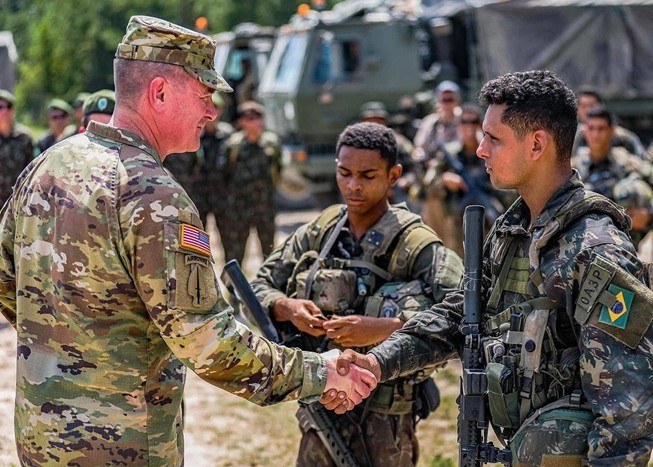
Since 2021, the U.S. Army and the Brazilian Army have conducted combined military exercises as part of Exercise Southern Vanguard (SV), known in Brazil as the Combined Operations and Rotational Exercise (CORE). According to the U.S. Army Center for Army Lessons Learned (CALL), the “U.S. Army South’s Southern Vanguard (SV) series of exercises are built to enhance relationships, promote mutual military readiness, improve interoperability, and establish the foundation for lasting integrated deterrence with select partner nations (PNs) in the United States Southern Command (USSOUTHCOM) area of responsibility (AoR).”1 In all iterations of SV/CORE to date, Brazilian Army infantry units have been paired with a unit from a U.S. Army infantry brigade combat team (IBCT) company. In anticipation of the possibility of the introduction of U.S. Army units from a Stryker brigade combat team (SBCT) or an armored brigade combat team (ABCT) being paired with a Brazilian Army armored unit, this article seeks to first provide an overview of the U.S. Army’s security cooperation activities in the Western Hemisphere and more importantly, describe the Brazilian Army’s Armored and Cavalry formations to maximize SV/CORE’s ability “to enhance interoperability at the tactical level with operational and strategic significance ensuring integrated deterrence” at a U.S. combat training center (CTC).2

Although the Indo-Pacific and European theater remains a focus of the United States national security, the U.S. Army remains focused on improving security and stability throughout the Western Hemisphere and seeks to work with partners to “improve security, stability, and interoperability with partnered states and their military forces while deterring non-hemispheric states from intervening in the region”. Armor leaders will indirectly and directly spend portions of their career enabling security cooperation through training exercises that promote interoperability and strengthen partnerships. These activities at the tactical level with countries like Brazil make the United States safer, stronger, and more prosperous.
What is Security Cooperation?
The Defense Security Cooperation Agency (DSCA) defines security cooperation (SC) as “comprising of all activities undertaken by the Department of War (DoW) to encourage and enable international partners to work with the United States to achieve strategic objectives. It includes all DoW interactions with foreign defense and security establishments, including all DoW-administered security assistance (SA) programs, that build defense and security relationships; promote specific U.S. security interests, including all international armaments cooperation activities and SA activities; develop allied and friendly military capabilities for self-defense and multinational operations; and provide U.S. forces with peacetime and contingency access to host nations. It is DoW policy that SC is an important tool of national security and foreign policy and is an integral element of the DoW mission”. Examples of Armor leaders supporting security cooperation activities include participating in the U.S. Army Military Personnel Exchange Program (MPEP), overseas rotational deployments, U.S.-based CTC rotations with partners and allies, and collaborating with partners and allies in professional military education schools (e.g. Armor Basic Officer Leader Course (ABOLC), Maneuver Captain Career Course (MCCC), and the Command and General Staff Course (CGSC).

United States Presence in the Western Hemisphere
According to the Association of the United States Army (AUSA), “the U.S. Army continues to share responsibility for fostering peace and stability in the Western Hemisphere. U.S. Army South (USARSOUTH)—the Army Service Component Command (ASCC) of USSOUTHCOM — conducts and supports multinational operations and security cooperation in this AoR to counter transnational threats and to strengthen regional security in defense of the homeland.”3 USARSOUTH is headquartered at Fort Sam Houston in San Antonio, Texas and supports U.S. national security objectives in the region through proactive engagement and enduring partnerships with 24 counterparts in the AoR. Joint Task Force-Guantanamo Bay (JTF-GTMO) and Joint Task Force-Bravo (JTF-B) are permanently assigned in the AoR and facilitate contingency response, collective response, security capability and readiness in Army forces and partner militaries.4 Overall, USARSOUTH supports U.S. joint, combined, and interagency operations that increase regional security; supports interagency operations in coordination with U.S. military and U.S. embassy country teams; supports regional humanitarian and civic assistance, disaster relief, and contingency missions; and plans, coordinates and conducts regional search and rescue operations.5
The U.S. Army and the Brazilian Army have a partnership that was forged in combat during World War II. During World War II, the Brazilian Expeditionary Force, known in Brazil as the Força Expedicionária Brasileira (FEB), nicknamed Cobras Fumantes or “the Smoking Snakes”, fought alongside U.S. forces in the Mediterranean Theatre.
U.S. Army and Brazilian Army: Southern Vanguard and Combined Operations Readiness Exercise
In recent years, the U.S. Army and Brazilian Army have increased interoperability through Exercise Southern Vanguard. Exercise Southern Vanguard is a USSOUTHCOM-sponsored, USARSOUTH-conducted exercise at the operational and tactical levels designed to increase interoperability between U.S. and Western Hemisphere forces with the ultimate goal of establishing a multinational exercise, that will improve readiness, security, and interoperability.6 The first iteration with Brazil took place in Brazil in December 2021, with participating units from the U.S. Army’s 101st Airborne Division (Air Assault) and the Brazilian Army’s 5th Battalion, 12th Infantry Brigade.7 The latest iteration took place in Brazil in November 2023. U.S. participants included USARSOUTH, 101st Airborne Division (Air Assault), 7th Special Forces Group, 1st Security Forces Assistance Brigade (SFAB), and the New York Army National Guard who trained alongside more than 1,000 Brazilian army personnel assigned to the 52nd Battalion, 23rd Infantry Brigade.8 CORE is an extension of SV and is an exercise where a Brazilian unit participates in a CTC rotation at the Joint Readiness Training Center (JRTC) in Fort Polk, Louisiana.
Brazilian Army Cavalry: South America’s Largest Armored and Cavalry Formations
In Brazil, the branch that accounts for the Brazilian Army’s armored and cavalry formations is the Cavalry Branch. In contrast, the branch that accounts for the U.S. Army’s armored, mechanized, and cavalry formations is the U.S. Armor Branch. The modern history of the Brazilian Army’s Cavalry and Armored formations can be traced to the 1980s when the Brazilian Army received a large quantity of domestic and international mechanized vehicles to equip brigade and below armored and mechanized units. In 1997, the Brazilian Army received the M60A3 tank thermal sight (TTS) tank. In 1998, the Brazilian Army received the Leopard 1A1.9 The acquisition of these vehicles provided an increase of combat power to brigade and below units across the Brazilian Army. In 2009, the Brazilian Army began replacing the Leopard 1A1 with the Leopard1A5.10 Since 2014, the Brazilian Army has incorporated the Viatura Blindada Transporte de Pessoal (VBTP) Guarani into its structure along with the incorporation of the Lince Light Multitasking Armored Vehicle and the Centauro II.11 The acquisition of the Centauro II 8x8 Mobile Gun System represents a significant enhancement of Brazil’s cavalry and reconnaissance capabilities, providing the Brazilian Army with a modern, highly mobile fire support platform. The Centauro II, known for its firepower, speed, and versatility, aligns with Brazil’s strategy to modernize its mechanized forces while maintaining operational flexibility in diverse terrains. The strategic acquisition of the Centuaro II for the Brazilian Army marks a significant modernization effort for the Brazilian Army, enhancing its ability to conduct highly mobile armored warfare while maintaining a strong presence in diverse operational environments. The Centauro II’s combination of firepower and mobility makes it particularly suited for Brazil’s vast and diverse terrain, including its open plains in the south, dense jungle regions, and urban environments.
The Brazilian Army’s Cavalry Branch is the proponent of all cavalry, armor, and mechanized forces. Due to the large spectrum of operations and missions assigned to the Brazilian Army, the Cavalry Branch has organized its units based on vehicles and functionality to accomplish their missions. The mechanized cavalry constitutes a highly mobile and powerful force capable of conducting reconnaissance and security actions on wide fronts and in great depths. It is a light armored force capable of participating in both offensive and defensive operations.12 The armored cavalry constitutes a highly mobile and powerful force, equipped and trained to conduct combat on board. Its combat power rests on the combined use of tanks and armored riflemen. The possibility of quickly concentrating or dispersing on the battlefield makes armored cavalry a key element in combat decisions.

The parachute cavalry constitutes a highly mobile and powerful force, capable of carrying out reconnaissance and security missions and participating in airborne assault operations. The light cavalry is an airborne force carried by Army Aviation helicopters and can quickly operate in any part of the national territory.13 The jungle cavalry is a force capable of operating in the Amazon environment, increasing the firepower and security of its surrounding echelon. The guard cavalry is used, primarily, in Internal Defense operations and military ceremonies.14
Combat Training Center Interoperability Considerations
This portion of the article intends to discuss how a Brazilian armor company would fight at the National Training Center (NTC) alongside a U.S. Army ABCT or SBCT. This analysis is modeled by Exercise Talisman Sabre 23 where a U.S. Armor tank company went to Australia to train at the Townsville Field Training Area.15 We will focus on a company-sized element. We analyzed authentic materials from the Brazilian Army that were in Portuguese to provide accurate information. Based on the prospect of a Brazilian Cavalry unit being paired up with a U.S. Army ABCT or SBCT, we will explore the capabilities of an armored and mechanized unit.
Training at NTC with the Brazilian Army
A potential training exchange between the U.S. Army and the Brazilian Army at NTC would offer valuable insights into mechanized warfare tactics, interoperability, and logistical challenges. If a Brazilian armored platoon were to participate in an NTC rotation, its structure, operational methods, and logistical considerations would need to be examined in depth. Likewise, if a U.S. platoon were to train in Brazil, understanding the Brazilian training environment, infrastructure, and operational challenges would be essential. A Brazilian Leopard 1A5BR platoon is structured similarly to a U.S. Army tank platoon. The composition of a typical Brazilian armored platoon includes: four Leopard 1A5BR main battle tanks, one First Lieutenant platoon leader (PL) responsible for tactical command and maneuver decisions; one “Segundo Sargento” Platoon Sergeant (PSG) who is equivalent to a U.S. Army Staff Sergeant and responsible for leadership, discipline, and logistics within the platoon; two “Terceiro Sargentos” Section Leaders who are equivalent to U.S. Army Sergeants, each commanding a two-tank section; and a mix of twelve “Cabos” and “Soldados” Crew Members. “Cabos” function similarly to a U.S. Army Corporal, overseeing junior soldiers and assisting in vehicle operations. This structure enables tactical flexibility, ensuring that Brazilian armored platoons can conduct operations effectively while integrating infantry support when necessary.
Regarding tactical deposition and combat employment, Brazilian armored units follow offensive-oriented doctrines, with a standard disposition that prioritizes attack formations and area security operations. Their employment of Leopard 1A5BR tanks often includes forward attack positions, maintaining offensive pressure, integration of dismounted elements for securing key terrain and supporting armored advances, and the use of defensive positions when required, particularly in terrain where mobility is constrained. The Leopard 1A5BR is a versatile platform, optimized for maneuver warfare, and although it lacks the advanced protection and firepower of modern main battle tanks, it remains a highly capable vehicle for fast-moving engagements. When it comes to fuel and sustainment capabilities, one notable logistical advantage of the Leopard 1A5BR is its ability to operate on multiple fuel types. While it primarily uses traditional diesel fuel, it can also run on kerosene-based jet fuel if diesel is unavailable. This flexibility is particularly beneficial in austere environments where fuel supply chains may be inconsistent.
Training at the Brazilian Army’s Regional Training Center
If the U.S. Army sends a tank platoon to Brazil, the training would take place at “O Centro de Adestramento Sul” (CA-Sul), Brazil’s equivalent to NTC. Located in the south of Brazil, CA-Sul serves as the primary training and evaluation center for all Brazilian armored formations. Unlike the U.S., where training centers are distributed across different regions and can certify different brigade combat team (BCT) formations, Brazil consolidates armored unit evaluations at CA-Sul. Brazil also has other regional training and evaluation areas in the north and east, but these are primarily used for infantry, air assault, and light mechanized units. Any armored unit, regardless of where it is stationed, must undergo final evaluations at CA-Sul before being considered fully operationally certified. An exercise in Brazil between the U.S. Army and the Brazilian Army using a U.S. tank platoon would be the first time and would demonstrate the value of interoperability. An exercise of this type would provide valuable lessons in combined arms maneuver warfare; however, several challenges must be addressed.
One challenge would be infrastructure. The infrastructure required to support heavy mechanized units varies significantly between the two nations. Unlike the United States where roads, bridges, and rail systems can accommodate Abrams tanks and Bradley Fighting Vehicles, Brazil’s road networks and transport capabilities are optimized for lighter mechanized units. Transporting U.S. armored assets to training locations would require extensive logistical planning. Another challenge is logistical sustainment. Sustaining a U.S. tank platoon in Brazil presents a unique set of logistical hurdles such as fuel and ammunition resupply because while Brazil’s Leopards can operate on multiple fuel types, U.S. tanks and Bradleys would require JP-8 or diesel in large quantities. Regarding vehicle maintenance, spare parts, and specialized repair facilities may not be readily available, requiring the deployment of additional maintenance teams and equipment. As for resupply chains, U.S. supply chains are accustomed to operating in environments with well-established logistics hubs, whereas Brazil’s armored units rely on regional supply depots that may not align with U.S. Army sustainment models. Additionally, a challenge that exists is overcoming language barriers to create interoperability. Although many Brazilian military personnel speak English, Portuguese is the primary language of instruction and communication. This could create challenges in coordinating operations, issuing orders, and conducting after-action reviews. While interpreters could mitigate some of these difficulties, the efficiency of training exercises could be affected by communication barriers. A U.S. Army and Brazilian armored training exchange at NTC or CA-Sul would offer significant benefits that would foster tactical interoperability, promote cross-training opportunities, and enhance bilateral defense and security cooperation objectives. Infrastructure constraints, logistical considerations, and language barriers must be carefully managed to ensure a successful and productive training rotation. For example, communication barriers can be overcome with coordinated and deliberate integration with U.S. Army Foreign Area Officers (FAOs), MPEPs, and 1SFAB advisors. Despite these challenges, such an exchange would enhance combined arms maneuver capabilities and interoperability.
Conclusion
In all iterations of SV/CORE to date, Brazilian Army units have been paired with a unit from a U.S. Army IBCT company. As SV/CORE exercises mature, there is a possibility of the introduction of Brazilian Army Armor and Cavalry formations to join a U.S. Army SBCT or ABCT in a CTC rotation at the NTC in Fort Irwin, California. Additionally, the possibility of a U.S. tank platoon training with a Brazilian armored formation is within the realm of possibilities. The purpose of SV/CORE is “to enhance interoperability at the tactical level with operational and strategic significance” ensuring integrated deterrence.16 The participation of U.S. and Brazilian armored formations working together at the NTC or CA-SUL is the definition of integrated deterrence that ensures stability in the Western Hemisphere and makes America safer, stronger, and more prosperous.
MAJ Miguel Moyeno is an Armor Officer currently serving as a Military Personnel Exchange Program (MPEP) Instructor at the Brazilian Army Center for Languages (CIdEx), Rio de Janeiro, Brazil. His previous assignments include Garrison Operations Officer at Fort Hamilton, NY; Advisor Team Leader with 1st Battalion, 4th SFAB at Fort Carson, CO; and Company Commander with JRTC Operations Group at Fort Johnson, LA, as well as roles at WHINSEC, Fort Benning, and in Korea with the 72nd Armor Regiment. MAJ Moyeno is a graduate of the Brazilian Command and General Staff College, WHINSEC Maneuver Captain’s Career Course, and the Infantry Basic Officer Leader’s Course, and has completed Airborne, Air Assault, Ranger, Pathfinder, and Combat Advisor training. He holds a bachelor of science from the U.S. Military Academy, and master’s degrees from Liberty University, Teachers College (Columbia University), and Columbus State University. MAJ Moyeno’s awards include the Meritorious Service Medal, Expert Infantryman Badge, Basic Army Instructor Badge, Order of St. Maurice, and Noble Patron of Armor.
MSG Jaime Cantu is a 19C Bradley Crewmember currently serving as a Military Personnel Exchange Program (MPEP) Instructor at the Brazilian Army Armor School (CIBLD), Santa Maria. His operational experience includes Platoon Sergeant with 2-13 CAV in South Korea, Senior Scout with 6-1 CAV completing rotations at NTC and JRTC, a Security Forces Assistance Team (SFAT) deployment to Jordan training Jordanian Armed Forces, and a deployment to Afghanistan with 3-66 AR conducting patrols and raids. MSG Cantu also served as a U.S. Army Recruiter and held key staff positions as an Assistant S3 NCOIC and acting First Sergeant in 2-13 CAV. His military education includes the Master Leaders Course, Common Faculty Development Instructor Course, Senior Leaders Course, and multiple other leadership and specialized courses. MSG Cantu is pursuing a bachelor’s degree in organizational leadership from the University of Charleston, West Virginia, and is recognized with two Meritorious Service Medals, two Army Commendation Medals, the Combat Action Badge, and the Bronze Order of St. George, among other awards and badges.
Notes
1 CALL; U.S. Army South Exercise SOUTHERN VANGUARD 22 Integrated Deterrence in the Western Hemisphere; No. 22-716, August 2022 https://api.army.mil/e2/c/downloads/2023/01/31/513386df/22-716-southern-vanguard-22-public.pdf
2 Ibid.
3 Association of the United States Army (AUSA); Profile of the U.S. Army 2024 https://www.ausa.org/publications/profile-united-states-army-2024
4 Defense Security Cooperation Agency (DSCA); Security Cooperation Overview and Relationships https://samm.dsca.mil/chapter/chapter-1#C1.1.
5 Association of the United States Army (AUSA); Profile of the U.S. Army 2022 https://www.ausa.org/sites/default/files/Profile-of-the-United-States-Army-2022.pdf
6 Ibid.
7 Brazilian Army Armor and Cavalry Capabilities Brief
8 Ibid.
9 Ibid.
10 AUSA; Profile of the U.S. Army 2024 https://www.ausa.org/sites/default/files/AUSA-Army-Profile-2024.pdf
11 Brazilian Army Armor and Cavalry Force Capabilities Brief, 2023.
12 Ibid.
13 Ibid.
14 Ibid.
15 Ibid.
16 Ibid.
17 Maj. Jessica Rovero, “U.S. Army M1A2 tanks train in Australia alongside partner nations for the first time,” U.S. Army Pacific, Aug. 1, 2023, https://www.usarpac.army.mil/Our-Story/Our-News/Article-Display/Article/3479360/us-army-m1a2-tanks-train-in-australia-alongside-partner-nations-for-the-first-t/
18 CALL; U.S. Army South Exercise SOUTHERN VANGUARD 22 Integrated Deterrence in the Western Hemisphere; No. 22-716, August 2022 https://api.army.mil/e2/c/downloads/2023/01/31/513386df/22-716-southern-vanguard-22-public.pdf
Social Sharing