

Why Change is Needed
The Commander of the 3rd Armored Brigade Combat Team (ABCT), 1st Cavalry Division (1CD), directed the development and implementation of a standardized certification process, embodied in the sustainment qualification tables (SQTs), for critical sustainment tasks in direct support of brigade maneuver operations. The SQTs were designed to enhance lethality and operational readiness across the Grey Wolf Brigade by validating the proficiency of sustainment personnel in mission-essential tasks. The brigade commander’s vision was to certify 215th Brigade Support Battalion (BSB), 3rd ABCT, 1CD’s critical sustainment tasks prior to the brigade’s combat training certification at the National Training Center (NTC).
The primary objective of the SQT program was to ensure 215th BSB could effectively sustain the brigade’s maneuver operations at the required operational tempo. Additionally, the brigade commander emphasized the importance of holding sustainment personnel to certification standards commensurate with those of combat vehicle crews, including M1 Abrams tanks, M2 Bradley Fighting Vehicles, and M109 Paladin self-propelled howitzers. This initiative reinforced the brigade’s commitment to achieving a high level of tactical proficiency and support capability across all warfighting functions.
While 215th BSB sustainers proved capable of supporting the brigade, it was observed during a previous NTC rotation that 215th BSB required more deliberate training to keep pace with operational demands. Key sustainment tasks had taken longer than expected; these tasks included resupplying the brigade support area and the field trains command posts (FTCPs) and combat trains command posts, conducting logistics release points (LRPs), executing recovery operations, and facilitating medical evacuations (MEDEVACs). In large-scale combat operations (LSCO), delays in sustainment directly impact maneuver effectiveness.
For instance, if a forward support company (FSC) takes eight hours to conduct a logistics package (LOGPAC) via LRP, the delay would likely disrupt the brigade’s resupply plan, reducing operational capability for the next 24 to 48 hours. When this delay is multiplied across six FSCs, the challenge compounds, increasing the risk to future maneuver operations. The commander’s vision for SQTs aimed to significantly reduce this risk by standardizing sustainment tasks throughout the brigade and ensuring repeated execution within a LSCO environment.
SQTs offer a structured and rigorous training progression for our sustainment formations, much like the training conducted in artillery, armor, and infantry units across the Army. A unified, standardized approach led jointly by sustainment and maneuver commanders elevates unit proficiency and operational expertise.
Sustainers are often perceived as always doing their job, whether in garrison or in the field. Therefore, the desire for a dedicated training program is frequently overlooked. Too often, units within the BSB are tasked with supporting maneuver operations and executing them as an administrative move, which does a poor job of creating a sense of urgency and discipline in executing sustainment tasks. Because sustainers execute sustainment tasks every day, they believe they are proficient in those tasks without factoring in the need to operate under combat-like conditions, timelines and standards. Sustainers needed SQTs.
What Are SQTs?
SQTs are the standardization of sustainment tasks across the brigade, executed in a LSCO environment in support of maneuver operations. SQTs were developed to standardize and better align sustainment tasks with combat-oriented maneuver operations. The 3rd ABCT, 1CD, training plan aligned the SQT certification with the brigade’s tank gunnery, situational training exercises, and combined arms live fire exercises, which provided dedicated time, space, and clear standards for executing sustainment tasks within 3rd ABCT, 1CD. SQTs also ensured key leader involvement. This was critical because battalion commanders and command sergeants major certified their FSCs’ operations, just as they did their maneuver platoons.
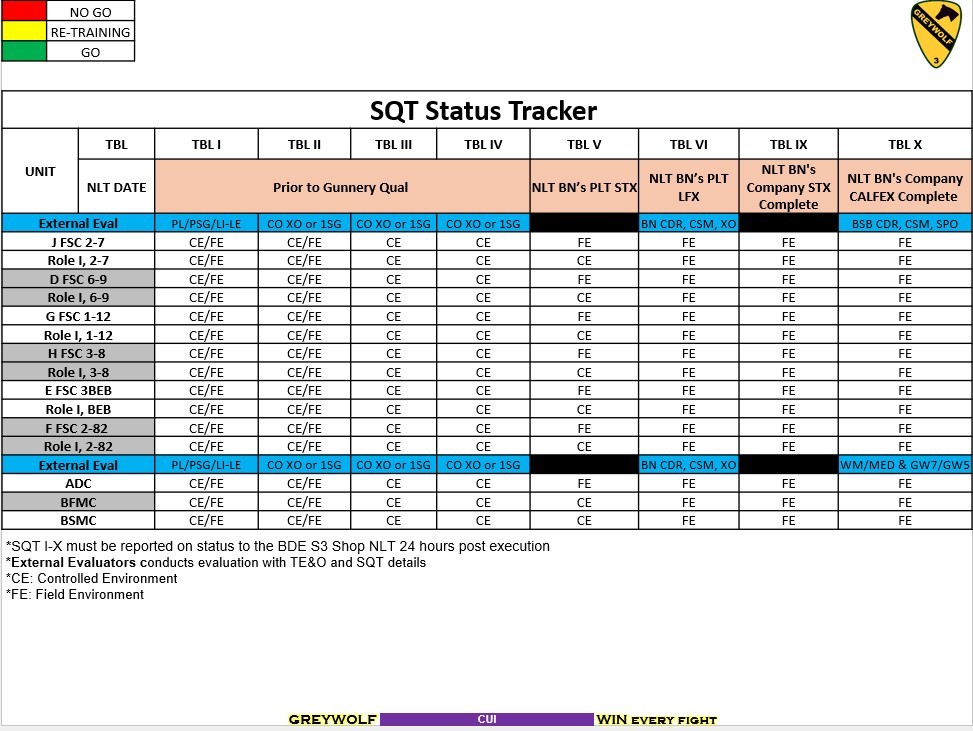
SQTs have the essence of the Integrated Weapons Training Strategy (IWTS) and gunnery tables combined. Like IWTS, SQTs use tables to provide a common, consistent training model and are executed in a gated and progressive manner. Similarly, SQTs use 10 tables of sustainment tasks critical to supporting the brigade’s combined arms battalions (CABs), field artillery battalion, and brigade engineer battalion; as the tables increase, so does the level of difficulty for the sustainment tasks. The higher tables introduce time constraints, and a change in environmental conditions, transitioning from a controlled environment to a field environment with limited visibility.
Standardizing SQTs
The challenge then became determining how an ABCT can standardize sustainment tasks across a brigade with varying capabilities while ensuring these tasks are tailored to the unique operational requirements and combat strategies of each battalion. The training needed to be simple, concise, and standardized across the brigade yet still aligned with the sustainment tasks required to support 3rd ABCT, 1CD’s maneuver operations. This standardization would allow sustainers to work in tandem, synchronizing movements to execute multiple sustainment tasks efficiently and effectively. This meant that SQTs needed to model the gunnery tables from Tactical Combat Casualty Care 20-21 and the IWTS correlating the tables to the crawl-walk-run phases.
Tables I to III represent the crawl phase of SQTs, during which individual Soldier’s tasks were the focus, such as driver training, dismounted/mounted land navigation, weapons familiarization, and Joint Battle Command-Platform utilization. The base companies and FSCs had the autonomy to execute Tables I and II in a field environment or controlled environment, such as a unit motor pool. In contrast, Tables III and IV had to be executed in a controlled environment to ensure that proper risk mitigation was implemented and sustainment tasks were executed to standard.
Table IV initiated the walk phase and was completed before proceeding to Table V. Because Table V was the rehearsal for Table VI, the medical and maintenance tasks were also executed in a controlled environment. Tables V and VI introduced time constraints to the sustainment tasks. In these phases, the sustainment tasks were executed during the 215th BSB brigade support area exercise and CAB gunnery. FSCs established their FTCPs in the BSA and integrated into the BSB both physically and operationally. These tables focused on platoon/section operations, such as distribution platoon, field feeding section, evacuation platoon, and electronic logbook maintenance section.
All SQT tasks during Tables VI to X were conducted in a field environment. Tables IX to X designated the run phase of SQTs and were executed during the brigade’s combined arms live fire exercise. These tables focused on executing multiple sustainment tasks within a specified time frame, thus providing the framework for both BSB base companies and FSCs. The evaluation tasks were developed from the unit’s mission essential task list (METL), the BSB Army Techniques Publication (ATP) 4-90, Brigade Support Battalion, and other Army publications specific to sustainment functions.
For example, during Table VI, the distribution platoon was evaluated on several key criteria: time required to complete a full LRP, organization of commodities by unit, and involvement of key leaders. To complete the LRP in under four hours under limited visibility, commodities had to be pre-sorted by unit and ready for immediate handoff to each unit’s first sergeant. Key leader involvement was also a critical evaluation metric, as the presence of the right leaders ensured that tasks were executed efficiently, to standard, and were reported appropriately to the brigade’s support operations center.
Evaluating SQTs
In addition to standardizing the SQTs, it was necessary to establish a method for evaluating the training. Drawing from the approach used in the IWTS, SQTs were assessed using a similar framework. Each table within the SQTs had a designated evaluator of equal or higher rank to ensure accurate and credible assessment of training performance.
SQT Table I was evaluated by platoon leaders of platoon sergeants because they were being assessed on Soldier-level tasks. Tables II to IV were evaluated by the company commander, executive officer (XO), or first sergeant because they were being assessed on section-level tasks. Table VI was evaluated by each FSC’s battalion commander, XO, or command sergeant major and Table X was evaluated by the BSB commander, support operations officer, or command sergeant major because these assessments were on company-level tasks. The assessment of certain sustainment tasks was ideal for a subject matter expert (SME) evaluator. All SMEs supported the training with constructive criticism, ensuring the unit was certified to execute in a LSCO environment. Additionally, to ensure the training was effective in preparing the BSB for NTC, evaluators who had recently participated in a NTC rotation were sent to assess the BSB sustainment tasks.
The unit’s METL, located on the Army Training Network, provided a vast number of tasks that support sustainment tasks, while ATP 4-90 and other sustainment manuals provided a required timeframe to complete a specific task. For tasks without previously prescribed timeframes, the timeframe was determined based on previous NTC rotations.
The Execution
Once all planning and prior coordination was complete, the base companies and FSCs were given the evaluation checklist to execute the SQTs. Units were required to complete multiple critical sustainment tasks under specified conditions, time constraints, and standards, which was reflective of the demands of supporting an ABCT in a LSCO environment. The checklist enabled deliberate, standards-based execution of essential tasks such as bulk fuel resupply, LOGPAC distribution, and mass casualty (MASCAL) operations.
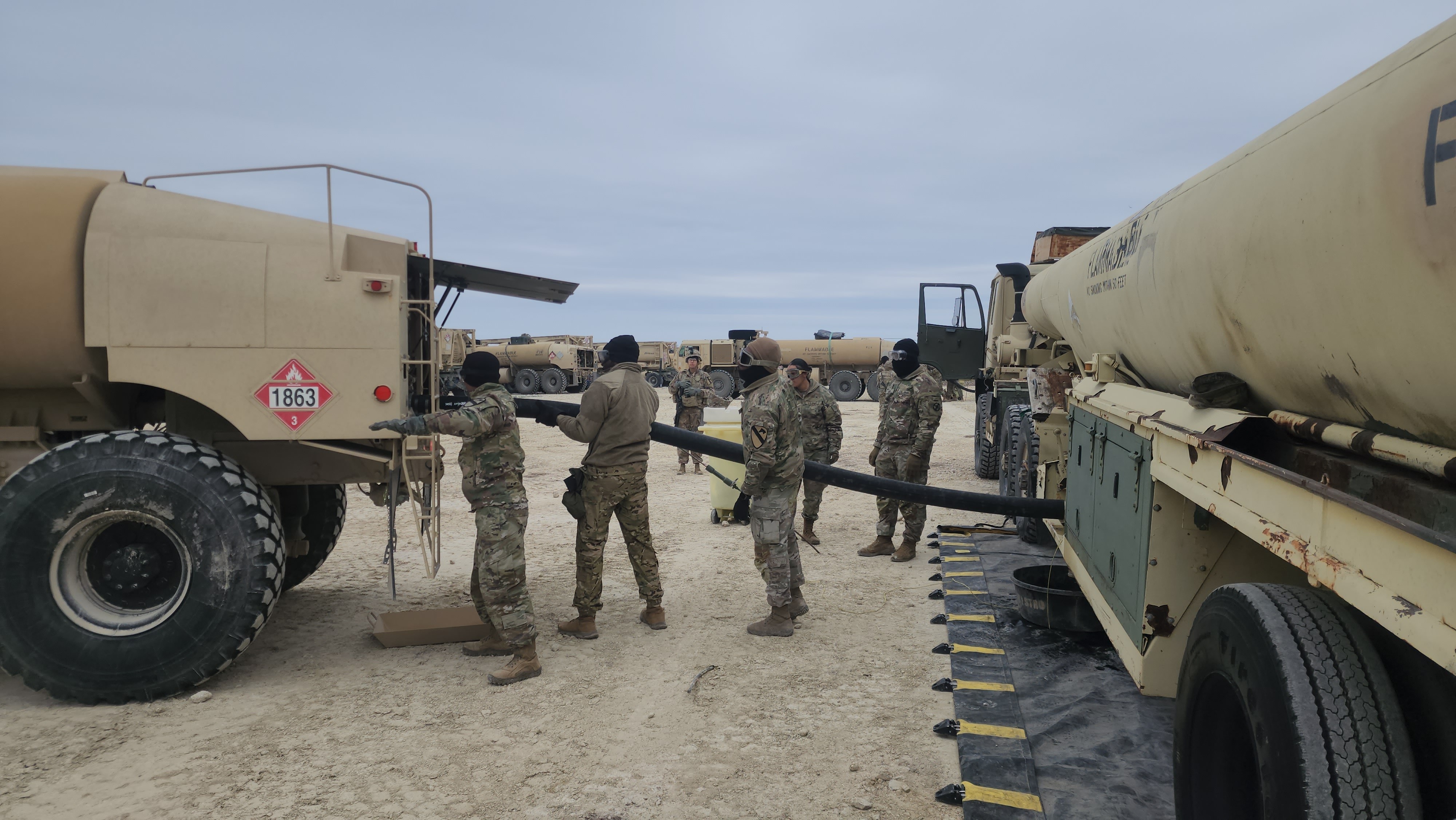
During SQTs, Alpha Distribution Company (ADC) executed several sustainment tasks, with one of the most critical being the resupply of fuel from the division sustainment support battalion (DSSB) to ADC, and then from ADC to the FSCs. The DSSB typically conducts bulk fuel transfers using M969 or M967 tankers, while ADC may use M978 to M978 platforms — each requiring specific hoses and nozzles. To maintain proficiency, ADC must rehearse transfers on all platforms. Without rehearsal, bulk fuel transfer averages six to eight hours, jeopardizing maneuver operations. SQTs enforced these rehearsals, enabling Soldiers and leaders to become familiar with the equipment, optimizing fuel site layout for faster throughput, and ensuring rubber seals were stocked to reduce leaks and ensure mission success.
The FSCs executed numerous and more deliberate LOGPACs, thereby greatly increasing the unit’s proficiency. The FSCs were required to conduct LOGPACs twice a day and established an LRP for each LOGPAC. The FSCs were evaluated on their ability to execute the LRP under limited visibility within four hours. Due to each CAB’s unique mission, not all FSCs executed LRPs using the same method, but were still required to achieve the standard time requirement. The multiple repetitions of LOGPAC operations enabled FSC and battalion key leaders to synchronize every detail of the operation to make it more efficient and effective.
To effectively execute MASCAL operations, the brigade support medical company required deliberate internal coordination to simulate the event. The BSB worked closely with each battalion to synchronize a brigade-level MASCAL using all battalion Role 1 locations. This synchronization allowed the brigade to conduct comprehensive training on casualty movement from Role 1 to Role 2 using both MEDEVAC and casualty evacuation platforms. Upon arrival of the casualties at Role 2, external evaluators from the 1st Medical Brigade assessed the execution and effectiveness of Role 2 operations.
Conclusion
SQTs provided a concrete framework to certify sustainment tasks. As a result, 3rd ABCT, 1CD, sustainers are now better equipped to execute complex operations under pressure, directly contributing to the brigade’s overall lethality and success on the battlefield. This enhanced readiness was clearly reflected in the brigade’s performance at NTC, setting the NTC record for the least amount of back-hauled fuel during an ABCT rotation, improving LOGPAC efficiency by 28%, and maintaining over 70% operational readiness rate on combat platforms. The development and implementation of SQTs have been transformative steps for 3rd ABCT, 1CD, ensuring that sustainers are trained, certified, and held to the same rigorous standards as their maneuver counterparts. By institutionalizing a deliberate and standardized training process, the commander reinforced the vital role sustainment plays in enabling operational reach and maintaining tempo during LSCO. SQTs not only addressed critical gaps in proficiency and readiness but also instilled a culture of urgency, precision, and accountability across 215th BSB. As the unit prepares for its upcoming combat training center rotation in Europe, we will implement SQT 2.0, refining the tables and adjusting the training progression to further enhance the readiness and effectiveness of our sustainment formations. These refinements include the addition of specific subtasks to the evaluation criteria and the incorporation of base defense as a critical task, ensuring a more comprehensive assessment of sustainment capabilities in a contested environment.
--------------------
LTC Kimberly DeFour is serving as the commander of 215th Brigade Support Battalion, 3rd Armored Brigade Combat Team, 1st Cavalry Division, Fort Hood, Texas. She was commissioned as a second lieutenant in the Transportation Corps upon completion of ROTC. She received two master’s degrees: the first in Christian ministry from Liberty University and the second in international relations from Webster University. Her military schooling includes the Support Operations Course phases I & II, Division Transportation Officer Course, Theater Sustainment Planners Course, the U.S. Army Command and General Staff College, and the Joint and Combined Warfighting School. She was recognized by the International Society of Logistics as the Demonstrated Senior Logistician for her knowledge and competence in the field of logistics in 2013.
MAJ Christopher Torres currently serves as the battalion executive officer for the 215th Brigade Support Battalion, 3rd Brigade, 1st Armored Division, Fort Hood, Texas. He previously commanded a forward support company in 3rd Brigade, 1st Armored Division, Fort Bliss, Texas. He has a wide variety of military experience including convoy operations, special operations support, and evaluating junior leaders. He is a graduate of the U.S. Military Academy and holds a master’s degree in pastoral counseling from Liberty University.
MAJ Stephen I. DuCharme is the battalion executive officer for 215th Brigade Support Battalion, 3rd Armored Brigade Combat Team, 1st Cavalry Division, Fort Hood, Texas. He holds a master’s degree in administration from Central Michigan University and a master’s degree in operational studies from the Command and General Staff College (CGSC). He is an intermediate-level education graduate from CGSC, Army Sustainment University Logistics Captains Career Course, and Army Ordnance Basic Officer Leader Course.
CPT Jose G. Arriaga Jr serves in 3rd Armored Brigade Combat Team, 1st Cavalry Division, Fort Hood, Texas. His previous assignments include platoon leader for 59th Military Police Company, Fort Carson, Colorado; executive officer for the 59th Military Police Company; operations officer in brigade S-3 for the 4th Infantry Division Sustainment Brigade at Fort Carson; and operations officer in the brigade S-3 for the 1st Cavalry Division Sustainment Brigade at Fort Hood. His military education includes Military Police Basic Officer Leadership Course, Logistics Captains Career Course, and Air Assault Course. He commissioned and graduated from Sam Houston State University in Huntsville, Texas, in 2019 with a Bachelor of Science degree in criminal justice.
--------------------
This article was published in conjunction with the fall 2025 issue of Army Sustainment.
RELATED LINKS
The Current issue of Army Sustainment in pdf format
Current Army Sustainment Online Articles
Connect with Army Sustainment on LinkedIn
Connect with Army Sustainment on Facebook
---------------------------------------------------------------------------------------------------------------
Social Sharing