
Army Sustainment
Army Sustainment Professional Bulletin (PB 700)
Army Sustainment Professional Bulletin
Download the current issue here: Summer 2026.pdf [PDF - 13.1 MB]
Current Issue Theme: Strengthening the Sustainment Warfighting Profession
-
 Strengthening the Sustainment Warfighting Profession: An Imperative for the Modern Battlefield
July 15, 2026
Strengthening the Sustainment Warfighting Profession: An Imperative for the Modern Battlefield
July 15, 2026
-
 Not Just a Competition: The Strategic Value of the Army’s Sustainment Award Programs
July 15, 2026
Not Just a Competition: The Strategic Value of the Army’s Sustainment Award Programs
July 15, 2026
-
 AMC Drives Innovation in Military Construction by Infusing Commercial Construction Best Business Practices
July 15, 2026
AMC Drives Innovation in Military Construction by Infusing Commercial Construction Best Business Practices
July 15, 2026
-
 Forging the Sustainment Functional Data Analyst: Institutionalizing Analytics with the L9 Skill Identifier
July 15, 2026
Forging the Sustainment Functional Data Analyst: Institutionalizing Analytics with the L9 Skill Identifier
July 15, 2026
-
 Transforming Sustainment for Armored Formations: Building Aerial Delivery Capabilities in the ABCT
July 15, 2026
Transforming Sustainment for Armored Formations: Building Aerial Delivery Capabilities in the ABCT
July 15, 2026
-
 Welcome to the Jungle: What JOTC Reveals About the Future of Sustainment
July 15, 2026
Welcome to the Jungle: What JOTC Reveals About the Future of Sustainment
July 15, 2026
-
 The Anatomy of Sustainment: Strengthening the Culinary Management Profession through Training with Industry
July 15, 2026
The Anatomy of Sustainment: Strengthening the Culinary Management Profession through Training with Industry
July 15, 2026
-
 Property Accountability Through a Withdrawal: Effectively Retrograding and Reposturing Forces
July 15, 2026
Property Accountability Through a Withdrawal: Effectively Retrograding and Reposturing Forces
July 15, 2026
-
 Expanding Operational Dentistry in the Brigade: A Starting Framework
July 15, 2026
Expanding Operational Dentistry in the Brigade: A Starting Framework
July 15, 2026
-
 The Case for a Logistics Career Management Field Sergeant Major in the BSB
July 15, 2026
The Case for a Logistics Career Management Field Sergeant Major in the BSB
July 15, 2026
-
 Readiness Begins with Sustainment Excellence: The Tactical Field Readiness Training Center as a Combat Multiplier
July 15, 2026
Readiness Begins with Sustainment Excellence: The Tactical Field Readiness Training Center as a Combat Multiplier
July 15, 2026
-
 Closing the Gap: Making Sustainment as Agile as the Fight It Feeds
July 15, 2026
Closing the Gap: Making Sustainment as Agile as the Fight It Feeds
July 15, 2026
-
 Our Own Worst Enemy: Overcoming the Challenges of Army Communication
July 15, 2026
Our Own Worst Enemy: Overcoming the Challenges of Army Communication
July 15, 2026
-
 The Revolution of Army Sustainment: Strengthening the Sustainment Warfighter Profession
July 15, 2026
The Revolution of Army Sustainment: Strengthening the Sustainment Warfighter Profession
July 15, 2026
-
 Show Me the Data! — Analysis in Maintenance Manpower Utilization
July 15, 2026
Show Me the Data! — Analysis in Maintenance Manpower Utilization
July 15, 2026
-
 Forging the Human Dimension of Victory: Strengthening the Sustainment Warfighting Profession
July 15, 2026
Forging the Human Dimension of Victory: Strengthening the Sustainment Warfighting Profession
July 15, 2026
-
 America’s Achilles’ Heel: Deploying Forces in a Contested World
July 15, 2026
America’s Achilles’ Heel: Deploying Forces in a Contested World
July 15, 2026
-
 Modernizing 92F Training to Enable Army-Wide FARP Operations
July 15, 2026
Modernizing 92F Training to Enable Army-Wide FARP Operations
July 15, 2026
-
 Maintenance as a Combat Multiplier: How Disciplined Maintenance Leadership Strengthens the Sustainment Warfighting Profession
July 15, 2026
Maintenance as a Combat Multiplier: How Disciplined Maintenance Leadership Strengthens the Sustainment Warfighting Profession
July 15, 2026
-
 Leveraging Lessons from the Russia-Ukraine War: Enhancing Tactical Sustained Operations in the European Theater
July 15, 2026
Leveraging Lessons from the Russia-Ukraine War: Enhancing Tactical Sustained Operations in the European Theater
July 15, 2026
-
 Sustainment Through a Joint Lens: An Army Captain’s Experience at Marine Corps AXLOC
July 15, 2026
Sustainment Through a Joint Lens: An Army Captain’s Experience at Marine Corps AXLOC
July 15, 2026
-
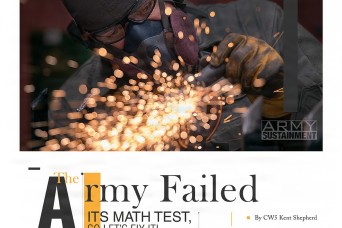 The Army Failed Its Math Test, So Let’s Fix It!
July 15, 2026
The Army Failed Its Math Test, So Let’s Fix It!
July 15, 2026
-
 The Citizen-Soldier Leader: Applying Modern Leadership Theory to National Guard Sustainment
July 15, 2026
The Citizen-Soldier Leader: Applying Modern Leadership Theory to National Guard Sustainment
July 15, 2026
-
 Rules for Meetings
July 15, 2026
Rules for Meetings
July 15, 2026
ASPB Online
-
 Game Changer: Why the Philip A. Connelly Program Matters More Than Ever
July 15, 2026
Game Changer: Why the Philip A. Connelly Program Matters More Than Ever
July 15, 2026
-
 Going the Distance: Planning, Sustaining, and Executing a Multi-Day Tactical Road March
July 15, 2026
Going the Distance: Planning, Sustaining, and Executing a Multi-Day Tactical Road March
July 15, 2026
-
 JPOTS: Enhancing Joint Petroleum Distribution for Strategic Solutions
July 15, 2026
JPOTS: Enhancing Joint Petroleum Distribution for Strategic Solutions
July 15, 2026
-
 Modern Weapons, Legacy Logistics: Why SSAs Are the Army’s Readiness Bottleneck
July 15, 2026
Modern Weapons, Legacy Logistics: Why SSAs Are the Army’s Readiness Bottleneck
July 15, 2026
-
 Automating Combat Loading to Strengthen LSCO Readiness
July 15, 2026
Automating Combat Loading to Strengthen LSCO Readiness
July 15, 2026
-
 Strong Sergeants. Strong Soldiers. Strong Squads.
July 15, 2026
Strong Sergeants. Strong Soldiers. Strong Squads.
July 15, 2026
-
 Watts Next for Sustainment? — Treating Electrical Energy as a Combat Requirement in LSCO
July 15, 2026
Watts Next for Sustainment? — Treating Electrical Energy as a Combat Requirement in LSCO
July 15, 2026
-
 Breaking the BSA: Cluster-Based Sustainment in the MBCT
July 15, 2026
Breaking the BSA: Cluster-Based Sustainment in the MBCT
July 15, 2026
-
 The End of Strategic Sanctuary: Deploying from a Contested Homeland
July 15, 2026
The End of Strategic Sanctuary: Deploying from a Contested Homeland
July 15, 2026
-
 Eagle Mindset: Spiritual Readiness Strengthening the Sustainment Warfighter Profession
July 15, 2026
Eagle Mindset: Spiritual Readiness Strengthening the Sustainment Warfighter Profession
July 15, 2026
Army Sustainment Article of 2025
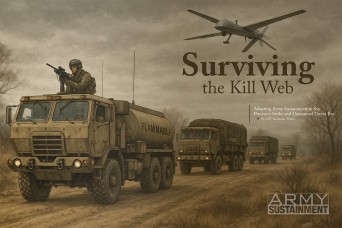
Other Sustainment News
-
 3rd Corps Sustainment Command Soldier receives Army Commendation Medal after aiding wounded civilian
October 15, 2026
3rd Corps Sustainment Command Soldier receives Army Commendation Medal after aiding wounded civilian
October 15, 2026
-
 Type 1 cranes strengthen long-range Fires readiness
October 7, 2026
Type 1 cranes strengthen long-range Fires readiness
October 7, 2026
-
 CASCOM partners with Theater Sustainment Commands to deliver critical LOADOUT enhancements
October 7, 2026
CASCOM partners with Theater Sustainment Commands to deliver critical LOADOUT enhancements
October 7, 2026
-
 402nd AFSB collaboration supports Culinary Outpost service at Fort Shafter
October 5, 2026
402nd AFSB collaboration supports Culinary Outpost service at Fort Shafter
October 5, 2026
-
 A New Chapter in Sustainment: 10th Support Group transitions to 45th Sustainment Brigade
October 6, 2026
A New Chapter in Sustainment: 10th Support Group transitions to 45th Sustainment Brigade
October 6, 2026
-
 A year of change, a lineage of service
October 6, 2026
A year of change, a lineage of service
October 6, 2026
Mission
Army Sustainment's mission is to publish timely, authoritative information on Army and Department of War sustainment plans, programs, policies, operations, procedures, and doctrine for the benefit of all Army personnel. Its purpose is to provide a medium for disseminating and exchanging sustainment news and information and a forum for expressing original, creative, innovative thought about sustainment.
Leaders
-
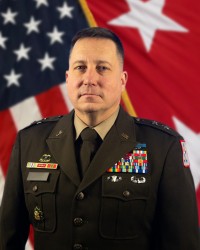 CASCOM Commanding GeneralMaj. Gen. Sean P. Davis
Background
Army Sustainment (PB 700) is a quarterly professional bulletin prepared by Army Sustainment University, Fort Lee, Virginia, and published by the Administrative Assistant to the Secretary of the Army. It was established in 1969 by the Department of the Army as the official magazine for Army logistics and was originally known as Army Logistician. It was renamed Army Sustainment in 2009 and now serves as the Army's professional bulletin for the sustainment warfighting function, including logistics, personnel services, medical logistics, and evacuation.
About Us
Army Sustainment (ISSN 2153-5973) is a quarterly publication, prepared at the Army Sustainment University and published by the Army Combined Arms Support Command, Fort Lee, Virginia, for the Department of the Army. It was established in 1969 by the Department of the Army as the official magazine for Army logistics and was originally known as Army Logistician. It was renamed Army Sustainment in 2009 and now serves as the Army's professional bulletin for the sustainment warfighting function, including logistics, personnel services, and medical logistics and evacuation.
Army Sustainment's mission is to publish timely, authoritative information on Army and Department of War sustainment plans, programs, policies, operations, procedures, and doctrine for the benefit of all Army personnel. Its purpose is to provide a medium for disseminating and exchanging sustainment news and information and a forum for expressing original, creative, innovative thought about sustainment.
Articles that appear in the publication express the opinions of their authors, not the Department of War or any of its agencies, and do not change or supersede official Army publications. The masculine pronoun may refer to either gender.
Contact Us
Articles on all facets of sustainment are solicited. Direct communication is authorized and should be addressed to:
EDITOR ARMY SUSTAINMENT ASU
562 QUARTERS ROAD
FORT LEE, VA 23801-1705
Phone: Email:
804-765-8011 | DSN 539-8011
armysustainment@army.mil
We encourage readers to send us suggestions, comments, or questions. Feedback from readers is particularly important, and we solicit "letters to the editor" to appear in our Lines of Communication column. Lines of Communication letters may be sent by mail or email
NOTE: Contact information will only be used to respond to your inquiries, requests and comments.
Army Sustainment
- Army Sustainment on Line of Departure — https://www.lineofdeparture.army.mil/Journals/Army-Sustainment/
- Army Sustainment on DVIDS — https://www.dvidshub.net/unit/Army-SustainmentBulletin
LOGSTAT Podcast
- The LOGSTAT Audio Podcast DVIDS — https://www.dvidshub.net/podcast/652/the-logstat
- The LOGSTAT Video Podcast DVIDS — https://www.dvidshub.net/podcast/679/the-logstat-video-podcas
Official Websites
Submission Forms
All three forms are required when an article is selected for publication.
OPSEC_Review_Form.pdf [PDF - 183.8 KB]
Author Bio Form for Signature.pdf [PDF - 154.3 KB]
ASPB_Permission_to_Publish_Form.pdf [PDF - 173.2 KB]
Army Sustainment Author Submission Guidelines
We are always looking for quality articles to share with the Army sustainment community. If you are interested in submitting an article to Army Sustainment Professional Bulletin (ASPB), please follow these guidelines:
- Ensure your article is appropriate to the publication’s subjects, which include Army logistics, human resources, medical operations, and financial management.
- Ensure that the article’s information is technically accurate.
- Download the OPSEC review form and have it completed by your public affairs office. We also encourage you to compare your article against your unit’s critical information list.
- Do not assume that those reading your article are Soldiers or that they have background knowledge of your subject; ASPB’s readership is broad.
- Write your article specifically for ASPB. If you have submitted your article to other publications, please let us know at the time of submission.
- Keep your writing simple and straightforward.
- Attribute all quotes to their correct sources.
- Identify all acronyms, technical terms, and publications. For example: Field Manual (FM) 4-0, Sustainment Operations. However, do not establish an acronym if the acronym is not used again in the article. In the above example, there would be no need to establish FM as an acronym if it does not appear again in the article.
- Maximum article length is 2,500 words. A more ideal length is in the 1,200–1,500 range.
Review past issues of the publication; they will be your best guide as you develop your article.
Submitting an Article:
- Submit your article and signed forms by email to armysustainment@army.mil.
- Submit the article as a simple Microsoft Word document — not in layout format. We will determine the layout for publication.
- If you have questions about these requirements, please contact us at armysustainment@army.mil or (804) 765-3113.
Submitting Images:
Any images you wish to submit with your article must first be uploaded to DVIDS. You provide us with the links, and we pull the images from there. This applies to all images: photos, charts, graphs, etc.
Create a DVIDS account » Create a DVIDS Account
- Submit DVIDS links as well as a description of each photo to us at: armysustainment@army.mil
- If you have questions about these requirements, Please contact us at: armysustainment@army.mil or (804)765–8110.
Include a description of each photo, including who is in it, what they are doing, where it was taken (post/city, state, country if outside the U.S.), the date it was taken, and the name and rank of the photographer.
Themes and Submission deadlines:
Deadline for submission of content for ASPB is no later than 75 days prior to targeted publication date. The deadlines for each quarterly issue are:
- WINTER 2027 | Sustainment Lessons from Epic Fury | Due by Oct. 15, 2026
- SPRING 2027 | TOPIC COMING SOON | Due by Jan. 15, 2027
- SUMMER 2027 | TOPIC COMING SOON | Due by April 15, 2027
- FALL 2027 | TOPIC COMING SOON | Due by July 15, 2027
Editorial Policy:
The primary intent of ASPB is to support the professional development of U.S. Army personnel in the sustainment warfighting function by providing a professional information forum for a wide variety of professional development information focused on the Army sustainment enterprise.
ASPB content:
The content of ASPB directly supports the mission of U.S. Army Combined Arms Support Command (CASCOM) as the Sustainment Center of Excellence with proponency for all sustainment branches, as established in Army Regulation 5-22, The Army Force Modernization Proponent and Integration System.
Typical content for ASPB includes, but is not limited to, the following:
- Technological developments in sustainment.
- Sustainment strategy, tactics, techniques, and procedures.
- Sustainment focused how-to pieces.
- Practical exercises.
- Training methods for sustainment.
- Historical perspectives.
- Monographs and summaries of sustainment-focused research papers.
- Views and opinions concerning sustainment.
- Short biographies of authors to demonstrate professional credentials.
- Short bulletin-type items summarizing official Army actions that directly relate to sustainment.
Items that are not appropriate for publication in ASPB (and that will not be published) are:
- General personnel information not specifically related to sustainment. This information is usually available through command information and official channels.
- Routine personnel items, such as listing graduates of courses, promotions, and awards.
- General military-related news articles that do not have significant professional development value for the sustainment community.
- Letters to the editor commenting on the quality of the bulletin or other matters that do not contribute to the mission of CASCOM.
- Personality-type articles, except for those that have historical significance.
- Articles, photographs, or other materials that promote self-aggrandizement of an Army or non-Army individual, group, or institution.
ASPB publishes approximately 20 articles per quarter in the PDF edition of ASPB and as individual articles on army.mil and our social media pages. ASPB serves the entire sustainment community and strives to have a variety of content that represents the professional development needs of the entire sustainment warfighting function. ASPB also strives to provide a variety of content that addresses all levels of military operations and aims to have an even mixture of strategic, operational, and tactical level content.