Introduction
You are tasked to lead a 40-truck convoy resupplying combat troops at the front during large-scale combat operations. The mission is critical, and every vehicle must complete it as quickly, efficiently, and safely as possible. The enemy has repeatedly demonstrated their intent to destroy any line of communication to isolate friendly forward units. With limited information, you rely solely on word of mouth to decide which vehicles to send. To err on the side of caution, you treat every vehicle as equally unreliable. But what if there were a tool to visualize and quantify the reliability of each truck before the convoy ever rolled out?
Background
In modern sustainment operations, both readiness and performance of a unit depend on proactive foresight rather than reactive response. Convoys are the backbone of logistical movement. Yet, a convoy’s success often depends on the reliability of its vehicles. A single truck failure can delay delivery timelines and create tactical vulnerabilities for both the convoy and the area of operations. According to Field Manual (FM) 4-0, Sustainment Operations, “Sustainment leaders must visualize and prepare resources for future operations.” In this new age, the Army can adapt this logic within command and control (C2) through data-centric decision tools. This article presents a machine learning (ML) model using synthetic data to demonstrate how predictive maintenance can enhance convoy readiness within a C2-integrated sustainment framework.
Civilian World Transportation
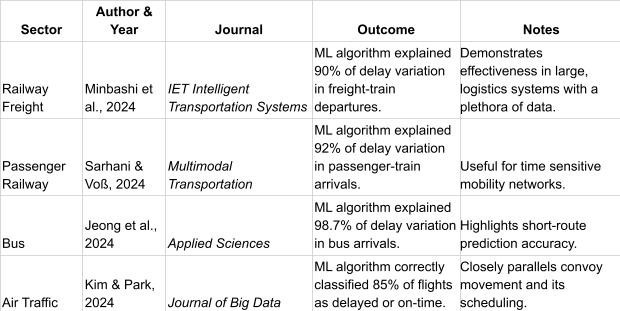
Private companies are not immune to real-world variables that disrupt logistical routes. ML algorithms have been shown in several civilian studies to achieve exceptionally high precision, accuracy, and recall. Civilian transportation systems already apply ML to predict operational delays, optimize scheduling, and reduce costs. The consistently high predictive accuracy across civilian transportation sectors shows the value of ML algorithms for sustainment planning.
Army Application
The Army can apply similar predictive models to enhance convoy predictability and maintenance readiness under C2 modernization. Much like civilian logistics systems, military convoys generate vast datasets, including diagnostics, route history, maintenance records, and breakdown statistics, which can be modeled to predict potential failures. FM 3-0, Operations, says, “Timely, accurate, relevant, and predictive intelligence enables decision making, tempo, and agility during operations.” Although this FM 3-0 principle addresses predictive intelligence in terms of enemy activity, the same logic applies internally. Through data-driven analysis, sustainment leaders can generate predictive insight that directly enhances C2 capabilities.
Translating predictive sustainment into practice requires defining measurable variables that capture convoy reliability factors. Vehicle condition, operating environment, and maintenance history each influence failure likelihood. By structuring these data points into an ML algorithm, sustainment leaders can visualize where risk accumulates and anticipates disruptions before they occur. Just as FM 4-0 emphasizes anticipation and preparation of resources, ML algorithms can enable commanders to forecast maintenance risks and key metrics essential to operational planning.
Testing Parameters
To model predictive reliability within a convoy, several synthetic key variables were selected to reflect the vehicle condition and environmental stressors. These variables included truck age, days since last service, ambient temperature, load percentage, and terrain difficulty. Every parameter represents a measurable factor that influences mechanical reliability and convoy performance. For example, increasing load percentage or ambient temperature increases strain on a truck’s engine and braking system, while steeper terrain correlates with higher failure probability. The synthesized data was generated to preserve operational security while still maintaining realistic proportional relationships between variables. A small dataset was used, consisting of 120 driving instances across 30 trucks and three convoys. The ML algorithm tested and predicted against these parameters.
Results
The model was tested across multiple alert thresholds to evaluate how accurately it predicted vehicle failures within simulated convoy scenarios. An alert threshold is the minimum predicted probability that triggers a maintenance warning. For example, if the model predicts a 25% chance of failure, it generates an alert. Accuracy, precision, and recall were analyzed to determine the optimal balance between early detection and false alerts. A logistic regression model was selected for its ability to interpret and balance these variables effectively. These variables are defined as follows:
- Accuracy: the overall percentage of correct predictions, indicating how often the model correctly identified both failures and non-failures.
- Precision: how often predicted failures were true failures.
- Recall: the rate at which the model successfully identified actual failures.
The most balanced performance occurred at a 25% alert threshold, achieving 75% overall accuracy. Precision was 22%, meaning roughly one in five alerts corresponded to a true failure, while recall was 50%, indicating that half of all actual failures were successfully detected.
Although the most effective model did not capture every failure, its ability to correctly predict half of all breakdowns using a small synthetic dataset demonstrates meaningful operational potential. Even partial foresight enables proactive decision making for the mission and, based on civilian research using ML algorithms, would only improve with larger quantities of real-world data.

Of 120 cases, 90 trucks were correctly identified as operational; 15 generated false alarms; eight failures were missed; and seven were accurately predicted as genuine failures.
At a 25% alert threshold, the model demonstrated a balanced level of conservatism, generating alerts early enough to be useful without overwhelming the operator with false positives. This threshold can be adjusted based on commander preferences, maintenance capacity, or risk tolerance. The logistic regression model demonstrated the trade-off between sensitivity and selectivity. At a 10% threshold, the model generated 54 false alerts but captured the largest number of true failures. In contrast, at a 50% threshold, it was accurate 87% of the time in predicting non-failures but failed to identify any actual failures. In short, the 10% alert threshold was very cautious and often gave false alerts, whereas the 50% alert threshold never gave an alert since the ML algorithm was never 50%+ sure of a failure.
Operational Implication
Predictive analytics extend a commander’s ability to visualize future sustainment challenges before they come to fruition. Rather than reacting to breakdowns as they occur, leaders can plan reroutes or maintenance windows based on model outputs. This aligns with FM 4-0, which emphasizes anticipation as one of the key sustainment principles. This approach effectively creates a data-driven form of maintenance triage, allowing leaders to better prioritize higher-risk vehicles and conserve resources for those most critical to mission success.
Commanders could adjust alert thresholds based on resource availability and mission tempo, mirroring how operational risk is managed in other sustainment functions. For instance, a 10% threshold may be appropriate during high-risk missions where failure costs are severe, while a 25% or 50% threshold may be used during routine operations to reduce false alerts and information overload. In addition, unit warrant officers, truckmasters, and maintenance platoon sergeants could use this data to make maintenance decisions that help to meet the commander’s intent. Using data analysis through an ML algorithm, leaders could fast-track vehicles with a higher chance of failure for maintenance and send the trucks with the lowest likelihood of breakdown on the most critical missions.
Conclusion, Limitations, and Discussion
Predictive modeling offers a powerful opportunity to enhance sustainment readiness through data-driven anticipation rather than reaction. As this study demonstrated, even a simple logistic regression ML algorithm can detect patterns that mirror real-world convoy risk. The 25% alert threshold demonstrated the most balanced performance, providing commanders with an analytical early warning option that can be tuned based on mission risk and available resources.
However, the ML algorithm in this study operated solely on synthetic data. The dataset included just 120 simulated driving instances across three convoys. This limited sample size reduced the model’s predictive reliability. In real Army operations, ML algorithm performance would improve significantly because more authentic, high-quality data would be introduced over time. This emphasizes the importance of providing real data to predictive systems whenever legally and tactically possible. Feeding the model with incomplete or inconsistent data, or no data at all, will undermine the Army’s ability to use newer data-driven technology, just as poor maintenance logs or missing dispatch records can compromise a convoy. The more accurate the data, the more effective the sustainment.
An ML algorithm could integrate with a real-time dashboard through an application programming interface, automatically feeding commanders actionable data to enhance C2. Key sustainment leaders could then apply their experience and judgment to interpret the tool’s outputs and incorporate them into operational decisions. By pairing data-driven insight with leader experience, the Army could turn information into readiness and make every mile of convoy movement more effective in achieving mission success.
--------------------
2LT Nicholas R. Thierfeldt currently serves as a logistics officer attending the Army Sustainment University’s Basic Officer Leadership Course at Fort Lee, Virginia. He earned his commission through Officer Candidate School at Fort Benning, Georgia, following the completion of Basic Combat Training at Fort Jackson, South Carolina. His home unit is the 419th Transportation Company in Salt Lake City, Utah. He holds a Project Management Professional certification, a Master of Business Administration degree from Amberton University in Garland, Texas, and is pursuing a Ph.D. in business at the University of the Cumberlands.
--------------------
This article was published in the winter 2026 issue of Army Sustainment and was a winner of the ASU Writing Competition.
RELATED LINKS
The Current issue of Army Sustainment in pdf format
Current Army Sustainment Online Articles
Connect with Army Sustainment on LinkedIn
Connect with Army Sustainment on Facebook
-----------------------------------------------------------------------------------------------
Social Sharing