Introduction: Fighting Together, But Not United
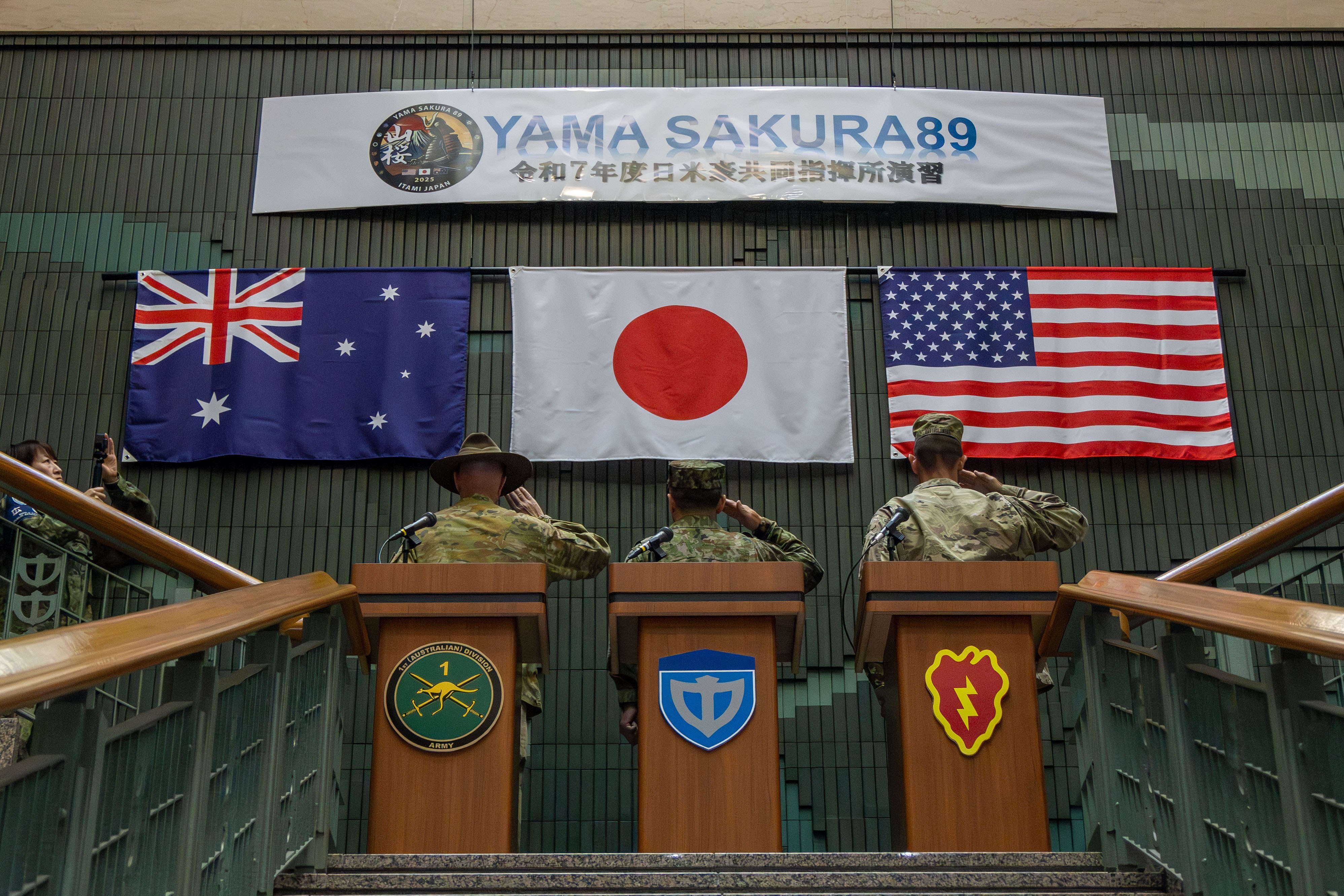
Large-scale combat operations (LSCO) in the Indo-Pacific will never be fought by the U.S. alone. Any conflict will be a coalition fight, conducted with partners on shared terrain against a peer adversary. This reality was tested and reinforced during Yama Sakura 89, a trilateral command post exercise held in Itami, Japan, in early 2025. The exercise brought together the U.S. Army, the Japan Ground Self-Defense Force (JGSDF), and the Australian Army under a parallel command structure.
The exercise highlighted what we already knew: coalition sustainment is both a strength and a challenge. While we trained shoulder to shoulder, we did so with parallel systems that could not yet fully integrate. Instead of weakening the coalition, however, these challenges clarified the work ahead. Yama Sakura 89 gave us a valuable opportunity to identify gaps in interoperability and take tangible lessons back to our formations.
The Gap: Parallel Networks, No Shared Picture
Each nation entered Yama Sakura 89 with its own command and control (C2) backbone. The U.S. operated through the Cooperative Maritime Forces Pacific (CMFP). The Japanese relied on their national system. The Australians employed the CMFP. These systems were strong within their own formations but operated in parallel rather than converging into a single sustainment picture. The result was not one view of the battlefield, but three. Unfortunately, this fragmentation created challenges in the very areas where clarity was most critical.
Route deconfliction was the first and most visible friction point. Without a shared digital overlay, convoy movements risked overlap and/or conflict until analog coordination solved the problem. Commodity tracking proved equally difficult. Fuel, water, and ammunition data could not be easily compared across systems in real time, slowing decisions on where to mass or redistribute interoperable resources. Combat power visibility suffered, too, with sustainers forced to extrapolate demand signals without a common picture of force disposition or operational tempo. The most significant demand was the use of common-user land transportation assets for troop transportation and casualty evacuation.
The real lesson of Yama Sakura 89 is not that these frictions existed but how we overcame them. Coalition sustainers fell back on one of the Army’s oldest and most reliable tools: the liaison officer (LNO). By embedding LNOs into partner formations, we created human bridges between disparate C2 systems. These officers carried information by hand, translated data into analog products, and physically laid maps and reports side by side until a common picture emerged. This gave us the shared understanding we needed in the moment. But it came at a cost: slow processes, heavy manpower demands, and a fragility that would not hold up under the relentless tempo of LSCO. LNOs proved, once again, the value of adaptability and human initiative. Yet, the fact that we had to rely on this age-old solution underscores the point: while LNOs will always be indispensable, they cannot remain the primary mechanism for achieving coalition sustainment interoperability.
Relying on LNOs reminded us of an enduring truth: people can bridge gaps that technology cannot. But LSCO will not give us the time or space to depend on analog methods as our primary solution. If coalition sustainment is to keep pace with LSCO, we must deliberately build systems that fuse data across nations. Shared route overlays, common commodity dashboards, and integrated combat power visualizations are not luxuries; they are the baseline requirements for fighting and winning together. Exercises like Yama Sakura 89 highlight both the resilience of our sustainers and the urgent need to move beyond ad hoc solutions. The way ahead is to channel the same ingenuity that carried us through this exercise into deliberate investments in coalition C2 interoperability, so that in crisis or conflict we are not just adapting but are synchronized from the start.
Why This Matters in LSCO
Sustainment velocity is decisive. Ammunition, fuel, water, and repair parts must move forward in synchronized distribution chains or combat power will stall. In the Indo-Pacific, no operation will be fought by the U.S. alone. Every campaign will depend on partners and allies — not only for access and basing, but also for shared sustainment responsibilities. That reality makes it imperative that coalition sustainers can see one another’s routes, supply demands, and critical stock levels. Without that visibility, the risks multiply. Convoys may overlap and duplicate effort, leaving some units oversupplied while others wait. Coalition elements could unknowingly converge on the same road space, exposing themselves to fratricide or enemy interdiction. One nation may accumulate commodities while another quietly exhausts its reserves, simply because demand signals remain invisible. Most critically, a coalition without shared sustainment data cannot mass effects when and where they are needed. This shortfall undermines deterrence before the fight and diminishes combat power once the fight begins.
Yama Sakura 89 made these challenges tangible, but it also showed us the opportunity. Several examples brought the point into sharp focus. U.S. sustainers and the JGSDF planned logistics package (LOGPAC) routes in their respective national systems. Only by sitting down together could we align movements — an analog drill that underscored how essential a digital coalition route overlay will be in the future. Fuel and ammunition reporting offered a similar lesson. The JGSDF tracked fuel in liters, while the U.S. did so in gallons, and the Australians could not view either system digitally. By comparing reports side by side, we forced ourselves to think through how automated translation tools could accelerate coordination in the next fight.
Each of these friction points revealed not only a vulnerability but also a pathway forward. They taught us that coalition sustainers are fully capable of overcoming obstacles with ingenuity, trust, and teamwork — but also that we cannot rely on manual fixes alone. The real lesson is that shared data systems are not an abstract goal but a requirement. By building on the human collaboration that we demonstrated, and by embedding those lessons into future training and modernization, we can ensure that in the next fight, partners and allies will not just adapt together at the table — they will fight together from a common picture.
C2 Next: What a Data-Centric Future Looks Like
The Army’s concept of C2 Next envisions a future where data flows seamlessly across echelons and partners, creating a shared decision environment. For sustainment, this means building a coalition logistics common operating picture (LOGCOP) that does the following:
- Visualizes Sustainment Demand and Supply in Real Time. A dashboard where fuel, ammo, water, and repair part levels are visible across the coalition, regardless of origin system.
- Normalizes Data Across Partners. AI-enabled translation layers that reconcile gallons to liters, NATO symbols to JGSDF icons, or English labels to Japanese text automatically.
- Integrates Routes and Movement Control. Shared overlays that allow planners to see all LOGPAC movements across coalition divisions, reducing risk of congestion or compromise.
- Builds Role-Based Access. Each nation controls what data it shares, but the coalition benefits from the aggregate picture. Sensitive data can be masked while still contributing to the whole.
- In many ways, this is the natural progression of what we proved at Yama Sakura 89. Coalition sustainers demonstrated that trust, transparency, and teamwork can overcome system gaps. C2 Next simply takes that same spirit and scales it through technology, turning liaison-driven workarounds into automated, real-time collaboration. A coalition LOGCOP would not replace the human relationships on which sustainment depends; it would amplify them, ensuring that every partner fights from the same picture. That is the future of sustainment in LSCO.
Recommendations for Future Exercises and Operations
- Use CMFP as the Common Denominator. Future exercises must deliberately treat CMFP, or its eventual successor, as the baseline environment for coalition sustainment. National systems will and must continue to operate in parallel, but CMFP gives us a shared layer where all partners can contribute. Establishing this common denominator early ensures that every participant has a place to plug in, even if their national systems remain distinct. Over time, this practice will normalize CMFP use as the coalition standard for sustainment C2.
- Rehearse Building Coalition LOGCOPs. Even partial feeds of sustainment data into a coalition LOGCOP are valuable. Exercises provide the perfect venue to practice fusing what information is available, however incomplete, into a shared product. This not only trains staff on the mechanics of integration but also reveals where technical and procedural gaps remain. By rehearsing LOGCOP development in training, we build muscle memory for how to create a coalition sustainment picture quickly under wartime conditions.
- Standardize Data Translation. The challenges posed by differences in measurement units, symbology, and language were among the clearest lessons from Yama Sakura 89. Training events must incorporate automated translation tools that reconcile gallons to liters, English to Japanese, or NATO symbols to JGSDF equivalents. Practicing with these tools under exercise pressure helps sustainers trust the outputs and refine workflows. Standardizing data translation in peacetime ensures that these frictions are minimized in combat.
- Exercise Digital Sustainment Rehearsals. Just as maneuver forces rehearse operations on a digital map before stepping off, sustainers must rehearse convoy routes, commodity forecasts, and demand signals across coalition systems before execution. Digital sustainment rehearsals would allow commanders to see where convoys risk congestion, where supply might not align with demand, and how to adjust before wheels are on the road. By building this into exercise battle rhythm, we would normalize sustainment rehearsals as a routine part of coalition planning and ensure that shared data is current and correct.
- Codify Standard Operating Procedures (SOPs). Perhaps the most important step is to capture these lessons in standing procedures. Each command must develop and rehearse SOPs that dictate how to integrate partner sustainment data, what systems are used, who validates the feeds, and how the information is shared across echelons. Codified SOPs would ensure that coalition integration would not be left to chance or improvisation but would become part of how every unit fights. The benefit would be twofold: partners would gain confidence that their data would be used effectively, and U.S. formations would build predictability into coalition sustainment operations.
Conclusion: Better Postured for the Future
Yama Sakura 89 did not expose failure. It revealed opportunity. By working through friction points, the U.S., Japanese, and Australian armies proved their commitment to sustaining the fight together. The exercise made one fact undeniable: shared terrain requires shared data. Because we identified these gaps in training, we are now better prepared to close them in war. C2 Next gives us the framework to get there. With it, coalition sustainment will not be a patchwork of analog fixes but a unified system that delivers the speed, precision, and resilience LSCO demand.
--------------------
MAJ Sean McLachlan is the deputy G-4 for the 25th Infantry Division and formerly the support operations officer for the 225th Light Support Battalion, 2nd Light Brigade Combat Team, 25th Infantry Division. He has master’s degrees in military history from Norwich University and the U.S. Army Command and General Staff College and is a Ph.D. candidate at Liberty University. He is the winner of the 2024 LTG Arthur Gregg Sustainment Leadership Award and the Transportation Corps Field Grade Officer of the Year.
--------------------
This article was published in the winter 2026 issue of Army Sustainment.
RELATED LINKS
The Current issue of Army Sustainment in pdf format
Current Army Sustainment Online Articles
Connect with Army Sustainment on LinkedIn
Connect with Army Sustainment on Facebook
-------------------------------------------------------------------------------------------
Social Sharing