
It has been almost 75 years since the first North Korean People’s Army crossed the 38th parallel, beginning a war that still has not formally ended. U.S. forces still remain on the Korean Peninsula today to deter against future North Korea aggression, develop interoperability with the Republic of Korea Army (ROK-A), and foster shared understanding with our ally. The U.S. Army has permanent stationed units throughout the Korean Peninsula; however, it also hosts units conducting nine-month rotations to increase combat power in the Korean theater of operations (KTO). To benefit the larger Stryker community, U.S. Army, and ROK-A partnership, this article highlights the lessons learned during preparation and execution of 1st Battalion, 12th Infantry Regiment’s rotation at the Korean Combat Training Center (KCTC). Throughout the KTO, there is no better location to build readiness and lethal units preparing for large-scale combat operations (LSCO) than at KCTC.
The 1-12 IN “Red Warriors” from the 2nd Stryker Brigade Combat Team, 4th Infantry Division served as the Korea Rotational Force 13 (KRF-13) for nine months from June 2023 to February 2024. 1-12 IN is a Stryker battalion with three Stryker companies, a headquarters and headquarters company (HHC) with organic scout and mortars, and a forward support company (FSC). During KRF-13, 1-12 IN augmented the ROK-A’s 3rd Brigade, 7th Infantry Division during its culminating training event at KCTC in December 2023 (Rotation 23-11 – 7-12 December 2023). The six-day exercise mirrored a U.S. combat training center (CTC) rotation but with a greater combined forces aspect, which more accurately simulated LSCO on the Korean Peninsula.
KCTC stands alone as the premier CTC that replicates the fight closest to what American Soldiers experienced during the Korean War. The training center is tucked into the mountainous terrain in the northeast corner of South Korea, located near where the Battle of Heartbreak Ridge occurred in 1951. The world-class KCTC opposing force (OPFOR) not only replicates the North Korean Army’s techniques, tactics, and equipment but also speaks the North Korean dialect during the fight. Moreover, KCTC’s challenging terrain and climate make it an excellent location to train Stryker formations preparing for U.S. Indo-Pacific Command (INDOPACOM) operations.
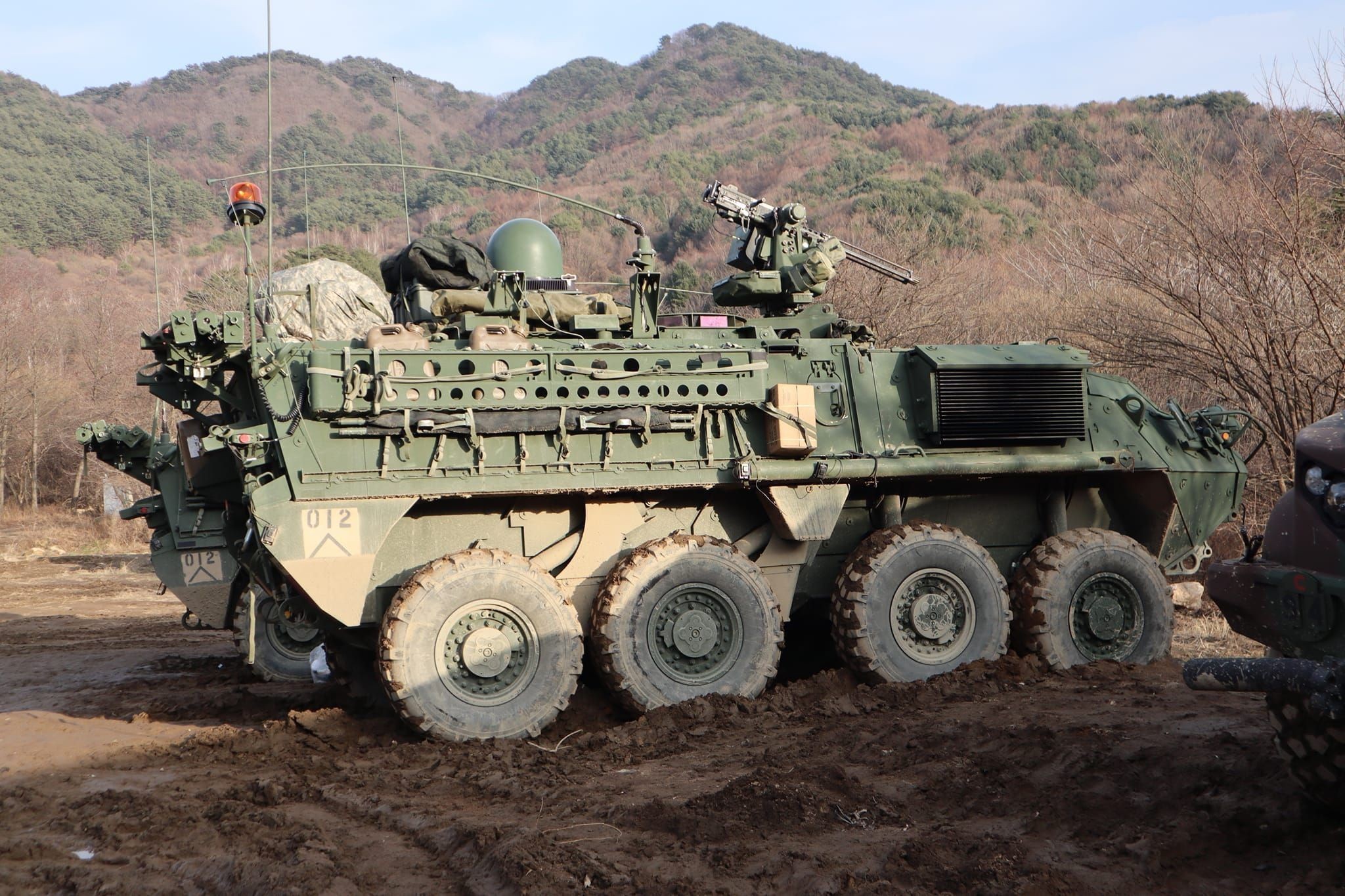
If the terrain and extremely professional OPFOR were not enough to provide a very difficult fight, the winter weather added another layer of complexity and hardship for 1-12 IN. Freezing rain, mud, and snow made it a challenge for both Strykers and dismounted infantry alike. Soldiers’ trust in their winter equipment and clothing became paramount to their success. Units conducting operations in mountainous areas must start at the Soldier level to build confidence and grit to operate in the harsh environment.
Preparation
A disciplined approach to planning and preparation for any military operation is not only prudent but expected of leaders in any military organization. Multinational operations add to the challenge of ensuring that planning and preparation is synched across a combined force as 1-12 IN experienced during the months leading up to the KCTC rotation. Early integration with the ROK-A brigade, commander-to-commander dialogue, the final coordination meeting, and understanding the differences between Korean versus U.S. Multiple Integrated Laser Engagement System (MILES) equipment will go a long way to ensuring the success of the overall training.
Early Integration
As the culminating training event for the ROK-A brigade, their planning and preparation begins far before what U.S. units typically experience when participating in a U.S.-based CTC rotation. Future participating U.S. units must coordinate and integrate as early as possible with the executing ROK-A brigade. Planners must be provided from both the KRF brigade and battalion level as early as possible in the deployment to understand the planning timeline and parameters of the KCTC rotation. The executing ROK-A brigade arrives to reception, staging, onward movement, and integration (RSOI) at KCTC with the tactical plan, communications exercise, rehearsals, and area recons already complete. With assistance from Eighth Army and the 2nd Infantry Division, the participating KRF battalion can better deconflict their training calendar prior to arriving to assume the KRF mission to ensure a similar level of understanding and that training gates are met.
ROK-US Commanders’ Dialogue
ROK-A brigade commander to U.S. battalion commander dialogue on the tactical plan is vital. The initial ROK-A brigade tactical plan for the rotation was drafted 60 days out and then used during the initial in-person dialogue with the U.S. battalion commander. This dialogue is instrumental in the ROK-A brigade’s understanding of the capabilities and composition of a U.S. Stryker battalion and key higher-level U.S. enablers. With this information given in a timely manner, the ROK-A brigade can continue to refine its tactical plan, giving the Stryker infantry battalion tasks in line with its mission and capabilities. This requires the participating Stryker battalion to provide a capabilities brief to the ROK-A counterparts early and often, if needed. Through understanding each counterpart’s capabilities, the respective unit can integrate fires and effects to enable a successful rotation.
Final Coordination Meeting
The ROK-A brigade’s final coordination meeting at KCTC (approximately two weeks out from the beginning of the rotation) is the most crucial pre-rotation training event for participating U.S. units to attend. This weeklong conference goes over the entire rotation from start to finish and serves as the final checks and balances for all participating units. It is recommended that the KRF battalion commander with staff attend this event. All the details from arrival, RSOI, tactical assembly areas, battle positions, avenues of attack to objectives are discussed during this conference. If the KRF battalion misses other train-up opportunities prior to the final coordination meeting, this event is critical to help synchronize their efforts prior to the rotation.
ROK Army MILES
The Korean MILES equivalent is easier to use and more intuitive than U.S. MILES gear. Not only is every Soldier’s movement tracked from start to finish, but every bullet shot from any MILES-equipped weapon is logged. If MILES “rules the battlefield” at U.S. CTCs, then it is true to a much higher degree at KCTC. Kills will not be adjudicated by ROK-A observer controllers (OCs) unless the MILES records it. Korean and like U.S. weapons have the appropriate MILES, but the following key U.S. weapon systems do not have Korean MILES: M2 .50 Caliber Machine Gun, Javelins, 81mm mortars, and 120mm mortars. If equivalent MILES gear can be procured, this will help more accurately replicate the combat power of a Stryker formation and increase the supporting unit’s lethality during the exercise. For example, during KCTC, 1-12 IN fired 1,362 rounds of 120mm mortars, of which only six rounds were adjudicated due to a lack of MILES. Last, with the lack of replicated Javelin and Common Remotely Operated Weapon Station-Javelin (CROW-J) capabilities, a Stryker battalion’s ability to destroy enemy armored vehicles becomes limited to Korean MILES-equipped Panzerfausts. Thus, U.S. Soldiers must be properly trained and ready to use the Panzerfausts prior to the beginning of the exercise. For a real-world mission, the application of dismounted anti-tank weapons (AT4s and Carl Gustafs) will be crucial to the success of the infantry along the limited number of main and alternate supply routes accessible due to Korea’s topography.
Overall, the approach and attention to detail from the ROK-A rotational unit during planning and preparation should be mirrored by the supporting KRF battalion. Every attempt at integration prior to the exercise should be prioritized when humanly possible. The early link-up and synchronization will pay huge dividends during the KCTC fight.

Execution
The execution of KCTC 23-11 included two battle periods: a three-day defensive phase and a three-day offensive phase. Throughout each phase, the OPFOR was relentless from start to finish, replicating North Korean tactics from the individual level all the way up to battalion level. All nine 1-12 IN maneuver platoons experienced significant combat action, having to fight as a platoon tied into a larger company, battalion, and brigade fight. Of all the lessons learned from a KCTC rotation, there are four critical areas to highlight to increase shared understanding across the force: multinational interoperability, engagement area development (EA DEV), rear area security, and the advantages of Stryker formations in Korea.
Multinational Interoperability
Multinational interoperability begins with having the right liaison cells at the right locations, up and down the chain of command. The ROK-A and U.S. liaison officers (LNOs) directly impact mission command through the human aspect of interoperability during the rotation, bridging procedural and technological interoperability gaps. LNO cells played a major role in the effectiveness of all three dimensions of interoperability.
Both the ROK-A brigade and KRF battalion must agree upon a deliberate plan for LNO support. Bridging the language, tactical, and cultural barriers between U.S. and ROK-A forces is critical not only to promoting combined interoperability but also to winning the fight. During 1-12 IN’s KCTC rotation, the ROK-A brigade provided a two-man LNO package with communication systems to the 1-12 IN battalion main command post (MCP), and in turn, 1-12 IN provided a LNO package to the ROK-A brigade MCP with two digital platforms (Joint Battle Command-Platform [JBC-P]) and two frequency modulation (FM) communications nets. This communications redundancy ensured that even if one system became non-mission capable or impaired by enemy actions, there was still information exchange between the headquarters.
The one major improvement gleaned from the KCTC rotation was the requirement to have LNO packages with adjacent multinational battalions, not just higher headquarters, to be able to have shared understanding and synchronization of the battlefield. Future U.S. rotations to the KCTC or other multinational CTCs should provide at least one U.S. LNO with communication equipment to each adjacent ROK-A unit. 1-12 IN’s situational awareness was severely limited during offensive operations due to the inability to directly talk with adjacent ROK-A units. These additional LNO packages with a higher-level synchronization matrix would have significantly increased cross-talk and near simultaneity of U.S. and ROK forces’ efforts.


Engagement Area Development
EA DEV over large company sectors in severely restricted terrain provided a unique challenge to 1-12 IN. Most of the terrain in northern Korea is challenging for Stryker battalions due to the mountainous terrain. The enemy understands this limitation and employs dismounts to penetrate combined forces’ defenses off major and alternate supply routes. As a result, platoons must establish mutually supporting dismounted battle positions (BPs), utilizing the terrain to their advantage. Key to this defense is to employ all forms of BPs: primary, alternate, supplementary, and subsequent. This will allow a company to defend terrain that is very susceptible to enemy infiltration. Proper security and early warning tactics and techniques must be used to identify which avenue of approach the enemy is using to get accurate indirect fires on enemy movements and to reposition friendly forces to other BPs when necessary. In the mountainous terrain, linear defenses and non-linear defenses will quickly be overcome by superior enemy numbers. Primary BPs must be mutually supporting with very clear engagement, disengagement, and movement criteria to alternate, supplementary, and subsequent BPs.
For brigade and battalion-level EA DEV planning, obstacle belt intent must be tied to reality. On the Korean battlefield, unless you have a superior number of forces or the requisite Class IV and V (material for obstacles), blocking or turning enemy forces into engagement areas will be nearly impossible. 1-12 IN quickly learned this during the first 24 hours of the defense. Although the battalion was arrayed in BPs, it was not going to be able to turn the enemy dismounted forces into its main engagement area. In reality, obstacle intent should be to either fix or disrupt the enemy movements utilizing indirect fires as the primary means and eventually jumping infantry platoons to supplementary or subsequent BPs as the unit continues to attrite the enemy’s superior numbers. Obstacle emplacement along main or alternate supply routes do reduce the enemy’s ability to sustain the fight, but the dismounted forces are able to continue the pressure on the defensive fight.
Rear Area Security during Offensive Operations
Deliberate actions for rear area security missions in Korea are vital to maintaining and building combat power. As 1-12 IN transitioned to the offensive phase of the operation, they were given the mission for brigade rear area security prior to stepping off on the attack during later phases in the operation. The number one lesson learned is that the enemy will have eyes everywhere. The terrain provides a drastic advantage to enemy special purpose forces and observation posts when fighting a wheeled or tracked U.S.-ROK force. The nature of a Stryker fleet operating in severe mountainous terrain is being road-bound, where command posts (CP) and tactical assembly areas (TAA) can only stray from the main routes to an extent before the terrain becomes more hazardous for vehicles than the enemy. Dismounts in mountainous terrain remain crucial, which implores units to train both mounted and dismounted.
Through 1-12 IN’s experience, Stryker companies must focus on the following priorities of work during rear area security operations: posting local security, positioning key weapons systems, assigning sectors of fire, and establishing the company counter-reconnaissance and surveillance operations. Counter-reconnaissance is the sum of all actions taken at each echelon to counter enemy reconnaissance and surveillance efforts throughout the area of operation. The purpose of counter-reconnaissance is to destroy, defeat, or repel all enemy reconnaissance elements within capabilities and following engagement criteria. It is not a distinct mission but a component of all forms of security operations, denying the enemy commander the ability to conduct reconnaissance and develop situational understanding. Successfully countering enemy reconnaissance is the first and possibly most important step in an operation. During the KCTC rotation, 1-12 IN learned that active reconnaissance and surveillance (R&S) patrols were the main deterrent to keep enemy observers from finding CP and TAA locations in a severely restricted terrain environment.
Secondly, for the company and platoon elements not directly participating in rear area security operations, you must always have a plan to jump locations when the enemy is able to identify your location. This identification of friendly CPs and TAAs was always followed by enemy indirect fires during the KCTC fight. It is critical, especially in Korea, to have a deliberate rear area security plan, counter R&S operations, and relocation plan. Without a plan and deliberate actions, the lack of preservation of combat power for offensive operations will quickly overwhelm a combat unit in the rear area.
Advantages of Stryker Formation in Korea
Although many lessons learned can be applied to any formation, whether they are light, wheeled, or mechanized, the three biggest advantages derived from fighting with a Stryker infantry battalion at KCTC are: increased tactical mobility, enhanced communications, and ability for greater sustainment operations.
Tactical Mobility: As in many locations in Korea and across INDOPACOM, severely restricted foothills to mountainous terrain provide unique challenges and opportunities to train the capability of a Stryker formation. The control of limited ground lines of communication (LOCs) due to the natural canalization of the severally restricted terrain will be a key task during combat operations. Without open LOCs, forward-positioned forces will quickly become cut off from the larger body of friendly ground forces as has been readily documented during many battles in the Korean War. A U.S. Stryker infantry battalion’s advantage in this type of warfare is the ability to quickly self-transport infantry to a dismount point, just outside of enemy contact range, and then have the infantry clear forward, destroying enemy positions along the LOCs. This technique of dismounting and clearing forward of the mounted element in severely restricted terrain has the advantage of not exposing Strykers to enemy anti-tank weapons or indirect fire before the infantry can clear the enemy positions. Once the dismounts have destroyed enemy observation posts and anti-tank elements are destroyed, only then should Strykers be called forward to help sustain the fight. Clearing the possible threats allows the true advantage of Stryker formations to be used to rapidly seize terrain and maintain momentum. Training at the KCTC allows a combined force to practice these exact tactics, which cannot be replicated at other CTCs to the same effect.
Enhanced Communication: The Stryker’s enhanced communication systems are a game-changer in mountainous terrain. It is relatively easy to outrun line-of-sight communications in Korea, but the JBC-P alone will help a geographically dispersed Stryker formation maintain situational awareness and execute command and control. The real-time sharing of graphics, intelligence, and situation reports across the complex KCTC terrain was instrumental to the commander’s understanding of the battlefield. The fight for communication is continuous on the Korean battlefield. The proper utilization and positioning of JBC-P systems at the battalion and company levels provided the only means of communication when companies were out of FM comms range with battalion. For example, the battalion scouts were able to forward position and conceal one reconnaissance Stryker variant with JBC-P comms while maintaining FM comms with their scout teams on the ridgelines. This allowed the scouts to call in indirect fire on enemy positions within seconds of the reports coming in from the scout observers on the ground. Through a combined approach of JBC-P and FM comms, units can mitigate the terrain’s denial of dismounted comms architecture alone.
Greater Sustainment: Finally, the ability of a Stryker battalion to self-sustain for up to 96 hours once entering the fight allows for extended combat operations and a greater ability to react to contingencies as they arise. When resupply was called forward through brigade support battalion and supply chain assets, the priority for classes of supply was Class III(B) (fuel) followed by a combination of Class I (food and water) and Class V (ammunition) as requested by companies through accurate logistic reports. Companies then utilized the service station resupply method by pulling only a limited number of Strykers out of position or TAAs as needed to conduct resupply operations. The bottom line is that the utilization of Strykers to self-sustain dismounted combat operations will be key to sustaining the tempo of the fight in Korea.
Conclusion
In conclusion, training at the KCTC allows Stryker units to exercise all their mission-essential tasks while improving interoperability with the ROK-A, thus increasing warfighting capabilities in the KTO. Between the severely restricted terrain, the harsh winter weather, world-class OPFOR, and highly professional ROK-A OCs, valuable lessons can be learned daily at echelon. KRF units should strive to be selected to complete a KCTC rotation, as it significantly increases their formations lethality and interoperability. Moreover, U.S. Army Forces Command deployment readiness exercises should send a unit straight to KCTC after RSOI as they assume KRF or from CONUS locations to KCTC. These lessons will help future KRF units be fully prepared to “fight tonight and win” in similar real-world combat conditions not only in Korea but across the INDOPACOM area of responsibility.
At the time this article was written, LTC Lloyd B. Wohlschlegel commanded 1st Battalion, 12th Infantry Regiment, 2nd Stryker Brigade Combat Team, 4th Infantry Division, Fort Carson, CO. His battalion was assigned forward to U.S. Forces Korea, where it served as the Korean Response Force 8th Army Reserve Battalion from July 2023 to March 2024. He currently serves as the senior task force trainer at the National Training Center, Fort Irwin, CA. His previous assignments include serving with the Joint Multinational Readiness Center in Hohenfels, Germany, as a task force senior and deputy senior observer controller/trainer. LTC Wohlschlegel has served primarily in light infantry and Stryker formations throughout his 20 years of service.
This article appears in the Winter 2025-2026 issue of Infantry. Read more articles from the professional bulletin of the U.S. Army Infantry at https://www.benning.army.mil/Infantry/Magazine/ or https://www.lineofdeparture.army.mil/Journals/Infantry/.
As with all Infantry articles, the views herein are those of the authors and not necessarily those of the Department of War or any element of it.
Social Sharing