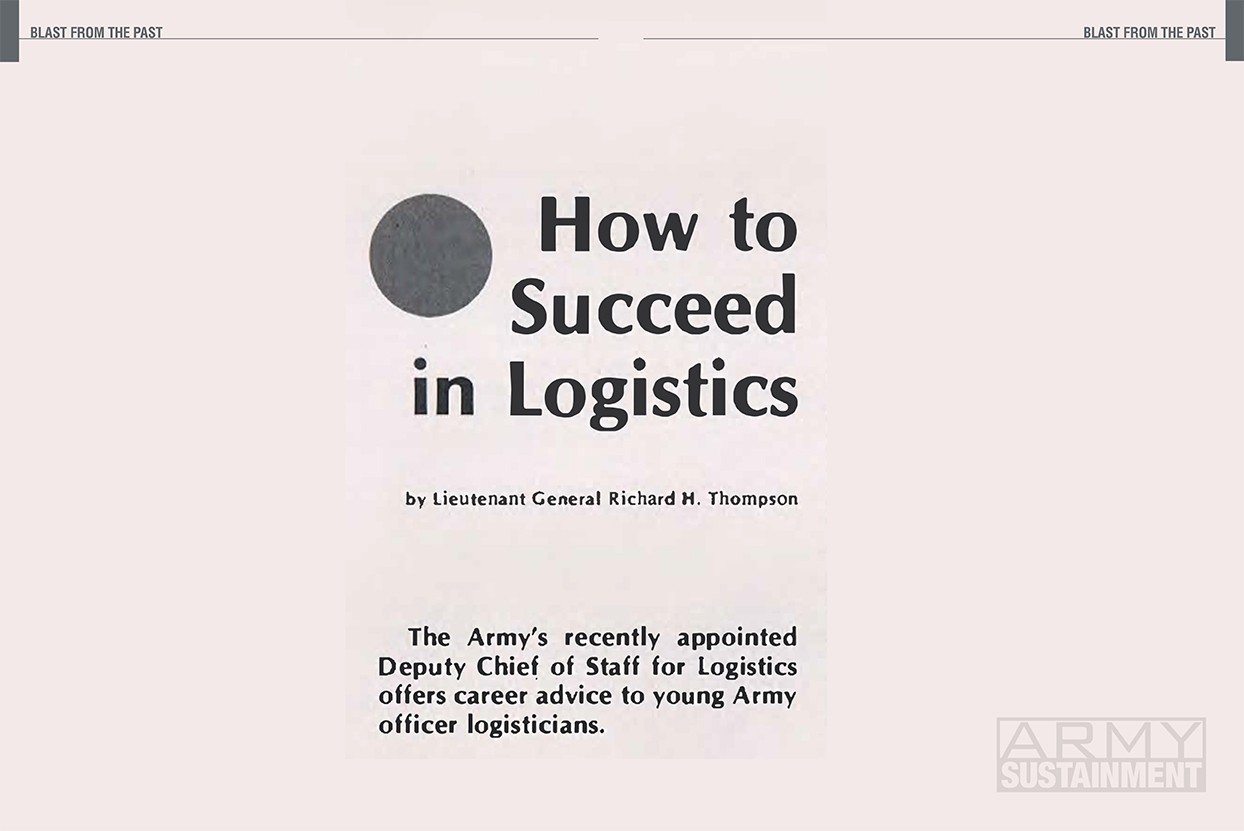
(Editor’s Note: This Blast from the Past article was initially published in Army Logistician (the former title of Army Sustainment) in the SEP-OCT 1981 issue. The career advice provided by the then Deputy Chief of Staff for Logistics to young Army officer logisticians still holds true today.)
The Army’s recently appointed Deputy Chief of Staff for Logistics offers career advice to young Army officer logisticians.
“What should I do to be competitive in my Army career?”
I am asked this question during virtually every visit that I make to the field. Young, energetic Army officer logisticians are concerned about the kinds of things they should do to improve their competitive edge in vying for career development opportunities.
Having served on a number of selection boards for various coveted opportunities, I have given considerable thought about how to answer that often-posed question. I would like to share some of those thoughts with all of you logisticians who have pondered that question.
First, we need to understand our Army, not only its missions and functions but also its values and beliefs. Our Army is in transition, just as our society is in transition, but the element of transition has always been present. At no time in our Nation’s history have the opportunities, challenges, and satisfactions for Army logisticians been greater. It is a “super” time to be serving our Nation.
Regardless of your current position or experience there are going to be occasions when your seniors will be perplexed, or even dismayed, by some of your attitudes. There is, indeed, a generation gap; but there are also core values and beliefs that you and your seniors can jointly embrace and build a lifetime of service around. I think there are three beliefs that can be universally shared:
- The Army Is a Profession. It is a profession that requires dedication, sacrifice, and commitment. Service to our country, in the highest and finest sense, is the principal reward.
- The Army Is People. The Army is not an impersonal assembly of sophisticated weapons of destruction linked by high-speed electronics. It is people, and the people — comrades, family, friends, and countrymen — are whom the Soldier is willing to die for.
- The Army Is Opportunity. The Army, as perhaps no other institution, offers the opportunity to serve, to develop, to grow, to share, and to contribute.
These, then, are some of the beliefs that I think are mutually shared. I also think there are some fundamental values — values steeped in our Nation’s heritage and culture — that can be mutually shared. Among those values are:
- Honesty and Integrity. These words describe specific, recognizable values, not hazy concepts. They mean “tell it like it is” and “be willing to stand up and be counted.”
- Dedication. This, too, is a recognizable value, manifested in our willingness to defend our free society and its constitutional guarantees.
- Pride. This value is perhaps our most obvious and is demonstrated by the pride we take in our Nation of free men, women, and children; in our profession that helps keep our Nation free; in our Soldiers and our leaders; and, most of all, in ourselves.
- Enthusiasm and Optimism. This value is reflected in our attitude that we can and will do the job.
- Respect. This value is demonstrated in our dealing equally with our fellow Soldiers regardless of race, sex, age, or station in life.
After recognizing these fundamental values and beliefs, let me share with you some things that I think a young logistician can do in charting their career to maximize their contributions and to achieve their potential. I offer these in no particular order of importance.
- Go after the tough jobs. Contrary to popular belief it can be beneficial to volunteer. Assert yourself and as a logistician assert your service to your customer.
- Stay physically and emotionally fit with a healthy appetite for work and a positive attitude toward mission accomplishment.
- Serve with troops as early and as often as possible. You will keep that vitality and sense of urgency that is so important to a small unit’s success.
- Learn to praise openly, counsel wisely and honestly, and chastise privately, impersonally, and without emotion.
- Do not work toward efficiency reports and scores; give each job your best and the reports and scores will take care of themselves.
- Learn to speak and to write expressively, understandably, and concisely. Be articulate without being verbose.
- Be active — a competitor and a doer — guided by technical knowledge, logical thought, and common sense. Do not do anything stupid.
- Understand and learn from your mistakes. You will make mistakes and correct them or be corrected, but maturity comes from understanding them.
- Remember your obligations to our taxpayers and to our Army and be ruthless in your efforts to weed out fraud, waste, and abuse.
- Study war and understand it — it is our profession. Learn from the triumphs and tragedies of our past leaders. Make their logistics successes and mistakes pay off for you.
- Do not get bogged down in the technical minutia and jargon of our logistics systems. Realize their importance, learn their critical points, and measure their effect on the combat units that you support.
- Learn to communicate with the commanders and staffs that you support in their language and thought patterns. Your knowledge is an important asset to them.
- Care of your Soldiers — the good ones and the not-so-good ones. Help, nurture, and defend them; for they will be what they think they are and what you think they are.
- When you evaluate subordinates, emphasize the importance of their jobs in plain, simple language. If they have done well, say so. We logisticians tend to understate things.
- Do not plan your retirement at the 10th year of service. Pursue assignments that provide continued professional growth, not necessarily those that will be the most marketable at your 20th year.
- Learn when to listen and when to speak up. It has been said that you cannot listen your way into a problem, but it is equally true that you cannot listen your way out of one either.
- Study your career opportunities and actively participate in managing your own development. Review and update your officer record brief and microfiche.
- Know your career manager at the Military Personnel Center. Talk with them. Tell them your goals, aspirations, and hopes and follow up in writing so that they do not forget. Use the preference sheet.
- Let your boss help you, just as you help your Soldiers. Learn to communicate your needs to them and let them watch you grow in responsibility, knowledge, assuredness, and maturity.
- Do not be afraid to ask for help or information when you need it, but do not be foolish enough to “shoot from the hip.” Do not be afraid to say, “I do not know,” but then go find out.
Remember, logisticians are important members of the Army team. There is a bright future for you on that team. Attune yourself to become a more vital part of that team, drawing upon the emerging regeneration of America’s defensive strength.
--------------------
LTG Richard H. Thompson was a former Deputy Chief of Staff for Logistics, Department of the Army from 1981-1984. In his 42 years of service, he achieved the rank of general and became the first Quartermaster officer in the corps’ history to hold the rank of full general while still on active duty. He was inducted into the Quartermaster Hall of Fame in 1991 for his lifetime of contributions to the Quartermaster Corps.
--------------------
This article was published in the fall 2025 issue of Army Sustainment.
RELATED LINKS
The Current issue of Army Sustainment in pdf format
Current Army Sustainment Online Articles
Connect with Army Sustainment on LinkedIn
Connect with Army Sustainment on Facebook
---------------------------------------------------------------------------------------------------------------
Social Sharing