

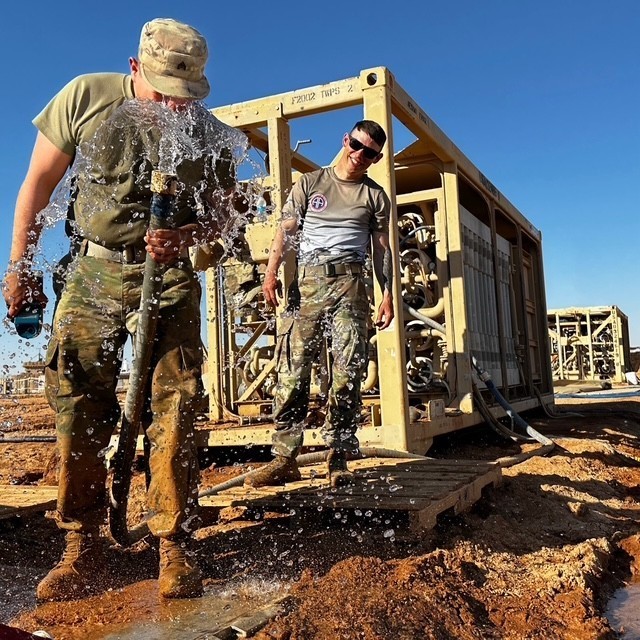
The 92W Water Treatment Specialist has been stifled by years of counterinsurgency (COIN) operations, underscoring the relevance of the occupational specialty, devaluing their need to be implemented in the evolving battlespace, and further crippling their ability to perform operational functions consistent with occupational necessity. This article provides critical analysis into real-time purification operations, the avoidable shortcomings linked to ongoing operations, how these shortcomings tie into decisive failures at echelon in the emerging battle space if not rectified, and a tiered plan of action to mitigate the risk of losing at the hands of sustainment. Any failure to acknowledge and follow-up with decisive action will certainly cause a loss in future wars.
A New Fight, An Old Requirement
Over the last two decades of COIN operations, the role of the 92W has been quietly underused. With contract support readily available in mature theaters, purification in theater became an exception rather than the norm. In most locations, logistical capabilities or host nation support replaced the need for expeditionary water production. However, over the past three years, 92Ws reemerged as critical players in sustaining the force in austere and undisclosed locations. Ongoing operations in theater boast the capability of 92Ws and their ability to sustain life support daily. Rotationally, water purification units are embedded in austere environments with the expectation to produce, maintain, and distribute potable water to sustain the force, which would otherwise be incapacitated. Amid the steady shift from COIN to large-scale combat operations (LSCO), outlined in Army Doctrine Publication 3-0, Operations, Field Manual (FM) 3-0, Operations, and FM 4-0, Sustainment Operations, the demand for organic water purification has surged. As global conflict evolves, so must our enabler posture. 92Ws are no longer a luxury: they are a necessity. The 92W military occupational specialty (MOS) must be re-postured to meet this challenge.
In these forward environments, life support operations have become a matter of survival. With contractor support unavailable, the Army defaulted to internal capabilities, 92Ws. Unfortunately, many units are unprepared to assume these missions due to limited training, degraded purification systems, and a garrison mindset rooted in stability operations. Since LSCO have become the dominant operational framework, this gap between capability and requirements represents a significant threat to operational readiness.
The Risk of Readiness Gaps in Water Support Operations
Without reliable organic water purification, operational reach becomes dangerously limited. Units are restricted to resupply lines; movements become lethargic; and medical readiness degrades. In LSCO, where maneuver forces are spread thin and enablers are operating within an insecure rear area, this becomes a critical vulnerability. Water has proven to be a logistical constraint. However, it is also a tactical one. If 92Ws fail in their essential purification task, troops fail. A single purification site can support thousands of Soldiers only if it is functional. If not, entire operations may grind to a halt. This is portrayed in real time when most rotational units arrive in theater without having conducted basic chemical maintenance on purification equipment. The garrison training environment is riddled with red tape and environmental considerations, rendering the conduct of basic skill-level tasks impossible. Distribution has never been managed in hundreds of thousands of gallons, so product management is a foreign concept. Worse still, equipment maintenance is sparse because the COIN fight has taught that contractors will be readily available to support the warfighter.
Doctrine and the Problem of Atrophy
Water support has been degraded by years of underuse. Many 92Ws have not conducted water purification operations since initial-entry training. Soldiers are technically qualified but operationally untrained. Purification equipment is inoperable or stored indefinitely. In COIN, this shortfall was masked by an old reliable route: the overuse of municipal water or contractor-supplied bottled water.
When the opportunity for training is presented, it is not uncommon for the water operations plan to consist of simply performing bulk-to-bulk transfers, which is distribution and setting up retail points from Hippos. This determines and quickens the movement aspect, but it fails to capture a fraction of what 92Ws are expected to execute. The failure to provide realistic training to 92Ws exacerbates the problem. They are critically unprepared for real-world challenges, because they never train on mission essential task list (METL) tasks. Most 92Ws have been reconstituted to being proficient wheeled vehicle operators, dedicating time to perfect basic Soldier tasks like establishing fighting positions and setting up perimeters. The occupational requirement of purifying and maintaining potability standards, reading and interpreting data logs, and managing daily issue logs to forecast water consumption has been neglected. Soldiers often request to reclass after multiple training exercises that fail to capture their relevance.
Many 92Ws are assigned to alternate duty positions where purification is rarely conducted because bulk water is conveniently accessible. The scope of their responsibilities consists of weekly preventive maintenance checks and servicing bulk distribution equipment. But LSCO would remove this safety net and would confront 92Ws with real-world challenges that would require technical expertise, attention to detail, critical thinking, and experience. Despite their lack of training, when 92Ws are thrust into an austere environment, they are expected to perform. Unfortunately, the COIN mindset is the perfect excuse to neglect or postpone relevant training. Commanders do not accept “I don’t know how” as an answer to the inability to perform MOS-related tasks.
With the “train as you fight” mentality, the focus must be centered on the enabler who must produce potable water under fire, under pressure, and under mission-critical conditions. Purification operations are decentralized, expeditionary, and continuous. Soldiers must conduct raw water site reconnaissance, set up Reverse Osmosis Water Purification Units (ROWPUs), and produce water within tight timelines to enable the warfighter. They are expected to manage consumption rates. Every gallon of potable water counts when 92Ws operate independently in small teams, supporting battalion-level or larger formations under logistical and environmental stress. Purification sites must be secured, sustained, and regularly relocated, placing increased logistical and operational demand on sustainment units. In a LSCO fight, logistics will be a kinetic operation.
Doctrinal Misalignment and Cultural Inertia
Despite updated doctrinal publications like ADP 4-0 and FM 3-0, there remains a significant misalignment between current sustainment practices and the requirements of LSCO. Many unit-level tactics, techniques, and procedures (TTPs) still reflect the realities of COIN, where water purification was often supplemented by external sources such as contracted services and the availability of bottled water. This is evident when bulk-water planning focuses on retail water operations and does not address purification operations. This type of operational planning must exist in echelons no higher than the forward support company. However, in sustainment brigades and corps sustainment commands where the purification assets are embedded, this level of planning dangerously fails to meet the intent. In contrast, LSCO demand a self-sufficient approach, where organic sustainment capabilities must be able to operate in austere and contested environments without reliance on external support. This type of exposure requires proficient 92Ws who can identify and meet the challenges that purification sites require for short- or long-term potability. Units must develop schedules for cleaning and maintenance, jumping purification and distribution sites to follow the fight, and responding in the event of total equipment failure. These procedures are not captured verbatim doctrinally. Rather, they become a function of realistic training to standard.
The merging of doctrine interpretation and operational practice is paramount. The profession requires leaders who possess an array of experience, including the process of purification and an equal balance between the technical knowledge acquired through institutional training and the tactical expertise that comes from repetition and exposure to different mission sets. How do the operators know that pH (potential hydrogen) levels are directly correlated to the chlorine residuals? How can site NCOICs prepare for an increase in days of supply when the number of personnel supported is increased from 100 to 1,000? Only through tough, realistic training. The need to be proficient in all spectrums of operational capability is paramount. While tedious in planning and execution, this process highlights why leaders at every level must understand equipment capabilities and the theory of operations. Units must prioritize efficiency and take a proactive approach to preserve the equipment and sustain operational readiness.
In COIN, sustainment planning assumed that rear areas would remain secure and accessible, enabling access to municipal water sources, bottled water, or logistical water capabilities. This assumption no longer holds in LSCO.
Furthermore, doctrinal guidance versus practice persists, particularly when doctrine directs potable water certification, necessitating the availability of preventive medicine for water testing. Technical Bulletin (Medical) (TB MED) 577 mandates that water must be tested for safety before consumption. However, the coordination for a certifying specialist often faces logistical challenges in remote, austere environments, especially given that preventive medicine teams are often needed elsewhere or are unavailable on short notice. Additionally, the requirements consistent with the maintenance of potability standards, as with primarily every other function regarding water support operations, are tactically ineffective due to the underuse of water production at scale. This doctrinal friction impedes units from preparing and executing water purification operations efficiently.
Bridging the Gap: A Doctrinal Roadmap
To close the critical water sustainment gap in LSCO, the Army must institutionalize water readiness as a foundational sustainment capability. This integration begins with formally designating water purification as a mission essential task within the Digital Training Management System. Water operations must be deliberately incorporated into METLs, field exercises, and rotations at readiness training centers. Validation of hands-on proficiency, comparable in rigor to gunnery tables or combat lifesaver certification, must become the standard.
Alongside training, equipment fielding and sustainment must be elevated to a command-level priority. Many units currently face readiness issues with ROWPUs. These systems are frequently stored, unserviceable, and provide diminished water support capability. Fleet-wide equipment audits must be mandated to identify readiness gaps. Partnerships must be established with original equipment manufacturers and field service representatives, facilitated by agencies such as U.S. Army Combined Arms Support Command, who can provide targeted MOS-specific maintenance training and troubleshooting. We must consider establishing protocols for regional equipment rotation pools to enable Soldiers to train on purification systems, regardless of organizational equipment readiness.
Additionally, water sustainment must be incorporated into operational planning. Water treatment specialists and sustainment staff must participate in pre-deployment surveys, sustainment working groups, and synchronization meetings to ensure water considerations are embedded in the concept of support plans. To ensure alignment, staff planners such as support operations and S-3s must receive formal training in water support requirements and considerations, using TB MED 577 and other joint water doctrine as core planning references. This doctrinal grounding would ensure water production and potability verification were treated with the same urgency and foresight as food service, maintenance, and ammunition.
Finally, the institutional Army must modernize its professional military education and doctrinal content to reflect LSCO conditions. Current programs of instruction at the Advanced Leader Course, Senior Leader Course, and unit-level training events often remain rooted in COIN-era assumptions. Therefore, training scenarios must simulate degraded logistics networks and include realistic constraints on water access and certification. Cross-training between water specialists, medics, and engineers must also be expanded to cover chemical/biological threats, water security, and field-level testing. Units must be encouraged to create and share TTPs for decentralized purification in contested terrain, ensuring adaptive practices are spread across the operational force. They all play key roles in the operation, and it is imperative they understand what each element does.
Conclusion
In LSCO, sustainment is not only an enabler: it is decisive. The Army cannot maneuver without fuel, ammunition, and water. And unlike fuel and ammo, water cannot be stockpiled in the same way. It must be produced, tested, and secured in real time, under real pressure.
The 92Ws must be rebuilt for this fight. It starts with doctrine, by achieving a ready on day one mentality. But the fight tonight continues through training, and it ends with victory sustained by Soldiers who can purify, secure, and deliver water on the move. Water is the Army’s most forgotten and most vital battlefield skill. Sustainment is combat power, but water is its lifeblood.
--------------------
CW2 Johnny E. Frambo II is a petroleum systems technician assigned to 24th Composite Supply Company, 13th Combat Sustainment Support Battalion, 593rd Corps Sustainment Command, I Corps, Joint Base Lewis-McChord, Washington. He holds a Bachelor of Science degree in business administration: data analytics from Liberty University. He is a graduate of Warrant Officer Advance Course and Support Operations Phase 2.
SSG Ramon Negron Ortiz enlisted in the Army in 2014. He completed basic combat training at Fort Jackson, South Carolina, and advanced individual training at Fort Lee, Virginia, where he became a 92W Water Treatment Specialist. His military education includes the Advanced Leadership Course. He is currently pursuing a Bachelor of Science degree in criminal justice from the University of Maryland Global Campus. His combat and operational experience includes two deployments in support of Operation Inherent Resolve in Iraq and in Syria.
--------------------
This article was published in the fall 2025 issue of Army Sustainment.
RELATED LINKS
The Current issue of Army Sustainment in pdf format
Current Army Sustainment Online Articles
Connect with Army Sustainment on LinkedIn
Connect with Army Sustainment on Facebook
---------------------------------------------------------------------------------------------------------------
Social Sharing