“Can you keep us fighting?” This is a question most logisticians in the Army have been asked many times from their maneuver counterparts in any organization. I certainly expected to answer this question after nearly a year of commanding a forward support troop (FST) assigned to an infantry squadron in a Stryker brigade combat team (SBCT). Despite experience as an FST commander, having supported a previous National Training Center (NTC) rotation, platoon live fire exercise, multiple gunneries, and numerous smaller training events, I was still surprised when presented with the challenge of keeping our squadron fighting for 11 days during Korea Combat Training Center (KCTC) Rotation 24-06.
While the question is often framed simply as a yes or no, the truly important, implied, and complex task from this question is developing how you will keep an organization fighting with a concept of support. Critical in developing any concept of support is understanding your own internal sustainment capabilities and limitations, the known and expected needs of the maneuver units for their operations, and the availability of any external sustainment support within or outside the brigade.
Many members of a unit have some familiarity with NTC rotations. The wide-open spaces of the California desert provide natural opportunities for spacing in accordance with the well-known sustainment field trains concept. Fort Irwin is a well-established and rehearsed staging ground with logistics capabilities for units to prepare and recover after training.
These qualities did not exist at KCTC. Only twice before had an entire U.S. Army SBCT infantry squadron partnered with the Republic of Korea (ROK) Army to train at KCTC. Further complicating this exercise was that the training mainly occurred in severely restricted and rugged mountainous terrain during the warmest and most humid part of the year without any bulk resupply points in the vicinity of the training area. As the organic support structure for the squadron, and with several other ongoing logistical requirements across the Korean Peninsula consuming the rest of the regiment, sustaining this highly valuable and visible training opportunity to maximize its benefit fell squarely on the shoulders of our FST.
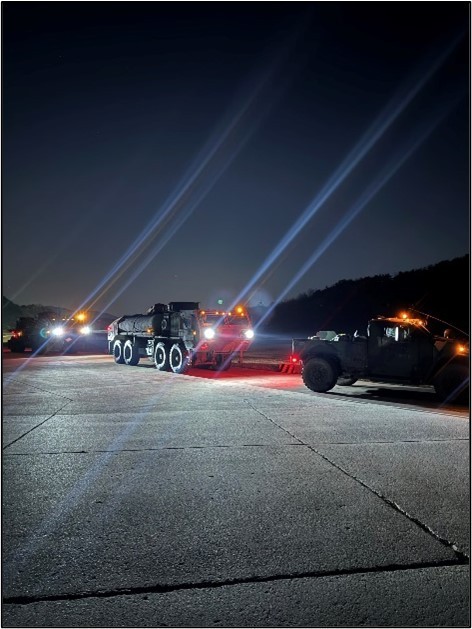
After considerable analysis and wargaming with platoon leaders/platoon sergeants, troop executive officer (XO), first sergeant, S-4, and the squadron XO, we reached a course of action that was irregular but gave us the best chance to sustain this squadron fight. Broadly, the plan was to establish a field trains command post (FTCP) and a combat trains command post (CTCP), but these locations were extended by nearly 100 miles of improved Korean roadway. At the FTCP, we had to secure our own resupply without a regimental support area managed by the Regimental Support Squadron. Instead, the distribution platoon had to draw its own bulk fuel, water, ammo, and supply and maintenance parts directly from Camp Casey interfaces and then navigate Korean roadways on a daily two- to three-hour logistics package (LOGPAC) convoy to deliver these supplies to the CTCP, which was located within a few kilometers of the forward line of own troops (FLOT) as normal. This put a significant strain on the drivers, their equipment functionality, and their convoy commander’s ability to navigate significant distance on Korean roads.
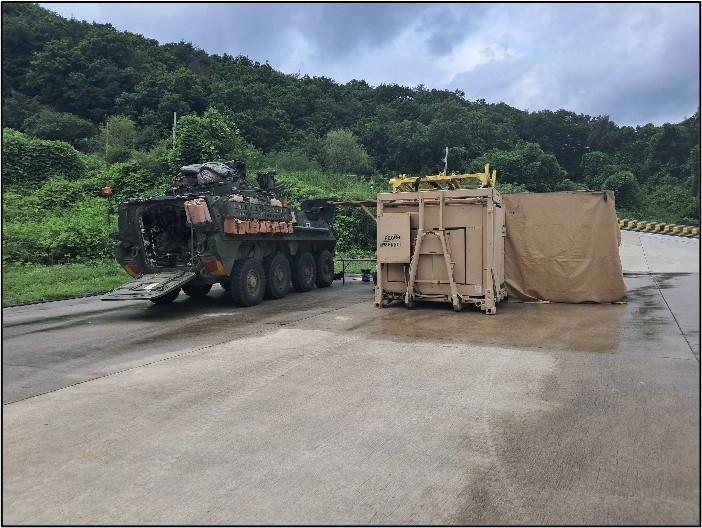
After multiple reconnaissance trips to the training site, we identified an area to establish a small unit maintenance collection point near the CTCP, which also served as a staging area for a dedicated recovery asset. Establishing this key node required coordination with adjacent ROK units to ensure adequate spacing within the overall training area and sound alignment with partner forces. Forward maintenance teams remained attached to their dedicated troop to provide expedient field maintenance. We also determined where we would set up the field feeding team’s assault kitchens to provide hot chow up to twice daily, as long as convoys leaving from the FTCP to deliver heat-and-serve meals and water were successful.
The last planning challenge was solving how to deliver supply commodities to the end user. During this training event, most of the squadron dismounted for significant periods to navigate challenging terrain. Essentially, the challenges of supporting a light infantry formation were also at play in addition to our typical function of supporting a Stryker infantry formation. This meant we needed a solution for the literal last mile of logistics, which at KCTC could be on the other side of a mountain through dense vegetation from platoon to platoon. The typical logistics resupply point method was unfavorable given how dispersed elements of the squadron were and how difficult it was for them to consolidate once in place on key terrain.
Major advantages of a Stryker, such as its storage and lift capabilities to carry supplies, were severely limited. To solve this, many supply cache points were identified either by myself as the FST commander, the S-4 working from the CTCP, or the maneuver elements themselves. We identified sites during the training where platoon- or even squad-sized packages of supplies could be dropped and then carried by hand to provide sustainment of critical commodities and anything else otherwise requested via logistics status reports.
Getting supplies into position at these caches at the right times required continuous coordination and significant manpower expenditure beyond just the distribution platoon to carry commodities across difficult terrain the final few hundred meters where they could not be driven. Accomplishing this allowed for the maximum amount of combat power to stay as far forward as possible while getting easy access to needed supplies to keep fighting as long and as hard as needed.
Executing this concept of support was challenging and stretched our FST to the limit for nearly the entire 11 days in the mountains of KCTC. Despite this unique and difficult challenge, the proficiency and skill we developed in the previous year allowed us to bend without breaking and to provide successful support to our squadron and our ROK allies. We demonstrated our equipment and personnel’s capability to deliver commodities after covering nearly 200 miles a day. We proved that we were tough and resilient enough to carry the load up mountains through hot sun and pouring rain to deliver to supply caches. And, most importantly, we showed that we trusted each other as a larger team. Each platoon executed its respective logistics functions within our plan, working toward the same end state and making adjustments when needed.
A few key takeaways from the internal after-action report to improve this type of operation in the future are provided to assist other units planning for similar events. Tying in more closely with the ROK Army sustainment network already in place and supporting our partner force as a potential source of short-notice assistance may have provided additional flexibility. Maximizing the impact of each LOGPAC would have reduced the overall risk of so many miles driven and served to increase our unpredictability to mitigate potential enemy effects. We did break away from our standard operating procedure as an SBCT formation in this environment, where our squadron mainly fought dismounted, by only conducting one LOGPAC each evening. This was helpful, but we could have done more.
Sometimes limited supplies were being transported, leaving plenty of pallet space or unused fuel capacity in our trucks. Increased planning to fill and maximize the storage space available at the CTCP and to then move supplies farther forward would have reduced the number of lengthy movements. Closely tracking commodity levels on hand at the CTCP and close to the FLOT to trigger necessary LOGPAC movements, which potentially occurred less than daily, would have provided the maximum possible benefit by reducing both backhaul and the overall number of convoys.
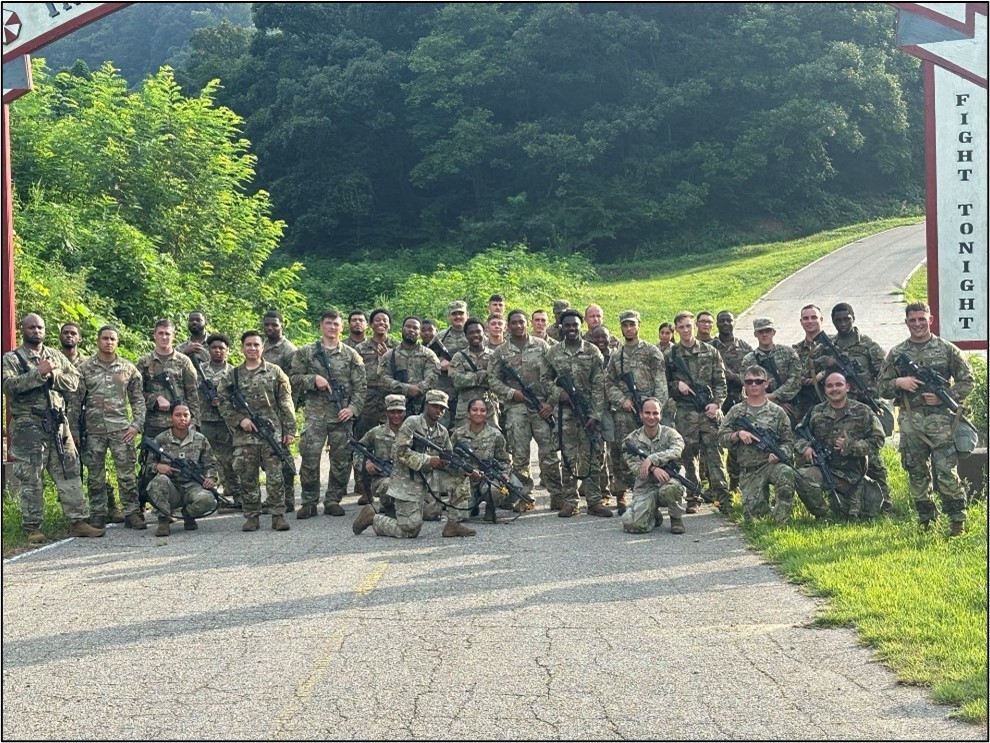
While there were certainly improvements that could have been made, overall our sustainment mission was highly successful, extending the squadron’s operational reach over 100 miles from the FTCP and fighting hard for the entire training event. I was proud of each of my Troopers and of each platoon. Field feeding, maintenance, distribution, and headquarters sections all were asked to do more than is usually expected, even for a large collective training event, and all rose to the occasion. As my career moves forward, I will look back on this training opportunity often for the lessons learned and teamwork displayed.
--------------------
CPT Connor S. Joyce currently serves as the headquarters and headquarters troop commander in 2nd Squadron, 3rd Cavalry Regiment, at Fort Hood, Texas. His previous assignments include serving as troop commander in Heavy Forward Support Troop, 2nd Squadron, 3rd Cavalry Regiment, which included National Training Center 23-09 and an operational deployment in support of Korea Rotational Forces. He also served as a platoon leader, executive officer, and assistant operations officer in 264th Combat Sustainment Support Battalion, 3rd Expeditionary Sustainment Command, which included a combat deployment to Iraq in support of Operation Inherent Resolve. His completed training includes Basic Airborne Course, Air Movement Planner, 80-Hour Sexual Harassment Assault Response and Prevention course, Ordnance Basic Officer Leader Course, and Logistics Captains Career Course. He holds a Master of Business Administration degree from the University of Maryland Smith School of Business and a Bachelor of Science degree from Johns Hopkins University.
--------------------
This article was published in conjunction with the fall 2025 issue of Army Sustainment.
RELATED LINKS
The Current issue of Army Sustainment in pdf format
Current Army Sustainment Online Articles
Connect with Army Sustainment on LinkedIn
Connect with Army Sustainment on Facebook
---------------------------------------------------------------------------------------------------------------
Social Sharing