
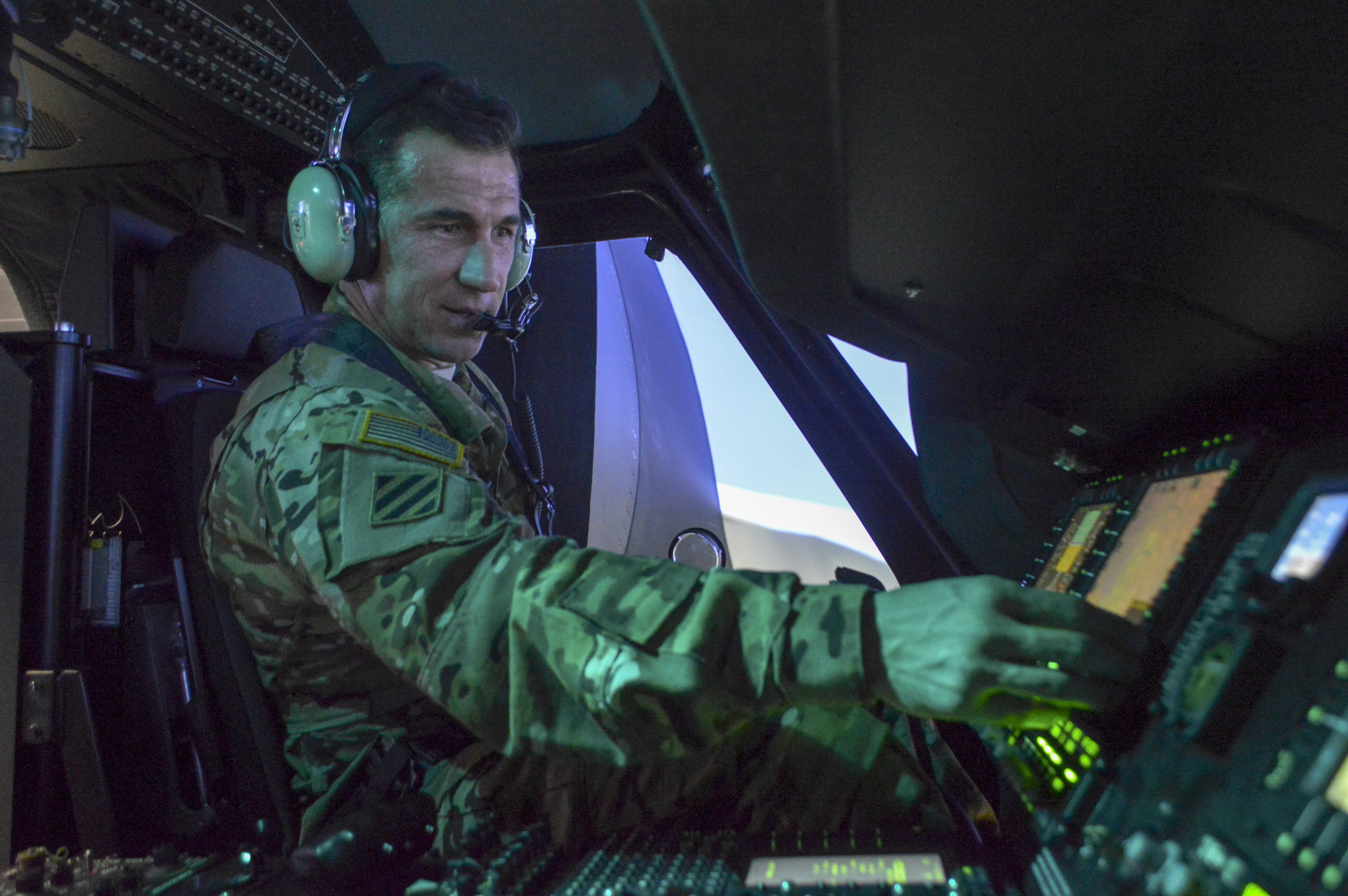
REDSTONE ARSENAL, Ala. (Feb. 1, 2016) -- The Army's new Black Hawk Aircrew Trainer was developed using capabilities, resources, and expertise across Team Redstone, reducing costs, creating efficiencies, and streamlining schedules.
The BAT is a highly immersive home-station flight training device for the UH-60M aircraft. To address the shortcomings of the legacy FTD, the Utility Helicopter Project Office turned to the U.S. Army Aviation and Missile Research, Development, and Engineering Center's System Simulation & Development Directorate to lead the development of a new UH-60M FTD. The effort focused on three objectives: designing the simulator's architecture such that any changes in the aircraft can be quickly implemented in the FTD; obtaining and maintaining full government purpose rights for all hardware and software designed and developed for this project; and leveraging new technologies to enhance immersive qualities and system RAM, when cost effective.
AMRDEC has extensive experience in the development of flight simulation and simulators. Much of that experience has been built through a successful partnership with the Program Executive Office, Aviation. Through this collaboration, AMRDEC and PEO Aviation have established both the development and refinement of simulators for several different rotary-wing platforms.
"Great outcomes are not driven by technical excellence alone," said James Lackey, AMRDEC director. "We must also add enterprise collaboration. One doesn't 'keep in house' or 'stay in their lane.' They instead reach out and recognize where and when certain facts of other organizational technical excellence make sense to pull together, integrate, and derive great outcomes."
The BAT Team was required by the UHPO to execute the project in five phases, providing specific deliverables at the end of each phase, before being given the "green light" to transition to the next. Real events and constraints, including sequestration, multiple government shut-downs, and materiel procurement further compressed the time available to complete the project to only three years. Despite the issues, the BAT Team completed the design work, along with the assembly, integrations and accreditation of the prototype BAT, almost five months ahead of schedule.
"The charter given to the ARMDEC by PEO Aviation was a new FTD design with government full purpose rights of the technical data package, technology enhancements, and the ability to rapidly integrate and field changes that had been made to that actual aircraft," said Kris Strope, AMRDEC lead engineer for the project. With these ownership rights, and a departure from a FTD with proprietary software and technical data package, the Army anticipates significant cost savings, both in unit procurement and total fleet lifecycle sustainment.
The AMRDEC team used numerous innovative approaches and concepts, which achieved cost reductions during the development, Strope said. For example, UH-60 cockpits were taken from decommissioned aircraft and used to fabricate the cockpits of the BAT. The team also used software interfaces, flight models, and programs that already existed within the AMRDEC enterprise. These and other innovative approaches and concepts combined to make the project more cost effective and ensure the government retains ownership of every aspect of the BAT's design.
BAT is no longer just an idea or concept, it is an operational flight simulator.
In less than three years, the team designed and assembled the first prototype BAT device ready for government accreditation and acceptance. The prototype was set up at Fort Bliss, Texas, in early-December and gained accreditation in mid-December 2015. It will remain at Fort Bliss as a training device for several months before moving to the next unit and installation.
---
The U.S. Army Aviation and Missile Research, Development, and Engineering Center is part of the U.S. Army Research, Development and Engineering Command, which has the mission to ensure decisive overmatch for unified land operations to empower the Army, the joint warfighter and our nation. RDECOM is a major subordinate command of the U.S. Army Materiel Command.
Social Sharing