Competition History
Command information in the form of Army Journalism began during World War I. Hand and type-written news was spread by couriers to soldiers in combat zones. This era of Army information saw the beginning of news bulletins at various levels of command. Writing was done by the intelligence or adjutant section in most units. The Army newspaper was born.
The establishment of the Bureau of Public Relations in February, 1941, triggered the development of the Office of the Chief of Information, Department of the Army. Under this new department, the Command Information Division and its mission to prepare and define policies for Army Command Information was developed.
Maj. Gen. Keith L. Ware Biography
Maj. Gen. Keith L. Ware was born in Denver on November 23, 1915. His military career began on July 9, 1941 when he undertook his basic training at Camp Roberts, California following his induction into the Army under the Selective Service Act. He attended Officer Candidate School at Fort Benning, Georgia and was commissioned a Second Lieutenant of Infantry on July 18, 1942.
Assigned to the 3rd Infantry Division, he sailed on October 22, 1942 from Hampton Roads, Virginia and was part of the North African invasion force. He participated in the Algeria-French Morocco and Tunisian Campaigns. The next major operations he participated in were the invasion of Sicily, the Naples-Foggia battles of southern Italy, the landings at Anzio Beachhead and then on the San Tropez beaches of southern France in August of 1944.
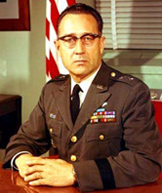
On June 18, 1945, he was awarded the Medal of Honor. An excerpt from the citation states, "On December 26, 1944, while serving as battalion commander of 1st Battalion, 15th Infantry, near Sigolsheim, France, he went forward of the front line elements of his command and for two hours reconnoitered a strongly held enemy position. He then led a small patrol forward and destroyed or captured four machine-gun positions and killed numerous enemy riflemen. Half of the patrol including himself were wounded, but he refused medical attention until the position was captured by his men. As an interesting side note, Audie Murphy received his Medal of Honor for actions in January 1945 as a member of Lt. Col. Ware's battalion. Later, he served as one of Ware's company commanders.
After serving six months in the occupation forces of Germany, Ware returned to attend the Command and General Staff College at Fort Leavenworth and then was assigned to the Military District of Washington. This is where he met his future wife Joyce, and they were married five months later on May 3, 1947.
Ware was then assigned to West Point to teach Military Psychology and Leadership, then attended the Armed Forces Staff College and was assigned to serve in Korea from March 1955 until June of 1957. It was then off to the National War College, back to Washington D.C. to serve as a Congressional Liaison and then a tour in Europe. During his next assignment as Assistant Division Commander of the 2d Armored Division ("Hell on Wheels") at Fort Hood, Texas, he was promoted to brigadier general. His next tour of duty was as Deputy Chief and Chief of Information for the Department of the Army from September 1964 through November 1967. During that tour, he was promoted to Maj. Gen. on July 1, 1966.

Originally due for assignment to Germany, Ware appealed to the Secretary of the Army and was reassigned to Vietnam where he initially served in major command assignments until taking over as commander of the 1st Infantry Division ("Big Red One").
Six months after assuming command, while moving forward to get "first hand" observations of the offensive operation in progress, he was killed when his helicopter was shot down on September 13, 1968. His funeral was held and he was laid to rest in Arlington National Cemetery. President Johnson, whom Ware had known from his legislative liaison days, attended.
His wife, who resides in Colorado, said that "he loved his country dearly and was a man of very high morals, very dedicated and a wonderful human being."
The Army continues to recognize Maj. Gen. Ware and his accomplishments to this day. The Army's annual Awards for Journalism are named after him as are the Parade Ground and an Elementary School at Fort Riley, Kansas (traditional home of the "Big Red One"); a range facility at Fort Benning, Georgia (home of the Infantry"); a Simulation Center at Rock Island Arsenal, Illinois; and, of course, an etching on panel 44W of the Vietnam War Memorial. His Medal of Honor is currently on display at the National Infantry Museum at Fort Benning.
Timeline
-
1970
Maj. Joseph Burlas established the Maj. Gen. Keith L. Ware award.
-
1975
The Print Journalist of the Year program was created by Lt. Col. Billy Spangler and Sgt. Maj. Gary G. Beylickjian. The namesake for this military award was Staff Sgt. Paul D. Savanuck, a Stars & Stripes reporter killed in Cam Lo, Vietnam in 1969.
-
1983
The Broadcast Journalist of the Year program was created by Mr. Clark Taylor.
-
1985
Mr. Clark Taylor, director of SRTV, and Retired Master Sgt. Gary D. Thompson recommended Master Sgt. John T. Anderson as the namesake for the Military Broadcast Journalist of the Year award. Anderson was captured by enemy forces at Hue (Way), Vietnam in 1968. He was a POW for five years before his release as part of Operation Homecoming.
-
1998
The Acting Secretary of the Army, the Honorable Robert M. Walker, approved Mr. John Moss and Ms. Peggy Holland as the namesakes for the Civilian Print Journalist of the Year award. They were killed in the bombing of the Alfred P. Murrah Federal Building in downtown Oklahoma City, April 19, 1995.
Both Moss and Holland were public affairs specialists in the Oklahoma City Recruiting Battalion. -
2008
The Office of the Chief of Public Affairs created the Kathy Canham Ross Award of Distinction to recognize extraordinary Community Relations contributions.
-
2009
Then-Secretary of the Army Pete Geren authorized the Kathy Canham Ross Award to officially become part of the Maj. Gen. Keith L. Ware Awards program.
-
2010
The award for Outstanding New Writer was renamed in honor of Staff Sgt. James P. Hunter, who died as he covered a combat patrol while serving with the 502nd Infantry Regiment, 2nd Brigade Combat Team, 101st Airborne Division in southern Afghanistan in 2010. This award recognizes excellence in Army journalism among enlisted Soldiers with 24 months or fewer in CMF 46. Only Soldiers in the rank of staff sergeant and below are eligible for this award.
-
2010
The award for Civilian Broadcast Journalist of the Year was renamed in honor of legendary military broadcaster, Mr. Clark Taylor. A Vietnam veteran with a Purple Heart and Bronze Star with 'V' device, Taylor revolutionized Army broadcasting, retiring from civil service as director of Soldiers Radio and Television in 2006, after a career which spanned 40 years of dedicated service to the United States Army. Taylor was inducted into the Public Affairs Hall of Fame in 2008.