
Field Manual (FM) 4-0, Sustainment Operations, emphasizes the importance of improvisation: “Sustainment leaders must be able to improvise operational and tactical actions to meet a changing operational environment (OE).” When logisticians read this definition of improvisation, they understand it to mean minor tactical adjustments like shifting the location of a logistics release point or establishing base clusters at a brigade support area rather than the sweeping organizational adaptation sometimes demanded of sustainment units. Logistics commanders must ask: Can our sustainment formations improvise beyond basic operational and tactical actions? Can they overhaul their mission-essential task lists and overcome deep structural shortfalls when the mission demands it in large-scale combat operations, when the Army insists that a logistics battalion headquarters is just that and must be able to conduct any logistics mission? The 49th Movement Control Battalion (MCB) proved that the answer is a resounding yes. The MCB can shift focus and function as a division sustainment support battalion (DSSB) when duty calls.
From Doctrinal Misalignment to Operational Necessity
In April 2025, III Armored Corps (IIIAC) faced a dilemma. No DSSB was available to support the 1st Brigade Combat Team, 1st Armored Division (1/1 AD), during National Training Center (NTC) Rotation 26-01. The four DSSBs across IIIAC were already overtasked. One was supporting an overseas rotation, one was supporting border operations, one was in training for a warfighter exercise, and one was recovering because IIIAC had supported five other NTC rotations in the last 12 months. With no DSSB available, IIIAC turned to 13th Armored Corps Sustainment Command (ACSC), which in turn tasked the 49th MCB. The 13th ACSC is the pass-back support for IIIAC’s divisions and brigade combat teams (BCTs).
This decision presented immediate challenges. The 49th MCB was neither structured nor manned for a DSSB mission. Its modified table of organization and equipment (MTOE) authorized only 51 personnel, primarily 88N Transportation Management Coordinators. The doctrinal purpose of an MCB is to provide in-transit visibility, coordinate the use of common-user land transportation (CULT) assets, and synchronize use of routes. A DSSB, by contrast, includes hundreds of Soldiers across multiple specialties — fuelers, mechanics, ammunition handlers, and logisticians. To further complicate matters before this mission, the MCB would command and control the three companies in its operational control (the composite supply company, the support maintenance company, and the composite truck company) but not organically assigned to it.
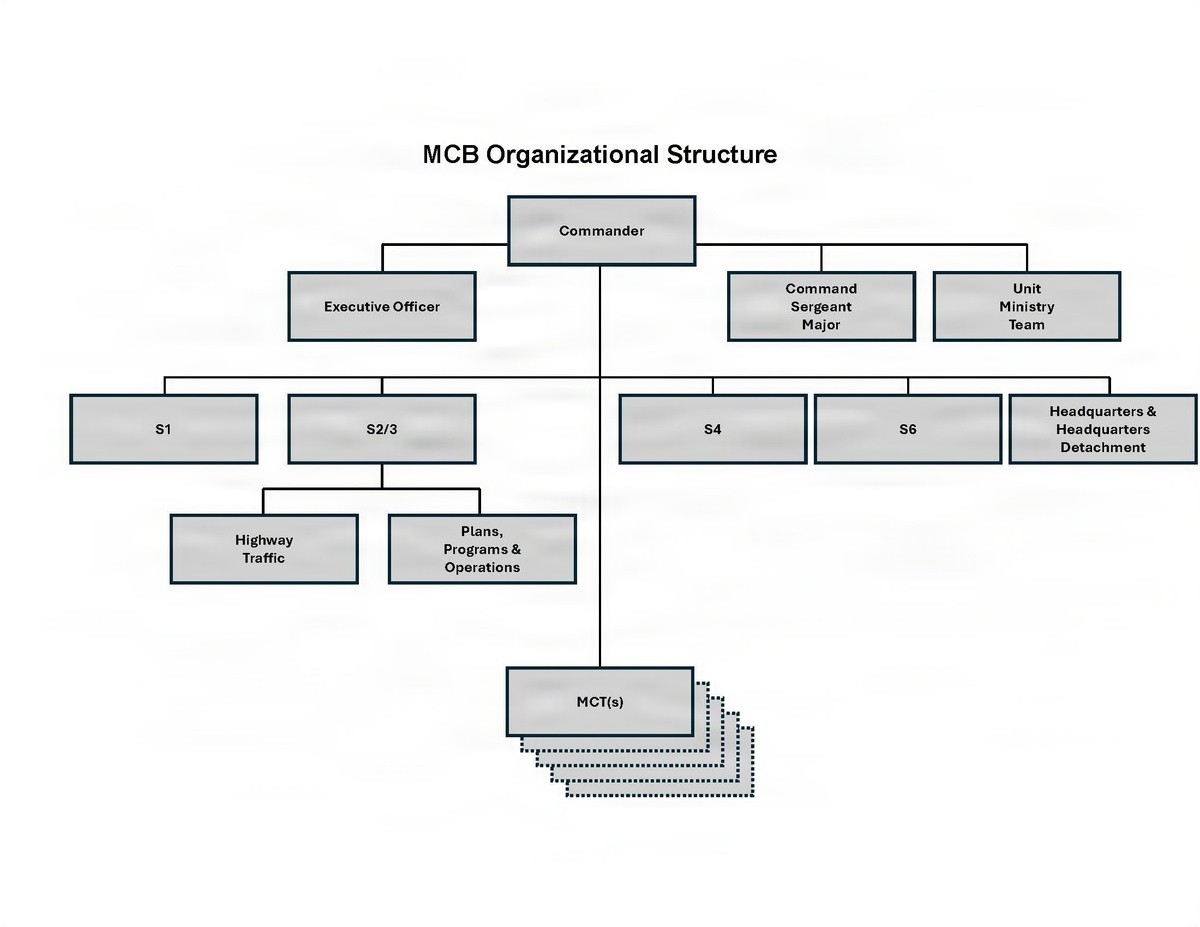
Figure 1. Movement control battalion organization.

Figure 2. Combat sustainment support battalion staff.
The battalion faced two operational questions:
- How to fill critical specialty manning gaps, or substitute the skills required using an MCB MTOE, in a mission designed for a DSSB?
- How to rapidly form a cohesive team with newly attached companies during reception, staging, onward movement, and integration (RSOI) before going into The Box at NTC?
Improvising Structure: Learning the DSSB Mission
Before deploying to Fort Irwin, the battalion began by focusing on adapting the structure of the MCB headquarters staff at home station. A structural focus enabled the battalion staff to understand what gaps it had compared to a DSSB. To bridge identified structural and doctrinal gaps, the MCB conducted leader professional development (LPD) sessions on DSSB organization and support operations (SPO) processes. Internal leaders with DSSB and SPO experience took the lead on training the staff. While these LPD sessions were instructor led, they were also discussion heavy to gain comprehensive understanding of how a DSSB staff functioned. A major insight gained during the discussions was that the MCB must consider the role that a DSSB plays at NTC. The question was: What would the 49th MCB be required to do at NTC as the division echelon of support? The question was not: How can the 49th MCB recreate the entirety of a DSSB staff structure without operational context? This reframing allowed for optimization and efficiency in manning. While specific manning and expertise gaps would need to be addressed, many would not.
The LPDs were followed by a three-week command post exercise (CPX) at Fort Hood that used real garrison sustainment tasks as a simulation within the exercise. The command added injects that demanded the command post jump several times, react to enemy drones, and receive reports from convoys on distribution missions. In this CPX, the MCB bifurcated its S-3 and dedicated half the manning to SPO. The benefit was that SPO delved into planning for fuel, maintenance, and Class IX parts deliveries. In the end, the CPX trained the staff on critical sustainment planning skills necessary to establish the muscle memory needed for NTC and further solidified contentions from the LPDs that manning from outside of the organization must be sourced.
When the MCB arrived at NTC, it applied the operations process (plan, prepare, execute, and assess) just as it would for movement control operations. The staff adapted the same thought process to a sustainment battalion framework to enable the tracking of commodities for the supported battalions in BCT, which would not be normally tracked by the MCB. During RSOI, requirements arrived quickly and simultaneously: tracking incoming personnel, managing rail and line-haul operations, overseeing equipment draw and issue, and running a new untested battle rhythm. To synchronize efforts, the MCB integrated the newly received company command teams into the military decision-making process (MDMP). Companies are usually the beneficiaries (or victims) of the output of MDMP rather than a part of the process. Bringing the companies in (a necessity for the shortened planning timeline) ensured shared understanding of staff functions, timelines, and intent. Later in operations, this enabled mission command, where companies could make tactical decisions with a complete understanding of the commander’s intent. The newly received companies also brought expertise to the MCB that it needed to function as a DSSB. Once in The Box, the borrowed manning and expertise (fuel, ammunition, maintenance, etc.), was returned to the staff.

Figure 3. Staff activities of focus during RSOI and force-on-force at NTC 26-01 for 49th DSB.
Improvising Teamwork: Building a DSSB on the Fly
RSOI planning quickly evolved into full sustainment operations with an emphasis on planning and preparation. The MCB deeply integrated the company command teams with the newly altered staff, and forced shared experiences through MDMP, rehearsals, and the battle rhythm to establish a unity of effort. The following eight products developed in the RSOI phase proved to be key throughout the operation, especially during the MDMP:
- Base order.
- Logistics synchronization matrix.
- Execution checklist to measure convoy timeliness.
- Convoy tracker.
- Decision support/authority matrix.
- Digital and analogue operations graphics.
- CULT report.
- Running estimates of consumption and capacity.
Once in The Box, the battalion adjusted its battle rhythm events to better align with the immediate needs of executing and assessing real operations — moving the battle update assessment (BUA) to later in the evening. Since this was the first time the battalion functioned together in the field, the command emphasized frequent communication and adaptable processes.
The battle was in constant evolution, and frequent updates mitigated the risk of decision-space being squandered. The commander’s update assessments, BUAs, operations synchronizations, and command team huddles were tailored in flight to prioritize real-time adjustments, creating a fluid exchange of information and fostering faster decision making that drove execution and assessment. This battle rhythm kept priorities aligned, even with an undersized staff. The battalion commander used each forum to restate intent (purpose, key tasks, and end state), ensuring clarity and creating disciplined initiative across the formation. During events, the battalion staff refined each forum and altered how information flowed to ensure company actions aligned with evolving requirements.
Improvising Expertise: Filling Gaps with Ingenuity
During the rotation, the MCB reorganized the staff to form an ad-hoc sustainment operations section. The S-3, entirely manned by 31A Military Police, 88N Transportation Management Coordinators, and 90A Logistics Specialists, provided the bulk of the personnel. The S-4 provided visibility of internal and external capacity by developing an external logistics status and CULT report. The battalion also leveraged expertise from attached units:
- 664th Ordnance Platoon (Fort Bliss) for ammunition operations.
- 142nd DSSB (Fort Bliss) for fuel management.
- 96th Heavy Equipment Transporter Company (Fort Hood) for materiel management proficiency.
- 86th Expeditionary Signal Battalion (Fort Bliss) for connectivity.
- 153rd Field Feeding Company (Fort Bliss) for field feeding expertise.
This mosaic of skills exemplified true improvisation. Soldiers and leaders stepped outside their normal roles to meet the mission guided by the philosophy often attributed to Steve Harvey: “Be comfortable being uncomfortable.”
Improvisation Redefined
The 1/1 AD had a very successful NTC rotation in its victory over Black Horse. Logistics and sustainment were considered big wins, and the lines of communication extended further into the east-west rotation than one would normally see. Not a single battalion ran out of fuel, went hungry for a meal, or went without water. The 49th MCB played a large role in the brigade’s success. The ad-hoc DSSB kept the supply trains running on time, and the headquarters displaced multiple times with no interruptions in support by staggering jumps over two days. In addition, the battalion was able to protect itself from drone attacks using counter-reconnaissance and a quick reaction force. The observer controllers noted that they had not seen a DSSB protect itself so well in years.
The bottom line is that the logistics community’s interpretation of FM 4-0’s definition of improvisation, acting at the tactical level to meet a changing OE, is too small and does not fully capture what modern sustainment units must do. We would be better off looking to other doctrine. Army Doctrine Publication (ADP) 6-0, Command and Control, offers a broader lens: “Army forces continue to make decisions and act in the absence of orders, when existing orders no longer fit the situation, or when unforeseen opportunities arise.” By this measure, the 49th MCB’s experience at NTC 26-01 was improvisation at its finest. The battalion transformed itself from a movement control headquarters into a functioning, and expeditionary, DSSB. It built new processes, trained beyond its military occupational specialty expertise, and successfully led unfamiliar units through a complex sustainment mission. The MCB not only adapted but reinvented itself in real time.
As the Army faces increasingly dynamic OEs, this kind of improvisation will be essential. The 49th MCB’s success must challenge the sustainment community to expand its own definition of improvisation, not as a tactical reflex, but as an organizational art form that keeps the Army moving, supplied, and ready for the next fight. The Army must adopt the art of improvisation as a core competency, and units must stop training for the perfect and start training for functional fluidity.
--------------------
LTC Carl S. Miller serves as the battalion commander for the 49th Transportation Battalion stationed at Fort Hood, Texas. He commissioned through OCS and is a graduate of the Advanced Military Studies Program at the U.S. Army’s School of Advanced Military Studies. He has a Master of Science degree from the University of Phoenix and Master of Arts degrees from Liberty University and the U.S. Army’s Command and General Staff College.
CPT Zachary P. Rardon serves as an operations officer with the 19th Expeditionary Sustainment Command stationed at Camp Henry, Korea. He was commissioned through OCS and has completed both the Basic Airborne Course and the Captains Career Course. He holds a Bachelor of Science degree and a Bachelor of Arts degree from Winthrop University.
--------------------
This article was published in the fall 2026 edition of Army Sustainment Professional Bulletin.
RELATED LINKS
Army Sustainment on Line of Departure
---------------------------------------------------------------------------------------------------------------
Social Sharing