


CAMP SMITH TRAINING SITE, Cortlandt Manor, N.Y. — More than 1,200 New York Army National Guard Soldiers and 275 military vehicles assigned to the 369th Division Sustainment Brigade maneuvered across five states by highway and cargo aircraft during Operation Sustain Thunder, the brigade’s annual training exercise.
The two-week exercise moved troops and heavy trucks from home armories across New York to Fort A.P. Hill, Virginia, validating the brigade’s readiness to mobilize on short notice and keep the Troy-based 42nd Infantry “Rainbow” Division supplied during combat.
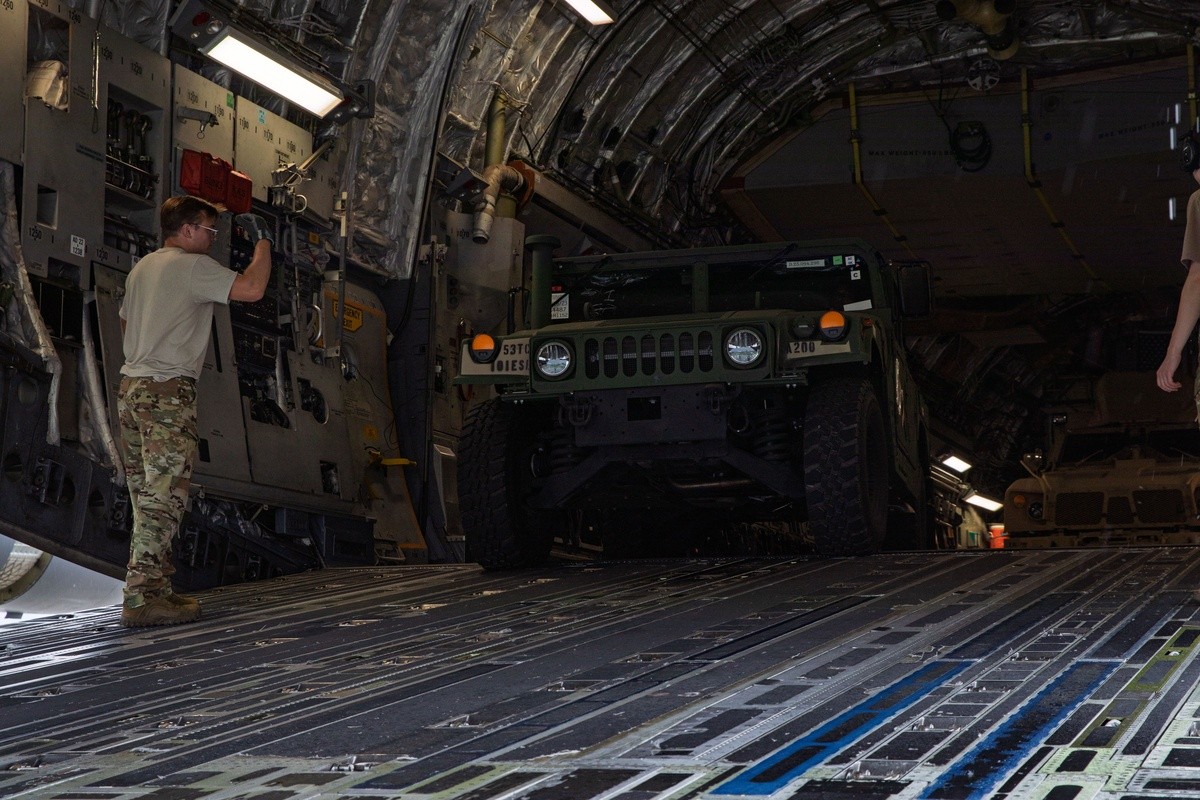
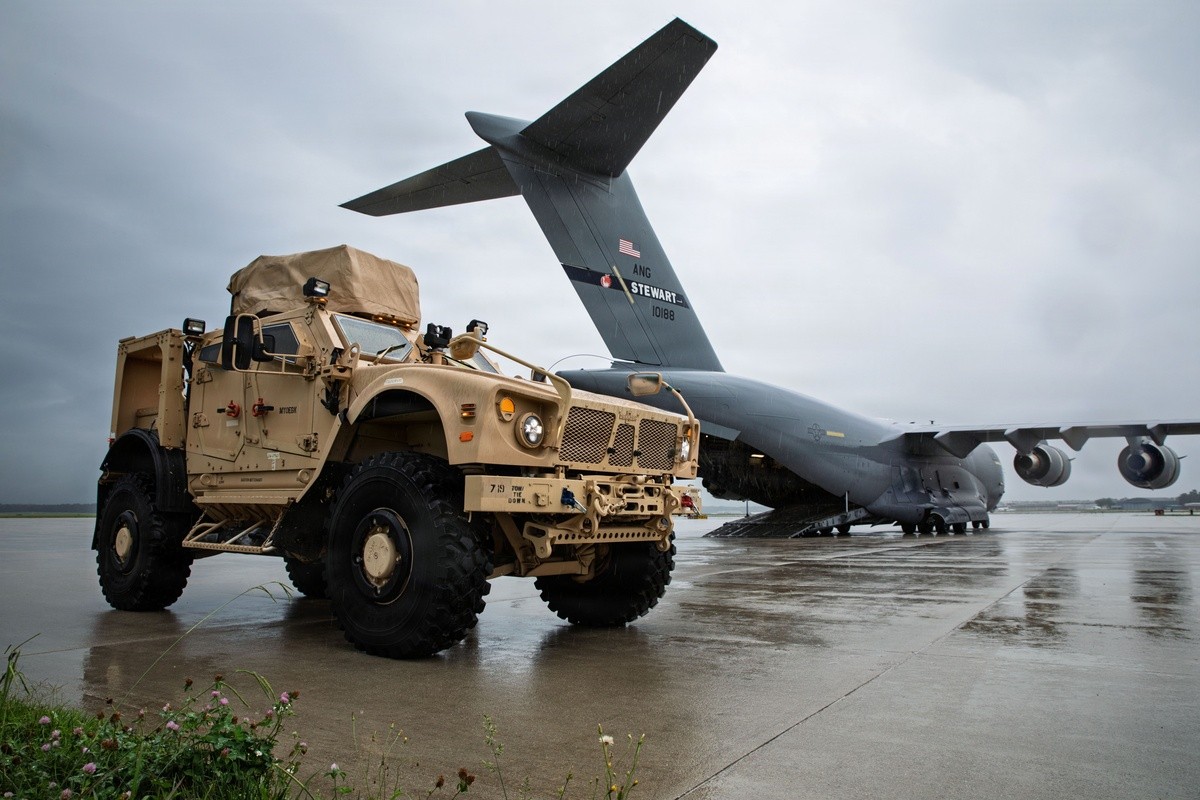
The multistate movement combined long-distance road convoys with strategic airlift conducted in partnership with the New York Air National Guard’s 105th Airlift Wing, based at Stewart Air National Guard Base in Newburgh. Aircrews flew six C-17 Globemaster III missions to transport heavy trucks and support teams.
“It was an incredibly proud moment seeing 18 months of planning culminate in moving 1,200 Soldiers and over 275 vehicles from New York down to Fort A.P. Hill,” said Lt. Col. David Myones, who directed airfield operations. “Working with C-17 cargo planes shows why teaming up with the Air Force is so vital.”
Myones said air integration gives combat commanders maximum operational flexibility.
“In high-intensity combat, our brigade has to deliver fuel, clean drinking water, ammunition, and replacement parts across land, sea, and air,” Myones noted.
The joint airlifts provided hands-on experience for flight planners preparing military vehicles to meet strict Air Force flight regulations.
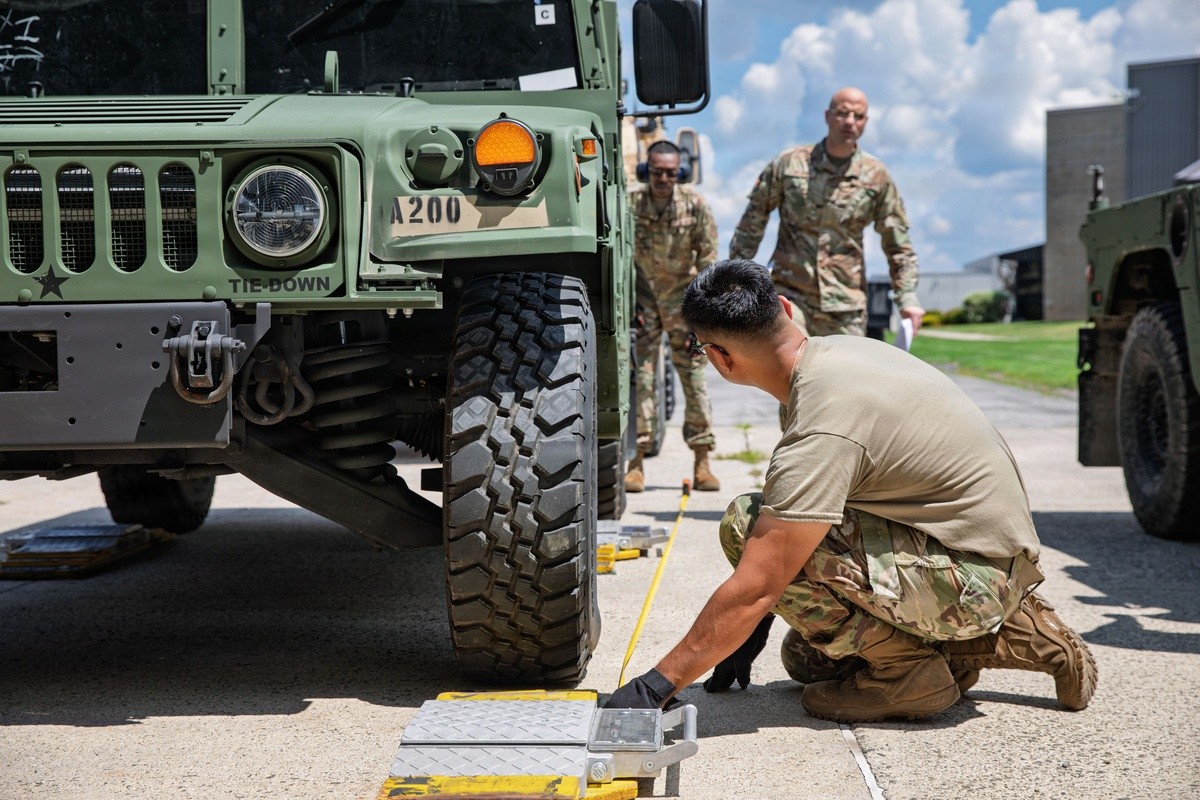
“Moving Army trucks by air takes far more planning than just driving to the runway,” said Warrant Officer 1 Robert Bassett, a brigade mobility warrant officer. “Every vehicle must meet strict size and weight limits.”
Bassett said technical inspections require meticulous preparation before vehicles can board.
“We have to verify fuel levels, balance hazardous materials like vehicle batteries, and calculate exactly where each vehicle sits inside the cargo hold so the plane flies safely,” Bassett noted.
Bassett worked closely with Air Force air transportation specialists and flight loadmasters during joint inspections, using the live flights to mentor junior transportation management coordinators.
“What I’m most proud of is the real-world experience our junior transportation specialists gained,” Bassett said. “In our home brigade, we are surrounded by seasoned logisticians who can answer questions.”
Bassett said junior Soldiers must be prepared to operate independently on future battlefields.
“As these young Soldiers advance, they may be sent to an isolated battalion where they are the only transportation expert on site,” Bassett noted. “Giving them these realistic repetitions now builds the confidence they need to advise commanders and solve complex shipping puzzles under pressure.”
While cargo aircraft departed Stewart Air National Guard Base, the brigade’s road units executed one of the largest vehicle movements mounted by the New York National Guard in recent memory.
Capt. Marconi D’Auria-Gupta, commander of Charlie Company, 119th Division Sustainment Support Battalion, guided 40 tactical trucks organized into four travel groups along a 486-mile route traversing five states.
“Charlie Company’s road movement required months of mechanical preparation, borrowing supplemental fleet vehicles, and mapping detailed highway routes,” D’Auria-Gupta said. “We managed 40 heavy trucks in busy civilian traffic on Eastern Seaboard interstates, shared commercial truck stops for diesel refueling, and handled our own towing and mechanical repairs on the road.”
D’Auria-Gupta said driver safety remained the overarching priority during the long transit.
“We safely and efficiently managed Soldier rest cycles while conducting a massive convoy along the eastern coast,” D’Auria-Gupta noted.
Coordinating hundreds of heavy military vehicles across crowded public highways required continuous tracking by the brigade’s movement control cell.
“Movement control centers are where road plans meet real-world highway traffic,” said Maj. Yancey Reynoso, who directed the control cell. “Convoys encounter traffic delays, radio dead zones, and occasional mechanical breakdowns.”
Reynoso said proactive tracking prevents small problems on the road from becoming operational failures.
“Our job is tracking vehicle locations, planning alternate detours, and coordinating breakdown support immediately so a stalled truck never stalls the overall mission,” Reynoso noted.
Upon arriving at Fort A.P. Hill, the brigade established a full division support area, a sprawling field logistics hub supplying fuel, water, ammunition and medical support to fighting units.
Soldiers worked through extreme summer heat, conducted night driving with night-vision goggles, tested long-range radio networks and defended their perimeter against simulated ground attacks.
Col. Bryon L. Linnehan, commander of the 369th Division Sustainment Brigade, said the exercise demonstrated the historic Harlem Hellfighters’ ability to rapidly mobilize, protect themselves and sustain fighting units across great distances.
“Our consolidated annual training at Fort A.P. Hill gave Hellfighters the chance to prove our expeditionary capabilities in a tough, realistic setting,” Linnehan said.
“By moving troops by air and road with our Air National Guard partners, we sent a clear message that the 369th is ready to support the 42nd Infantry Division anywhere in the world,” he added.
Linnehan said the training also highlighted the importance of partnerships with allied nations. Representatives from partner nations, including Sweden, were invited to observe the brigade’s complex, large-scale combat operations training.
Social Sharing