

BEMOWO PISKIE TRAINING AREA, Poland - U.S. Army Capt. Harold McMurrin quickly stood out in the Field Artillery Squadron (FAS)\, 2d Cavalry Regiment (2CR)\, for his technical skills and innovative ideas. As commander of the Launched Effects “Demon” Battery\, he was tasked with building the unit from scratch and introduced advanced\, unmanned aerial systems — remotely piloted aircraft with cameras and sensors — to the regiment. His experience\, leadership\, and vision have placed the Launched Effects Battery at the center of the Army’s modernization efforts.
“He’s got a long, varied background… very smart, very growth-minded,” U.S. Army Lt. Col. Steven Huckleberry, commander, FAS, 2CR. “Giving him this ambiguous problem set and creating a new capability that fills a gap — he’s the right person for this.”
Huckleberry said McMurrin was hand-selected six months ago to form and lead the unit, tasked with implementing multiple unmanned armed systems within 2CR’s FAS.
McMurrin graduated from the Cavalry Leaders Course and served as a squadron fire support officer (FSO). He brings reconnaissance, armor, and fire support experience. This mix helped him build a functional battery from limited equipment and an ambiguous mission set.
Throughout the combined-arms live-fire exercise during Saber Strike at the Bemowo Piskie Training Area (BPTA), Poland, McMurrin was seen testing drones with his team, conducting arms rehearsals and moving between the tactical operations center (TOC) and the field.
These early actions highlighted McMurrin’s hands-on approach and commitment to integrating advanced technologies into real-world training. His visible leadership during Saber Strike not only demonstrated the potential of UAS in a dynamic environment, but also set the tone for how Demon Battery would operate under his command.
His unique role — possibly the only one in the Army — means he wears two hats: commanding the launch effects battery and, filling a staff position in the TOC, managing the regiment’s firefight as the assistant FSO.
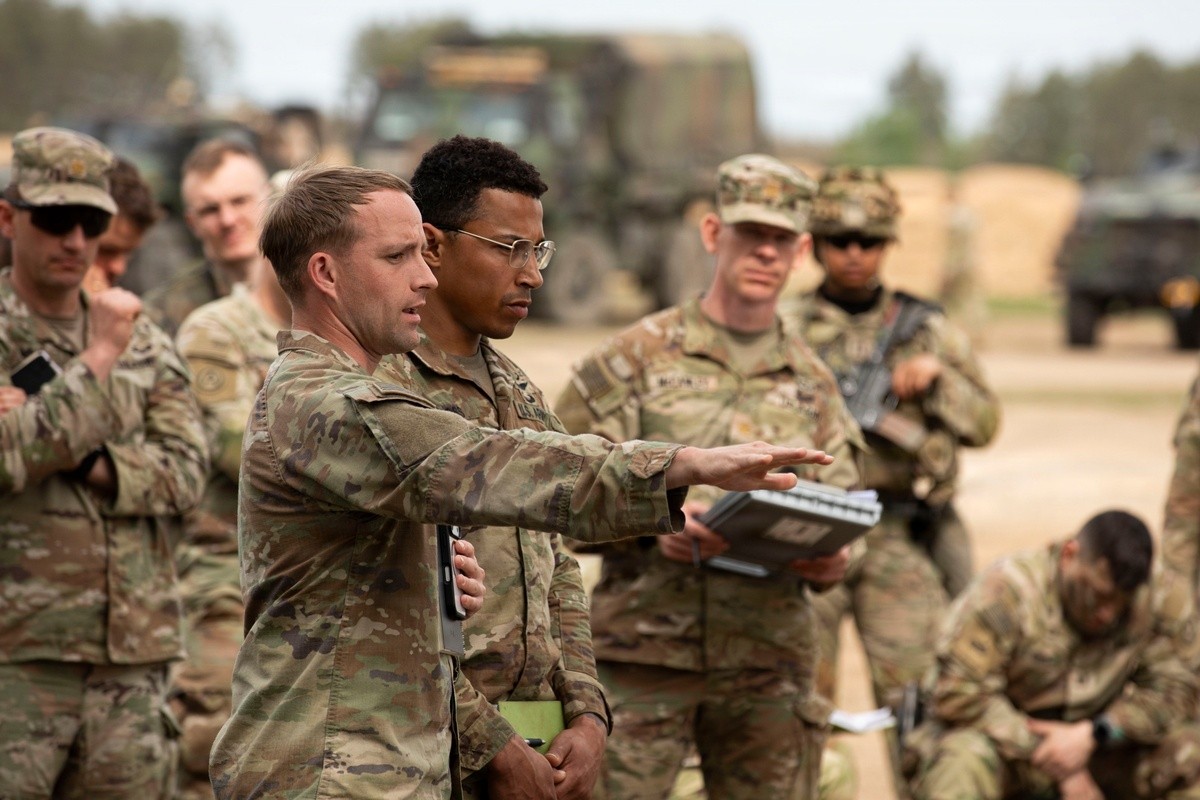

during prerehearsal for the Combined Arms Rehearsal part of the Saber Strike exercise on May 4, 2026 at Bemowo Piskie Training Area, Poland. From April 27 to May 31, 2026 U.S. and Allied forces will exercise NATO’s Eastern Flank Deterrence Initiative, demonstrating NATO’s ability to fight and win on the modern battlefield. Nearly 15,000 troops from eleven nations will train across the High North, Baltic region, and Poland, executing rapid maneuvers, air defense, counter-drone operations, and cyber defense to validate NATO’s regional defense plans in real time. This series of linked exercises, including Saber Strike, Immediate Response, and Swift Response, turns investment into capability. Soldiers integrate unmanned systems, AI-enabled command and control, and live data networks to move faster, decide faster, and fight more effectively across all domains. Sword 26 demonstrates how U.S. Army Europe and Africa drives transformation at scale while strengthening deterrence. Together with our Allies, we are building a unified, lethal force ready to defend NATO territory and respond to any threat. (U.S. Army Reserve photo by Staff Sgt. Emilie Lenglain) VIEW ORIGINAL
McMurrin’s path into field artillery is a family tradition. Both his mother and father served as field artillery officers, and he has served for eight years in the Army. He held prior jobs as a biologist and a truck driver before committing to a career in the military.
He participated in exercise Saber Strike, a multinational training event, while his first sergeant and other Soldiers of the battery took part in Project Flytrap 5.0, a joint initiative at the Pabradė Training Area, Lithuania.
Launched Effects Battery’s first sergeant, 1st Sgt. Mohammad Bihamta said, “Capt. McMurrin is a key contributor to the regiment’s success during Saber Strike 26 and Flytrap. His ability to connect teams, systems, and capabilities across the formation ensures Demon Battery delivers effects that directly support the regiment’s mission. He thrives in complex environments. He leverages relationships and a persistent, solutions-oriented mindset to overcome friction and maintain momentum.”
Across the regiment and U.S. Army Europe, launched effects batteries like "Demon" Battery and another in the 25th Infantry Division are among a growing number of units experimenting with UAS integration in field artillery.
McMurrin stated that the work done during Saber Strike and associated experiments helps shape standard operating procedures and informs how emerging technologies will be employed in future engagements.
Both Project Flytrap and Saber Strike, part of Sword 26, are exercises that turn investment into capability. Soldiers integrate unmanned systems such as AI-enabled command and control and live data networks to move, decide, and fight more effectively across all domains. Sword 26 demonstrates how U.S. Army Europe and Africa drives transformation at scale while strengthening deterrence.
Thanks to McMurrin’s dedication and strong communication skills within the battery, the Launched Effects Battery demonstrated precision during Saber Strike. In just six months since creation, they used several types of reconnaissance drones: medium, long-range, short-range, and a few first-person-view drones. This showcased the battery’s strength and versatility.
“UAS provides the Soldier on the ground the ability to look further than ground-based sensors have — so further than their binoculars, their mark-one eyeball (eyes), the sights on their weapons, and other sensors that they carry on their person,” said McMurrin. “It lets them go further; it lets them naturally go beyond terrain that would block their view — the other side of a hill, the other side of a wood line — and it lets them see the enemy before the enemy can gain ground and observe them.”
His role as commander of the battery is essential to providing this type of support to the troops of the Field Artillery Squadron of the 2nd Cavalry Regiment.
“The regimental operating concept is to be able to deploy and fight upon arrival,” McMurrin said. “Training in Poland and Lithuania simulates the conditions the regiment could face if employed in crisis, whether for deterrence, presence, or combat operations.”
Social Sharing