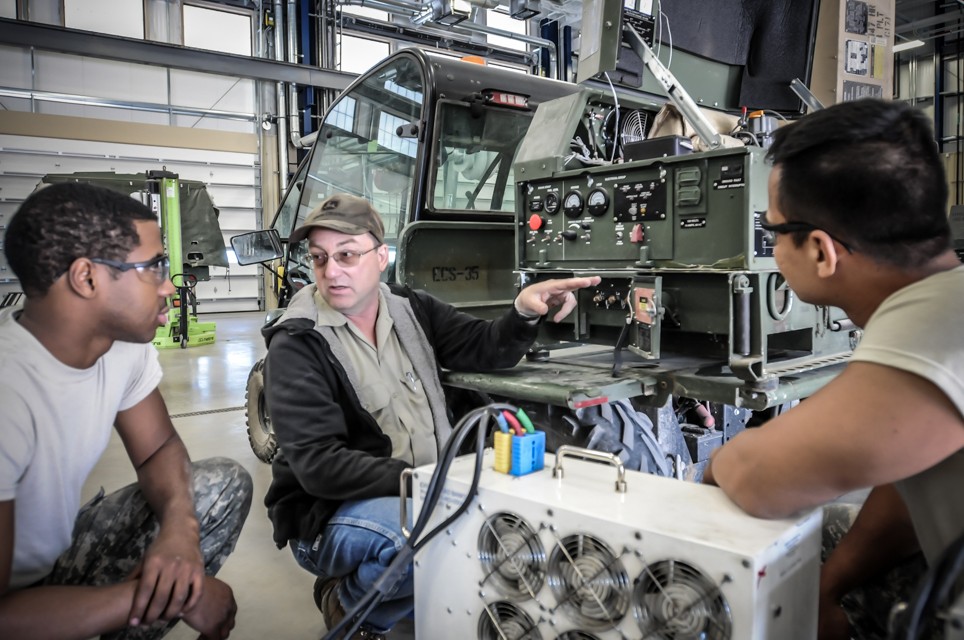
There is considerable debate over the future of the Army's reserve component structure and on-going questions about how budgetary constraints and force structure changes will affect our industrial base. Because most of our logistics infrastructure is in the reserve component, any changes to force structure, dollar resourcing, or the industrial base will immediately create challenges.
Developing and establishing innovative partnerships with small businesses within the nation's industrial base is critical to retaining equipment readiness and maintaining the functional expertise of reserve component Soldiers that is necessary to the military's future success during deployments.
OBSTACLES TO MAINTAINING EXPERTISE
Our principal challenge is figuring out how to maintain the wealth of experience now serving in the reserve component. Our reserve force is no longer strategically configured; through repeat deployments, it has transformed into an operational force that is trained and ready to respond to the nation's needs.
While withdrawing forces from the battlefield, reserve component formations directly confront a staggering array of resource, time, and personnel challenges. Soldiers want to remain technically relevant in their military occupational specialties. They want to be engaged, challenged, and have the opportunity to routinely participate in relevant training.
Some of the challenges faced by reserve component units in accomplishing relevant training are time, distance, and equipment and facilities shortfalls.
TIME. Most reserve component Soldiers have limited days per year to participate in active-duty training. Realistically, only a small number can afford to leave their civilian jobs once a year to train for three to four weeks. It is simply not realistic to assume that a meaningful number can engage in such training numerous times per year.
Here is today's challenge: the active and reserve components must train together extensively to ensure battlefield success. Army leaders mandate that reserve component personnel satisfy the same annual requirements as their active duty counterparts including weapons qualification, nuclear, biological, chemical instruction, personnel update activities, and diversity and sensitivity classes. Numerous administrative actions also fill their monthly training calendars.
As a result, Soldiers may not find much time to exercise their military occupational specialties during battle assemblies. And there is little time for senior staff to coordinate, communicate, and function in ways that prepare them for the highly stressful environment they will face during deployment.
DISTANCE. Also detrimental to training is the reality that most of our unit facilities are far from regional training centers. Even when facilities are close, training time for actual mission skills still is limited. How often can an engineer bridging unit deploy its equipment across a ravine and have it tested by a common vehicle or tank? Units are often unable to practice such skills even during extended training.
EQUIPMENT AND FACILITIES SHORTFALLS. Redeploying units return to a less than full complement of rolling stock. The remaining equipment is being staged at reserve centers instead of with the units that use them. It is hard for a military police organization to create simulated and realistically rehearsed convoy operation without a full equipment set.
Reserve facilities may not offer adequate space to conduct engineer, maintenance, or warehousing activities either, leaving logistics units looking to ways to practice warehousing operations.
OVERCOMING CHALLENGES
So what steps can our operational reserve forces take to retain the experience acquired in our most recent conflicts and keep reserve component Soldiers focused and engaged in their duties? The Army needs to seek inventive ways to employee these Soldiers to ensure that they are ready to meet the requirements outlined in our nation's defense strategy.
An approach that begs to be explored is expanded partnerships between the reserve component and functional private-sector organizations. Such partnerships can grow in a variety of locations and ways.
Almost 15 years ago, reserve forces realigned in the Northern Rust Belt. The Army Reserve relocated its railroad battalion closer to the metropolitan Chicago rail yards thereby enhancing access to live rail operations. The move bolstered real-time equipment use and personnel training for yard crews, engineers, and administrative staff. This relocation also was instrumental in identifying qualified engineers and those interested in railroading with the Army Reserve.
In an August 2012 article by Maxford Nelson, "Public-Private Partnerships Offer Smart Alternative to Sweeping Defense Cuts," in "The Daily Signal," he writes, "One way to improve the defense budget is through partnerships between the military and private industry. Public-private partnerships are part of a larger approach known as performance-based logistics, which seeks to improve efficiency in defense projects by focusing on outcomes."
Nelson provides an example where the Anniston Army Depot and General Dynamics Ground Systems teamed up to repair Stryker vehicles. The Lexington Institute's Loren B. Thompson calls it a "model of efficiency."
How can we enhance more logistics opportunities for the bulk of our infrastructure as we move forward? The Army could create an environment where reserve logistics warehousing units partner with a private-sector logistics organizations. Envision an aviation maintenance unit repairing turbine engines on an assembly line in a private- sector facility alongside civilians. Together they would support the logistics entity and the government need for those engines.
WHY NOW?
Our industrial base is in a critical state. As forecasted, contractual work reductions continue. Some small businesses owners fear their facilities will face closure. Our logistics footprint at the small business level is vital to our nation's major industries who count on small business for unique major materiel support. If lost, small business technical know-how will be hard, if not impossible, to regenerate.
The tactic to prevent this loss is to award defense supply support-related contracts that create partnerships between military and private businesses. In this environment, our reserve components could reap benefits to include stable employment.
As part of the partnership, the contractual arrangement would establish job rights, eliminating Soldiers' concerns over their civilian employment. Once home they would merely exchange their military uniforms for civilian clothing and return to work. The military-corporate partnership would have a fully staffed, year-round support group for deployed Soldiers and their families.
This partnership would be designed to yield quality workers within the military unit and the private sector. Providing logistics Soldiers the opportunity to work in the same environment during battle assemblies and routinely as a civilian would add to their expertise and broaden their skills and upward mobility potential. This arrangement would enhance those who stay in the force, build the capacity and skills of all partners, and present a stable economic outcome for the military workforce.
THE SPECIFICS
Critical processes must be in place first in order to launch this partnership. The military establishment needs to designate logistics functions that fit, identify private-sector partners, and approve a detailed memorandum of agreement (MOA). The concept will need to be tested under various scenarios over an extended period that includes times when reserve members are deployed.
FACILITIES. The concept is designed to partner reserve logistics units with private-sector small businesses over the full spectrum of logistics services. For example, if the contractual work was repair or refurbishment of a number of turbine engines for aircraft or tanks, the Department of Defense and the corporate entity would establish the required assembly lines in its facility.
These assembly lines would be manned by reserve component Soldiers. During unit training drills, the work may include repairs on the government-contracted turbine engines at the private-sector facility.
Routine activities that occur during drill assemblies would be done on site as well. Businesses will need to adjust some existing operations and facilities in order to accommodate military needs. In partnership, the two separate organizations would agree to standards based on regulatory guidance, policies, and other agreed-to-authorities specified in the MOA.
MANNING. In the early 2000s, the Army restructured its logistics infrastructure at the theater headquarters level by integrating active and reserve component Soldiers. This composite modified table of organization and equipment was valued for its capability to rapidly respond to crises. The trained and ready force reduced active duty requirements and yielded seasoned reserve logisticians and other supply and support efficiencies.
The unit manning infrastructure for military-private sector partnerships would be similar to that of a multicomponent military organization. Under a Department of Defense directive, civilian and military personnel would be cross-leveled throughout the structure. Certain positions would be dual-hatted with flexibility built in to accommodate the contractual agreement.
Duties and responsibilities would be approved in advance through the proper military personnel channels, defense contract offices, and in agreement with the selected small businesses. Most of the activities agreed to in the arrangement would be outlined through routine regulatory guidance, policies, procedures, and processes. An umbrella contract gauged by a comprehensive MOA would serve as the management tool for each partnership.
MOA. Each MOA would be locally managed by a joint team of military and civilian personnel parallel chains of command that manage the critical aspects of each entity. Specified leaders would be permitted to exercise the authorities necessary to accomplish specific work within contractual agreements.
For example, this relationship would allow individual sections to maintain functional capability even while Soldiers are deployed. Based on the partnership, other reserve component Soldiers could be activated to supplement the private venture if it was working on a full or extended defense-laden contract during the deployment period.
A military and private-sector partnership is a winning proposition that would help decrease the chances of contracted businesses suffering when reserve component Soldiers deploy.
With skilled and dedicated leaders, this concept can work in any of our service components. Certainly the Army and its small business partners must cross barriers, determine roles, draft policies, and design and test models. But as each day passes, quality Soldiers are leaving the force because of a lack of productive growth and potential rewards.
The future operational environment requires that the defense establishment and the private sector work together to produce and service equipment within the industrial base in order to accomplish mission readiness. Partnering with small businesses can revolutionize our industrial base and our ability to retain experienced Soldiers in the reserve component. _____________________________________________________________________________________________________
Maj. Gen. (Ret.) George W. Wells Jr. served 35 years in the Army Reserve and was last assigned as the assistant deputy chief of staff, G-4, for mobilization and training. He is now a supervisory financial specialist with the Defense Finance and Accounting Service. He hold masters' degrees in international relations (from Salve Regina), public administration (from Ball State University), guidance and counseling (from Virginia State University), and physical education (from Indiana University). He is a graduate of the Army Command and General Staff College, the Naval War College, Air War College, Army War College, the National Defense University, and the National Security Studies Institute.
_____________________________________________________________________________________________________
This article was published in the September-October 2016 issue of Army Sustainment magazine.
Related Links:
Discuss This Article in milSuite
Browse September-October 2016 Magazine
Army Sustainment Magazine Archives
Social Sharing