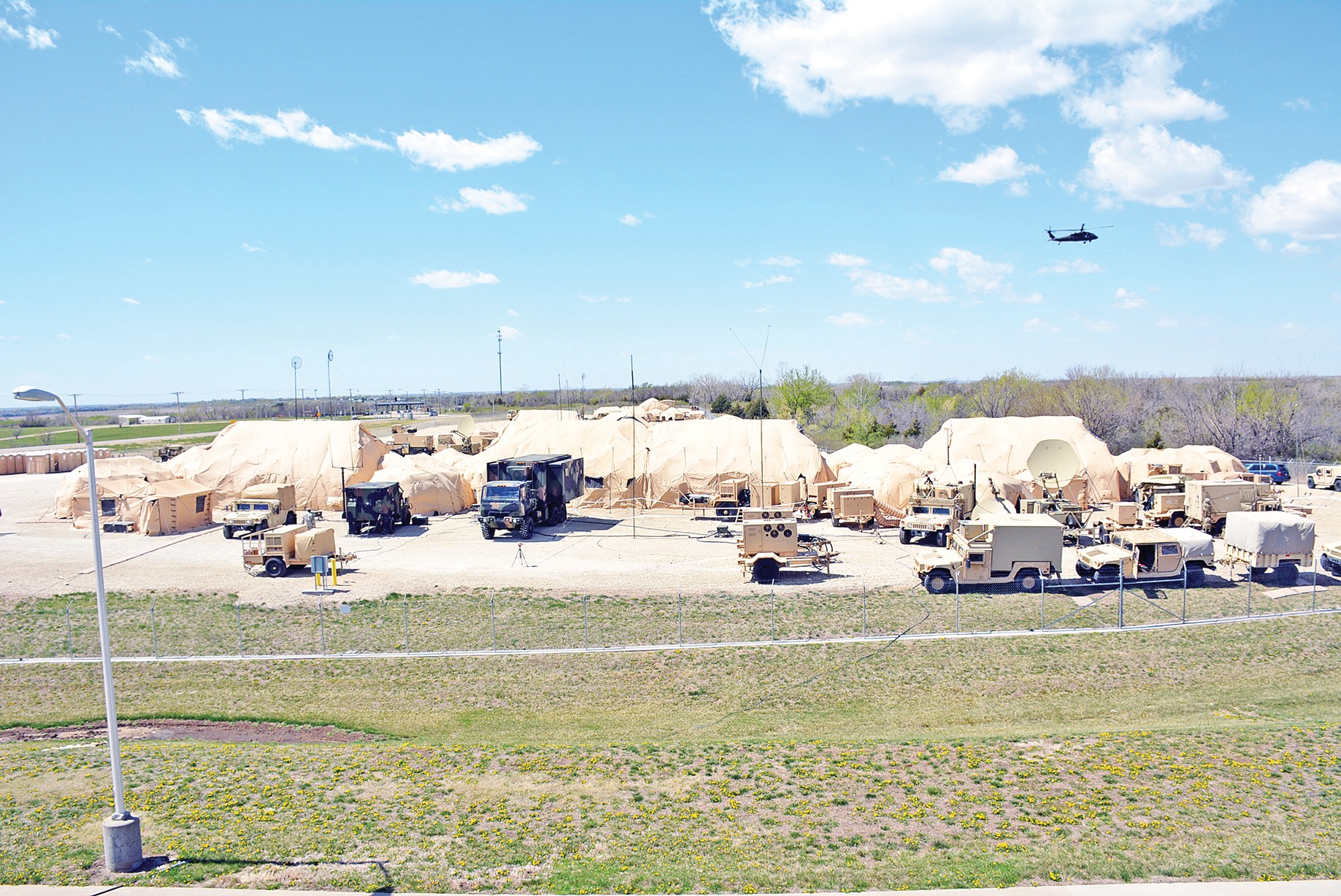
Nearly 60 people from the garrison civilian workforce supported the Warfighter exercise April 6 to 15 at Fort Riley -- five Department of the Army Fort Riley USAG civilians and 44 contractors.
The 1st Infantry Division at Fort Riley, as well as units -- active-duty, National Guard and Reserves -- from Florida, Missouri, Nebraska, North Carolina, Texas and Virginia, participated in Warfighter.
It was a significant training event a year in the making, an event of high priority and, in the end, one that exemplified the Total Army component of modern doctrine.
"This is the end of a year-long process for us," said Randy Curry, director of the Mission Training Complex. "A lot of our work went into preparing Fort Riley to conduct this exercise."
Virtually all of it took place using an elaborate computer-generated model, said Bill Raymann, chief of the Training Division, Directorate of Plans, Training, Mobilization and Security.
Its importance is heightened when viewed in light of the budgetary challenges all Army units and installations have faced in recent years. Much of Fort Riley's network infrastructure was in place before the most recent spate of budget restrictions occurred.
"We've been able to leverage that capability," Raymann said, "so that we can push these simulations out to the ranges."
The support from garrison also helped Fort Riley to reach beyond its fences and include other posts and units, an ability that allows the 1st Inf. Div. to involve regional partners for training that sharpens their fighting edge.
And it does so within budgetary confines. Raymann said the garrison's network infrastructure and simulation capabilities allowed realistic training to take place while conserving valuable resources particularly through the use of simulation.
Our Army isn't using its assets and equipment," he said, "and running them into the ground."
But Raymann added simulations would not take the place of training in the field with equipment. Leadership and skills still must be proven at the National Training Center in Fort Irwin, California, before any deployment overseas.
Warfighter, combined with a preceding series of Command Post Exercises developed by 1st Inf. Div. leadership, helps the division prepare for a kind of fight that is different from what the Army has been conducting in recent years. It is a fight based on high-intensity offensive engagements rather than counterinsurgency operations, said Maj. Gen. Wayne W. Grigsby Jr., commanding general, 1st Inf. Div. and Fort Riley.
"This is a computer simulation where I'm fighting a very aggressive enemy who has a lot of artillery and aviation," Grigsby said. "I've got to move the division about 300 kilometers and be able to destroy the enemy, and I've got to move while keeping the systems synchronized. It's more offensive, whereas in the past 12 years it's been defensive with counterinsurgency."
The aim of the Training Division's work is to create a meaningful virtual environment, Raymann said.
"We help the Soldiers believe they are actually fighting a battle in a faraway land," he said.
"We put in a lot of work since last fall," Raymann said.
The work has paid off.
"The garrison recognizes how important this is," said Maj. Matthew Derfler, Division Headquarters and Headquarters Battalion, 1st Inf. Div. "It's done a great job of supporting us."
But the support extended beyond 1st Inf. Div. to the other reserve and guard units participating in the exercise.
"This has been one of the best experiences we've ever had," said Command Sgt. Maj. Efrem Waller, the senior noncommissioned officer for the 300th Sustainment Brigade, 4th Sustainment Command (Expeditionary), U.S. Army Reserves, Grand Prairie, Texas.
He not only praised the training environment, but also the overall support his unit received from Fort Riley.
"Everything we've needed, we've received," Waller said. "Our Soldiers can focus solely on the mission, and that is very important for reservists, because we only have so much time to train."
The garrison staff provides the resources the warfighter needs for training.
"We could not do this without (garrison support) -- period," Grigsby said. "Because, remember: the 1st Infantry Division and Fort Riley are leadership factories. We build leaders all the time, both civilian and military. And we have the best civilian leadership team that I've ever been around in 32 years, right here at Fort Riley."
Social Sharing