Army logisticians must be ready to both project and support an expeditionary Army. We must be ready to execute expeditionary logistics from fort to port, port to port, port to foxhole, and beyond. We must focus our efforts on executing core missions to standard--missions that provide the base for everything else we do to support the warfighter. We must also be innovative and open to new ideas and new ways of doing things. And we must do all of this as part of a joint team.
While much work remains, we are making progress in our transition to an expeditionary force. What encourages me most is that the expeditionary improvements are leader led. I asked several notable leaders to share their insights about projecting an expeditionary force, and this issue of Army Sustainment is packed with beneficial information from leaders across the Army and the Defense Logistics Agency. They share thoughts on preparing to support combat operations that may be required at any time--tonight or 10 years from now.
My own recollection of an expeditionary Army dates back to 2001, before the wars in Iraq and Afghanistan, when the entire Army was geared toward being expeditionary. In the Army G-4 office, we are using the same mental framework that we used then ("from fort to foxhole") to analyze logisticians' ability to support an expeditionary Army.
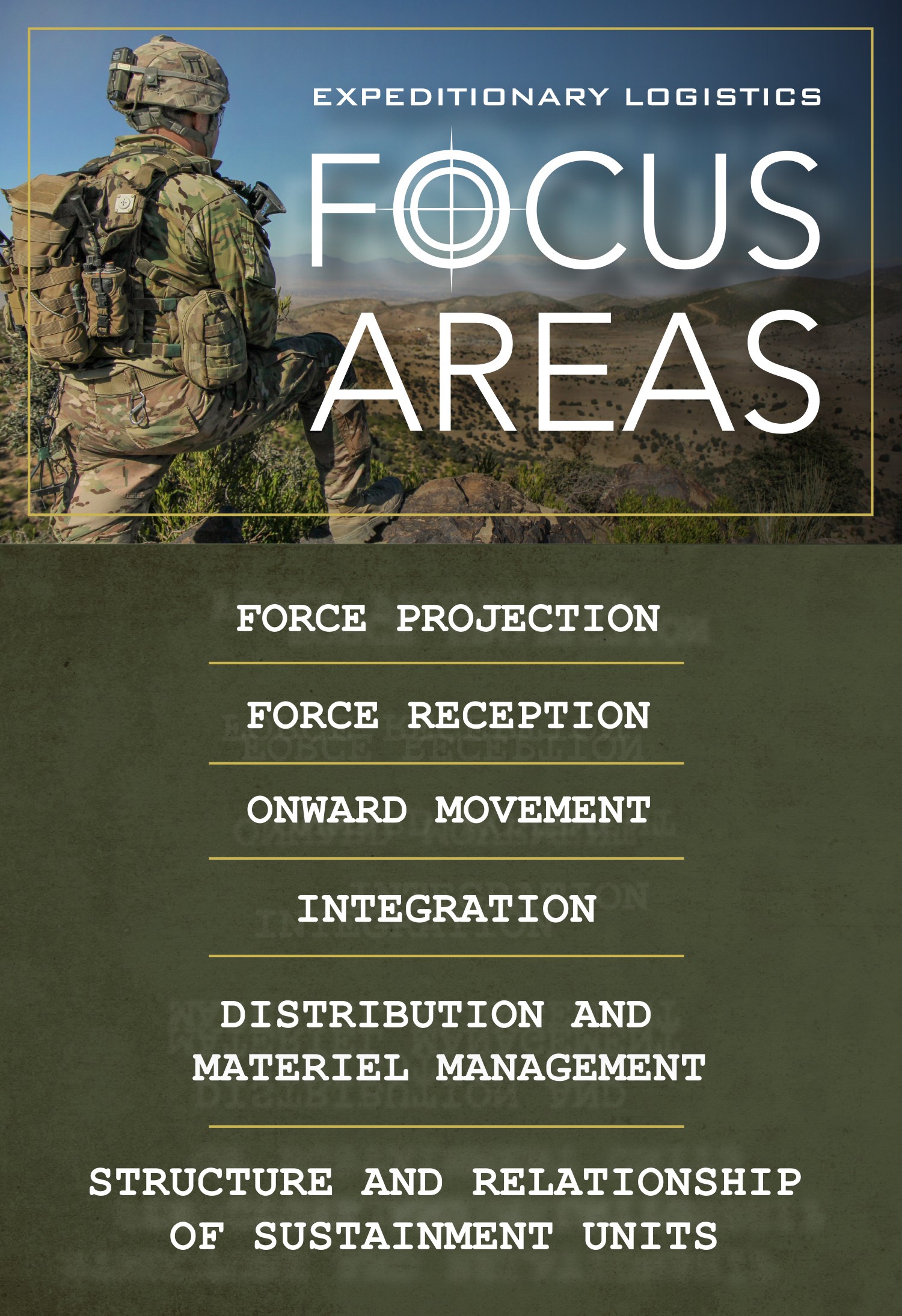
To give further structure to our analysis, we are focusing on these critical areas: force projection, force reception, onward movement, integration, distribution and materiel management, and the structure and relationship of sustainment units.
FORCE PROJECTION
From a strategic perspective, force projection is about the entire deployment enterprise (the "pipeline"). Units must be prepared to deploy, and installations must be ready to deploy them. Force projection is also about our ability to partner with the U.S. Transportation Command to ensure it is postured to provide enough strategic lift to get Army forces where they need to go in time to meet the combatant commander's requirements.
From an operational perspective, force projection is about understanding how to leverage appropriate units to conduct critical reception missions and to prepare seaports and airports to receive Army forces. Tactically, it is about units having all assigned equipment at 10/20 standard and being able to pack their own equipment and load it for movement by road, air, rail, or sea.
Since most of our Army is now based within the United States, the Army's ability to project the force relies heavily on its ability to move rapidly across great distances as opposed to maneuvering from nearby garrisons. One way these distances are mitigated is through Army pre-positioned stocks sets.
From a strategic perspective, the Army G-3 is ensuring we have the right equipment sets positioned in the right places. Operationally, the G-4 and the Army Materiel Command (AMC) are working to ensure our Army pre-positioned stocks sets mirror the equipment of the units that are likely to draw it.
The sets should mirror not only the units' modified tables of organization and equipment but also their nonstandard enabling equipment whenever possible. From a tactical perspective, AMC is enabling rapid employment by ensuring the equipment is maintained and ready to use.
FORCE RECEPTION
We know that the Army is tactically proficient at running large, well-established intermediate staging bases to support force rotations. Where we need more work is in our ability to work within a small, quickly established footprint. Operationally and tactically, we also need to work on our ability to overcome enemy anti-access and area-denial efforts by quickly opening ports in a contested environment long enough to deliver an effective combat force.
With nearly 80 percent of the Army's early-entry enablers in the National Guard and Army Reserve, we also need to ensure reserve units are trained and ready to join active units deploying with little notice.
ONWARD MOVEMENT
At the strategic level, freedom of movement across sovereign nations requires close coordination with our allies, partners, and local authorities, an understanding of local laws, and cooperation with the State Department.
The Army never does it alone; the next time we go somewhere, we will be operating in a joint, interagency, intergovernmental, and multinational environment. Consequently, we must understand and be prepared to leverage the capabilities of our sister services, other government agencies, allies, and partners.
We need to be able to quickly assess the operational environment to understand the capabilities of road networks, bridges, rail lines, and littorals. We need to understand the availability of commercial options for supporting logistics operations, and we need to determine the sustainment force structure required for planning, contracting, managing, and overseeing operational contract support.
Tactically, to limit external transportation requirements, our units must be able to move their own equipment to the greatest extent possible, and they must maintain proficiency in convoy operations. Our units must continue to work to ensure they can execute key battlefield logistics tasks, like refuel on the move.
Onward movement relies heavily on the transportation infrastructure, modes available, routes, host-nation support, and transportation support. Movement control capabilities play a critical role, providing commanders a mechanism to synchronize movements for deployment, redeployment, and distribution operations.
INTEGRATION
After the logistics processes discussed above have been completed, the operations process of integration occurs. As described in Army Techniques Publication 3-35, Army Deployment and Redeployment, this is the synchronized transfer of capabilities into an operational commander's force prior to mission execution.
While integration is G-3 centric, logisticians are nevertheless responsible for several tasks that are essential for making units ready to fight. Those tasks include ensuring ammunition is uploaded, enabling technologies are installed, and units and equipment are configured for combat.
DISTRIBUTION AND MATERIEL
The Joint Logistics Enterprise provides outstanding strategic distribution of materiel, which is essential in linking our nation's industrial might to the tactical level. However, for expeditionary deployments to logistically immature theaters, we have to be at the top of our game with centralized management and decentralized execution of materiel management and distribution.
Our theater sustainment commands (TSCs) play an essential role in this. Properly employed, a TSC serves as the centralized manager for all classes of supply except medical materiel. The TSC is also the distribution manager for the intratheater portion of our global distribution system. Through those two roles (among many others), TSCs can greatly increase our effectiveness and efficiency at sustaining combat forces in a theater of operations.
At the tactical level, I can already see some progress in reinvigorating materiel management. Since the assignment of sustainment brigades to their habitually supported divisions, I am seeing more sustainment brigades assisting brigade combat teams in materiel management areas like authorized stockage list management and turn-in of excess equipment.
This summer we will also begin providing every sustainment brigade with a class VII (major end items) materiel management capability. Every sustainment brigade support operations section will gain a 10-Soldier class VII materiel management section on their modified tables of organization and equipment by 2019. We will do a pilot test of this effort this summer. It is one small example of how we can decentralize materiel management execution and increase senior mission commander influence over their combat power generating capabilities.
SUSTAINMENT UNIT STRUCTURE
The Army's establishment of regionally aligned forces has helped set the framework for expeditionary sustainment operations. Nevertheless, the complexity of setting multiple routes, modes, and nodes and then receiving and sustaining large formations on short notice will still require teamwork from organizations at all levels. Our entire sustainment structure must stand up to the test when called.
Close partnerships at the strategic level among AMC, the Defense Logistics Agency, the Transportation Command, other services, and coalition partners will lead to shared priorities and a common situational awareness that will pay off when immediate action is required. Maintaining strong relationships through continual training and planning for operations, including early-entry support, will go a long way.
I am confident we have the determination and the right focus. With your help, logisticians can quickly deliver an Army ready for expeditionary missions.
_____________________________________________________________________________________________________
Lt. Gen. Gustave "Gus" Perna is the Army deputy chief of staff, G-4. He oversees policies and procedures used by 270,000 Army logisticians throughout the world. _____________________________________________________________________________________________________
This article was published in the March-April 2016 issue of Army Sustainment magazine.
Related Links:
Discuss This Article in milSuite
Browse March-April 2016 Magazine
Army Sustainment Magazine Archives
Social Sharing