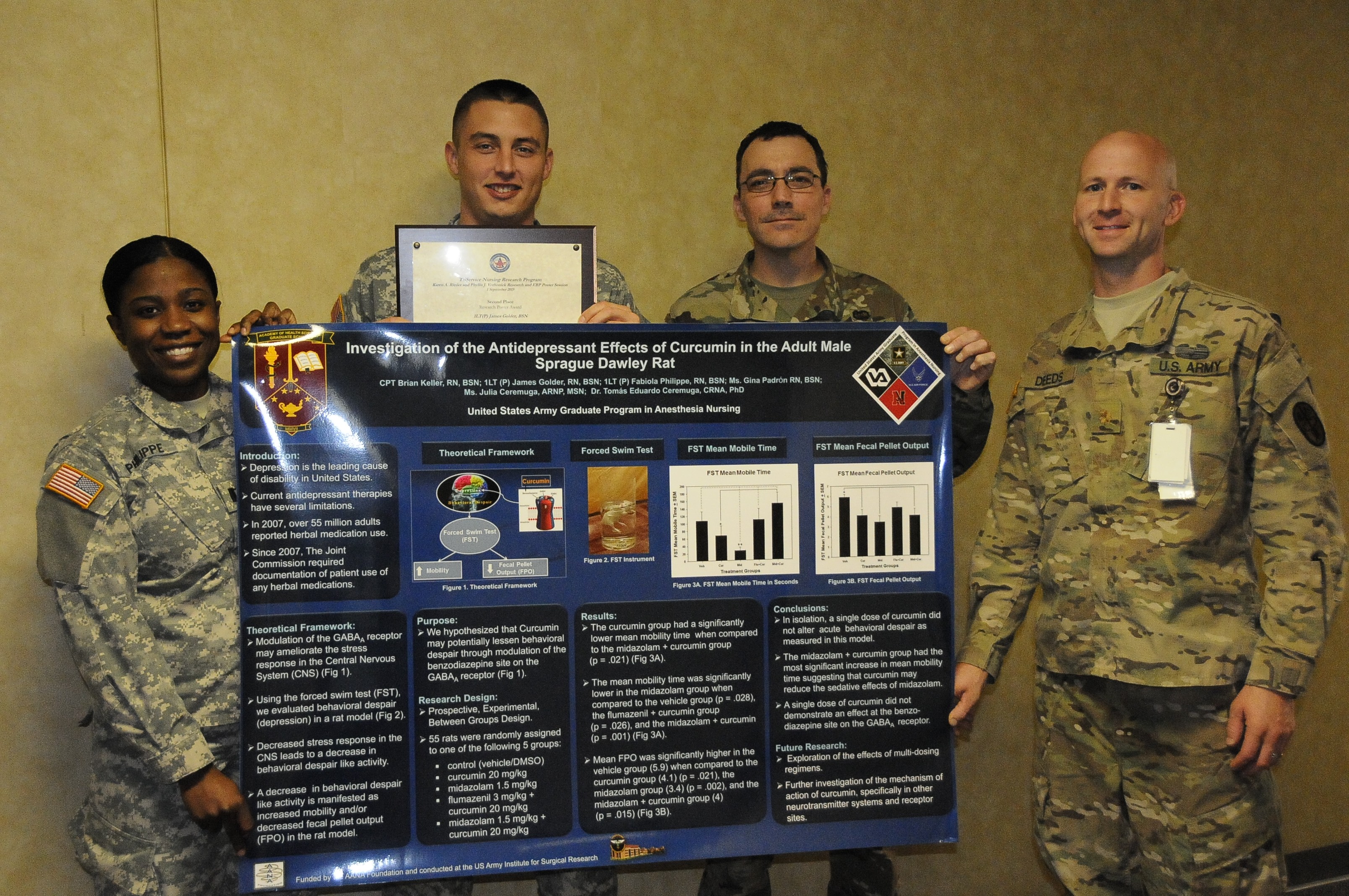
A William Beaumont Army Medical Center student registered nurse anesthetist won second place at the TriService Nursing Research Program in San Antonio Sept. 1.
First Lt. James Golder received the award, named the Karen A. Rieder and Phyllis J. Verhonick Research and Evidence Based Practice Poster Session, after he presented a poster that explained his medical research called "Investigation of the Anxiolytic and Antidepressant Effects of Curcumin, a Compound from Turmeric (Curcuma longa), in the Adult Male Sprague-Dawley Rat."
Golder conducted his research with Capt. Brian Keller and Capt. Fabiola Philippe, fellow nursing residents, while attending the U.S. Army Graduate Program in Anesthesia Nursing in San Antonio during the first phase of anesthesia training. After completing the research and fulfilling all phase-one requirements, the nursing officers had begun their second phase of training at WBAMC when they heard from TSNRP they were scheduled to give a presentation. The team began to help Golder practice and rehearse.
Golder said he appreciates the award immensely and finds it a validation of the team's hard work.
"Just to have all that work validated and recognized, it always makes you feel good," Golder said.
Golder's teammates said he did a great job in presenting, and he called them immediately when he learned of the accomplishment.
"It was a big cheer. I was happy for him because he did an excellent job in presenting our product," Keller said.
"Research is a tedious process, but it is also very rewarding when you find out anything with your results, whether it's positive, negative or nothing at all," Philippe said. "It's always a very good thing."
The team's research took 55 laboratory rats and put them into five groups, attempting to test the herbal medication called curcumin for any antidepressant effects. Making the rats go through a forced swim test, the team found different results than expected.
"In our results, we found that curcumin didn't necessarily have an impact on their mobility time, but being in anesthesia, we tested midazolam, which is a medication we administer fairly regularly to patients, pre-operatively, and we found that it actually acted as an antagonist to the medication," Golder said. "When the rats were administered midazolam, they did not swim as long as our control model."
Golder said when midazolam and curcumin were both administered, the rats swam for a longer period of time.
"So curcumin actually acted as an antagonist effect to the midazolam," Golder said.
The reason the team chose to investigate curcumin was not only because this method of testing was never done before, but also because many patients use herbal medications, such as curcumin, and the team wanted to know if curcumin had any interactions with the medications commonly used in anesthesia.
"For this specific study, we didn't find anything conclusive," Philippe said. "We need to look at it more -- maybe use different routes, different doses -- but it is something worth looking at more."
Maj. Jacob Deeds, program director for Phase Two of the U.S. Army Graduate Program in Anesthesia Nursing, WBAMC, said having two awardees for research here "speaks to the level of our nurse residents in both classes."
Social Sharing