
ANNISTON ARMY DEPOT, Ala. -- Five years ago, Anniston Army Depot was perched on the edge of a major change.
The Standard Depot System, which served the installation's inventory management functions, was about to go offline and be replaced by the Logistics Modernization Program.
Across the depot, those who would be in LMP-affected roles were training in an effort to quickly be able to input the necessary information into the new system.
"The Army told us before we went live with LMP, it would take five to six years before the system was fully implemented," said Keith Echols, a logistics management specialist for the depot.
Five years later, sustainment training is ongoing at the installation and the next iteration of LMP software is on the horizon.
LMP Increment II is scheduled to go on-line next year.
Where LMP to-date has been an enterprise resource planning system, LMP Increment II includes plant maintenance, an interface for tool ordering, management of non-conforming parts, work-in-process tracking, manufacturing management and objective quality evidence through shop floor instructions, according to Gerald Tucker, the Expanded Industrial Base project manager for the LMP Office.
The new system will allow for better tracking of actual time spent in overhaul and repair processes throughout the depot's industrial area, which will benefit the installation in cost, according to Randy White, chief of the LMP Office.
"We compete against private industry and this system will allow us to track our costs better, so the depot has a more accurate way of projecting costs," said White. "It will make us more efficient."
Lessons learned from the 2010 rollout of LMP are affecting the way Increment II is going into effect.
Training has already begun to introduce directors and division chiefs to the type of equipment and the tools which will be used by employees.
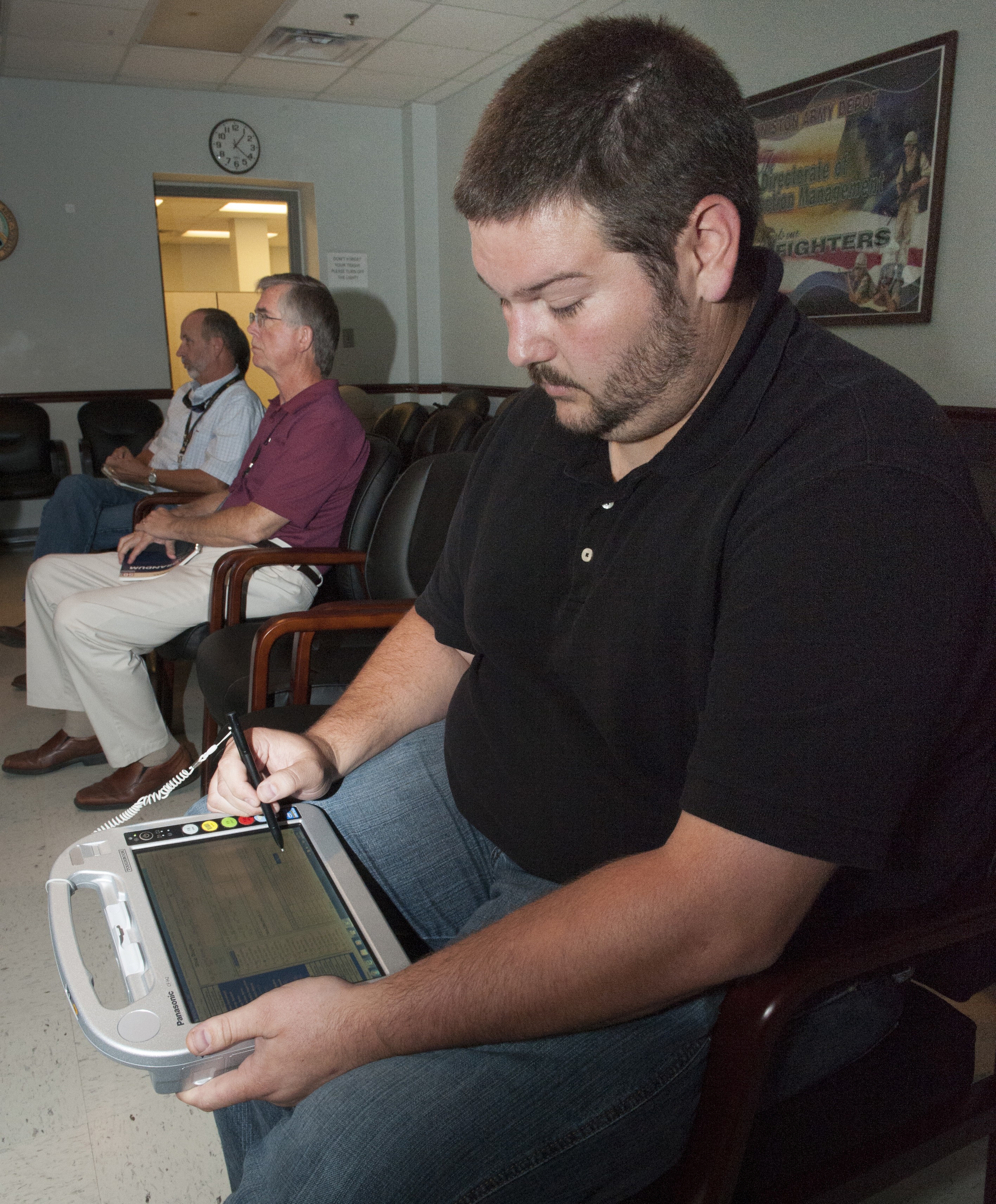
There will be additional desktops throughout the industrial area and rugged tablets on the shop floor to give the workforce mobile computing options.
The tablets will have a built-in scanner, enabling employees to quickly pull up the shop work instructions pertinent to that component.
"This gives the capability on the shop floor to electronically access reference publications," said Tucker.
These publications will include documents such as technical manuals and depot maintenance work requirements through an internet hyperlink to the depot's electronic library of military publications.
"Complex Assembly Manufacturing Solution, better known as CAMS, is the shop floor software which will be used by Army Materiel Command's depots and arsenals to capture shop floor activities thru automation," said Ken Henderson, the business transformation lead for the LMP Office. "Benefits of this program for ANAD will be a quality module that provides enhanced traceability on defects and non-conforming materials."
ANAD has been involved in the development Increment II from the beginning, through participation in workshops and teleconferences.
ANAD's LMP cadre will be attending "knowledge transfer sessions" provided by the Army Materiel Command beginning in September to gain first-hand knowledge of the new system's functions.
All employees who utilize LMP are encouraged to continuously enhance their education in the system.
As Tucker explains, LMP is not merely one piece of software, but a wide array of programs, many of which are integrated together.
Ongoing sustainment training keeps users up-to-date on important system information and can assist employees who need to learn new roles.
Employees will be role mapped for CAMS by their supervisors and directors and assigned to training classes by their supervisors based upon their assigned roles within LMP.
Social Sharing