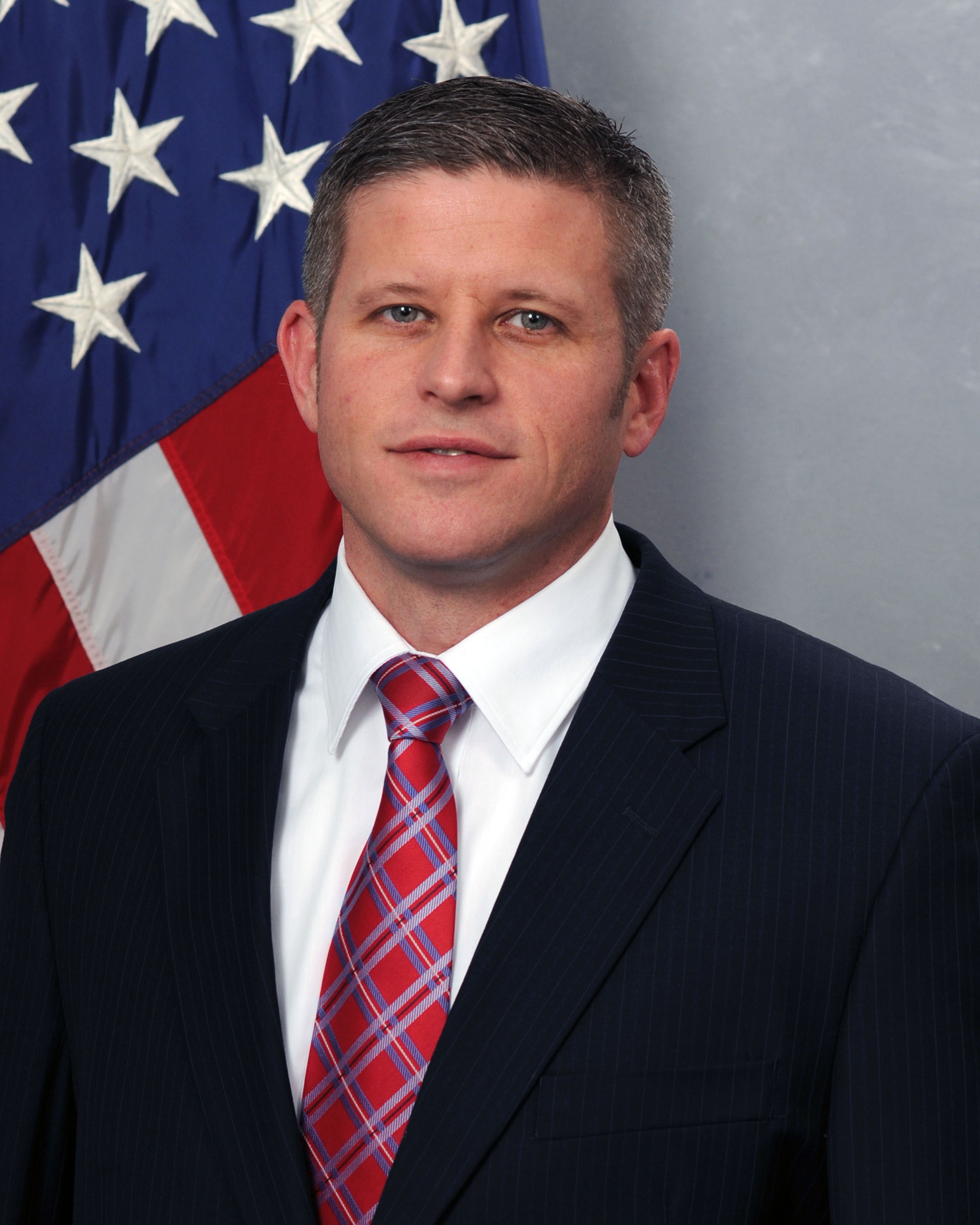

An engineer for the Gray Eagle unmanned aircraft systems product office was recognized with the 2014 Defense Acquisition Workforce Individual Achievement Award during a ceremony at the Pentagon Hall of Heroes Dec. 9.
Dan Dittenber from the UAS Project Office was among 15 individuals across the Department of Defense who received the award from Frank Kendall, undersecretary of defense for acquisition. The Individual Achievement Award recognizes individuals who have demonstrated excellence in the acquisition of products and services for the department.
Dittenber is an expert engineer for the MQ-1C Gray Eagle UAS who achieved extraordinary results in terms of cost, schedule and performance execution of the $2.1 billion, Acquisition Category 1D (at the time), and high visibility acquisition program. He was recognized for implementing innovative solutions to dramatically improve readiness and sustainability, while simultaneously improving performance capabilities through technology insertions, and achieving savings in accordance with Kendall's Better Buying Power initiatives.
"I'm honored to even have been nominated and feel very much humbled to have been selected," Dittenber said. He credits his team and his leadership for their support, adding that the team often worked on their own time to get the job done.
"No one person can do anything alone, and I really owe it my team who did a lot of the heavy lifting," he said. "We had several challenges leading up to the full rate production Defense Acquisition Board."
Since the Gray Eagle is an ACAT 1D program at the time, it always generated a lot of interest from many external organizations. Some of the biggest challenges moving forward were in reliability, safety of flight at continental U.S. fielded sites, and life cycle cost.
"They all worked tirelessly … with little need for acknowledgement or thanks except to know that we are changing the way the Army fights and that we are providing the Army and the Soldier with the best possible unmanned aircraft," Dittenber said.
The end result was the establishment of a robust reliability improvement plan that was demonstrated at the Initial Operational Test and Evaluation and met the Key Performance Parameters. Teaming with the Aviation and Missile Command safety community and the Aviation Engineering Directorate, the team developed a process by which the Army modeled routes of flight at fielded sites.
"This effort was critical to gain approval for our Materiel Release and show that we can operate safely at planned CONUS locations," Dittenber said.
Gray Eagle UAS have now been fielded to six units at five locations including Fort Hood, Texas, Fort Riley, Kansas, Fort Drum, New York, Fort Stewart, Georgia, and Fort Campbell, Kentucky.
Dittenber is credited with enabling or supporting several firsts within the Army, which will influence the next generation of UAS and related technologies. These efforts include: the first Hellfire shot from a UAS in the Army; first fully autonomous UAS takeoff and landing; first Air Data Relay between two Gray Eagle aircraft (doubling the effective range); first operation of an UAS by an enlisted Soldier (not aviator qualified); first UAS Manned-Unmanned Teaming joint engagement in theater (Army/Air Force); and the first "remote control" of a unmanned (Gray Eagle) aircraft and its payload by an Apache helicopter pilot.
Because of Dittenber's efforts, along with his team, these initiatives have had far reaching impacts and have resulted in fully realized capabilities today.
Dittenber was also recognized for his work involving the implementation of a "universal" product management plan to include common baseline efforts for Gray Eagle in post Follow-On Test and Evaluation software. He worked diligently with industry partners to implement "open" system architectures and interoperability standards among unmanned platforms.
"One of the big accomplishments for my team was establishing various methods to push our payloads' products in a standard form either from the aircraft or Ground Control Station. Another was proving out the ability to conduct Manned Unmanned Teaming in test and in real world operations. In theater, we saw this real time," Dittenber said.
He deployed with several others to Afghanistan in 2013 to support the fielding, deployment and sustainment efforts for F Company, 1st Aviation Regiment, the second unit equipped with the Gray Eagle. It was important to Dittenber to know firsthand from the users how the system is doing in theater, as well as obtain lessons learned so they can make improvements to better suit the needs of the Soldiers. Reliability, survivability and lethality were the key priorities.
"My purpose was to understand exactly how the system was being employed and how to improve it. We learned a ton. From that, we came back and established efforts with our prime contractor to address as many issues as possible, as soon as possible. Since then we've fielded several engine improvements as well as usability improvements to radios, user interfaces and payloads. There is still more to come," Dittenber said.
The best part of the deployments, he said, was to see the system in operation and witness the Soldiers use it to save lives on a daily basis. "The experience was absolutely inspiring," Dittenber said.
He continues to lead by example. His dedication and focus on the deployed Soldiers and civilians has only grown stronger. He and his team are busy preparing for the Follow On Test and Evaluation in 2015 which will test the Universal Ground Control Station and Universal Ground Data Terminal when operated with Gray Eagle.
The product office continues to maintain support to the currently fielded assets that includes Hellfire Romeo fielding, High Definition payload fielding, more ways to disseminate video from the aircraft, among others. They are also planning for out-year activities including ways to address emerging threats and future capability requirements.
"That's what is nuts about this job, the pace never slows," Dittenber said. "All of these efforts are focused on one thing -- that is to make the most reliable, survivable and lethal unmanned aircraft we can for the Soldier."
Social Sharing