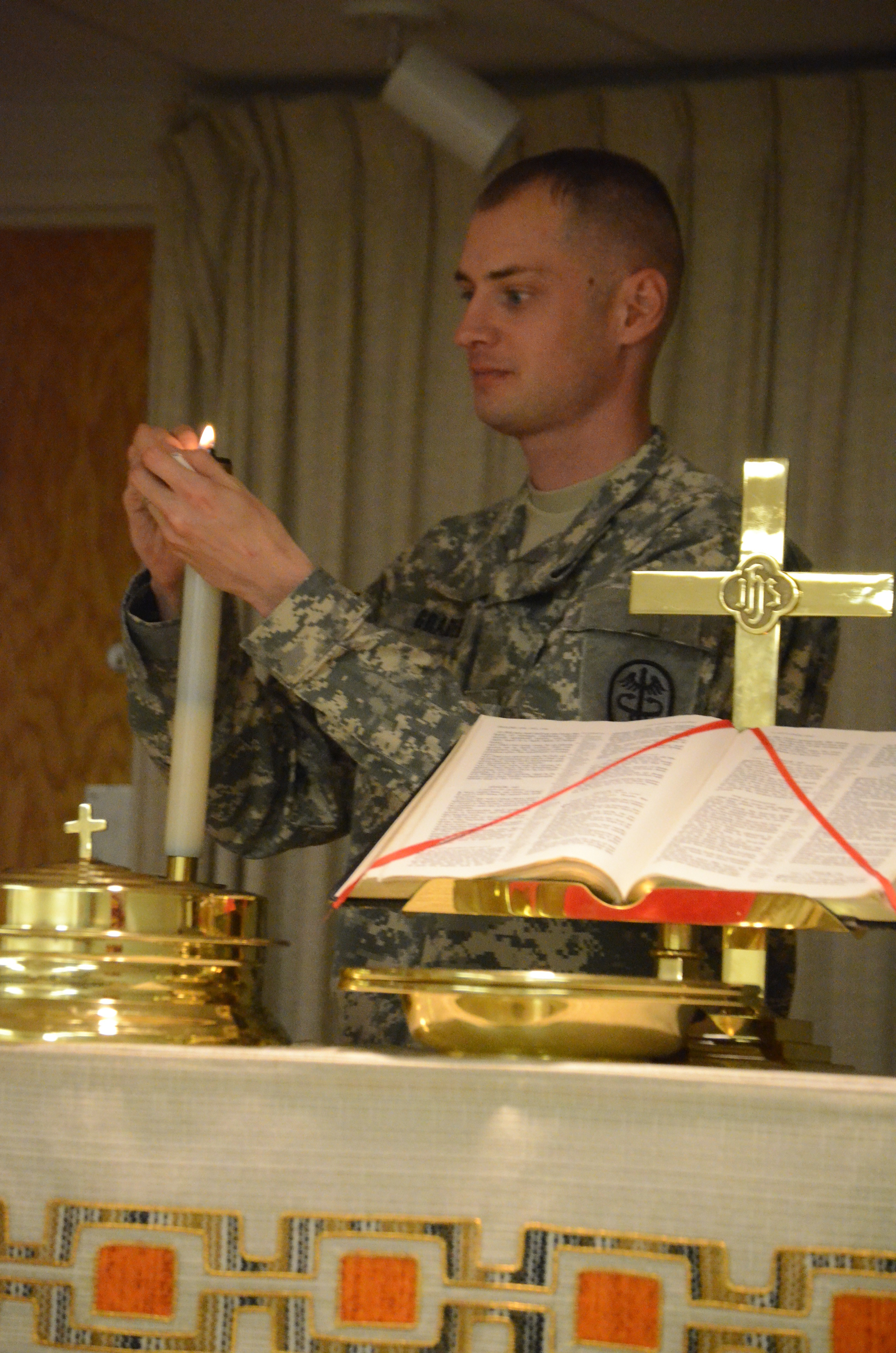
FORT CAMPBELL, Ky. -- Within the walls of Blanchfield Army Community Hospital, thousands of Fort Campbell Soldiers, Family members, retirees and civilians have come and gone -- receiving every type of diagnostic and preventative care one could imagine. On Zero Floor, there is a different type of care being administered, and it all starts within the small, inviting hospital chapel.
Each week, the MEDDAC chaplain conducts two church services and three bible studies for staff, Soldiers -- any person who might wish to attend. Helping to organize these services and provide command support is Sgt. Mark Anthony Graber, the MEDDAC chaplain assistant. With 14 years in the Chaplain Corps under his belt, the preparations and duties have become like second nature, but the job is -- and has always been -- symbiotic with his career as an American Soldier.
The road to the Chaplain Corps
Graber grew up in an Army Family. Upon his father's retirement is when the Family began to rediscover their spiritual roots.
"When my dad got out of the military we settled back into our small little farm town that I grew up in and we started getting back into the church," he said. "I actually started preaching in our church -- under the supervision of our preacher -- at the age of 14."
Under the mentorship of his preacher, Graber felt himself being drawn toward ministry -- particularly toward providing spiritual guidance to younger members of the congregation.
"I went to a Christian college up in St. Louis," said Graber. "I was actually looking at youth ministry as my major. I ended up dropping out of college. Meanwhile, my brother had joined the Army. He came back from training and said I might enjoy being a chaplain assistant."
The position of chaplain assistant is one that Graber never knew existed within the ranks of the Army.
"That's strange because my dad was actually in the military for 20 years and I'd never heard of chaplain assistants before," he said.
Upon learning of the position, Graber went and spoke to his hometown recruiter about signing up.
"I specifically joined for this," he said. "I told them I wasn't going to join if I couldn't get chaplain assistant. That was my only interest in joining the Army was to do this job."
Graber knew little of what the position entailed -- aside from the fact that he'd be working under chaplains and helping to set up various religious services. Gradually he came to realize that the job was much more. Life within the Chaplain Corps put him right where he wanted to be.
Putting a spin on goals
As a chaplain assistant, Graber soon realized that he was not far from his initial goal of working in youth ministry.
"I kind of traversed that to the military," he said. "We have a lot of younger Soldiers, and that's where I've really been able to direct a lot of my attention. We have marriage retreats and single Soldier events -- and that really is more directed toward the younger Soldiers. They tend to be the ones that generally come to us. They're the ones that seek out our help a lot more."
He has been able to work in this capacity throughout his military career -- much of which has been spent outside national borders.
"I've spent the majority of my time in the military outside of the United States," said Graber. "I have a year I spent in Korea. I spent a year in Iraq, three years in Japan and another year in Afghanistan."
During deployments, Graber said there was a bigger need for the type of support and ministry to which he felt suited. Down range, young Soldiers seeking guidance don't have many places to go in times of strife, and many seek out assistance within the Chaplain Corps.
"You have a lot more Family issues that arise during deployment," he said. "Deployments tend to sometimes break what's already cracked. You also have to worry about a potential risk for casualties while you're there."
Add to that the increased role of security taken on by chaplain assistants down range (Chaplains do not carry weapons) and it can be a demanding situation. Still, he thrived in the environment.
"I talk about Soldier issues down range, but what comes with that is getting closer to those Soldiers," said Graber.
Graber has been home from Afghanistan since February. His work as a chaplain assistant within a hospital environment began in August. While it's new territory, he has enjoyed the new challenges the position has presented.
"It is different in that you're working with the Soldiers and the staff and the patients -- who can be retirees or dependents," he said. "You work with civilians here. The Sunday service we have here is mostly retirees. It's a different element, a different environment, but it's good."
As the Army prepares to commemorate the anniversary of the chaplain assistant position this month, Graber acknowledges that it is nice to receive recognition for the behind-the-scenes role he has played for the duration of his career.
"It definitely makes me proud," he said. "I joined the Army to be a chaplain assistant -- I wasn't going to be anything else. I was taking chaplain assistant or I was going back home. I'm proud that the Army is acknowledging that."
At the end of the day, however, accolades are not the motivation behind the job.
"Most chaplain assistants would probably share my belief though -- I don't do it for the recognition," said Graber. "I appreciate the Army recognizing the corps, though. Because it makes you feel good. I am proud to be a chaplain assistant."
Tomorrow and beyond
With 14 years down, Graber said he is fully intent on staying with the Army until he has to retire. If the rank changes, all the better. The one thing he does not want to change, though, is the core responsibilities of his job.
"I really can't see myself doing anything else besides this," he said. "There are so many aspects of the job that I've fallen in love with. At the center of that is taking care of Soldiers."
Graber credits his ability to do what he loves to a strong and supportive Family. Being a person sought out for help with problems, Graber said that it is his Family to which he turns when the problems are his own. He says his wife -- whom he met during his tour in Japan -- is his rock. His solace from weary days is his children -- an 11-year-old daughter, 3-year-old son and a baby on the way.
"You're constantly looking at your life and your relationship with your children -- because I want to leave a legacy for my children," he said. "My wife says our son can't join the Army, but I hope that in other ways what I've done will live on through him."
Editor's note: This is the sixth in a series on chaplain assistants at Fort Campbell leading up to the 105th anniversary of the Army position in December.
Related Links:
Blanchfield Army Community Hospital on Twitter
Fort Campbell Courier on Twitter
Blanchfield Army Community Hospital
Blanchfield Army Community Hospital on Facebook
Social Sharing