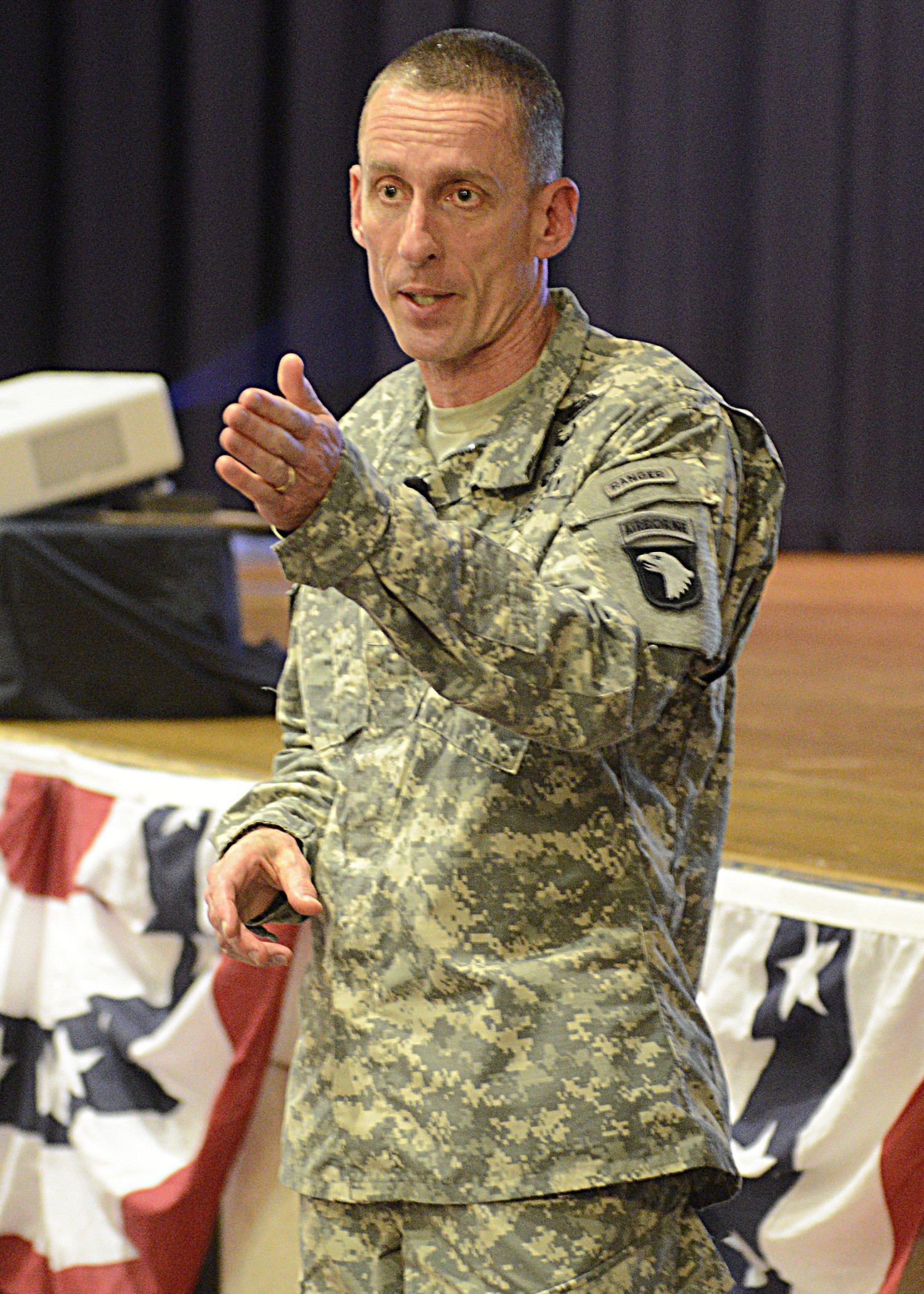
FORT CAMPBELL, Ky. -- Major Gen. Gary Volesky, commander of the 101st Airborne Division and Fort Campbell, invited the installation's Soldiers, Family members and civilian employees to join him and a variety of subject matter experts for a town hall meeting at Wilson Theater Aug. 11.
To kick off the meeting, Volesky offered his perspective on priorities for the Soldiers and Families of the installation, and where everybody fit into the equation.
"Our priorities -- from my perspective, this is what I owe our Army," Volesky explained. "The first thing we've got to do is make sure we're trained and ready."
Outlining the slides he presented to the group, Volesky explained that the keys to operating effectively in any environment are improving physical and mental toughness, building upon the reputation of the 101st Airborne Divison and developing adaptive leaders who lead by example and demonstrate strength of character.
These "first-line leaders," as he called them, will be one of the crucial components in the push to increase resiliency -- another priority on the list.
"Resiliency -- you can't have readiness without that," said Volesky. "You know as well as I do that we have issues with suicide and sexual assault. Here's where I need help from you all."
With that, Volesky revealed a triangular resiliency diagram with 1st Line Leaders, Family, and Buddies at the three corners.
"Our Soldiers, civilian employees and Family members are in the middle of that triangle," he said. "They have a support structure that is really close to them."
Volesky explained that the groups residing at the three corners of the triangle should be observing, staying alert for signs of trouble such as alcohol abuse, relationship problems or changes in character.
"What really distresses me is when a kid commits suicide -- we go over to the fatality review board and someone says, 'I knew it. He had these problems.' Why didn't you say something?" said Volesky. "Someone always knew there was an issue -- somebody that was close to him or her and didn't say anything. I need your help in helping us to make sure these three groups get energized."
Volesky also asked that the leaders of Fort Campbell take balance into consideration in terms of unit vs. personal time among Soldiers.
"I've had the honor of going to combat a time or two," he said. "What I was most proud of was in June, we would fly Soldiers from all across Iraq or Afghanistan to FOBs to watch their sons and daughters graduate high school. I'm more proud of that than anything we did."
As an example, he talked about a fictional sergeant missing his daughter's ballet recital because of company training -- even though it was just a day of maintenance exercises.
"I just want you to consider that," said Volesky. "We're going to train when we have to train, and we're going to miss events because the training we do is that important. But is it all that important?"
Following the map-out of his priorities, Volesky invited the group to voice questions and concerns about the installation and any upcoming changes. While many anticipated the gate procedure changes to be an issue, most in attendance agreed that the new visitor pass requirements are just a revamp of former policy and therefore an adaptable change.
When an Army spouse voiced concerns about the accuracy of the crime reports featured in Clarksville news publications, Volesky gave the floor to Keith Shumate, Fort Campbell Chief of Police.
"Your perceptions of Clarksville are partially true," said Shumate, citing the existence of active gangs as an example. "I'll also tell you that Clarksville is very vigilant. They work very closely with task forces … Clarksville is also a very safe neighborhood. Like any place, there are good neighborhoods and bad neighborhoods -- you always have to be vigilant about your surroundings. Watch out for one another."
A final perspective offered by Volesky was the importance of maintaining the standard of Army excellence, regardless of time or place.
"I've got Soldiers that believe that when retreat is called and they take their uniform off they're not Soldiers," he said. "You're a Soldier 24 hours a day, seven days a week. You're leaders 24/7."
"This means Uncle Sam Ain't Released Me Yet," said Volesky, pointing to the U.S. ARMY tape on his ACUs. "You better be out there checking your Soldiers -- they deserve the best leadership we can give them."
Related Links:
101st Airborne Division on Twitter
Fort Campbell Courier on Twitter
101st Airborne Division on Facebook
Social Sharing