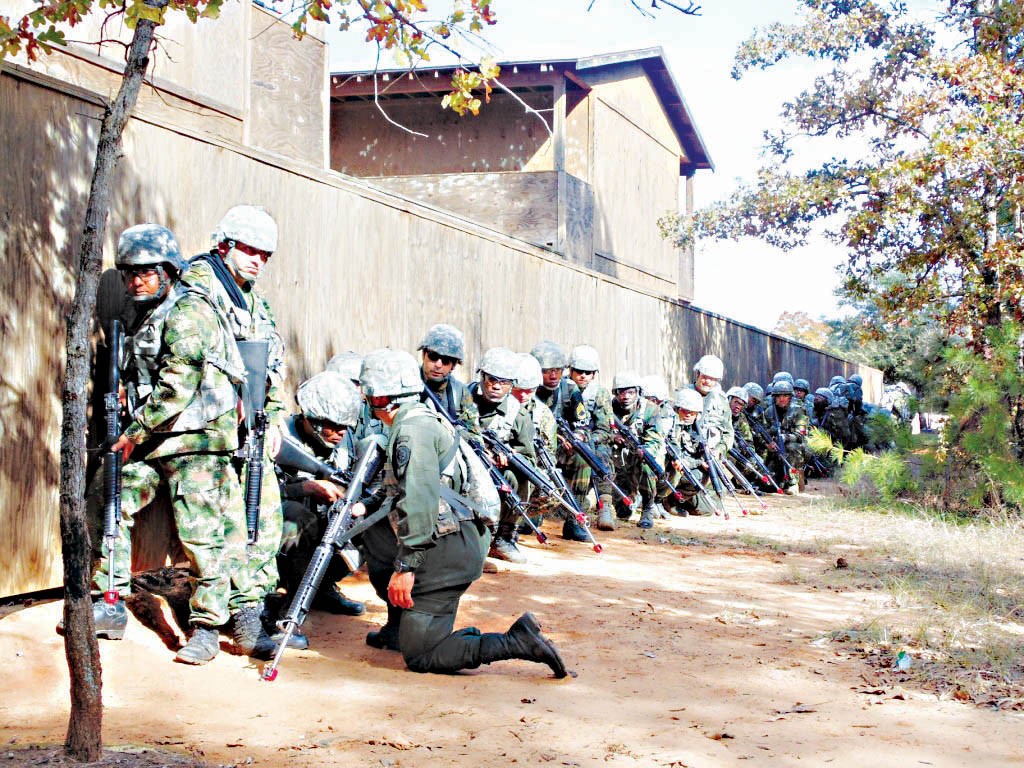
FORT BENNING, Ga., (Nov. 6, 2013) -- The Roy P. Benavidez Noncommissioned Officer Academy has two professional development courses in session, teaching and training exactly the same work, one in English and one in Spanish.
Classroom work is done separately, but in all the practical work and field exercises, the two groups come together. Language is no barrier as they navigate over Fort Benning terrain, fire weapons, learn combat water survival techniques, maneuver through military operations on urban terrain and conduct the field training exercise that culminates the courses.
All students also joined in a Field Studies Program Trip to Atlanta, visiting businesses such as Coca-Cola and CNN, and cultural sites including the Holocaust Museum, Georgia Aquarium and the Martin Luther King, Jr. Memorial.
The English language students are usually all from the Caribbean, but this class of 15 NCOs has two Canadians along with sergeants from Antigua, Barbados, Grenada, Jamaica, St. Kitts and Nevis, St. Vincent and Trinidad and Tobago.
The Spanish course has 47 students from Chile, Colombia, Costa Rica and El Salvador.
The instructors are nearly as diverse, with U.S. and partner nation NCOs teaching both courses. Senior sergeants from Belize, Brazil, Chile, Jamaica and Paraguay are key leaders and teachers. A few students in each class were asked to write a comment about their experiences.
"Our experience during the NPME 8 course has been great in learning different cultures and being able to live, learn and train with different countries and forces," Canadian Sgt. Nathaniel Mills said. "This increased our personal and military awareness and ability to work alongside troops no matter what back ground or past experiences."
Sgt. John Williamson of the Jamaican Defense Force enjoyed the interaction among the countries. He said it "assisted us overcoming the thought that language was a barrier when conducting training with other Spanish speaking personnel, as the more we train together the impact was tremendous that we felt comfortable enough to operate along with them knowing that this experience will take us to another level."
Two Trinidadians from the Air Force and Coast Guard said "with determination and training, language will not be an obstacle for us to operate jointly. Overall this impact will improve (our) individual and leadership skills, which (we) can apply when going back to(our) unit."
Spanish speakers agreed with their counterparts. Colombian Army Staff Sgt. Faber Segundo Molina Arce started with the faculty.
"The course developed by (the) NCO Academy was excellent," he said. "The disposition and professionalism of instructors was reflected in the vast knowledge passed on to us on a daily basis and with our experience shared among all members of the course. We refreshed our knowledge and came to realize how important we are in the chain of command to create a cohesive team within our armies to achieve success."
Molina said he could "highlight the effort and discipline (of) our comrades from different countries; even though we have different cultures we manage to overcome the minor differences that we had with the concept of being united."
Intendente Jefe Manuel Olaya Franco of Chile expressed the view that it was an "excellent course that generates an added value with the diversity of countries, cultures, techniques and tactics and experience shared that assisted each course participant to improve our military knowledge."
El Salvadorian Army Sgt. Jaime Mendez Rodriguez made a list, citing "integration of staff from different countries for contribution of ideas and unification was of high importance. The exchange of cultures and experience, knowledge of modern methods and learning methods, cohesive team development, key to success of any mission; and breaking barriers such as language."
Central American police officer agent Emmanuel Viera Aguilar of Costa Rica focused on values and norms.
"Human rights and integration of different cultures and application of diverse techniques were also helpful and will be applied during the development of (my) military career," he said. "The high level of professionalism and focus by the instructors in the way they developed the course seem to make it much easier to learn."
WHINSEC usually offers three NCOPD courses in Spanish and another in English. When scheduling permits, as in this case, the English course is paired with a Spanish course to expand the opportunities for relationship and cooperation building on a broader scale.
The Benavidez NCO Academy was formed several years before WHINSEC to provide NCO leadership training at the squad-platoon level to students from countries that were seeking to make their enlisted leaders qualified to take charge in the absence of their commissioned officers, to professionalize them on the U.S. model.
As the nations of the hemisphere developed their NCO Corps, the academy expanded its offerings both up and down, establishing a course for corporals and sergeants as they first became NCOs, and now a Senior Enlisted Advisor Course based on the Sergeants Major and First Sergeants Academy at Fort Bliss, Texas.
Social Sharing