
COMPLY
The CMA director serves as the Army treaty implementing agent, ensuring the Army complies with the Chemical Weapons Convention Treaty, which prohibits development, production, stockpiling, transfer and use of chemical weapons.
DESTROY
The Recovered Chemical Materiel Directorate provides centralized management and direction to the Department of Defense for the assessment and destruction of recovered chemical warfare materiel in a safe and environmentally compliant manner.
STORE
The U.S. Army Chemical Materials Activity Redstone Chemical Activity (CMA RCA) supports the Army’s investigative environmental remediation and storage activities at Redstone Arsenal in Huntsville, Alabama.
ABOUT US
Headquartered at Aberdeen Proving Ground, Maryland, the U.S. Army Chemical Materials Activity (CMA) director serves as the treaty implementing agent, delegated by the Department of Defense (DOD) to support United States compliance with the international Chemical Weapons Convention treaty. The CMA Center for Treaty Implementation and Compliance manages our Nation’s treaty implementation and compliance activities, including declared recovered chemical warfare materiel and single small-scale facilities.
As the program executioner for the DOD Recovered Chemical Warfare Materiel Program, CMA supports Army readiness by assessing and destroying chemical warfare materiel using transportable technologies wherever it is recovered in the United States. CMA’s Recovered Chemical Materiel Directorate provides centralized management and direction to DOD for the assessment and destruction of recovered chemical warfare materiel in a safe and environmentally compliant manner.
CMA provides DOD the expertise for safe and secure storage of chemical warfare materiel pending its destruction. The Army draws on CMA’s extensive knowledge and experience in managing chemical agent and munition assessment and destruction, storage facility design, safe handling and accountability processes to posture other nations’ stockpiles for destruction in compliance with the Chemical Weapons Convention treaty, if required. CMA also stood up Redstone Chemical Activity (CMA RCA) to support the Army’s investigative environmental remediation and storage activities at Redstone Arsenal in Huntsville, Alabama.
CMA MISSION
Assess and destroy chemical warfare materiel, comply with chemical weapons treaty, protect people and the environment.


HISTORY
In 2003 the Army combined elements from the U.S. Army Soldier and Biological Chemical Command and Program Manager for Chemical Demilitarization to consolidate the Army’s chemical agent, munitions storage and demilitarization functions under a single organization. The U.S. Army Chemical Materials Agency (CMA), a major subordinate command of the U.S. Army Materiel Command (AMC), managed the nine chemical weapons stockpiles, assessed and destroyed recovered chemical warfare materiel, and managed the Chemical Stockpile Emergency Preparedness Program to support communities around the stockpile sites.
The nine stockpile sites were located at Umatilla Chemical Depot in Oregon; Deseret Chemical Depot in Utah; Pueblo Chemical Depot in Colorado; Pine Bluff Chemical Activity at Pine Bluff Arsenal, Arkansas; Newport Chemical Depot in Indiana; Blue Grass Chemical Activity at Blue Grass Army Depot, Kentucky; Anniston Chemical Activity at Anniston Army Depot, Alabama; Edgewood Chemical Activity at Aberdeen Proving Ground, Maryland, and Johnston Atoll Chemical Agent Disposal System (JACADS) on Johnston Atoll in the Pacific Ocean, about 750 miles southwest of Hawaii.
In December 2006, the Agency completed destroying the Nation’s former chemical warfare production facilities, binary chemical weapons inventory in November 2007 and declared recovered chemical warfare materiel in 2010. By January 2012, all chemical weapons were destroyed at seven of the nine U.S. stockpile sites, eliminating nearly 90 percent of the original declared chemical stockpile.
In July 2012, the Agency was redesignated from a major subordinate command to an AMC Separate Reporting Activity and renamed the U.S. Army Chemical Materials Activity.
On July 7, 2023 the last declared munition in the domestic chemical weapons stockpile was destroyed at Blue Grass Army Depot, marking the completion of the mission in compliance with the Chemical Weapons Convention.
In January of 2025, CMA stood up Redstone Chemical Activity (RCA) to support the Army’s investigative environmental remediation and storage activities at Redstone Arsenal – once a historical center for chemical weapons production, storage and testing, the arsenal has the potential for a large amount of RCWM. CMA's dedicated personnel also fulfill CMA’s mission at RCWM locations across the Nation.

LOCATIONS
★ Headquarters – Aberdeen Proving Ground, Maryland
★ Redstone Chemical Activity – Redstone Arsenal, Alabama
★ Recovered Chemical Warfare Materiel Assessment and Treatment – Treatment locations Nationwide
CONTACT
U.S. Army Chemical Materials Activity Headquarters
8435 Hoadley Road (Bldg. E4585)
Aberdeen Proving Ground, Maryland 21010
Email: usarmy.cma.public.affairs@army.mil
CENTER FOR TREATY IMPLEMENTATION COMPLIANCE (CMA & CWC TREATY COMPLIANCE)
The CMA director acts as the United States Army Implementing Agent for executing the Chemical Weapons Convention (CWC) Treaty. In accordance with the CWC, CMA carries out Army Regulation 525-92, which states that CMA’s Center for Treaty Implementation and Compliance (CTIC) manages implementation and compliance activities.
Located at CMA Headquarters at Aberdeen Proving Ground, Maryland, CTIC is part of a U.S. host team for storage, Schedule 1 and destruction inspections that oversees CWC compliance. CTIC prepares initial visits and final engineering reviews by the Organization for the Prohibition of Chemical Weapons (OPCW), the international organization headquartered in The Hague, Netherlands, that verifies CWC implementation.
CTIC is also responsible for all notifications, reports and briefings submitted to the OPCW Technical Secretariat, and assists Army sites with refuting allegations during challenge inspections. The United States is responsible for hosting ambassador-level visits for the OPCW Executive Council for an overview of the destruction programs.
CWC BACKGROUND
On April 29, 1997, the Convention on the Prohibition of the Development, Production, Stockpiling, and Use of Chemical Weapons and on Their Destruction, known as the Chemical Weapons Convention (CWC), entered into force. At that time, the United States and 86 other nations became the first countries to sign and ratify the CWC. In doing so, the United States agreed to destroy all their chemical weapons and former chemical weapons production facilities and to abide by prohibitions from development, use, production and acquisition of chemical weapons. As of 2016, more than 192 nations have ratified the CWC.
The CWC prohibits the development, production, stockpiling, transfer and use of chemical weapons. The United States is a State Party to the CWC. The Organization for the Prohibition of Chemical Weapons (OPCW), an international organization headquartered in The Hague, Netherlands, oversees Convention implementation.
The CWC prohibits States Parties from:
- Developing, producing, acquiring, retaining or transferring chemical weapons
- Using chemical weapons
- Engaging in any military preparations to use chemical weapons and
- Assisting, encouraging or inducing anyone, in any way, to engage in any activity prohibited under the Convention
The CWC also requires States Parties with chemical weapons or chemical weapons production facilities to destroy them in an environmentally safe manner. It forbids disposal by open pit burning, land burial or dumping in any water body.


RECOVERED CHEMICAL MATERIEL DIRECTORATE
The U.S. Army Chemical Materials Activity (CMA) Recovered Chemical Materiel Directorate (RCMD) provides centralized management and direction to the Department of Defense for the assessment and disposal of recovered chemical warfare materiel (RCWM) in a safe and environmentally compliant manner.
RCMD leads the nation in the development and utilization of advanced technology to destroy RCWM. In 1997, the United States entered into force of the Chemical Weapons Convention (CWC), an international treaty requiring the destruction of chemical weapons.
In support of U.S. treaty obligations, CMA RCMD maintains the technology and personnel expertise to continue to destroy chemical warfare materiel around the country.
RCMD'S CAPABILITIES
-
RESPONSE
The Recovered Chemical Materiel Directorate uses the Mobile Munitions Assessment System (MMAS) to provide analysis of recovered items with unknown fills. MMAS uses non-intrusive assessment equipment to rapidly provide detailed information on recovered items and distribute that information to appropriate authorities, reducing risk to the public, military and emergency personnel.
MMAS
Mobile Munitions Assessment System (MMAS) provides analysis of recovered items with unknown fills by:
- Traveling to the site where recovered munitions are found
- Rapidly identifying the contents and condition of recovered items
- Providing detailed analysis with minimal handling
1- Portable Isotopic Neutron Spectroscopy System (PINS)
PINS accurately detects the presence of chemical elements by using neutron particles to produce a unique energy spectrum emitted by chemicals inside the munition.
2- Digital Radiography & Computed Tomography System (DRCT)
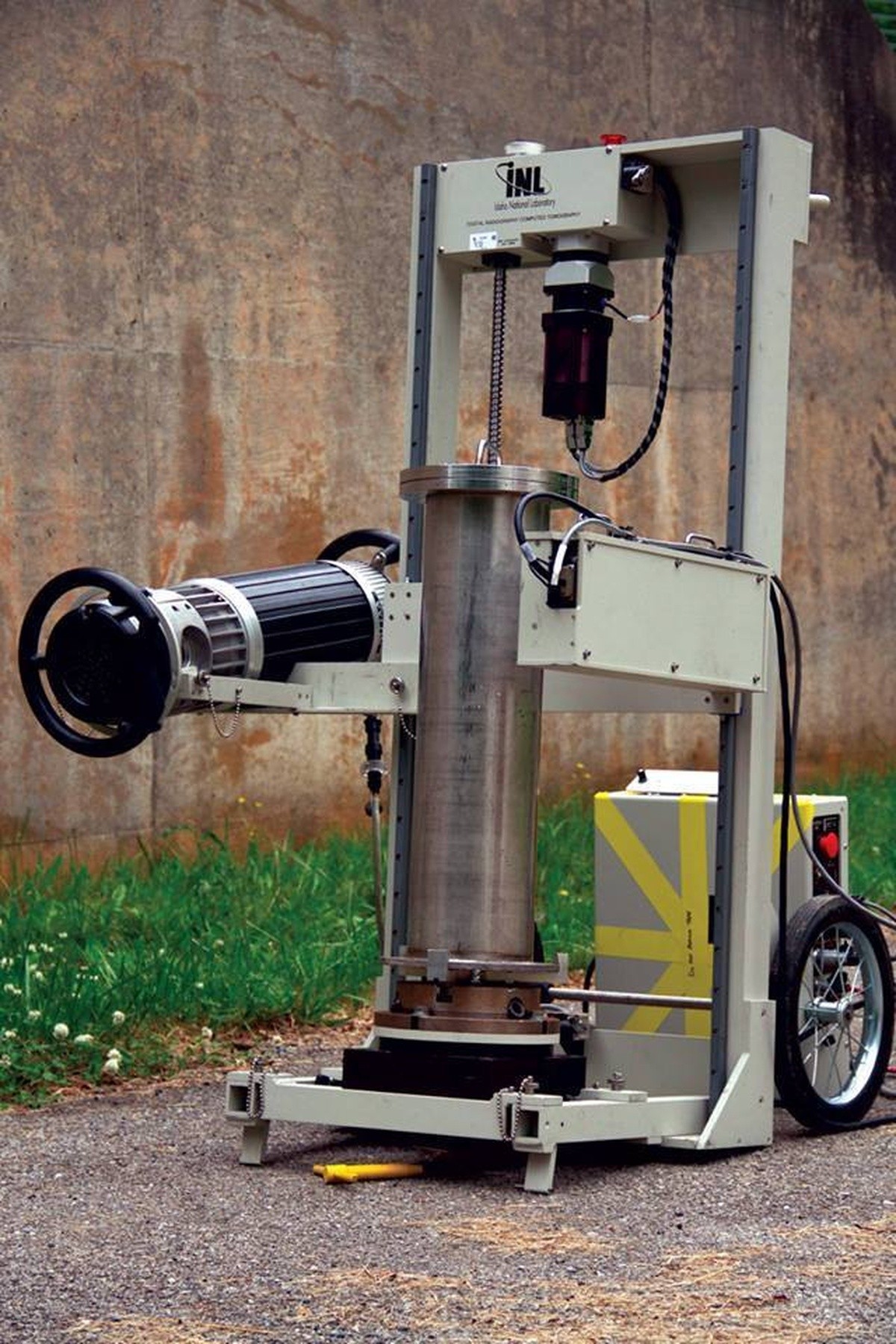
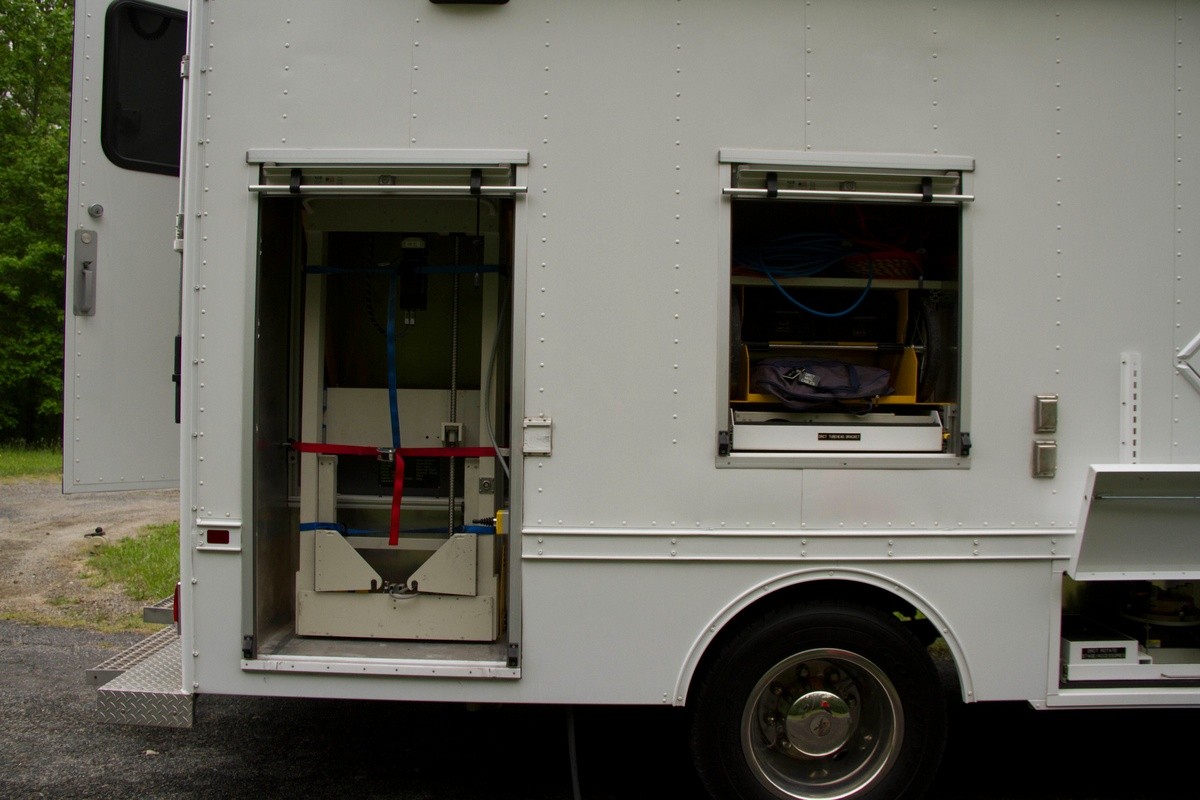
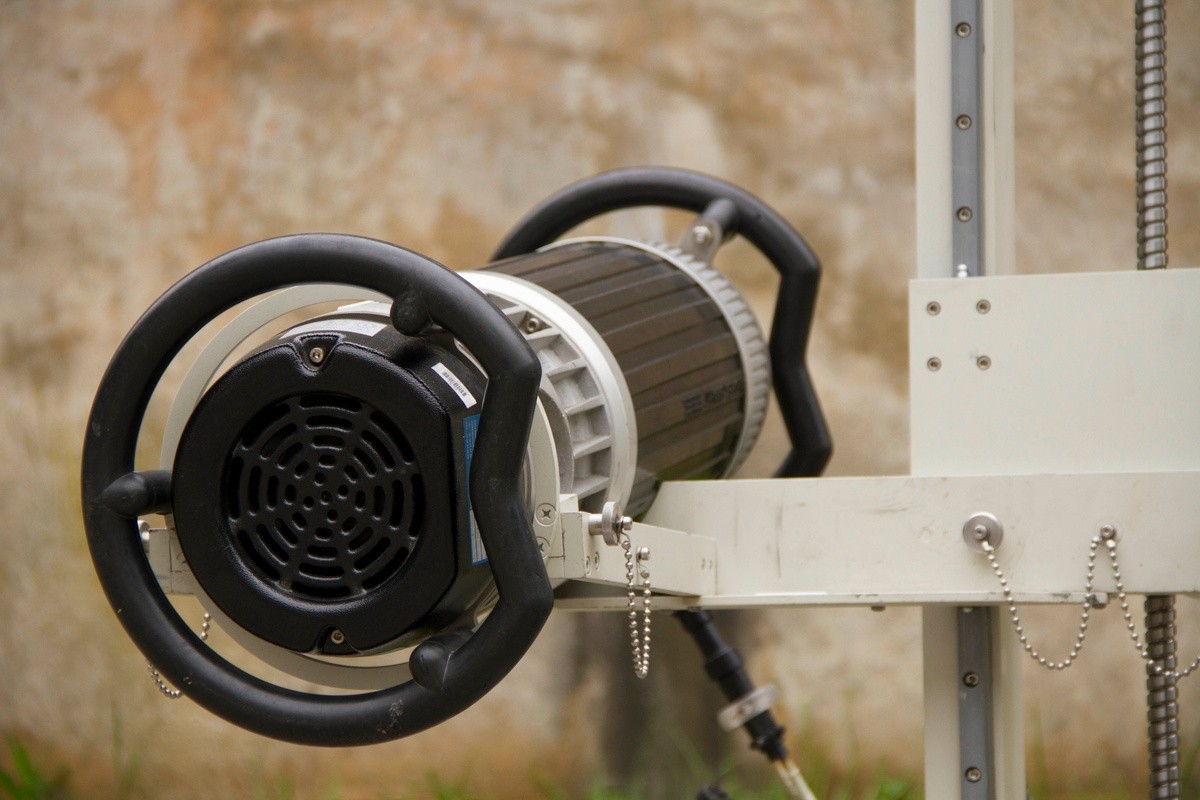
DRCT uses X-ray technology to vertically scan recovered munitions on a rotating platform, reproducing a high- quality digital image of their interiors to determine whether a liquid fill is present as well as the explosive potential of the item.
3- Raman Spectrometer
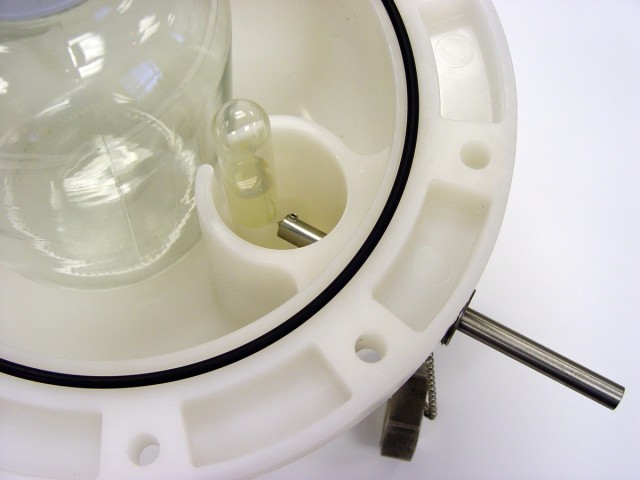
Raman Spectrometer identifies the contents of glass bottles that were part of Chemical Agent Identification Sets (CAIS), used for training decades ago. This technology uses a fiber optic probe and laser.
-
PACKAGING
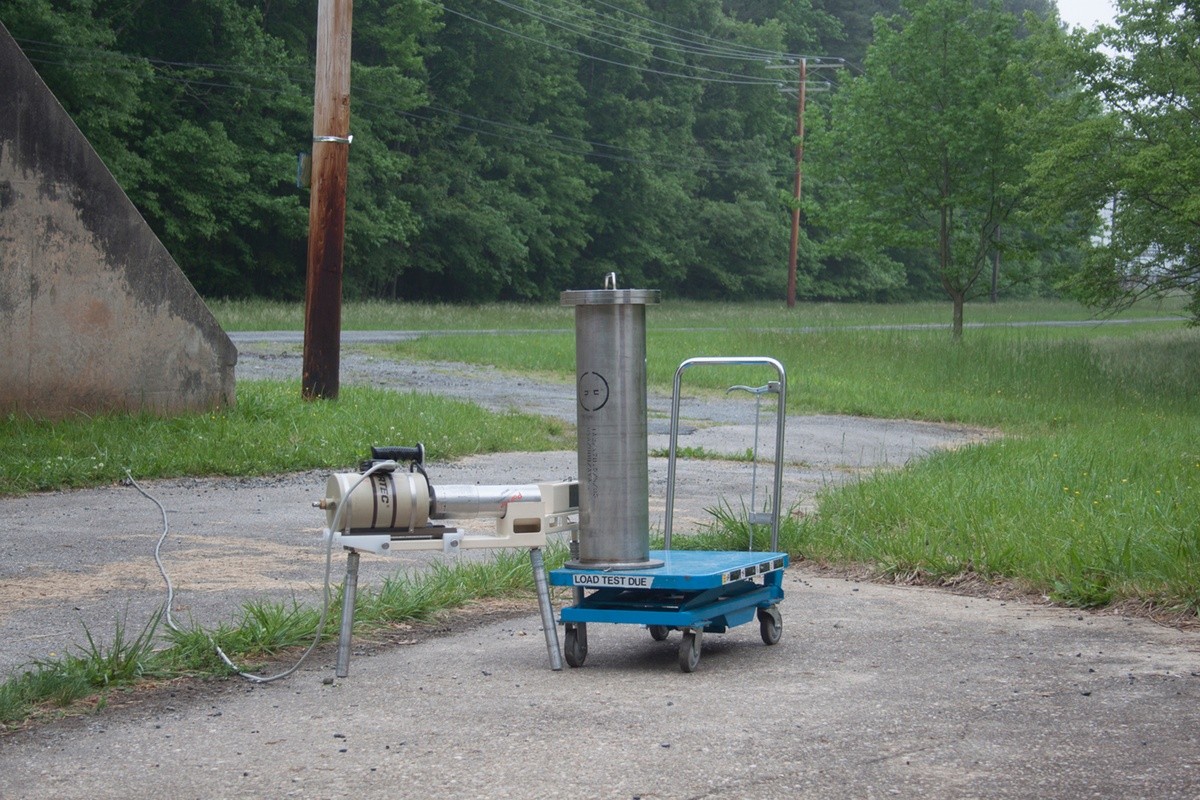
After suspect recovered chemical warfare materiel (RCWM) is discovered, the Recovered Chemical Materiel Directorate (RCMD) deploys equipment to determine if the items are explosively configured and contain a liquid fill. The recovered item is overpacked in a multiple round container (MRC). This allows for safe assessment, storage and transport.
MRCs were specifically designed, tested and fielded for the transport of chemical warfare materiel and are the only containers approved by the Department of Transportation for this purpose. MRCs exceed international packaging requirements. Each MRC contains one munition, but there are multiple sizes in the MRC family to accommodate a variety of munitions.
Considered “overpack” containers, MRCs are designed to prevent any accidental exposure to the environment in the unlikely event the overpacked items were to leak. Fragile items, such as chemical agent identification sets (CAIS) – glass bottles containing small amounts of chemical agent once used to train Soldiers in the identification and decontamination of chemical agent – may also be transported in MRCs.

Multiple Round Container (MRC) - After suspect recovered chemical warfare materiel (RCWM) is discovered, Recovered Chemical Materiel Directorate dispatches equipment to non-intrusively determine if the items are explosively configured and contain a liquid fill. Once it is determined that an item contains chemical agent, operators package them in a Multiple Round Container (MRC) for safe storage and possible transport to the nearest military installation. View original -
Safe treatment of recovered chemical warfare materiel (RCWM) relies on thorough assessment, packaging and storage before the destruction solution is deployed. RCMD’s proven assessment technologies provide critical information on site during suspect CWM recoveries, determining whether a munition is explosively configured or contains chemical agent.
Digital Radiography and Computed Tomography System (DRCT)
DRCT technology is a transportable, non-intrusive assessment system that analyzes and provides on-site information about the contents of unidentified munitions without opening them. This greatly reduces risk to the public, workers and emergency response personnel by rapidly obtaining detailed information and distributing it to the appropriate authorities and responders.
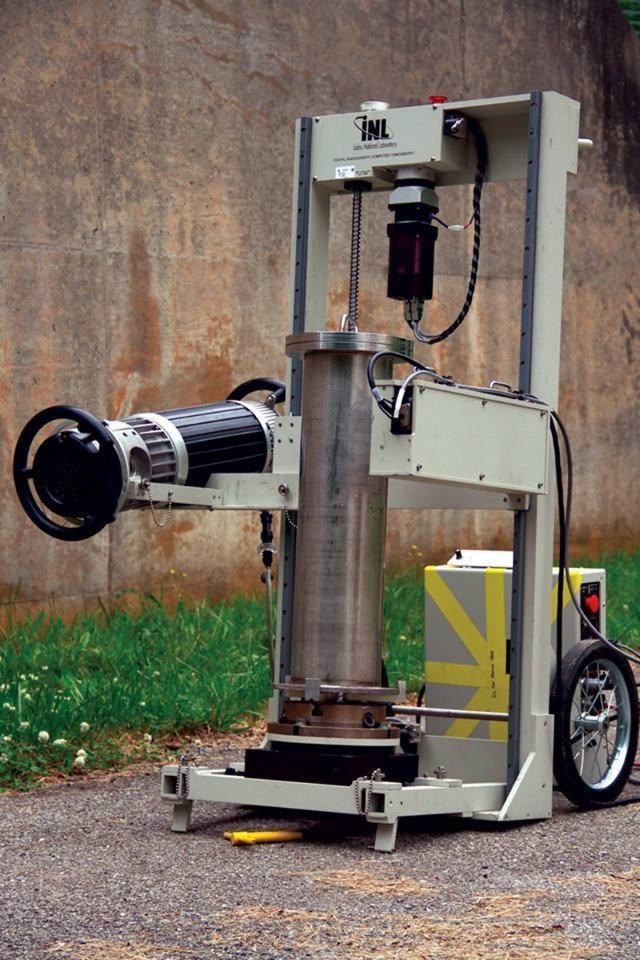
The Digital Radiography and Computed Tomography, or DRCT, technology is a transportable, non-intrusive assessment system that analyzes and provides on-site information about the contents of unidentified munitions without opening them. This greatly reduces risk to the public, workers and emergency response personnel by rapidly obtaining detailed information and distributing it to the appropriate authorities and responders. View original The Portable Isotopic Neutron Spectroscopy (PINS)
The Recovered Chemical Materiel Directorate uses PINS as a transportable non-intrusive assessment system to analyze and provide on-site information about the contents of unidentified munitions without opening them. This greatly reduces risk to the public, workers and emergency response personnel by rapidly obtaining detailed information and distributing it to the appropriate authorities and responders.

CMA uses the Portable Isotopic Neutron Spectroscopy, or PINS, as a transportable non-intrusive assessment system to analyze and provide on-site information about the contents of unidentified munitions without opening them. This greatly reduces risk to the public, workers and emergency response personnel by rapidly obtaining detailed information and distributing it to the appropriate authorities and responders. View original Raman Spectrometer
The Raman Spectrometer identifies the contents of Chemical Agent Identification Sets (CAIS), glass vials containing various agents and industrial chemicals once used to train soldiers. The Raman Spectrometer rapidly obtains detailed information about suspect chemical warfare materiel and distributes that information to the appropriate authorities and responder personnel, greatly reducing the risk to the public, workers and emergency response personnel.

Raman Spectrometer - Using a fiber optic probe and laser, Raman identifies the contents of Chemical Agent Identification Sets (CAIS), glass bottles containing agents and industrial chemicals once used to train Soldiers. View original -
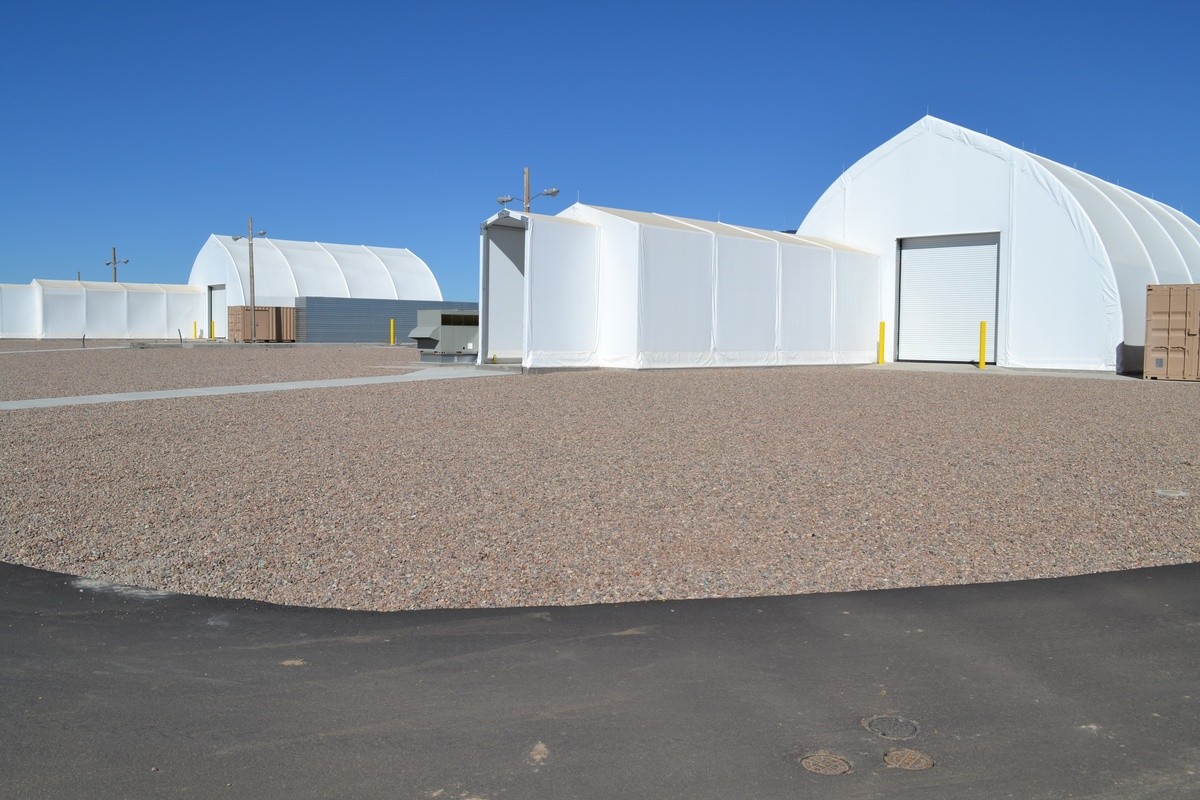
Recovered Chemical Warfare Materiel (RCWM) requires safe and secure storage pending destruction due to their often-deteriorated conditions. Interim holding facilities (IHF) provide safe, temporary storage for recovered chemical warfare materiel at sites where storage facilities, such as igloos and bunkers, are unavailable.
Interim Holding Facilities (IHF)
Engineers developed stringent construction and safety requirements for the IHF. The IHF’s design allows for the installation of a chemical agent filtration system, if necessary. The facilities consist of fireproof and corrosion-resistant materials. Light switches and fixtures, outlets and air conditioners must meet strict non-explosive design requirements to reduce the risk of fire inside the IHF. Additionally, the IHF includes a secondary containment area below the floor that would contain liquids should a leak occur. The IHF includes high-security locks and remains enclosed in a fenced area. Automatic lights attached to the IHF maximize lighting at night. Additionally, a visual security system and agent monitoring of the IHF is conducted until the recovered items are removed for treatment.

Interim holding facilities (IHF) - Recovered chemical munitions require safe and secure storage pending destruction due to their often-deteriorated conditions. Interim holding facilities (IHF) provide safe, temporary storage for recovered chemical warfare materiel at sites where storage facilities, such as igloos and bunkers, are unavailable. View original -
ANALYSIS
The U.S. Department of Defense has tested and disposed of chemical warfare materiel at military installations in the United States and its territories since 1918. These sites include active military installations, closed installations, land turned over to other government agencies and land transferred to private ownership. Range clearing operations and environmental remediation activities will often unearth old chemical warfare materiel.
Materiel Assessment Review Board
In January 1995, the U.S. Army Materiel Command (AMC) established the Materiel Assessment Review Board, or MARB, to make decisions for the Department of the Army regarding recovered suspected chemical warfare materiel. Many munitions and containers recovered from old burial sites at these installations lack identifying marks due to age and condition. This makes identification difficult and requires the use of non-destructive and non-intrusive methods to identify the item, its fill and status of its firing abilities. The MARB aids in the Army’s effort to accurately assess and treat recovered chemical warfare materiel.
-
PROJECT PLANNING
In addition to extensive assessment and destruction experience, RCMD possesses the programmatic, logistic and project management expertise to meet the needs of the Recovered Chemical Warfare Materiel (RCWM) Program.
Project Planning includes:
- Permit establishment and renewal
- Public outreach and awareness
- Safety training and compliance
- Logistical coordination
- Mission team and resources coordination
- Material procurement
- Mission execution supervision

Chemical Materials Activity employee project planning. View original -
★DESTRUCTION
When items are identified as chemical filled, destruction technologies safely and effectively destroy munitions of all shapes and sizes — providing complete containment of the neutralization process while protecting operators, the community and environment. RCMD maintains and deploys the following destruction technologies: Explosive Destruction System (EDS), Single CAIS Access and Neutralization System (SCANS), Transportable Detonation Chamber (TDC), Large Item Transportable Access and Neutralization System (LITANS) and Magnetic Induction Decontamination System (MIDS).
Explosive Destruction System (EDS)
The Explosive Destruction System (EDS) provides on-site treatment of chemical warfare materiel in a safe, environmentally compliant manner.

The Explosive Destruction System (EDS) provides on-site treatment of chemical warfare materiel in a safe, environmentally sound manner. As an innovative alternative to the open detonation of explosively configured munitions, the EDS supports both planned and quick-response munition recovery operations. View original Large Item Transportable Access and Neutralization System (LITANS)
The LITANS treats large RCWM items, such as ton containers, that are not treatable through other RCMD technologies.

Large Item Transportable Access and Neutralization System LITANS treats large RCWM items, such as ton containers, that are not treatable through other RCMD technologies. (U.S. Army photo by U.S. Army Chemical Material Activity) View original ★ VIEW THE LITANS FACT SHEET ★
Single CAIS Access and Neutralization System (SCANS)
The SCANS is a portable chemical reactor system that treats small quantities of chemical agent found in CAIS items. CAIS items were used to train Soldiers in the identification and disposal of chemical agent.
Single CAIS Access and Neutralization System (SCANS) - This portable chemical reactor system destroys small quantities of chemical agent found in Chemical Agent Identification Set (CAIS) items. View original -
WASTE DISPOSAL
Destruction of chemical warfare materiel results in the creation of secondary waste. The Recovered Chemical Materiel Directorate (RCMD) disposes of secondary waste at permitted commercial treatment, storage and disposal facilities.

Waste Drums - After chemical warfare materiel is neutralized, liquid waste is drained from the vessel of CMA RCMD’s Explosive Destruction System to 55-gallon waste drums, which make up the EDS waste transfer subsystem. View original Secondary Waste
This waste includes neutralents and remaining compounds that, although a byproduct of chemical weapons material destruction, are free of compounds controlled by the Chemical Weapons Convention (CWC) treaty. The handling and disposal of this waste remains consistent with methods used for disposal of hazardous and non-hazardous waste, which is regulated by federal and state agencies to ensure safe handling.
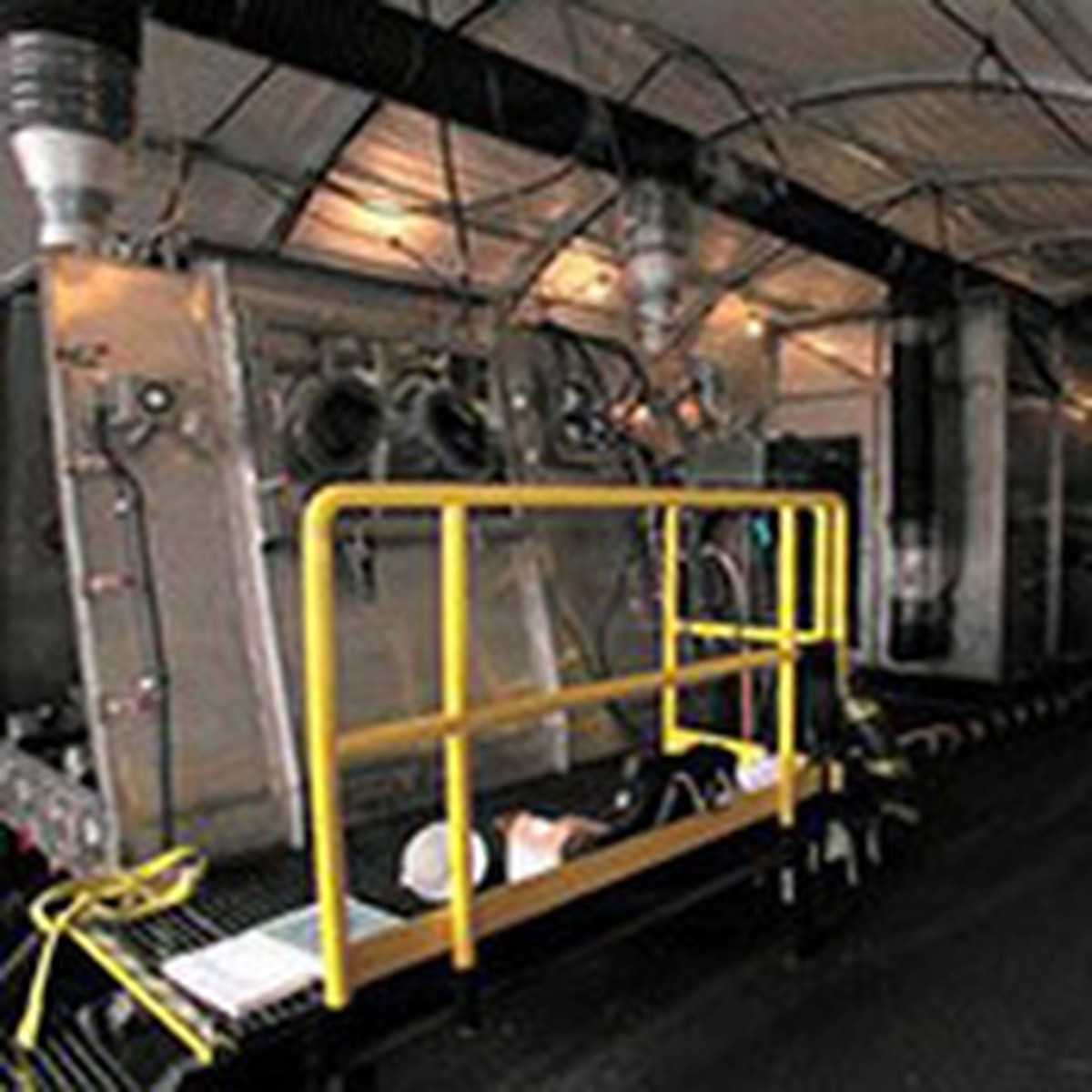
RCMD disposes of chemical materiel in a safe, environmentally compliant and cost-effective manner, ensuring compliance with the CWC. This may include chemicals and equipment used to produce some types of weapons, items recovered from military ranges and test kits once used to train Soldiers about chemical weapons.





RCMD HISTORY
The U.S. Army Non-Stockpile Chemical Materiel Project (NSCMP) was created in 1992 to support the assessment and treatment of chemical warfare materiel that was not part of the nation’s chemical weapons stockpile.
NSCMP’s expertise has transferred to the Recovered Chemical Materiel Directorate (RCMD), U.S. Army Chemical Materials Activity (CMA). RCMD leads the nation in the development and utilization of advanced technology to treat recovered chemical warfare materiel.
TREATY COMPLIANCE
In compliance with the treaty, CMA RCMD was tasked with destroying all non-stockpile chemical weapons and former chemical warfare production facilities. CMA RCMD safely completed all major treaty destruction missions ahead of schedule. CMA RCMD continues to assess and destroy RCWM as it is recovered, reporting all declared items to the Organization for the Prohibition of Chemical Weapons, the international organization that verifies treaty compliance.
CMA RCMD PERSONNEL & EQUIPMENT
Provide tools, tactics and technologies to strengthen the Soldier’s knowledge base in the assessment and treatment of chemical warfare materiel.
Proven, transportable assessment technologies to quickly respond to planned and unplanned recoveries on site, most often in response to items unearthed during range clearing operations and from relic burial sites.
On-site destruction of RCWM using proven technologies that safely and effectively neutralize chemical warfare materiel while protecting operators, the community and the environment.
RCWM ASSESSMENT & TREATMENT
When an item of chemical and explosive concern is recovered, CMA RCMD deploys its proven assessment technologies to the site to determine whether a munition is explosively configured or contains chemical agent.
When items are identified as containing chemical agent, CMA RCMD treatment technologies safely and effectively destroy munitions of all shapes and sizes, providing complete containment of the neutralization process while protecting operators, the community and the environment.
Not all assessments result in a finding of recovered chemical warfare materiel. If the item does not contain chemical warfare materiel, it is disposed of locally.
RCMD ACHIEVEMENTS
- RCMD leads the Nation in the development and use of advanced technology to treat recovered chemical warfare materiel, while protecting the public, its workers and the environment.
- As of July 2024, RCMD had destroyed more than 3,800 items using the Explosive Destruction System (EDS) in a steadily growing record of safety and efficiency.

REDSTONE CHEMICAL ACTIVITY
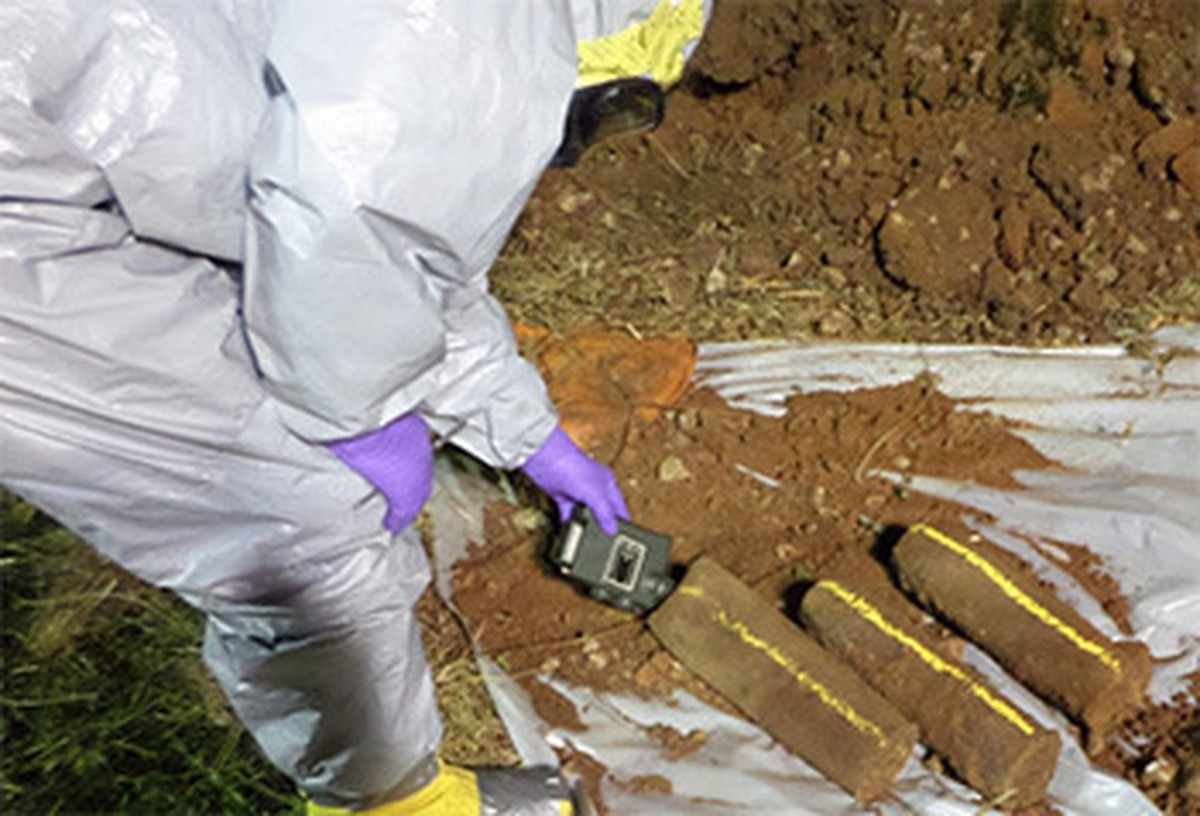
CMA stood up Redstone Chemical Activity (CMA RCA) to support the Army’s investigative, environmental remediation and storage activities at Redstone Arsenal in Huntsville, Alabama. Due to its historical position as a center for chemical weapons production, storage, evaluation and demilitarization, the arsenal has the potential for a large amount of recovered chemical warfare materiel (RCWM). CMA RCA’s four primary areas of responsibility are storage, commodity management, security, and technical expertise.
STORAGE
CMA RCA is responsible for the safe and regulatory-compliant storage of all RCWM, conventional munitions and explosives, and miscellaneous wastes generated during investigative and remediation operations. The Activity is also tasked with supporting emergency response and providing courtesy storage of explosive waste derived from other organizations at Redstone.
CMA RCA researches and provides packaging configurations for all hazardous waste, waste military munitions, and RCWM in compliance with Title 49 of the Code of Federal Regulations. CMA RCA coordinates Special Packaging Instructions and Interim Hazard Classifications for items without a prescribed package method. CMA RCA ensures compliance with the Alabama Department of Environmental Management Hazardous Waste Resource Conservation and Recovery Act permit, including conducting and documenting required storage inspections.
COMMODITY MANAGEMENT
CMA RCA performs and validates inventory and accountability of RCWM, all unknown conventional munitions and explosives recovered during investigative and remediation activities, as well as hazardous wastes generated.
Accountability for all RCWM recovered at the Arsenal is accomplished through the Chemical Accountability Management Information Network (CAMIN), which is managed by CMA. CMA RCA also provides external custodial support for CAMIN input and maintains a local database to track all recovered materiel through final disposition.
TECHNICAL EXPERTISE
CMA RCA is the focal point for explosives safety in transportation, storage, packaging and handling for all operations of recovered materiel, providing direct support to the U.S. Army Garrison-Redstone Arsenal (USAG-RSA), CBRNE (Chemical, Biological, Radiological, Nuclear, Explosive) Analytical and Remediation Activity–Remediation Response West, U.S. Army Corps of Engineers - Huntsville, and the site contractor.
CMA RCA provides local certification and recertification of overpack containers used at Redstone, participates in site-planning efforts and reviews of storage operations plans and procedures for compliance with Army and Department of Defense explosives safety requirements, and develops and submits explosive waivers and deviations for approval. CMA RCA provides external support as needed for Army chemical training instruction for the Defense Ammunition Center, Combatant Command (COCOM), and backup CAMIN support for CMA headquarters.
CMA RCA additionally provides support for the Prototype Recovered Ordnance Destruction System being established at USAG-RSA for destruction of recovered conventional munitions. The CMA Recovered Chemical Materiel Directorate owns, maintains, and deploys the Explosive Destruction System to destroy RCWM and will work closely with CMA RCA for any recovered at Redstone Arsenal.


RCA QUICK FACTS - SECURITY
- The CMA RCA Commander is the primary custodian and administrator of the Ammunition and Explosives Key and Lock Program for the 8200 Block storage area.
- CMA RCA controls and provides authorized access to the 8200 Block storage area on an as-needed basis and generates, maintains, and updates the Key Custodian and Key Holder lists in accordance with Army physical security requirements.
Resources
-
Scroll our photo gallery, share & download CMA photos:

1 / 106 Recent environmental restoration efforts at Pine Bluff Arsenal in Arkansas included more than 7,100 Chemical Agent Identification Sets (CAIS) K-941 bottles, once used for training soldiers in the safe identification and handling of chemical agent. View original 
2 / 106 The Digital Radiography and Computed Tomography (DRCT) uses X-ray photography to product high-quality images of an item's interior (seen here) to show if the munition contains a liquid fill and explosive content. View original 
3 / 106 Operators confirm treatment success by sampling residual liquid and air from the vessel prior to reopening the Explosive Destruction System (EDS). View original 
4 / 106 The U.S. Army Corps of Engineers conducts environmental restoration activities at Pine Bluff Arsenal, Arkansas. Once recovered, RCMD responds to any suspect recovered chemical warfare materiel to assess for safe handling and storage until destruction operations. View original 
5 / 106 CMA can quickly respond to unplanned CWM recoveries on site; such recoveries are most often in response to CWM unearthed during range clearing operations and from relic burial sites. View original 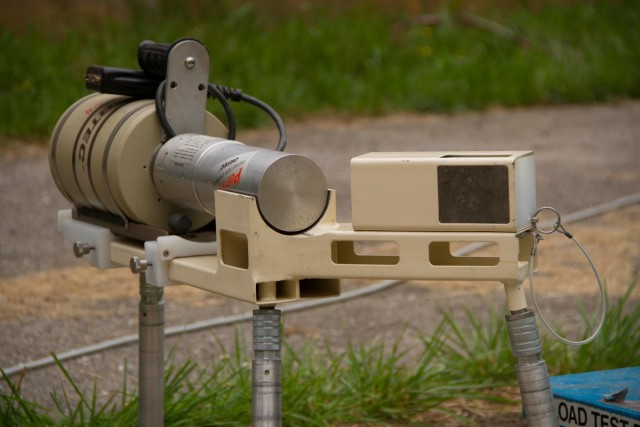
6 / 106 CMA Munitions Disposal - May 21, 2013 View original 
7 / 106 CMA Munitions Disposal - May 21, 2013 View original 
8 / 106 CMA Munitions Disposal - May 21, 2013 View original 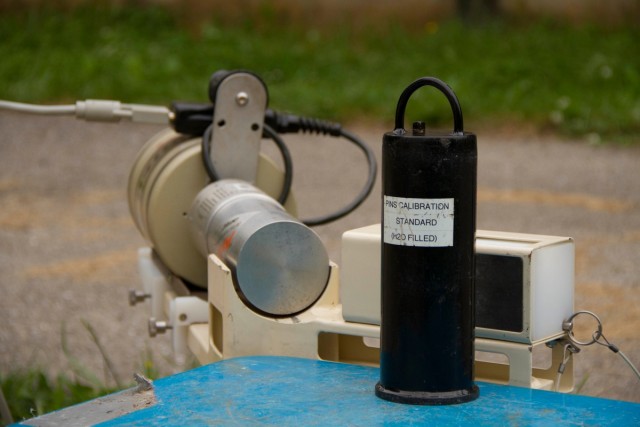
9 / 106 CMA Munitions Disposal - May 21, 2013 View original 
10 / 106 CMA Munitions Disposal - May 21, 2013 View original 
11 / 106 CMA Munitions Disposal - May 21, 2013 View original 
12 / 106 CMA Munitions Disposal - May 21, 2013 View original 
13 / 106 The Explosive Destruction System (EDS) provides on-site treatment of chemical warfare materiel in a safe, environmentally sound manner. As an innovative alternative to the open detonation of explosively configured munitions, the EDS supports both planned and quick-response munition recovery operations. View original 
14 / 106 CMA Munitions Disposal - May 21, 2013 View original
15 / 106 The Digital Radiography and Computed Tomography, or DRCT, technology is a transportable, non-intrusive assessment system that analyzes and provides on-site information about the contents of unidentified munitions without opening them. This greatly reduces risk to the public, workers and emergency response personnel by rapidly obtaining detailed information and distributing it to the appropriate authorities and responders. View original 
16 / 106 Explosive Destruction System View original 
17 / 106 The EDS uses cutting charges to explosively access chemical munitions, eliminating their explosive capacity. Seen here, a pre-vessel shot. View original 
18 / 106 The EDS site is not a fixed size or layout. In general, the EDS is placed within a structure which is under a slight vacuum with a pollution abatement system using carbon filtration units. This configuration ensures that any potential vapor contamination from the operation is removed by the pollution abatement system. View original 
19 / 106 The EDS is mounted on a trailer, which transports easily where needed. View original 
20 / 106 The Explosive Destruction System (EDS) has a well-documented history of safe and successful operation, destroying recovered chemical warfare materiel at various sites throughout the United States.
Initial training and certification of the workforce followed by regular retraining and recertification help ensure safety is maintained. View original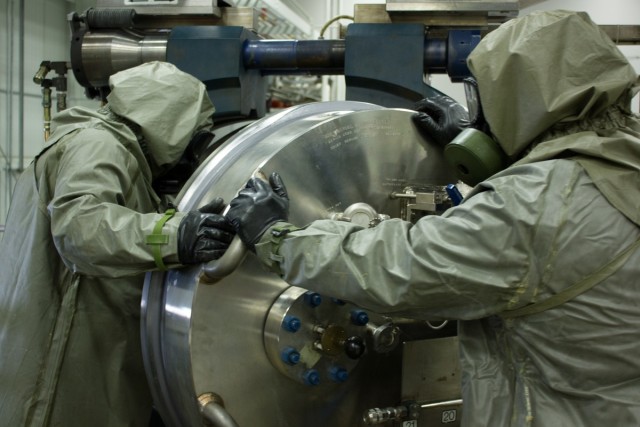
21 / 106 The Explosive Destruction System (EDS) has a well-documented history of safe and successful operation, destroying recovered chemical warfare materiel at various sites throughout the United States.
Initial training and certification of the workforce followed by regular retraining and recertification help ensure safety is maintained. View original
22 / 106 The Explosive Destruction System (EDS) has a well-documented history of safe and successful operation, destroying recovered chemical warfare materiel at various sites throughout the United States.
Initial training and certification of the workforce followed by regular retraining and recertification help ensure safety is maintained. View original
23 / 106 CMA uses the Mobile Munitions Assessment System (MMAS) to provide analysis of recovered items with unknown fills. The MMAS has three main tools: PINS, DRCT and the Raman Spectrometer. View original 
24 / 106 CMA uses the Mobile Munitions Assessment System (MMAS) to provide analysis of recovered items with unknown fills. The MMAS has three main tools: PINS, DRCT and the Raman Spectrometer. View original 
25 / 106 The Magnetic Induction Decontamination System (MIDS) decontaminates empty ton containers and scrap metal through thermal heating induced by magnetism. This generates less waste than a liquid rinse process and provides more thorough decontamination, along with increased safety, reduced environmental impact and quicker processing. View original
26 / 106 Multiple Round Container (MRC) - After suspect recovered chemical warfare materiel (RCWM) is discovered, Recovered Chemical Materiel Directorate dispatches equipment to non-intrusively determine if the items are explosively configured and contain a liquid fill. Once it is determined that an item contains chemical agent, operators package them in a Multiple Round Container (MRC) for safe storage and possible transport to the nearest military installation. View original 
27 / 106 Munitions are placed in a munitions holder and linear-shaped charges are attached along the munition bodies, prior to destruction. View original 
28 / 106 CMA uses PINS as a transportable non-intrusive assessment system to analyze and provide on-site information about the contents of unidentified munitions without opening them. This greatly reduces risk to the public, workers and emergency response personnel by rapidly obtaining detailed information and distributing it to the appropriate authorities and responders. View original
29 / 106 CMA uses the Portable Isotopic Neutron Spectroscopy, or PINS, as a transportable non-intrusive assessment system to analyze and provide on-site information about the contents of unidentified munitions without opening them. This greatly reduces risk to the public, workers and emergency response personnel by rapidly obtaining detailed information and distributing it to the appropriate authorities and responders. View original 
30 / 106 Using a fiber optic probe and laser, Raman identifies the contents of Chemical Agent Identification Sets (CAIS), glass bottles containing agents and industrial chemicals once used to train Soldiers. View original 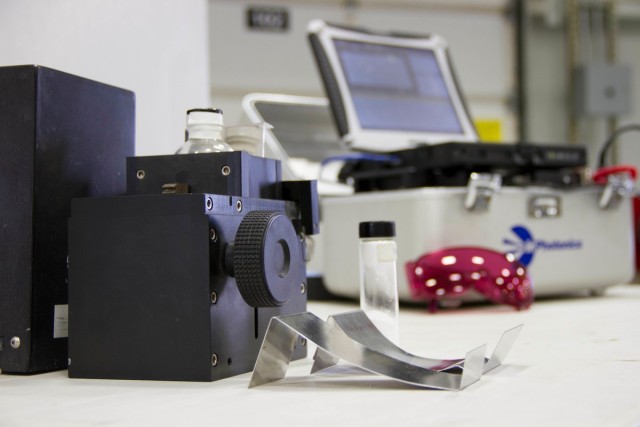
31 / 106 Using a fiber optic probe and laser, Raman identifies the contents of Chemical Agent Identification Sets (CAIS), glass bottles containing agents and industrial chemicals once used to train Soldiers. View original
32 / 106 Raman Spectrometer - Using a fiber optic probe and laser, Raman identifies the contents of Chemical Agent Identification Sets (CAIS), glass bottles containing agents and industrial chemicals once used to train Soldiers. View original
33 / 106 Single CAIS Access and Neutralization System (SCANS) - This portable chemical reactor system destroys small quantities of chemical agent found in Chemical Agent Identification Set (CAIS) items. View original 
34 / 106 CMA can quickly respond to unplanned CWM recoveries on site; such recoveries are most often in response to CWM unearthed during range clearing operations and from relic burial sites. View original 
35 / 106 Exercises are important for measuring CSEPP’s performance and testing emergency plans, and CSEPP training gives emergency responders skills and knowledge they can use every day. View original 
36 / 106 State and county partners, along with the U.S. Army and Federal Emergency Management Agency, practice keeping the public safe in the unlikely event of a chemical stockpile accident. Seen here, a mock news release distributed during an exercise. View original 
37 / 106 CSEPP protects people who live and work near installations with chemical stockpiles in the unlikely event of a chemical accident or incident. View original 
38 / 106 A Blue Grass Army Depot policeman checks on a volunteer posing as a recovering casualty during the June 2016 Chemical Accident or Incident Response and Assistance (CAIRA) exercise. A trained evaluator records his observations in the background. View original 
39 / 106 In 1988, the U.S. Army and FEMA Federal Emergency Management Agency establish the Chemical Stockpile Emergency Preparedness Program (CSEPP) in response to Public Law 99-145, which requires added public protection for communities around the chemical stockpiles. View original 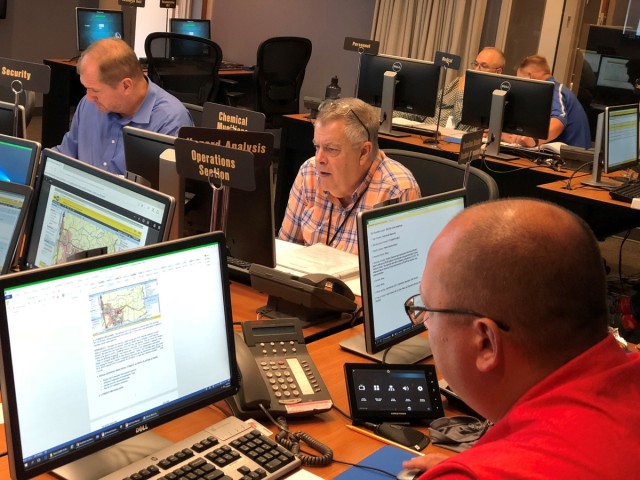
40 / 106 Chemical stockpile emergency preparedness capabilities are tested each year during exercises. View original 
41 / 106 Chemical stockpile emergency preparedness exercises are held in communities surrounding the two remaining chemical weapons stockpiles at Blue Grass Chemical Depot, Kentucky, and Pueblo Chemical Depot, Colorado, each year. The communities and states join the Army and FEMA to practice keeping the public safe in the unlikely event of a chemical stockpile accident. CSEPP training gives emergency responders – such as police officers, firefighters and emergency medical teams – skills and knowledge they can use every day. View original 
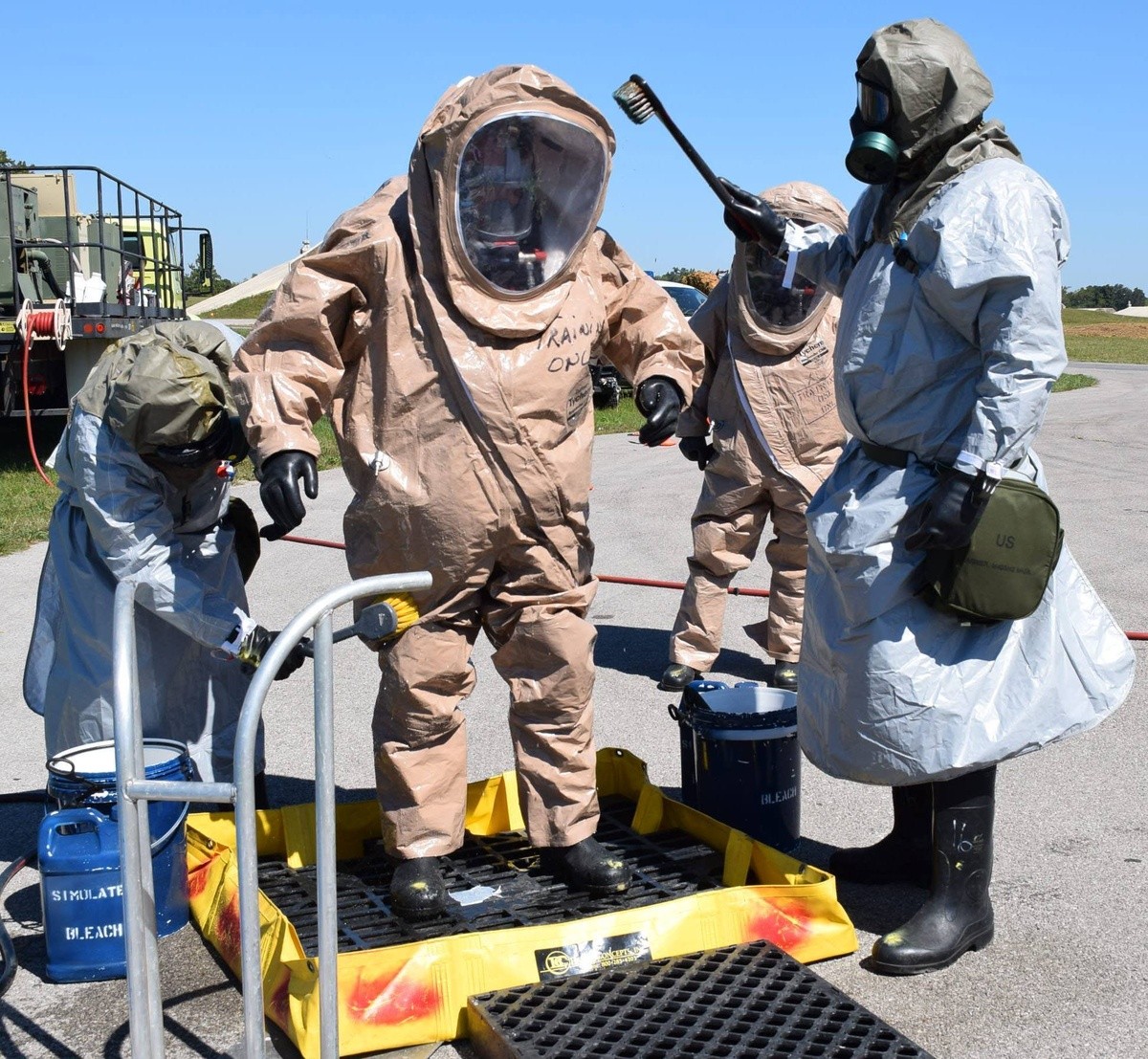
42 / 106 Exercise evaluators assess Toxic Material Handlers dressed in Level A personal protective equipment as they take part in a Chemical Accident or Incident Response and Assistance (CAIRA) exercise. View original 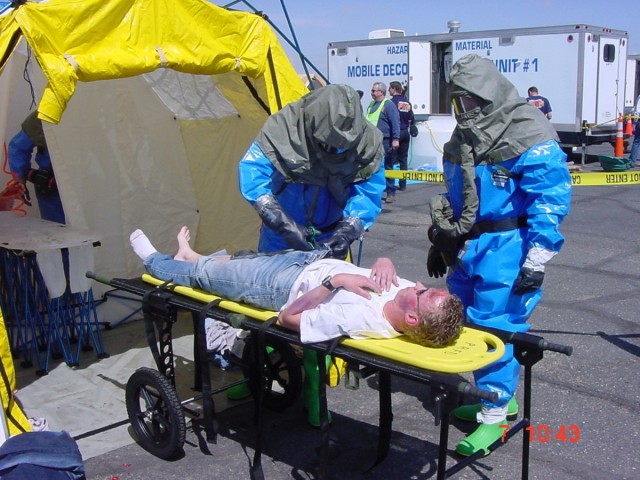
43 / 106 CSEPP training gives emergency responders – such as police officers, firefighters and emergency medical teams – skills and knowledge they can use every day. View original 
44 / 106 Personnel pull the first treaty sample at the treaty office facility View original 
45 / 106 Jonathan Strunk (left) and James Nunn (right), Blue Grass Chemical Activity toxic materials handlers, work together to guide training munitions into an enhanced on-site container during munitions movement training in the chemical limited area at the Blue Grass Army Depot on Feb. 13, 2019. (U.S. Army photo by Angela Messinger, releasable) View original 
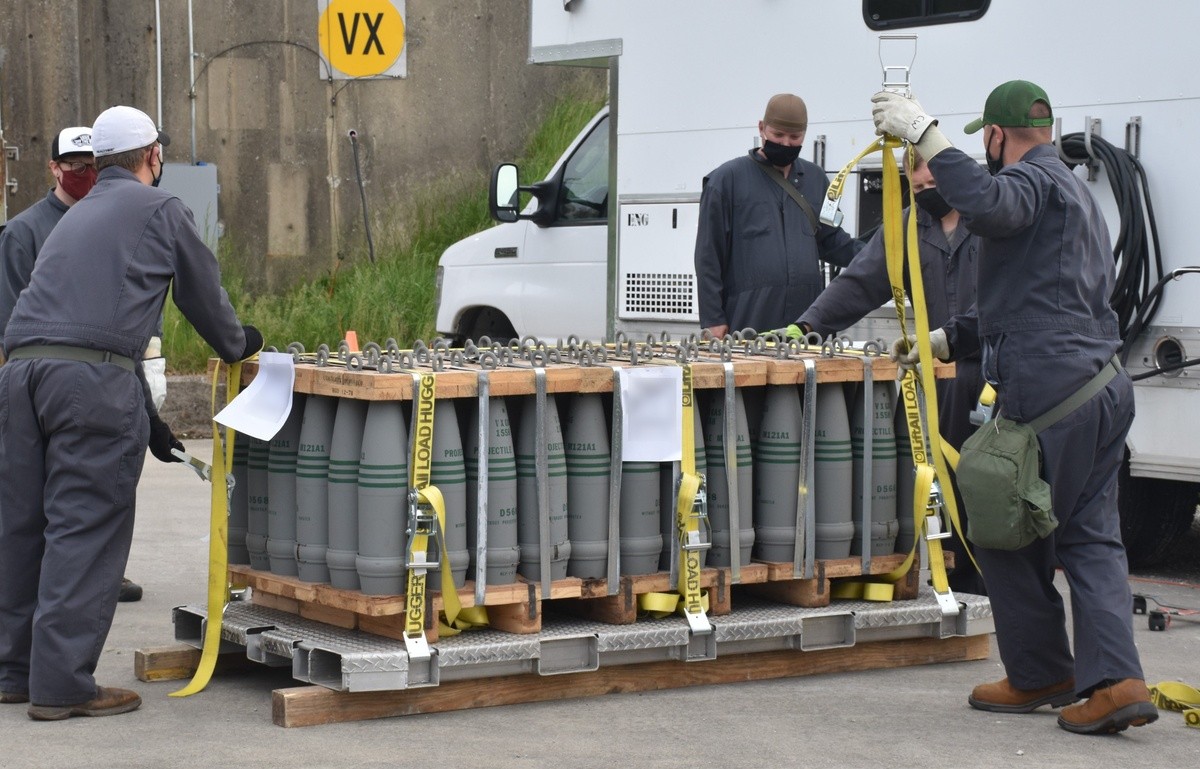
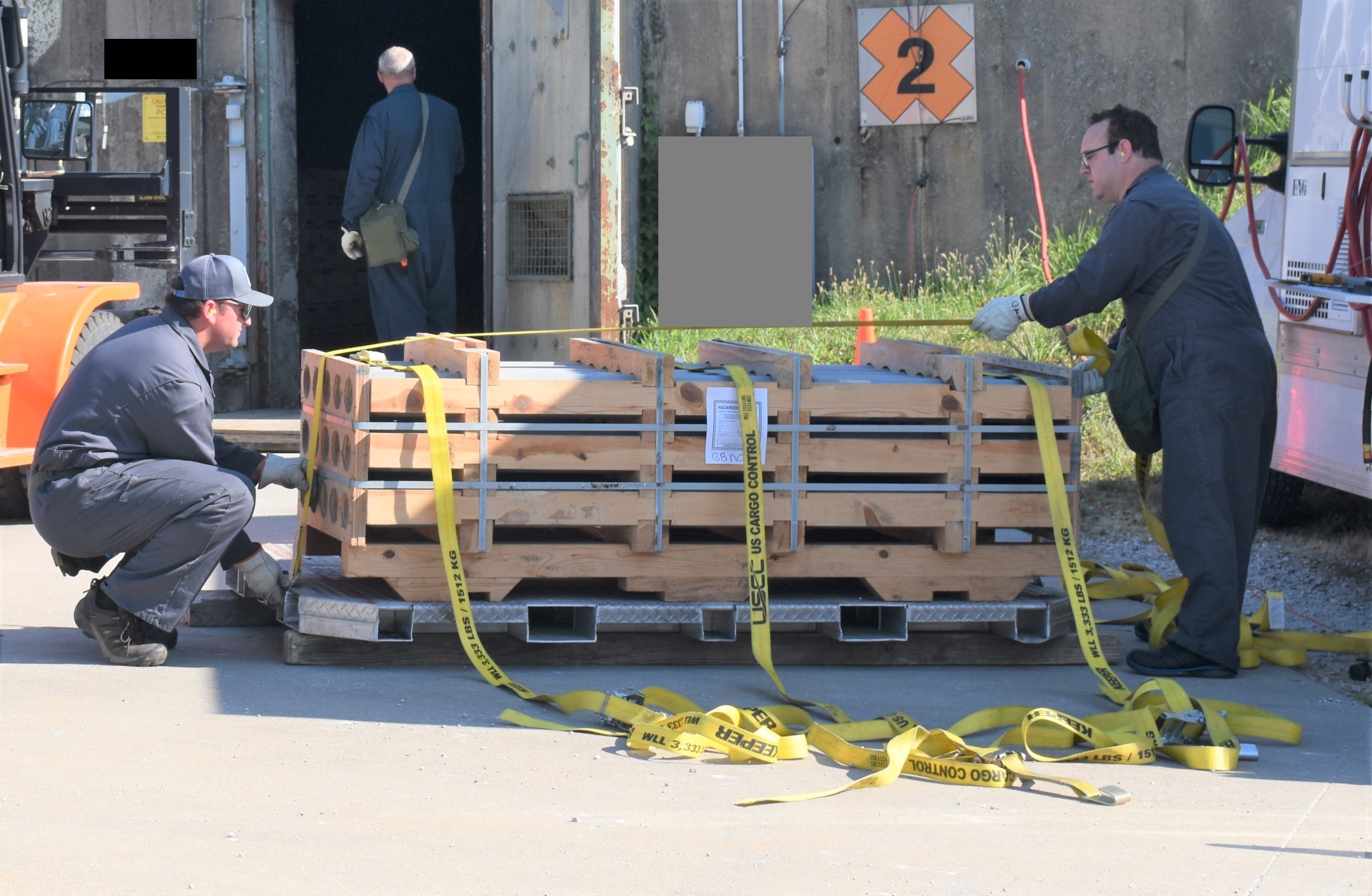
46 / 106 Jonathan Strunk (left) and Timothy McClish (right), Blue Grass Chemical Activity toxic materials handlers, use straps to secure munitions onto a pallet during munitions movement training while Nichole Mego (center), BGCA inventory specialist, observes at the Blue Grass Army Depot Feb. 19, 2019. (U.S. Army photo by Angela Messinger, releasable) View original 
47 / 106 Michael Tanner (left), Blue Grass Chemical Activity inventory specialist, transfers custody of training weapons to Justin Harris (right), Blue Grass Chemical Agent-Destruction Pilot Plant contract employee, during a joint training exercise in the chemical limited area at the Blue Grass Army Depot Feb. 19, 2019. (U.S. Army photo by Angela Messinger, releasable) View original 
48 / 106 The Recovered Chemical Materiel Directorate’s (RCMD) Logistics and Maintenance team is responsible for the training of all personnel who operate RCMD’s Explosive Destruction System (EDS). Using inert munitions, operators train on loading the vessel of the EDS. (Photo: Jessica Tayson, U.S. Army CMA RCMD Public Affairs) View original 
49 / 106 RCMD’s Logistics and Maintenance team requires all EDS operators to undergo initial training as well as an annual refresher course. Knowledge-based and on-the-job training and testing provide the basis for learning the requirements of the task, job and mission execution. (Photo: Jessica Tayson, U.S. Army CMA RCMD Public Affairs) View original 
50 / 106 RCMD Logistics and Maintenance team ensures a steady flow of the parts and consumables required for the mission. (Photo: Jessica Tayson, U.S. Army CMA RCMD Public Affairs) View original 
51 / 106 The Logistics and Maintenance team at RCMD manages a large warehouse at Aberdeen Proving Ground, Md., where the technology, spare parts and other consumables required for an EDS mission are stored. (Photo: Jessica Tayson, U.S. Army CMA RCMD Public Affairs) View original 
52 / 106 BGCA toxic materials handlers guide the last of the GB projectiles into an enhanced on-site container for delivery to the Blue Grass Chemical Agent-Destruction Pilot Plant for demilitarization. View original 
53 / 106 BGCA personnel stand in the last GB projectile earth-covered magazine, now emptied of munitions. View original 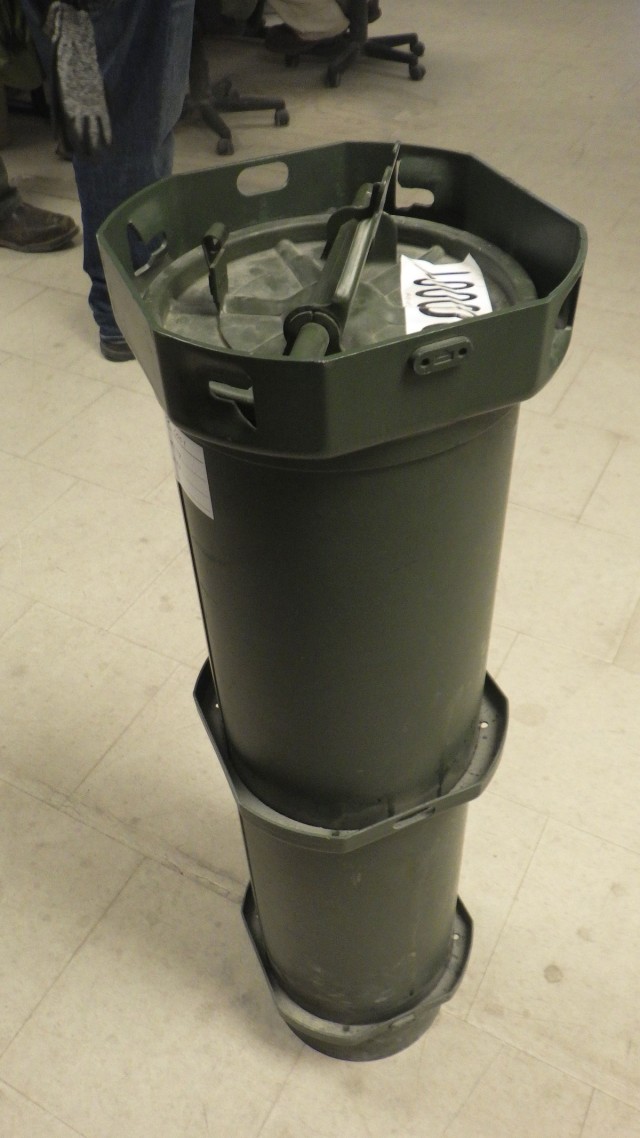
54 / 106 Pueblo Chemical Depot (PCD) and its higher headquarters, U.S. Army Chemical Materials Activity (CMA), developed a unique way to contain chemical agent munition rejects through the use of Propelling Charge Canisters (PCC). Use of PCCs has saved approximately $125,000 to date and ensured the demilitarization of chemical weapons is not interrupted. PCD is projected to receive 1,600 PCCs, ultimately saving the Department of the Army more than $4 million. View original 
55 / 106 Pueblo Chemical Depot (PCD) and its higher headquarters, U.S. Army Chemical Materials Activity (CMA), developed a unique way to contain chemical agent munition rejects through the use of Propelling Charge Canisters (PCC). Use of PCCs has saved approximately $125,000 to date and ensured the demilitarization of chemical weapons is not interrupted. PCD is projected to receive 1,600 PCCs, ultimately saving the Department of the Army more than $4 million. View original 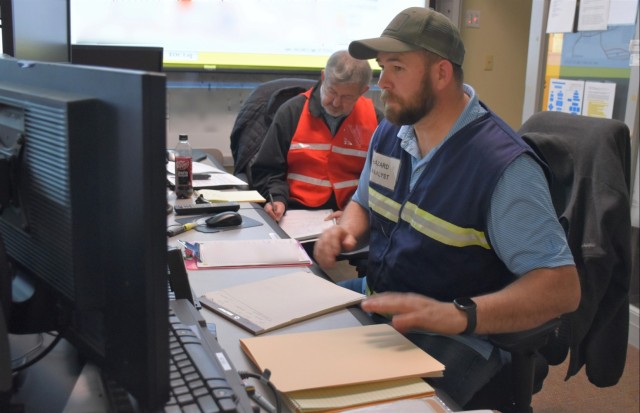
56 / 106 A technician in the BGCA emergency operations center runs hazard models as an evaluator takes notes during a recent exercise. View original 
57 / 106 The team that supported the delivery of the final pallet of GB rockets. View original 
58 / 106 BGCA chemical crews load the final pallet of GB rockets into an enhanced on-site container. View original 
59 / 106 BGCA chemical crews, quality assurance and inventory personnel prepare the final pallet of GB rockets to load into an enhanced on-site container. View original 
60 / 106 Abraham Aster, left, toxic materials handler supervisor, describes chemical field operations team safety procedures to Bradley Renwick, Edward Jerome and Kimberly Hollis, Department of Defense Safety Management Center of Excellence evaluators, at Blue Grass Army Depot on Feb. 12. (Photo credit: Angela Messinger Hurst) View original 
61 / 106 Anthony Dodson, protective equipment mechanic/inspector, fits an M40A1 mask on Bradley Renwick, Department of Defense Safety Management Center of Excellence evaluator, at Blue Grass Army Depot on Feb. 12. (Photo credit: Jana Felts) View original 
62 / 106 Rockie Robinson, physical science technician, describes the chemical storage igloo air monitoring process to Bradley Renwick and Edward Jerome, Department of Defense Safety Management Center of Excellence evaluators, at Blue Grass Army Depot on Feb. 12. (Photo credit: Angela Messinger Hurst) View original 
63 / 106 Blue Grass Chemical Activity and Pueblo Chemical Depot store munitions securely in earth-covered bunkers called igloos. Designed specifically to protect their contents from external factors such as storms, lightning and other weather-related events, the igloos are equipped with a rear vent and a dual lightning protection system. Aside from a 24/7 guard force, there are a number of other physical and electronic safeguards that protect this stockpile. View original 
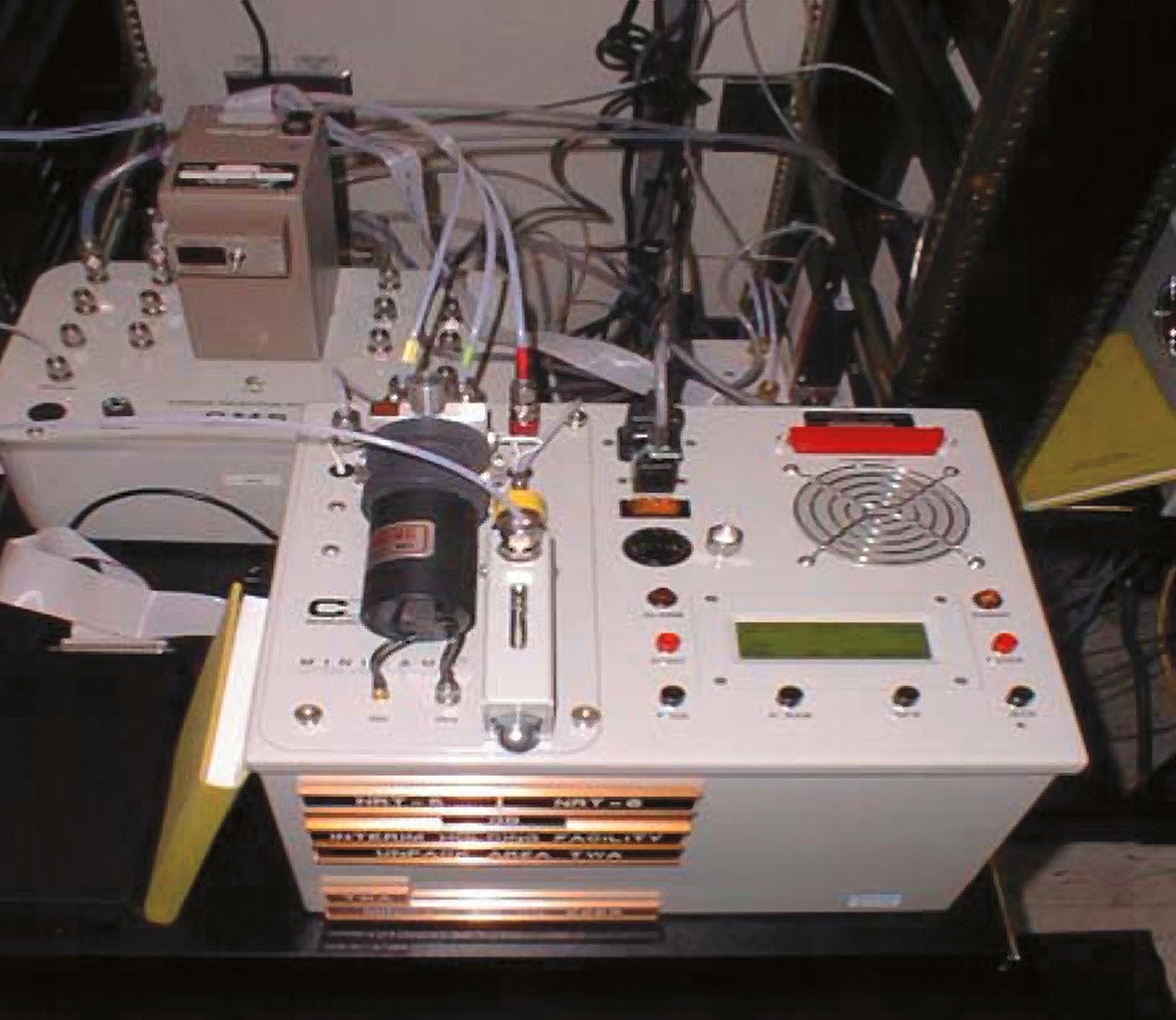
64 / 106 The Real Time Analytical Platform (RTAP) is a self-contained mobile monitoring and detection system. Blue Grass Chemical Activity RTAPs use gas chromatographs called Miniature Continuous Air Monitoring Systems (MINICAMS®) that can detect agent within three to five minutes.
The RTAP can detect chemical agent vapors at levels lower than those that would cause effects to unprotected persons. These levels are equal to the Department of Health and Human Services requirements to which unmasked workers can be exposed to agent for a 40-hour work week with no harmful effects. View original
65 / 106 Real Time Analytical Platforms use gas chromatographs called Miniature Continuous Air Monitoring Systems, or MINICAMS®, that can detect agent within three to five minutes. View original 
66 / 106 DAAMS, a manual monitoring system, has been used at stockpile and storage sites primarily to confirm the detection of agents and to conduct historical monitoring levels. View original 
67 / 106 Blue Grass Chemical Activity and Pueblo Chemical Depot store munitions securely in earth-covered bunkers called igloos. Designed specifically to protect their contents from external factors such as storms, lightning and other weather-related events, the igloos are equipped with a rear vent and a dual lightning protection system. Aside from a 24/7 guard force, there are a number of other physical and electronic safeguards that protect this stockpile. View original 
68 / 106 Blue Grass Chemical Activity and Pueblo Chemical Depot store munitions securely in earth-covered bunkers called igloos. Designed specifically to protect their contents from external factors such as storms, lightning and other weather-related events, the igloos are equipped with a rear vent and a dual lightning protection system. Aside from a 24/7 guard force, there are a number of other physical and electronic safeguards that protect this stockpile. View original 
69 / 106 All weapons are stored securely in earth-covered bunkers called igloos. Designed specifically to protect their contents from external factors such as storms, lightning and other weather-related events, the igloos are equipped with a rear vent and a dual lightning protection system. View original 
70 / 106 The chemical weapons at Blue Grass were received as far back as 1944. The majority of the nerve agent weapons arrived in the mid-60s. All weapons are stored securely in earth-covered bunkers called igloos. Designed specifically to protect their contents from external factors such as storms, lightning and other weather-related events, the igloos are equipped with a rear vent and a dual lightning protection system. The chemical stockpile is comprised of 523 tons of nerve agents GB and VX, and mustard agent in projectiles, warheads and rockets. View original 
71 / 106 Binary chemical weapons were designed to form lethal chemical agents by mixing two non-lethal chemicals during flight to a target. CMA safely completed destruction of the binary chemical weapon inventory. View original 
72 / 106 CMA Recovered Chemical Materiel Directorate View original 
73 / 106 With an impeccable safety and environmental stewardship record, the Explosive Destruction System operates within an environmental enclosure under negative pressure and carbon filters to ensure no agent or vapor is released into the atmosphere. Collectively, the destruction site at Pine Bluff Arsenal, Arkansas is known as the Pine Bluff Explosive Destruction System, or PBEDS for short. View original 
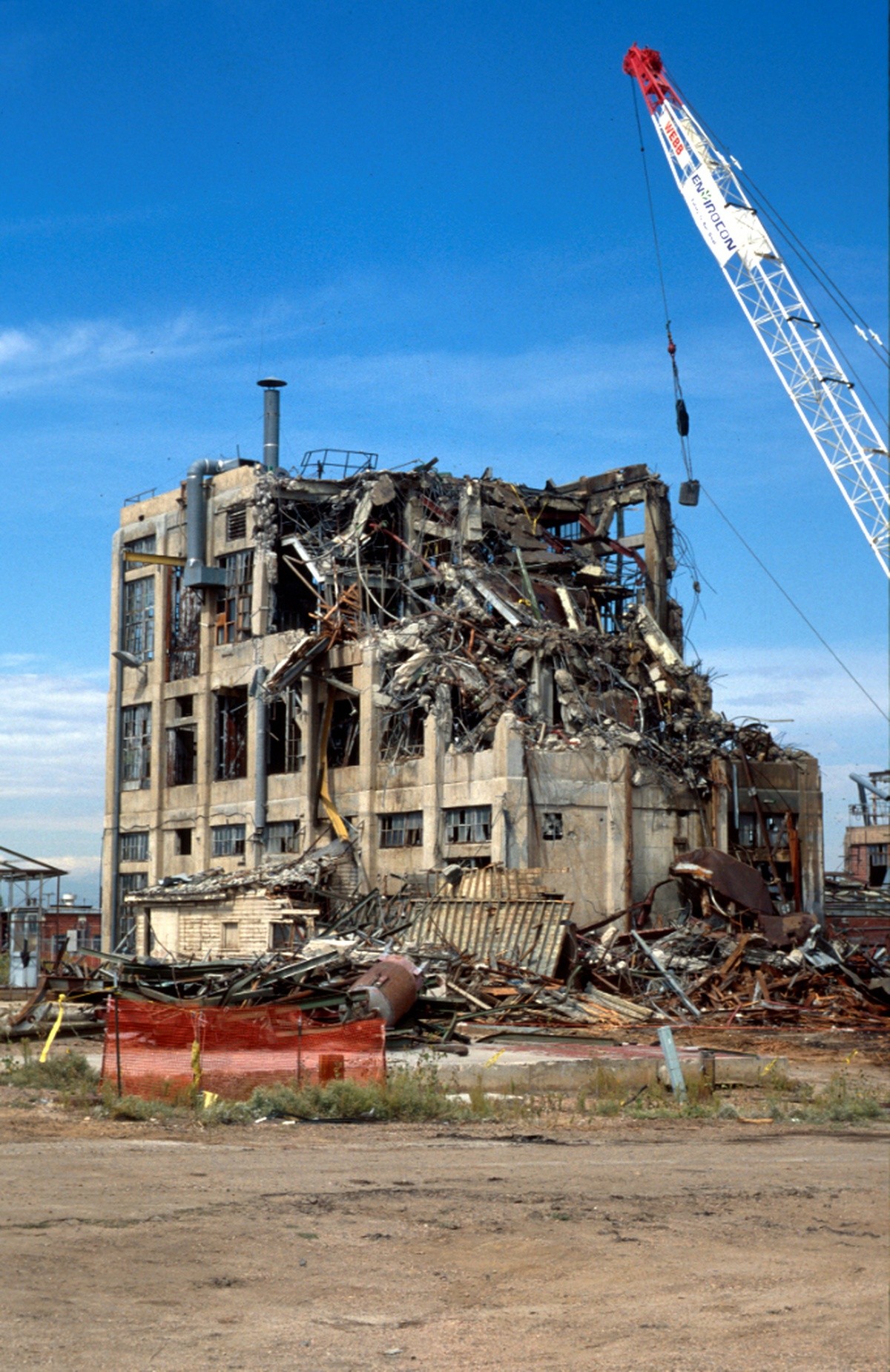
74 / 106 Former Chemical Warfare Production Facilities – Completed December 2006 (four months ahead of the deadline): These included government facilities and equipment that produced chemical agent, precursors and components for chemical weapons. NSCMP completed destruction of the facilities, located at Newport Chemical Depot, Indiana; Pine Bluff Arsenal, Arkansas; Rocky Mountain Arsenal, Colorado; Aberdeen Proving Ground, Maryland; and Muscle Shoals, Alabama. View original 
75 / 106 The EDS site layout, set up in accordance with all applicable laws and permit requirements, ensures the overall safety of the workers and the environment. View original
76 / 106 Interim holding facilities (IHF) - Recovered chemical munitions require safe and secure storage pending destruction due to their often-deteriorated conditions. Interim holding facilities (IHF) provide safe, temporary storage for recovered chemical warfare materiel at sites where storage facilities, such as igloos and bunkers, are unavailable. View original 
77 / 106 Blue Grass Chemical Activity toxic materials handlers move M56 rocket warheads in preparation for fuze removal operations. View original 
78 / 106 BGCA Chemical Accountability Management Information Network personnel verify weapons lot numbers prior to transferring custody to Blue Grass Chemical Agent-Destruction Pilot Plant workers. View original 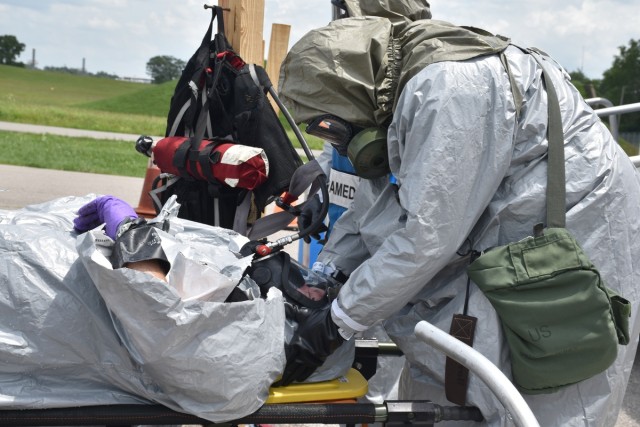
79 / 106 A Blue Grass Army Depot medic and a Blue Grass Chemical Activity toxic materials handler respond to a mock accident and injury during the pre-operational survey. View original 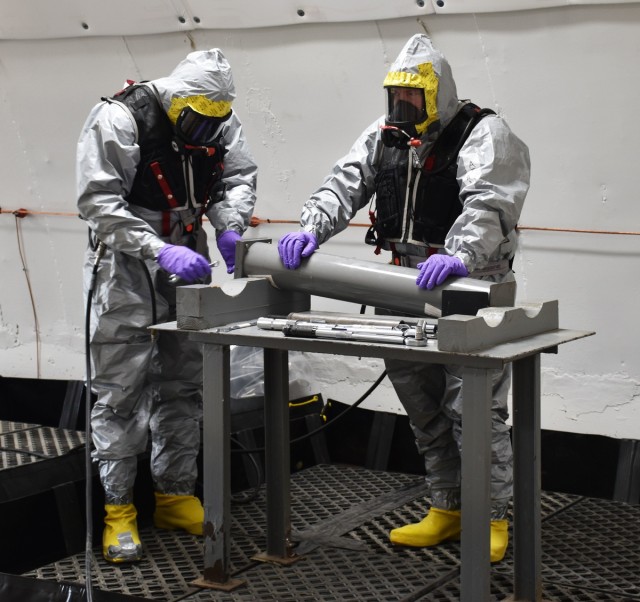
80 / 106 Chemical, Biological, Radiological, Nuclear and Explosives (CBRNE) Analytical and Remediation Activity (CARA) East personnel rehearse the fuze removal process during the pre-operational survey. View original 
81 / 106 BGCA real-time analytical platform operators monitor the VX projectile storage igloo for chemical agent release before workers enter, and continuously monitor until the igloo door is closed. View original 
82 / 106 BGCA toxic materials handlers guide the first of the VX projectiles into an enhanced on-site container for delivery to the Blue Grass Chemical Agent-Destruction Pilot Plant for demilitarization. View original 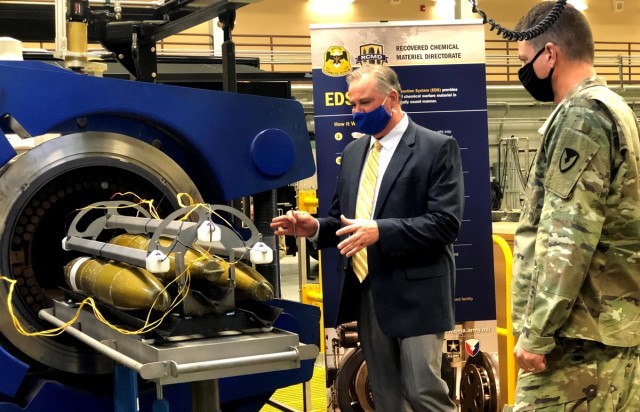
83 / 106 Chemical Materials Activity (CMA) Deputy Director Laurence G. Gottschalk briefs Col. Gavin J. Gardner, Commander of the Joint Munitions Command and Joint Munitions and Lethality Life Cycle Management Command, about the Explosive Destruction System (EDS) during a tour of CMA. The centerpiece of CMA Recovered Chemical Materiel Directorate’s destruction technology, the EDS destroys chemical warfare materiel in a safe and environmentally sound manner. View original 
84 / 106 Mr. Steven T. Bird, Explosive Destruction System Group leader for the Recovered Chemical Materiel Directorate, U.S. Army Chemical Materials Activity, explains the ground-breaking Pueblo Chemical Agent-Destruction Pilot Plant Explosive Destruction System project. View original 
85 / 106 Blue Grass Chemical Activity toxic materials handlers guide the last of the VX projectiles into an enhanced on-site container for delivery to the Blue Grass Chemical Agent-Destruction Pilot Plant for demilitarization. View original 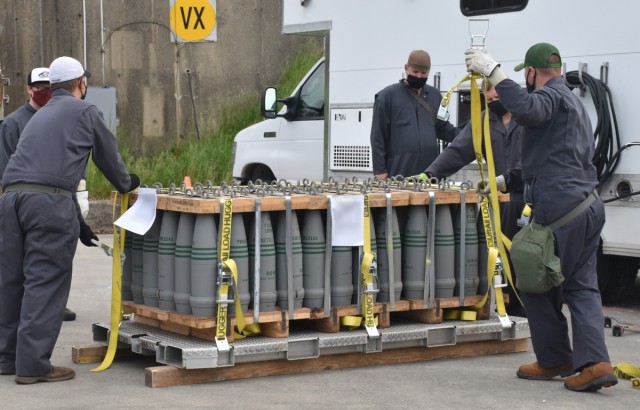
86 / 106 Blue Grass Chemical Activity personnel strap the last of the VX projectiles onto a tray for loading into an enhanced on-site container. View original 
87 / 106 The CMA director is the Army Implementing Agent for the Chemical Weapons Convention (CWC), responsible for treaty management and compliance. The U.S. Army supports the nation’s compliance with the CWC, a treaty overseen by the Organisation for the Prohibition of Chemical Weapons (OPCW). CMA has participated in storage, destruction and schedule one inspections since 1997. View original 
88 / 106 CMA is responsible for the safe and secure storage operations at the Army’s two remaining chemical weapons stockpile sites located at Pueblo Chemical Depot, Colorado, and Blue Grass Chemical Activity at Blue Grass Army Depot, Kentucky. View original 
89 / 106 The Chemical Stockpile Emergency Preparedness Program (CSEPP) is a partnership between the U.S. Army, the Federal Emergency Management Agency, and the communities surrounding the Army's chemical agent stockpiles. CSEPP supports emergency preparedness in the unlikely event of a stockpile accident. View original 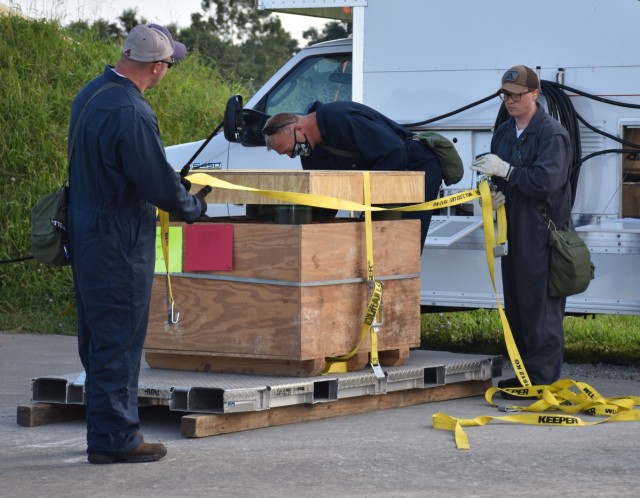
90 / 106 Blue Grass Chemical Activity personnel strap the last of the mustard overpacked projectiles onto a tray for loading into an enhanced on-site container. View original 
91 / 106 Blue Grass Chemical Activity toxic materials handlers guide the last of the H overpacked projectiles into an enhanced on-site container for delivery to the Blue Grass Chemical Agent-Destruction Pilot Plant for demilitarization. View original 
92 / 106 Blue Grass Chemical Activity personnel strap the last of the VX rockets onto a tray for loading into an enhanced on-site container. View original 
93 / 106 Blue Grass Chemical Activity toxic materials handlers guide the last of the VX rockets into an enhanced on-site container for delivery to the Blue Grass Chemical Agent-Destruction Pilot Plant for demilitarization. View original 
94 / 106 OINT BASE MCGUIRE-DIX-LAKEHURST, NJ - Joint Base McGuire-Dix-Lakehurst leadership is briefed on the process of explosive destruction and assesments during a tour of the destruction site hosted by the Recovered Chemical Materiel Directorate, May 2, 2022, on Joint Base MDL, New Jersey. RCMA partnered with Joint Base MDL for a second mission to destroy World War I-era chemical munitions after discovering a six 75mm projectiles at Joint Base MDL’s Parachute Jump Circle while investigating and removing chemical munitions, munitions of explosive concern and/or munitions constituents from two disposal pits. (U.S. Air Force photo by Sraff Sgt. Ariel Owings) View original 
95 / 106 JOINT BASE MCGUIRE-DIX-LAKEHURST, NJ - Joint Base McGuire-Dix-Lakehurst leadership is briefed on the process of explosive destruction and assessments during a tour of the destruction site hosted by the Recovered Chemical Materiel Directorate, May 2, 2022, on Joint Base MDL, New Jersey. RCMD partnered with Joint Base MDL for a second mission to destroy World War I-era chemical munitions after discovering a six 75mm projectiles at Joint Base MDL’s Parachute Jump Circle while investigating and removing chemical munitions, munitions of explosive concern and/or munitions constituents from two disposal pits. (U.S. Air Force photo by Staff Sgt. Ariel Owings) View original 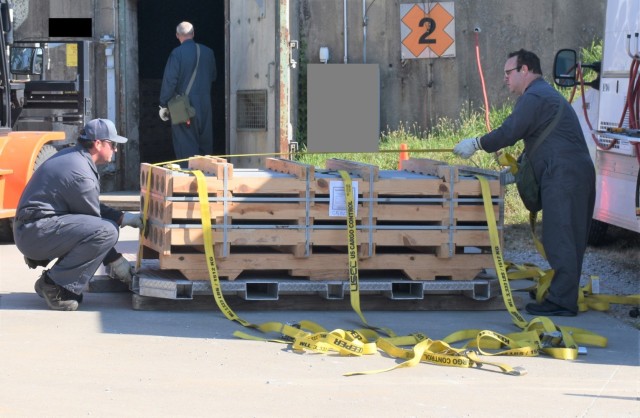
96 / 106 Daniel K., toxic materials handler, and Jeremiah L., quality assurance specialist/ammunition surveillance, strap GB rockets onto a pallet to prepare the munitions for movement to the Blue Grass Chemical Agent Destruction Pilot Plant for demilitarization. View original 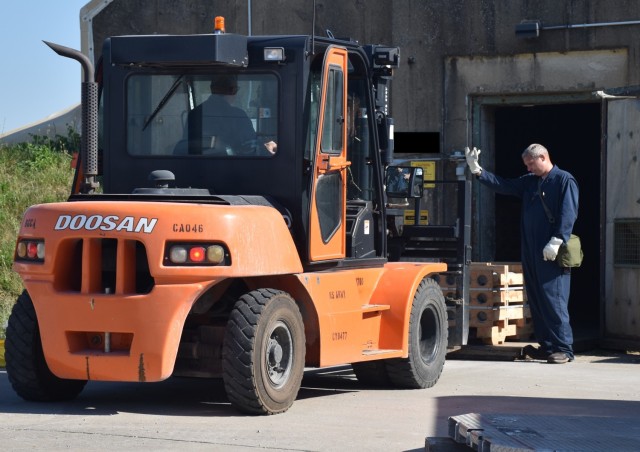
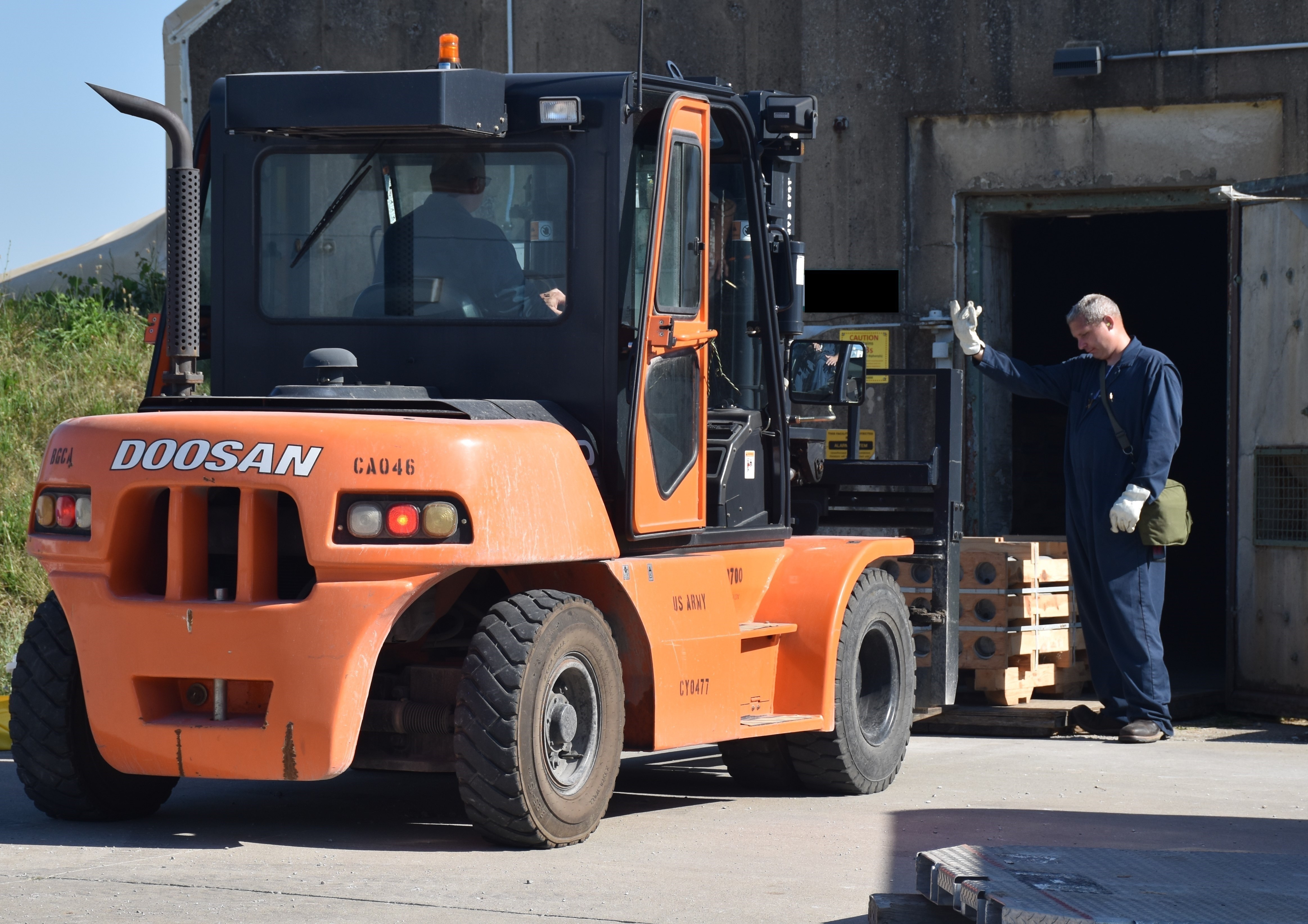
97 / 106 Daniel M., toxic materials handler leader, guides the forklift operator as he removes GB rockets from the earth covered magazine. View original 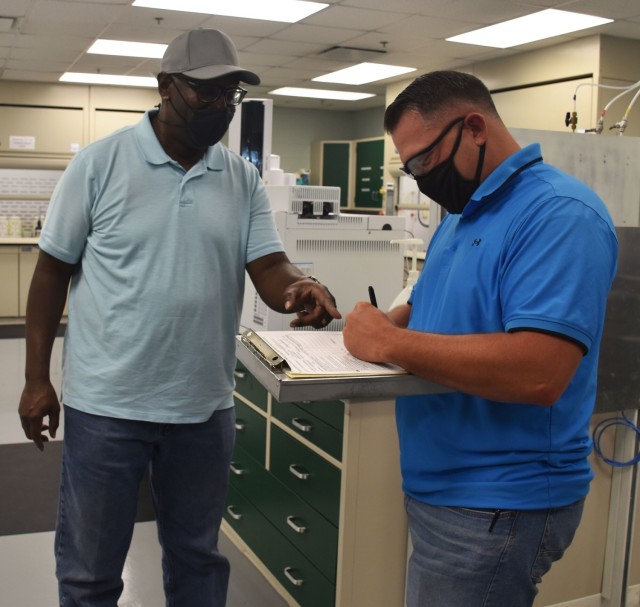
98 / 106 George G., Blue Grass Chemical Activity environmental protection specialist, works with Jason K., BGCA physical science technician, to document a hazardous waste inspection of the laboratory. View original 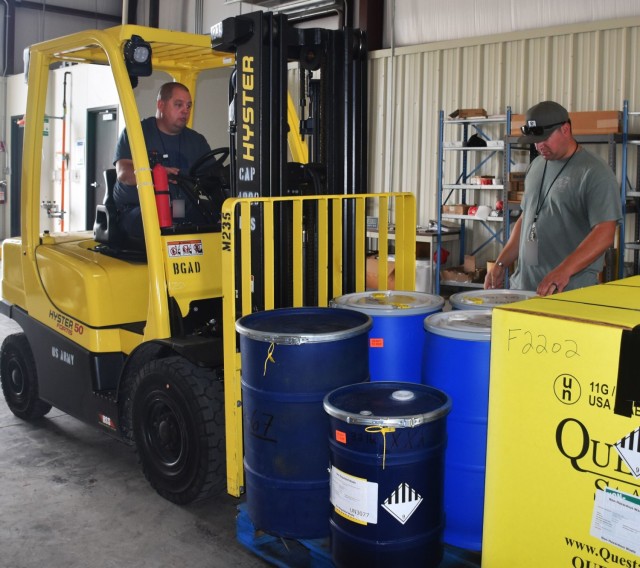
99 / 106 Jamie P., BGCA toxic materials handler and Daniel K., toxic materials handler leader, prepare to move hazardous waste for transportation to an approved processing site. View original 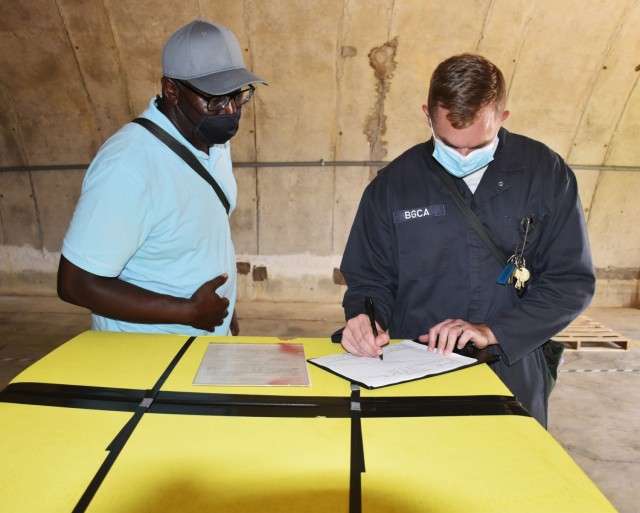
100 / 106 George G., Blue Grass Chemical Activity environmental protection specialist, works with Madison R., BGCA toxic materials handlers, to document a hazardous waste inspection in the chemical limit area. View original 
101 / 106 Photo 7 Caption: The DRCT system uses X-ray technology to vertically scan a munition on a rotating platform to produce a digital view of the interior. (Photo: CMA) View original 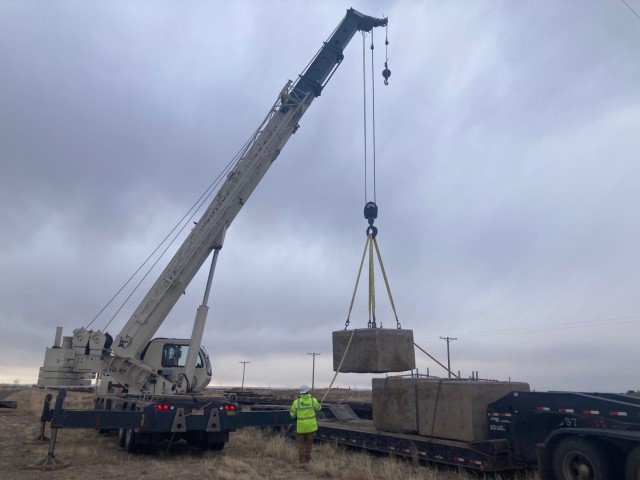
102 / 106 The final weather tower base is loaded onto a trailer, one of the last steps in the project to remove the weather towers that helped protect Pueblo Chemical Depot for decades. View original 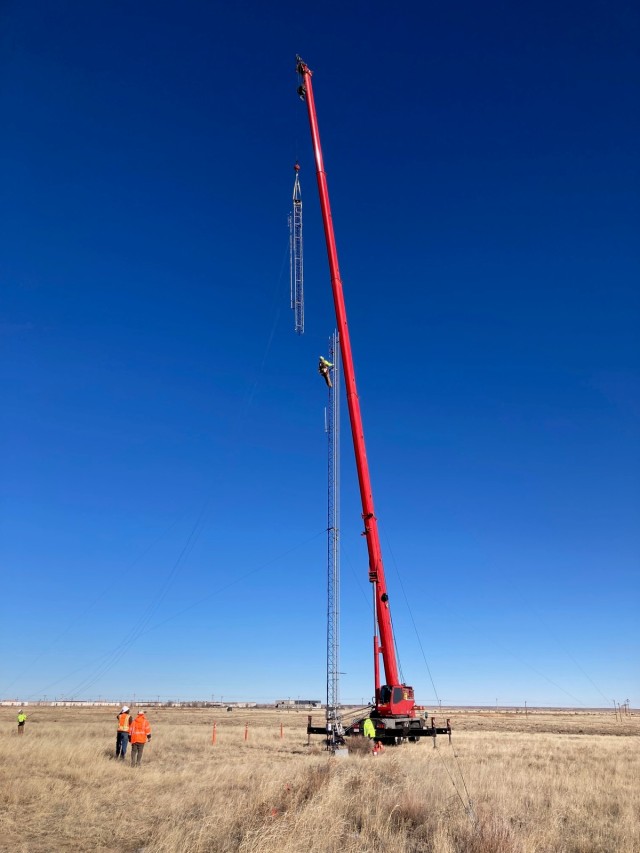
103 / 106 The top section of weather tower 1 is removed, marking the end of decades the tower provided data to help protect the Pueblo Chemical Depot workforce and surrounding communities. View original 
104 / 106 Following safe, secure storage by the Chemical Materials Activity, a subordinate command under the Joint Munitions Command, the last chemical weapon in the United States’ inventory was destroyed two years ago. View original 
105 / 106 MRCs Warehouse at the Redstone Chemical Activity on Redstone Arsenal. View original 
106 / 106 CMA-West employee puts on gear to conduct the mission View original -
Do you want more information about the Chemical Weapons Convention?
Find out more:

















Fact Sheets
-
CHEMICAL MATERIALS ACTIVITY (CMA)
▶ Chemical Materials Activity FY25-26 Fact Sheet
▶ Chemical Materials Activity Overview
▶ Center for Treaty Implementation & Compliance
▶ Chemical Accountability Management Information Network
▶ Chemical Stockpile Emergency Preparedness Program
-
▶ Recovered Chemical Materiel Directorate CMD Overview
▶ What Are Chemical Agents & Chemical Weapons? Fact Sheet
▶ What is Recovered Chemical Warfare Materiel (RCWM)
▶ RCMD Lifecycle of Deployment Fact Sheet
▶ Mobile Munitions Assessment System (MMAS)
▶ Multiple Round Container (MRC)
▶ Universal Munition Storage Container (UMSC)
▶ Digital Radiography & Computed Tomography System (DRCT) Fact Sheet
▶ Portable Isotopic Neutron Spectroscopy (PINS) Fact Sheet
▶ Raman Spectrometer Fact Sheet
▶ Non-Intrusive Threat Detection System (NITDS) Fact Sheet
▶ QL 0-(2-Diidopropylaminoethyl) O'-Ethyl Methylphosphonite Fact Sheet
▶ Materiel Assessment Review Board (MARB)
▶ Explosive Destruction System (EDS) Overview
▶ Single CAIS Access & Neutralization System (SCANS) Fact Sheet
▶ Large Item Transportable Access & Neutralization System (LITANS)
▶ Mobile Command Post (MCP) Fact Sheet
▶ Interim Holding Facility (IHF)
▶ RCMD Operations at Dover Air Force Base
▶ RCMD Operations at Pine Bluff Arsenal
▶ RCMD Operations at Redstone Arsenal
▶ Former Production Facilities Demolition
▶ Chemical Weapons Destruction Expertise Fact Sheet
▶ Sulfur Mustard Agents Fact Sheet
▶ Chemical Agent Identification Sets Fact Sheet


