
Army Medicine
Office of the Surgeon General | U.S. Army Medical Command
Army Medicine News
-
 DARPA autonomous vehicles deliver command-controlled robotic lethality at Fort Knox event
October 22, 2026
DARPA autonomous vehicles deliver command-controlled robotic lethality at Fort Knox event
October 22, 2026
-
 Army Medical Service Corps Officer Serves as Liaison to German Military Medical Forces
October 20, 2026
Army Medical Service Corps Officer Serves as Liaison to German Military Medical Forces
October 20, 2026
-
 Army Medicine Celebrates Army Animal Care Specialists
October 19, 2026
Army Medicine Celebrates Army Animal Care Specialists
October 19, 2026
-
 KACH recognition of West Point ATs highlights vital partnership
October 15, 2026
KACH recognition of West Point ATs highlights vital partnership
October 15, 2026
-
 Due for cervical cancer screening? BJACH helps patients take the next step
October 14, 2026
Due for cervical cancer screening? BJACH helps patients take the next step
October 14, 2026
-
 'That's when training kicks in': How Soldiers saved lives after car crash
October 10, 2026
'That's when training kicks in': How Soldiers saved lives after car crash
October 10, 2026
-
 Army Medical Soldier Powers All-Army Women’s Softball Team to Championship
October 7, 2026
Army Medical Soldier Powers All-Army Women’s Softball Team to Championship
October 7, 2026
-
 Two generations of Army dietitians celebrate selection for Army Baylor program
October 3, 2026
Two generations of Army dietitians celebrate selection for Army Baylor program
October 3, 2026
-
 Dental team turns routine appointments into rapid emergency response
September 30, 2026
Dental team turns routine appointments into rapid emergency response
September 30, 2026
News from Around the Army
-
 Army leaders discuss changes to improve PCS experience
October 19, 2026
Army leaders discuss changes to improve PCS experience
October 19, 2026
-
 Combined Resolve prepares Soldiers, NATO allies for modern battlefield
October 19, 2026
Combined Resolve prepares Soldiers, NATO allies for modern battlefield
October 19, 2026
-
 Powering the fight: Army Special Forces logisticians validate support capabilities
October 20, 2026
Powering the fight: Army Special Forces logisticians validate support capabilities
October 20, 2026
-
 Generational food changes optimize warfighter performance
October 16, 2026
Generational food changes optimize warfighter performance
October 16, 2026
-
 Army task force partners with acquisition directorate to accelerate counter-drone tech in Africa
October 16, 2026
Army task force partners with acquisition directorate to accelerate counter-drone tech in Africa
October 16, 2026
-
 Honoring their service: Soldier helps veterans receive overdue recognition
October 19, 2026
Honoring their service: Soldier helps veterans receive overdue recognition
October 19, 2026
Command Team
-
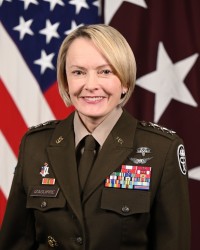 The U.S. Army Surgeon General and Commanding General, U.S. Army Medical CommandLieutenant General Mary K. Izaguirre
 -
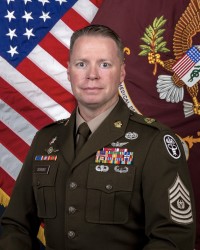 Command Sergeant Major, U.S. Army Medical CommandCommand Sergeant Major John E. Dobbins
 -
 Command Chief Warrant OfficerChief Warrant Officer 5 Terrence Ward
Mission
Provide ready and sustained health services support and force health protection in support of the Total Force to enable readiness and to conserve the fighting strength while caring for our People and their Families.
Vision
The Army Medicine of 2028 is ready, reformed, reorganized, responsive, and relevant, providing expeditionary, tailored, medically ready and ready medical forces to support the Army mission to deploy, fight and win decisively against any adversary, anytime and anywhere in a joint, multi-domain, high-intensity conflict, while simultaneously deterring others and maintaining its readiness posture.
Click here for the Army Medicine Logo Description
Army Medicine Senior Leaders
-
 Deputy Commanding General (Operations)Brigadier General Roger S. Giraud
 -
 Chief of StaffColonel Caryn Vernon
 -
 Deputy Commanding General (Support)Brigadier General Jonathan C. Taylor
 -
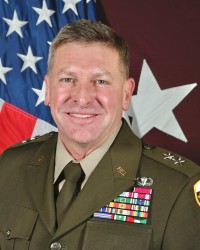 Deputy Surgeon General for Mobilization, Readiness and Army Reserve AffairsMajor General W. Scott Lynn
 -
 Deputy Commanding General, Army Reserve Medical Command United States Army ReserveBrigadier General Kathleeen A. Clary
 -
 Deputy Surgeon General for the Army National GuardBrigadier General Walter R. Ross, Jr.
 -
 Deputy Chief of Staff/Assistant Surgeon General for Mobilization, Readiness and NG AffairsBrigadier General Toby J. Alkire
 -
 Director, Policy and Force IntegrationBrigadier General Tracy Michael
 -
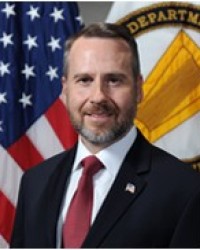 Deputy Chief of Staff for G-8/9 and Chief, AMEDD Civilian Corps (SES)Mr. Chris Rheney
Contact Us
-
If you have a medical emergency, please call 911 or contact your local hospital right away.
- Veterans Suicide Prevention Hotline: 800-273-TALK (8255) or text & call 988
- National Suicide Prevention Hotline: 800-SUICIDE (1-800-784-2433) or text & call 988
- Military One Source: 800-342-9647
-
Are you a Small Business and want to support the Military Health System? We're here and ready to help.
If your small business provides or seeks to provide medical and surgical equipment, medical consumable supplies, pharmaceuticals or vaccines, or items on the Medical Supply Chain Electronic Catalog (ECAT), please send capabilities and questions to Defense Logistics Agency(DLA), Troop Support, Medical at dlatroopsupportsbo@dla.mil, or call 215-737-5372.
If your small business provides Information Technology or Health Information Technology solutions, please send capability statements to the Defense Health Agency, Office of Small Business Programs at: dha.ncr.osbp.mbx.smallbusinessforum@health.mil
Army Medical Command's Acquisition Forecast can be found alongside the other Army contracting activities at the following link: https://www.army.mil/osbp#org-resources
If you are a small business and have concerns regarding an Army Medical Command contract or are having payment issues on an Army Medical Command contract, please call 210-975-6878.
If your small business is experiencing excessive regulatory compliance, in connection with ANY Federal agency, the Small Business Regulatory Enforcement Fairness Act of 1996 provides avenues for relief through the Small Business Administration by calling 888-734-3247, by emailing ombudsman@sba.gov or mailing to:
U.S. Small Business Administration
Office of the National Ombudsman
409 Third St., SW
Washington, DC 20416Should you require small business data in support of academic or professional research, please visit the Small Business Administration Office of Advocacy at: https://advocacy.sba.gov/small-business-data-resources/
-
- Veterans Crisis Line: Call, Text or Chat (988)
- National Suicide Prevention Hotline: (988)
- Military One Source: 800-342-9647
- U.S Army Wounded Soldier & Family Hotline: 800-984-8523
- Defense Centers of Excellence for Psychological Health & Traumatic Brain Injury: 800-424-7877
- Deployment Health Clinical Center: 910-449-9106
- Navy Safe Harbor-Severely Injured Support: 855-628-9997
-
This link is intended for requests from the media that do not require a response prior to the next business day. If you are a media member with a request or query, please contact Office of the Surgeon General/U.S. Army Medical Command Public Affairs at: usarmy.jbsa.medcom-hq.mbx.medcom-public-affairs@army.mil
Civilian Corps
The AMEDD Civilian Corps was established on 26 March 1996 and has played a vital role in maintaining Army Medical Readiness. AMEDD Civilians are valued members of the Army profession. Not only do they provide invaluable institutional knowledge and continuity for Army Medicine, our AMEDD Civilians lead, manage and maintain critical programs that support Army Soldiers, their Families and Civilians at home and abroad. AMEDD Civilians take their mission personally and provide mission-essential capability, stability and continuity during war and peace.
Dental Corps
The Army Dental Corps delivers global dental services to enable the sustained readiness of the Total Force. The Dental Corps teaches more residents than any other institution in the country. It maintains modern dental facilities both in the U.S. and abroad in diverse countries. The Army’s Specialty Residency Programs produce graduates regularly scoring in the top 95th percentile.
Enlisted Corps
The AMEDD Enlisted Corps is comprised of twenty-four military occupational skills and twelve additional skill identifiers, making it one of the most diverse and complex Corps in the Army. Charged not only with defending our Country, but also providing top quality health care for all men and women in uniform from all Services. The job of the AMEDD Soldier is constant.
Medical Corps
Medical Corps Sharepoint (CAC Enabled)
The Army Medical Corps are professionals that are unique in that we serve two professions; the Profession of Medicine and the Profession of Arms. We are Medical Corps Officers, not doctors who happen to wear a uniform. We live our Army's core values: Loyalty, Duty, Respect, Selfless service, Honor, Integrity, and Personal courage. I encourage you to learn more about Army Medicine and the myriad opportunities to serve as a Medical Corps Officer.
The Medical Corps ensures a ready medical force and medically ready force that recruits, trains, employs, and retains highly skilled Medical Corps officers in support of Army strategic priorities.
- BG Clint Murray, Chief of the Army Medical Corps
Interested in Joining the Army Medical Corps?
MC Chief’s Office Contact Information:
- Maj. Gen. Clint Murray, Chief of the Medical Corps: clinton.k.murray.mil@army.mil
- Deputy Corps Chief: arriving July 2025
- Col. Mark Craig, Proponent Officer: mark.s.craig10.mil@health.mil | 210-295-2493
- Lt. Col (P) Grant Evans, Assistant Proponent Officer: grant.h.evans.mil@army.mil | 210-808-3025
- Executive Officer: arriving July 2025
- Executive Fellow: arriving July 2025
Medical Service Corps
The Medical Service Corps is the most diverse branch of the U.S. Army. This Corps is home to medical administrative, scientific, and provider specialties, from direct patient care to management of the U.S. Army’s health service system. Disciplines include: Behavioral Sciences, Health Services, Laboratory Sciences, Optometry, Pharmacy, Podiatry, and Preventative Medicine.
Medical Specialist Corps
Medical Specialist Corps Website
The Medical SP Corps develops leaders that enhance Soldier health and readiness in garrison and throughout Multi-Domain Operations. Since World War I, Occupational Therapists and Physical Therapists (formerly known as reconstruction aides) and Dietitians have served the Army in a civilian capacity. On April 16, 1947 the Women’s Army Specialist Corps, comprised of officers from those three professions, was established by Public Law 80-36. The law was amended in 1955 to allow commissioning of males and the corps was renamed the Army Medical Specialist Corps (AMSC). In 1992, Physician Assistants were converted from warrant to commissioned officers and added to the corps’ skill inventory. By providing direct medical care as independent practitioners and physician extenders, SP officers play a key role in ensuring military medical readiness both on and off the battlefield. SP officers have served in every major conflict and humanitarian mission since the corps inception.
Nurse Corps
Army Nurse Corps MilSuite (CAC enabled):
https://www.milsuite.mil/book/community/spaces/armymedicine/corps/armynursecorps
The Army Nurse Corps provides responsive, innovative, and evidence-based nursing care integrated on the Army Medicine Team to enhance readiness, preserve life and function, and promote health and wellness for all those entrusted to our care. Preserving the strength of our Nation by providing trusted and highly compassionate care to the most precious members of our military family-each Patient.
Veterinary Corps
The Veterinary Corps conducts and oversees all Department of Defense veterinary service activities. Army Veterinary Corps Officers are responsible for preventing contagious and zoonotic diseases, providing care to military working dogs, caring for ceremonial horses, treating family pets, and even supporting Human-Animal Bond Programs at military hospitals.
MEDCOM Family Programs
Vision Support the Warfighter and their Families by reinforcing the direct link between Family and Operational Readiness regardless of the location.
Mission Manages and integrates the MEDCOM Family readiness programs encompassing a wide variety of Soldier and Family support, to include quality of life; MEDCOM Army Family Action Plan (AFAP); Morale, Welfare and Recreation (MWR); Army and Air Force Exchange Service. The Family Programs Specialist manages and integrates the MEDCOM Family readiness programs encompassing a wide variety of Soldier and Family support.
-
AMSS Newsletter: Senior-Spouse-NL-4-25.pdf [PDF - 3.9 MB]
Spouse Guide [PDF - 8 MB]
Military OneSource Spouse Education & Career Opportunities (MySECO)
-
AR 1-10 Fundraising within the Department of the Army [PDF - 246.8 KB]
HQDA EXORD 233-19 [PDF - 74.9 KB]
-
TO BE CONTINUED
-
AFAP Issue Update Book - August 2024 - numerical order (1).pdf [PDF - 5.9 MB]
AFAP One-pager.pptx [PPTX - 822.2 KB]
AFAP Living Document - January 2025.xlsx [XLSX - 251.4 KB]
AFAP Informational Briefing Slides (March 2026).pdf [PDF - 1.1 MB]
AFAP Active Issues (March 2026).pdf [PDF - 1.1 MB]
-
OTSG MEDCOM Family Readiness Resources 2025.pdf [PDF - 23.7 MB]
Deputy Chief Staff (DCS), G-9 (Installations)
Directorate of Prevention, Resilience and Readiness
Army Family Team Building (AFTB)
Association of the United States Army (AUSA)
Family Programs SharePoint (CAC Access Required)
Family Programs MS Teams Channel (must have .mil address to access)
Contact Us/Ask a Question
MEDCOM Family Programs Email: usarmy.jbsa.medcom.mesg.medcom-family-readiness@health.mil
Military Equal Opportunity (MEO)
U.S. Army Medical Command (MEDCOM) policy requires that everyone is expected to treat all persons with dignity and respect. Soldiers who violate this policy may be subject to punishment under the Uniform Code of Military Justice (UCMJ). We are members of the profession of arms and are all bound by the same professional ethic. The expectation is that all Soldiers treat one another with professional courtesy, whether that Soldier is a superior, peer, or subordinate. Simply put, treat others as you would want to be treated, with dignity and respect.
-
- Informal Complaints: An informal complaint is best for those issues that can be taken care of informally, or resolved through discussion, problem identification, and clarification of the issues. Informal complaints are not filed in writing and my be resolved directly by the individual, with the help of another unit member, the commander, or other person in the complainant's chain of command. Informal complaints are not subject to a time suspense.
- Formal Complaints: A formal complaint is one that a complainant files inwriting and swears to the accuracy of the information. Formal complaints require specific actions, are subject to timelines, and require documentation of the actions taken. An individual files a formal complaint using a DA Form7279 (Equal Opportunity Complaint Form). The complainant must state the EO basis of the complaint(for example, unlawful discrimination based upon race, color, religion, sex, national origin, or sexual orientation, and describe the incident(s) in as much detail as possible to assist in the investigative process). Soldiers have 60 calendar days from the date of the alleged incident in which to file a formal complaint. This time limit is established to set reasonable parameters for the inquiry or investigation and resolution of complaints, to include ensuring the availability of witnesses, accurate recollection of events, and timely remedial action. The complainant should file his or her complaint with the commander at the lowest echelon of command at which the complainant may be assured of receiving a thorough, expeditious, and unbiased investigation of the allegations.
- Anonymous Complaints: Anonymous Complaints are where the complainant remains unidentified may be handled as either an informal or a formal complaint and entered in MEO database, as such. The commander will determine if sufficient information is provided to proceed as either an informal or formal complaint. The commander will be identified as the complainant on the DA Form 7279(Equal Opportunity and Harassment Complaint Form) and in MEO database. If the complaint is processed as an informal complaint, the commander will determine if informing the entire command or part of the organization of the actions taken is appropriate. If during the informal or formal process of an anonymous complaint the identity of the actual complainant is revealed, the complainant will be edited in MEO database, and the actual complainant will be provided the requisite follow-up actions (DA Form 7279– 1 (Equal Opportunity and Harassment Complaint Resolution Assessment Form)). Actions taken regarding anonymous complaints will depend upon the extent of information provided in the anonymous complaint. If an anonymous complaint contains sufficient information to permit the initiation of an investigation, the investigation will be initiated by the commanding officer or supervisor in accordance with this instruction. If an anonymous complaint does not contain sufficient information to permit the initiation of an investigation, the information should be documented in a Memorandum for Record and maintained on file in accordance with disposition instructions and the central point of contact responsible for processing discrimination and harassment complaints. The Memorandum for Record should contain the following information, if available: date and time the information was received; a detailed description of the facts and circumstances included in the complaint; date and time the complaint was resolved and by whom; and any other pertinent information.
-
Email: usarmy.jbsa.medcom-hq.list.medcom-eo@army.mil
MEDCOM MEO Hotline: 210-891-8894
MEDCOM EO PM/Director: 520-716-8108
MEDCOM EO SGM: 520-693-1229
MEDCOM Senior EOA/Advisor: 210-466-7028
-
OTSG_MEDCOM Policy 26-006.pdf [PDF - 192.1 KB]
AR_600-20 CH6.pdf [PDF - 3.5 MB]
DOWI 1350.02 MEO PROGRAM.pdf [PDF - 555.4 KB]
OTSG_MEDCOM MEO Policy 26-007.pdf [PDF - 187.9 KB]
Equal Employment Opportunity (EEO)
Welcome to the Office of Equal Employment Opportunity (EEO) Programs website, US Army Medical Command (MEDCOM), Joint Base San Antonio/Fort Sam Houston, Texas. The EEO Office advises the OSTG/Commanding General US Army Medical Command on all EEO matters. Additionally, the office oversees and monitors compliance of Equal Employment Opportunity and Affirmative Employment policies, practices, and procedures that affect Civilian employees.
The EEO Office mission is to direct and manage the MEDCOM EEO Program. To formulate and recommend policies, establish program objectives, develop EEO plans and procedures for implementation, to analyze the results and measure progress. Provide EEO services and support to ensure all current and prospective employees have equal opportunities for employment and advancement based on merit and ability, without regard to race, sex, color, religion, disability, national origin, age, genetic information, or protected Title VII activity.
The EEO Office supports Army Medicine strategy and vision by advising commanders, leaders, and managers at all levels in carrying out their responsibilities under the EEO Program areas of Affirmative Employment, Discrimination Complaint Processing, and Alternative Dispute Resolution.
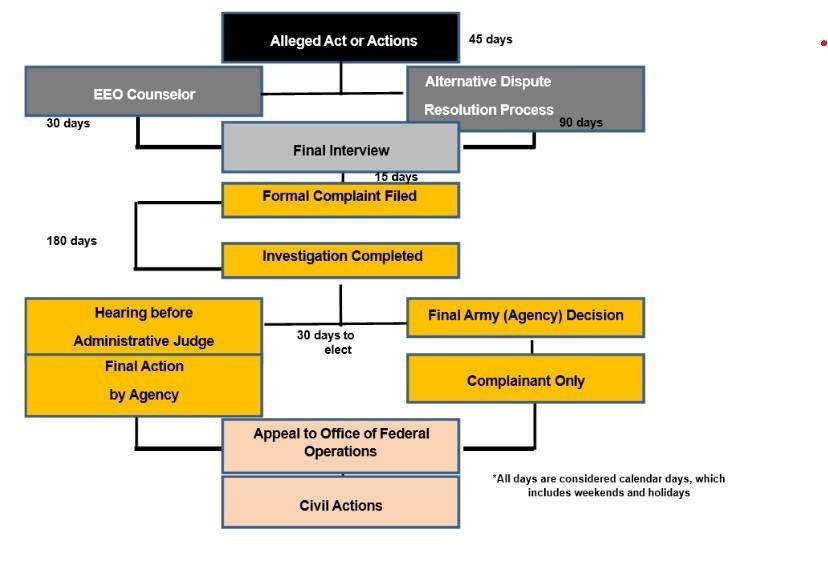
*Please Note: You must contact the EEO Office within 45 calendar days of the alleged discriminatory action for the complaint to be considered timely.
-
Services include processing complaints of discrimination, providing both in-person and on-line EEO training, facilitating resolution of EEO related workplace issues, and assisting in the request for reasonable accommodation process through the Disability Program Manager (DPM), who is also located in the EEO Office.
-
The EEO Office manages matters regarding discrimination based on:
- National Origin
- Race
- Religion
- Reprisal (Previous Protected EEO Activity)
- Disability (Physical & Mental)
- Age (40 and older)
- Color
- Sex
- Genetic Information.
-
Our customers include Department of the Army Civilian (DACS, former Army Medical Command employees, applicants for Army Medical employment, and contractors under certain circumstances.
The Army Medical Command Equal Employment Opportunity (EEO) Office is located at Joint Base San Antonio, Fort Sam Houston, TX, and services MEDCOM OneStaff Personnel civilian workforce as well as Directorates, OneStaff Personnel at DHHQ, and personnel not on an Army installation.
You may file a complaint if you are a:
- Civilian employee
- Former civilian employee
- Certain contractor/contingent employees
- An applicant for employment
When you initiate an EEO complaint, you should identify an issue relating to a term, condition, or benefit of employment along with the reason or Basis(es) of discrimination.
-
The EEO Complaint Process was created to determine whether an alleged act(s) of discrimination occurred within the nine protected categories.
To initiate the EEO complaint process, an individual must first contact their EEO office within 45 calendar days of when the most recent incident occurred or when the individual first became aware of the alleged discriminatory practice or action.
The process begins with an informal “pre- complaint” stage. If the matter is not resolved, the notice of right to file a formal complaint (DA Form 2590) is given after the final interview.
In order to file a formal complaint, the DA Form 2590 form needs to be signed and returned to the EEO office within 15 calendar days. Once returned and the EEO office accepts the DA Form 2590, the formal complaint process begins.
Complaint Process Flowchart:
-
Internal EO File Site (CAC Required)
Address: Bldg 2264, Room 42, 2450 Connell Rd, Fort Sam Houston, TX 78234
Office Hours: 7 a.m. through 5 p.m/ CT. Mon-Fri; excluding holidays.
Call us:
EEO/Director: 210-665-9803 (work cell)
EEO Complaints Manager: 210-529-6395 (work cell)
EEO Affirmative Employment Program/Disability Program Manager/Reasonable Accommodations Coordinator: 210-853-8858
Email Us:
For general EEO inquiries and information, email usarmy.jbsa.medcom.list.medcom-eeo@health.mil
For reasonable accommodations and the DPM, email, usarmy.jbsa.medcom.list.medcom-eeo-ra@health.mil
Mailing Address:
MEDCOM EEO Office
2450 Connel Rd
JBSA, Fort Sam Houston, TX 78234
Information
-
The U.S. Army Medical Command is authorized to act on requests for medical research and development records and the medical records of active duty military personnel, dependents, and persons given physical examinations or treatment at DA medical facilities, to include alcohol and drug treatment/test records.
FOIA requests must be submitted in writing (letter or email), reasonably describe the records you seek with enough detail so that the records can be located with a reasonable amount of effort, state your willingness to pay applicable fees, and include your mailing address and phone number.
Privacy Act:
This office is also responsible for allowing individuals to access and amend Privacy Act (PA) records pursuant to 5 U.S.C. § 552a(f), coordination of MEDCOM System of Records Notices (SORNs), and reporting of personally identifiable information (PII) breaches.
FOIA / PA Requests:
You can email your request to:
usarmy.jbsa.medcom.list.medcom-foia-users@health.mil
Or mail your request to:
CDR U.S. Army Medical Command
Attention: Freedom of Information/Privacy Acts Office (MCFP)
2450 Connell Road, BLDG 2264
Fort Sam Houston, Texas 78234-7664
If you have any concerns about the service you have received from this office, please contact the MEDCOM FOIA / PA Office FOIA Public Liaison at 210-466-5933 or usarmy.jbsa.medcom.list.medcom-foia-users@health.mil.
Freedom of Information and Privacy Act Regulations:
Health Tools
-
Wounded Soldier and Family Hotline: 1-800-984-8523
JULY 2026
-
By The Centre for Army Leadership
General Donahue sits down with the UK Centre for Army Leadership to talk about the importance of character in leadership, especially as our world becomes more technologically advanced. He also talks about the importance of a winning mindset, building a team, and fostering a culture of accountability, as well as how critical continuing development and learning is.
“What is the single most important leadership investment they should make over the next five years? It’s twofold. The first thing is, you have to understand your adversaries. Not one adversary, all your adversaries. The next one is, how do you balance ensuring you have all the right basics, but yet you also understand that things are changing, they’re changing very rapidly.”
Link to the podcast | More from The Centre for Army Leadership Podcast
-
By Capt. Robert Haggerty
Performance is inseparable from experience. True leadership lies in deliberately cultivating an environment of ownership and purpose. As military leaders, we must look beyond basic metrics and critically assess the environments we build. What kind of experience are you providing to the Soldiers you lead in garrison and combat? Just as importantly, for medical leaders, how does this commitment to an exceptional experience translate to the patients under your care during their most vulnerable moments?
“While everyone wants to win, everyone also wants to add value – even if they cannot be the most valuable performer. Visible work reinforces value. Conversely, isolated or thankless work erodes morale and a sense of belonging. Leaders must constantly assess whether their people feel optimistic and engaged—or disconnected and undervalued.”
Link to the article | More from Special Warfare Journal
-
By Frank Abbott
Frank Abbott argues that past military failures share a common cause: the inability to adapt to a changing character of war. Today, U.S. Army medical forces face a similar inflection point. Future combat will feature a transparent, sensor rich battlefield, high casualty rates, contested evacuation routes, and adversaries who may ignore the Geneva Conventions. To remain effective, medical units must be redesigned to survive and thrive in this environment.
“This future operational environment demands a new approach to battlefield medical support. We must transform our medical force structure and modernize our capabilities to address this changing character of war. This modernization effort centers on the need to survive and thrive. If medical units cannot survive on the future battlefield, they may as well not deploy.”
Link to the article | More from The Pulse of Army Medicine
-
By Capt. Spencer Cavotti
In future combat operations, prolonged casualty care is the reality. Medical personnel must shift their risk tolerance to save lives. This article outlines how one infantry battalion deliberately trained and employed Walking Blood Banks (WBB) for a combat training center rotation. As you read, challenge yourself: Are you prepared to manage emergency whole blood transfusions at the point of injury?
“Right now, the Army’s appetite for maneuver risk is much higher than its appetite for medical risk, leading to an imbalance. Until walking blood bank operations are second nature, units must prepare for LSCO casualties by establishing WBB SOPs and building proficiency at combat training centers like JRTC. The walking blood bank itself is an acceptance of risk, and the potential for acute hemolytic transfusion reactions and TBB does not fully disappear with tested and titered blood. We accept and train for this risk in emergency situations to save lives already. We cannot let risk prevent us from preparing for the realities of our next fight.”
-
By Command Sgt. Maj. Waylon Petty
The U.S. Army's Next Generation Command and Control (NGC2) initiative replaces legacy, functional-siloed software with a modernized, unified digital architecture. Spearheaded by prototyping efforts within the 4th Infantry Division, NGC2 provides a shared, real-time common operating picture. This capability reduces heavy hardware footprints at the tactical edge and allows commanders to make faster, more precise, and highly informed decisions in contested environments.
“NGC2 provides multiple options to communicate, the ability to pull/push more data, improved situational awareness, more efficient staff processes, and more effective rehearsals. The architecture for NGC2 is a whole-stack capability broken down into four layers: Transport, Integration, Data, and Applications. Employing and using these four layers will enable commanders, at echelon, to make faster, more informed decisions that will equate to lethality when and where we need it.”
Link to the article | More from NCO Journal
-
By Paulo Frade
Paulo Frade’s analysis of how submarine commanders manage structural uncertainty offers a playbook for the Army Medical leaders to approach command and control under denied, degraded, intermittent, and limited (DDIL) conditions. Challenge yourself to translate these undersea disciplines: How can we apply the art of productive waiting and paralysis to medical maneuvers? How must a medical officer separate assumption from fact when directing triage and casualty evacuation in an information-blind environment?
“One dimension of command deserves particular emphasis. Submarines have always operated under conditions where communication with higher authority is intermittent at best and, under emissions control, absent by design. Shore-based commands transmit. Submarines receive. The reply, if it comes at all, may be hours away. This is not a technical limitation to be overcome. It is the doctrinal baseline from which submarine mission command evolved. Commanders deploy with orders that should be interpreted, not merely executed. They make consequential decisions without the ability to seek clarification. They exercise authority through a pre-shared understanding of intent, bypassing the need for a data link. That model — execute the mission within understood parameters, report when silence permits, adapt when circumstances require — is precisely what ground and surface forces should internalize as their own communication environments become less reliable.”
Link to the article | More from War on the Rocks
MAY 2026
-
By LTC Vern Campigotto, MAJ Richard Skinner, CPT Hannah Dalke, CPT Gabriel Lizama
Imagine a high-intensity conflict where every minor injury permanently removes a soldier from the front lines due to a lack of beds. To address a capability gap, the 62nd Medical Brigade tested a hybrid model merging an Intermediate Care Ward with a Role 2 medical company. Expanding forward holding capacity allows teams to monitor and rapidly return non-critical soldiers to duty, preserving vital combat power without clogging long-distance evacuation chains. How are you experimenting with new concepts, technologies, and processes to address gaps?
“The preservation of combat power depends heavily on sufficient holding capacity, and unconventional employment of medical capabilities may be essential to achieving decision advantage. In largescale combat operations, the six core principles of the Army Health System—conformity, continuity, control, proximity, flexibility, and mobility—form the foundation of an effective and adaptable plan that enables rapid return to duty and sustains fighting strength. To meet this requirement, AHS planners must be integrated early in the planning process to develop running estimates and courses of action that deliberately support combat power at decisive points.”
Link to the article | More from The Pulse of Army Medicine
-
By Sanders Marble, PhD
A 100-bed field hospital becomes completely paralyzed the moment the 101st patient arrives with no way to move the first 100. Present day army field hospitals are insufficient for the staggering casualty volumes projected in future conflicts, highlighting the urgent need to revitalize mass-evacuation strategies inspired by historical hospital trains and ships. Without robust, scalable theater-wide evacuation pipelines, frontline medical facilities will quickly overflow, causing the entire casualty care system to stall and leaving incoming wounded troops stranded without lifesaving care. How are you studying history to influence the direction of the Army Medical Enterprise?
“Historically, the Army maintained three types of evacuation units for air, land, and sea patient evacuation. These units were designed to evacuate large numbers of patients from Role 3 hospitals back to Role 4 hospitals in theater rear. While four-patient ground ambulances were fine for tactical evacuation, they were not ideal for mass patient movement.”
Link to the article | More from The Pulse of Army Medicine
-
By Joseph Joey Jones
Madigan Army Medical Center has launched an AI-powered Pulmonary Nodule Registry to improve detection, tracking, and follow-up of incidental lung nodules - often found during unrelated imaging. The centralized system ensures no patient is lost to follow-up and AI prioritizes high-risk cases by analyzing clinical data. It reduces manual workload while keeping the clinician in the loop. While developed at MAMC, the intent is to scale across the medical enterprise, demonstrating how bottom-up innovation can solve enterprise challenges to improve patient outcomes.
“The use of AI in this context does not replace clinical judgment. Instead, it serves as a powerful decision-support tool, augmenting the capabilities of healthcare professionals and helping them work more efficiently. By reducing the administrative burden associated with manually reviewing and sorting cases, clinicians can dedicate more time to direct patient care and informed decision-making. This initiative reflects a broader commitment by Madigan to embrace innovation in support of its mission.”
-
By Charlie Phelps and Teddy Ruecker
Authors Charlie Phelps and Teddy Ruecker argue that the Army must redefine "lethality" beyond mere weapon metrics to prepare for combat operations against peer adversaries. True lethality combines advanced technology with a psychological willingness and capability to inflict violence. Future battlefields demand this holistic shift. The Army must reform its culture, training, and personnel systems, replacing static, superficial metrics with rigorous, realistic measures focused on actual combat outcomes. This article encourages medical professionals to critically examine how military medicine measures the readiness of medical forces and how it can be reformed.
“If senior leaders want to obtain a better understanding of the development of lethality across the Army, have ammunition allocations for training been increased? Have units dedicated more time to ranges and training? How many formations are led by appropriate or assigned ranks and grade? Are opposing force units at combat training centers operating restrained or unrestrained? Are leaders held accountable for organizational performance in venues like the combat training centers? Is our personnel management system prioritizing experience in tactical formations or broadening assignments? How much personnel change occurs at the platoon and company level each year? How many training events in a given unit’s calendar are truly built around combat scenarios? Are units promoting and stewarding a culture that encourages lethality?”
Link to the article | More from Modern War Institute
-
By MAJ Sean McLachlan
MAJ Sean McLachlan addresses the logistics crisis facing units in the Pacific theater, where vast distances, limited distribution infrastructure, and strained stocks restrict the transport of Class IX repair parts. Instead of defaulting to slow parts distribution or forward fabrication, the article advocates for "tele-maintenance." This emerging capability bridges the gap between isolated, dispersed forces and depot-level enterprise expertise. Tele-maintenance allows forward-deployed units to rapidly diagnose issues, assess battle damage, evaluate parts availability, and make deliberate, data-driven decisions on whether to pursue temporary fixes, permanent repairs, or fabrication under operational pressure. How can the medical enterprise rapidly adopt tele-maintenance at scale to increase the readiness of medical formations for combat operations?
“Tele-maintenance is not a mechanism to conduct depot-level work remotely. Its value lies in ensuring repairs occur at the correct echelon and that fabrication is pursued only when it is technically sound, legally authorized, and operationally supportable. By allowing enterprise experts to reach forward without physically deploying, tele-maintenance preserves distributed posture, prevents unnecessary retrograde movement, and protects scarce lift and sustainment capacity.”
Link to the article | More from Army Sustainment
-
By Maj. Gen. David S. Doyle and Maj. Lam Nguyen
Is your unit's mission statement a living guide for daily operations, or just a decorative, forgotten slide in a command briefing? To bridge the gap between a commander’s strategic intent and daily reality, staffs must forge three interconnected rings of organizational effectiveness: precise process maps, a synchronized battle rhythm, and clear terms of reference. Without translating high-level strategy into structured, practical administrative frameworks, day-to-day operations quickly become chaotic. As Army units undertake summer transition with changes of command and leadership turnover, reflect on your organization’s effectiveness, lessons learned, and how it can be improved.
“When an organization acts with discipline, a powerful effect occurs: the framework itself begins to compel alignment. The internal staff and subordinate units are almost forced to orient their efforts toward the parent organization’s purpose because the very structure of their work, their meetings, and their decision-making forums are now bound to it.”
Link to the article | More from Military Review
March 2026
-
By Christopher Denzel
What separates warfighting from a warrior? Is it skill? Is it experience? Or is it something deeper that only reveals itself when it matters most? This podcast unpacks the difference between technical proficiency and true warrior mindset, what commitment looks like when compliance disappears, and how leaders enforce standards without eroding trust. They explore whether resilience is built over time or revealed under pressure, and how purpose sustains Soldiers when motivation begins to fade.
“A warrior is a way of life. It is a mindset that is associated not so much with what you do but more with how you do it and the dedication and the selflessness and the sacrifice, the things that people do not understand why in the world you go that extra mile.” – SMA Mike Weimer
Link to the podcast | More from The Jedburgh Podcast
-
By COL Glenn Henke
Written in 2024, this article takes on renewed importance due to Operation Epic Fury. COL Henke discusses the critical need for integrated air and missile defense in the U.S. Central Command (CENTCOM) area, where American forces face continuous and lethal threats from Iran and its proxies. While partnerships with nations like Israel, Saudi Arabia, and the UAE are crucial for regional security, the demand for air defense capabilities far outstrips the available supply.
“Given the range of threats and tactics available to Iran and proxy groups, no single system can provide a comprehensive defense by itself. In short, there are no “silver bullets” in the counter-UAS fight. Instead, commanders must take all capabilities and employ them intelligently while looking for every opportunity to innovate."
Link to the article | More from Military Review
-
By MAJ Tim Hoyt and CPT Christina Hein
The unprecedented experiences of American service members contending with long range fires and small unmanned aircraft systems targeting bases in the Middle East during Operation Epic Fury warrants examining the importance of managing combat stress in a warzone. Written in 2021, the authors argue that the U.S. Army's approach to Combat and Operational Stress Control (COSC) is unprepared for future large-scale combat operations (LSCO) against near-peer adversaries. The military medical enterprise should shift towards a tiered approach, emphasizing self-aid, buddy aid, and enhanced training for medics and chaplains to manage combat stress reactions at the point of injury.
“The U.S. Army is on the precipice of new and modern warfare, and its future force must be prepared for the psychological impact of these changes.”
Link to the article | More from Military Review
-
By LTC Franklin Annis, LTC Daniel Gonski, MAJ Jace Rivard, MAJ Jarrod Nicholson, CPT Lance Jandreau, and MSG Andrew Baker
The Army National Guard's Chief Surgeon’s Office hosted wargames for senior medical leaders to improve medical readiness, using simulations based on real-world data. This article dives into an unexpected paradox: the team that most successfully increased its medical readiness score had the least understanding of its actual risk. Conversely, the team with the lowest score best understood its medical readiness challenges. This outcome highlighted Goodhart's Law, prompting a recommendation for the Army to reassess how it measures medical readiness and communicates risk to commanders, ensuring that metrics reflect true readiness rather than just the achievement of a target.
“Economist Charles Goodhart observed that when a metric becomes a goal, its effectiveness as a performance measure diminishes. Without a goal, a metric simply reports what “is.” When a target goal is applied to a metric, a value judgement of being “good” (within standards) or “bad” (outside of standards) is created. This may simply be a function of the law of unintended consequences. Organizations or individuals often change or manipulate their actions to artificially raise or maintain a desired performance measure, without actually addressing the underlying issue.”
Link to the article | More from The Pulse of Army Medicine
-
By Christopher Denzel
This article argues that while AI is often hailed as a breakthrough for military and corporate planning, it is primarily a tool for efficiency, not strategy. AI excels at data synthesis and drafting polished plans, but this “polish” often masks a lack of critical human judgement. By churning out plausible outputs, AI can obscure necessary trade-offs and tough decisions. The author warns that treating AI as an optimizer leads to defensible but mediocre strategies, emphasizing that AI should instead be used to surface tensions and spark human-led insight.
“An optimized plan places internal logic over external reality, allowing balance to substitute for focus. The result diffuses responsibility. This failure is structural, not technical. It cannot be fixed with better data, tighter prompts, or additional iteration. Optimization assumes that importance is latent in the data and can be surfaced through better analysis. Campaign design operates under a different logic. Priority is not discovered in the data but asserted by an authority. Algorithms cannot determine which objective should dominate, which lines of effort should be subordinate, or which risks are acceptable. Answers to those questions cannot be found in the data—they are a choice based on a commander’s judgment and accountability.”
Link to the article | More from War on the Rocks
January 2026 Articles
-
By Army Communications and Outreach Office (ACOO)
Army leaders gathered at Fort Drum for a candid Q&A and SITREP, spotlighting rapid transformation, modernization, and soldier-driven innovation. Leaders discussed new gear, agile training, quality-of-life upgrades, and lessons from Ukraine, all aimed at building a stronger, more responsive force. Secretary of the Army Dan Driscoll, Chief of Staff Gen. Randy George, and Sgt. Maj. of the Army Michael Weimer participated in discussion moderated by CSM Brett Johnson, Command Sergeant Major, 10th Mountain Division.Notable Quote:
“You are the most important platform that the United States Army has – people, you. We are going to invest in your training, we are going to invest in your quality of life, your education, all those things. Because you are still the most important thing we have.”
Link to the video | More from The U.S. Army
-
By Joe Byerly
General Christopher Donahue, commanding general of U.S. Army Europe and Africa, joins From The Green Notebook for a wide-ranging conversation on leadership, culture, and what it takes to drive real change at scale across massive, dispersed organizations. Regardless of rank or scope, leaders must still create belief in the why, articulate a clear vision, translate that vision into a workable plan, and embed it into culture and process so change sticks. They also explore what is changing rapidly and why leaders must continuously adapt, integrate new tools, and keep developing themselves to stay ahead. The conversation reinforces a timeless truth: while the tools evolve, leadership remains the decisive factor.
Notable Quote
“One of the things that hasn’t ever changed in combat is your adversary is going to change. So, your ability to understand the environment, and now you’ve just added other things you have to understand. The higher you go, the more things you have to understand. So, you got to understand, you have to have the ability to adapt it and integrate it. That will never go away. That has always been around… You should always be looking for an advantage.”
Link to the podcast | More from From the Green Notebook
-
By Col. James J. Jones, PhD, PA-C
Physician Associates (PAs) in military and operational medicine are frequently placed in environments where clinical expertise must be matched with adaptive leadership. Traditional leadership models often fail to meet the demands of modern healthcare delivery, particularly in preparing for LSCO, humanitarian missions, and crisis response. This article provides actionable guidance for resilience, collaboration, and transformational purpose.
Notable Quote
“Modern clinical leadership is not about issuing perfect orders; it’s about uncovering ground truth and fostering shared ownership. Listening is an operational imperative. It unlocks blind spots, elevates junior voices, and fosters trust at every echelon of care… The loudest truths often came from the softest voices—junior medics, interpreters, patients, and often the most exhausted among us.”
Link to the article | More from The Pulse of Army Medicine
-
By CW4 William Bryant
Chief Warrant Officer 4 William Bryant presents ten principles gathered over his career to complement the official Army Values. These "Rules of the Road" serve as a guide for effective leadership and personal growth. Key tenets include maintaining a positive outlook, inspiring hope in others, and setting high personal and professional goals. The author also emphasizes the importance of meticulous planning, lifelong learning, humility, and associating with principled individuals. Adhering to these rules helps leaders build trust, resilience, and a foundation for enduring success.
Notable Quote
“Brash, cocky, or arrogant attitudes are detrimental to unit cohesiveness. We've all experienced this behavior, whether in garrison, in the field, or in combat. For the most part, people do not appreciate this kind of behavior, and humility can go a long way in building trust. The moment you believe you've ‘arrived’ is the moment you stop improving. Good leaders understand that there is always room for growth, and they focus on continuous self-assessment and feedback. Leaders who stay humble remain open to new ideas and are eager to learn and adapt.”
Link to the article | More from Special Warfare Journal
-
By Sam Scanion
The war in Ukraine has produced a steady stream of striking images and tactical innovations that have baited the US defense community into simple conclusions. Far too often, the conversation begins and ends with first-person-view (FPV) drones, and the larger lessons get lost. To understand Ukraine’s relevance for US strategy, we need to widen the aperture—looking beyond FPVs to the other innovations across air, land, and sea that the United States can adapt for defense modernization to counter threats around the globe—in the many theaters where it has interests and where US forces might find themselves actively engaged.
Notable Quote
“The Mitchell Institute finds the average mission-capable rate for the US fighter fleet is only 59 percent, a level that constrains sortie generation and the ability to absorb attrition in a high-end fight. Compounding that vulnerability, unclassified public wargames indicate the United States could exhaust key munitions inventories in as few as three to four weeks in a major peer fight.”
Link to the article | More from Modern War Institute
-
By Patrick Sullivan and John Amble
This article analyzes the military lessons from "Operation Absolute Resolve," to capture Venezuelan President Nicolás Maduro. The authors caution that while the raid was a tactical success, its methods have limited use in a large-scale conflict with a peer adversary and that such a military victory does not guarantee a successful grand strategy.
Notable Quote
“Over the course of the post-9/11 wars, US special operations forces (SOF)—and particularly, the most elite units—were honed into a sharper tip of the spear than has ever existed in military history. The operation in Venezuela demonstrates that those elite units have retained those capabilities. But it would be a mistake to extrapolate from this narrow action (a raid, conducted by highly trained, exceptionally equipped units, as part of an interagency operation) to a wider mission set. SOF cannot do everything, and conventional forces cannot conduct this type of operation.”
Link to the article | More from Modern War Institute
December 2025 Articles
-
By President Donald J. Trump
The purpose of the National Security Strategy is to outline the President's vision for protecting the U.S., defining threats, and guiding the use of all instruments of national power (diplomatic, economic, military) to secure national interests. Mandated by law, it provides strategic context for the executive branch's approach to the world.
NOTABLE QUOTE
“The United States must reconsider our military presence in the Western Hemisphere. This means four obvious things: • A readjustment of our global military presence to address urgent threats in our Hemisphere, especially the missions identified in this strategy, and away from theaters whose relative import to American national security has declined in recent decades or years; • A more suitable Coast Guard and Navy presence to control sea lanes, to thwart illegal and other unwanted migration, to reduce human and drug trafficking, and to control key transit routes in a crisis; • Targeted deployments to secure the border and defeat cartels, including where necessary the use of lethal force to replace the failed law enforcement-only strategy of the last several decades; and • Establishing or expanding access in strategically important locations.”
Link to the strategy | More from The White House
-
By MAJ. Jason Christman and COL. Kenney Wells
Mobile optometry detachments are critical to maintaining combat effectiveness in large-scale combat operations by providing in-theater eye care and glasses fabrication, thereby increasing return-to-duty rates and reducing evacuation burdens. MAJ Christman and COL Wells challenge the traditional "life, limb, or eyesight" evacuation paradigm by demonstrating that vision-related casualties can be effectively treated forward, preserving fighting strength.
Notable Quote
“In modern warfare, the ability to maintain operational capability despite injury is a decisive factor. Optometry detachments ensure that service members with vision-related injuries or who rely on eyeglasses for operational effectiveness can remain with their units by providing in-theater eye care and fabricating lenses in the field. These capabilities conserve fighting strength by enabling service members to return to duty without the need for evacuation.”
Link to the article | More from The Pulse of Army Medicine
-
By Jane Kaufmann and Chris Pagenkopf
This article analyzes China's combined military exercises and security relationships as a deliberate strategy to enhance its military capabilities, expand its regional influence, and project power globally. Medical planners should adapt by understanding these evolving security landscapes and the impact to medical theater security cooperation initiatives.
Notable Quote
“Exercises should emphasize interoperability, rapid crisis response, and practical operational value, demonstrating to partners that US engagement provides tangible benefits compared to Chinese alternatives. In addition, exercises should not occur in isolation but be paired with diplomatic initiatives, economic incentives, and selective arms transfers to reinforce US influence across multiple domains.”
Link to the article | More from Modern War Institute
-
By Kasey O’Donnell
The U.S. Army's current efforts in robotics mirror the challenges of integrating tanks in the 1920s and 1930s. This article argues that, like the development of tanks, successful robotic integration requires a clear tactical problem, rapid iteration, and collaboration between developers and Soldiers to drive technological leaps and ensure battlefield superiority. What lessons can Army medical materiel developers take to successfully introduce new technologies throughout the enterprise?
Notable Quote
“Although future concepts for the Army require it, current employment has yet to reach the point of reshaping operational doctrine or prompting reorganization of the combined arms team. This is not necessarily a failing; rather, it reflects the same iterative, uncertain process that characterized interwar mechanization. Overcoming these obstacles and achieving the technological leaps to achieve robots with which the Army can win requires coalescing efforts around critical tactical problems, designing a path that enables rapid robotic advancement between industry and the government, and continued experimentation and evaluation under realistic conditions.”
Link to the article | More from ARMOR: Mounted Maneuver Journal
-
By Zachary Griffiths and Jeff Ivas
This article argues that the Army should treat small, expendable drones as ammunition to streamline their acquisition and deployment. This would allow tactical units to quickly access and utilize drone technology, which has proven to be a critical and decisive component of modern warfare, as seen in the conflict in Ukraine. This approach would enable faster innovation and adaptation on the battlefield. Are there aspects of the military medical supply chain that can adopt other sustainment and training methodologies?
Notable Quote
“Leaders would plan drone use based on their annual allocations, request drones by code through the ammunition forecasting system, draw the consumable drones with their other ammunition, and then expend or return them without drama. For the unit, this collapses everything into a familiar process. For the Army, it folds today’s ad hoc drone logistics into the predictable, scalable ammunition system.”
Link to the article | More from War on the Rocks
-
By Adrian Fonseca, Tomasz Gabor, Drew Goldstein, and Karim Thomas
To survive constant disruption, bold organizations must move beyond occasional restructuring and embrace continuous innovation and adaptation. This means reimagining renewal as an ongoing process to gain a competitive edge in a rapidly evolving external landscape. This approach allows them to not just survive but to thrive amidst uncertainty. How can medical Soldiers integrate and innovate with intention across the Army Medical Enterprise?
Notable Quote
“Innovation and learning aren’t just buzzwords—they’re survival skills. Organizations that thrive aren’t waiting for change; they’re actively seeking it out, testing bold ideas, and learning from every success and failure. They may not know the destination, yet they recognize the journey ahead calls for reinvention, courage, and a willingness to adapt.”
Link to the article | More from McKinsey & Company Insights
September 2025 Articles
-
By MAJ Jonathan Austin
This article emphasizes the urgent need to prioritize combat casualty care training for non-medical personnel in close combat force. It highlights the limitations of evacuation in large-scale combat operations and the importance of organic lifesaving capabilities, such as hemorrhage control and blood administration. Examples like the 75th Ranger Regiment showcase effective training models, including walking blood banks and advanced casualty care techniques.
Notable Quote
“Casualty response capabilities must have parity with physical fitness and tactical proficiency in the eyes of warfighters. Close combat forces have the most to lose from a lack of a casualty response capability but also have the most to gain. Preventing loss of life and limiting the severity of an existing trauma is the surest way of returning warfighters to the fight so they can win.”
Link to the article | More from Infantry
-
By LTC Tyler Patterson and CPT Nathaniel Piser
This article details a five-day Holistic Health and Fitness (H2F) immersion program conducted by the 2nd Battalion, 27th Infantry Regiment in May 2025. Activities included injury screenings, personalized fitness plans, meal-prep programs, sleep hygiene education, and mental/spiritual readiness sessions. Feedback highlighted improvements in sleep, nutrition, and injury prevention, with participants valuing personalized guidance and recovery techniques. The program emphasized the importance of leveraging H2F resources and integrating spiritual and mental fitness for holistic Soldier development.
Notable Quote
“Success in H2F may be hard to define as it doesn’t always mean higher Army Fitness Test scores or faster 12-mile ruck times. It may look like an entire platoon doing the world’s greatest stretch, fewer Soldiers going to sick call with knee or shoulder pain, or possibly a company’s Soldiers discussing their “whys” with the battalion chaplain after summiting Mount Ka’ala. No matter what it looks like, if you build it, they will come.”
Link to the article | More from Infantry
-
By The Jedburgh Podcast
The SGM Michael Weimer (The Sergeant Major of the Army) shares the “why” behind personal grooming standards and the importance of doing the little things that develop a culture of commitment from compliance. SGM Alex Kupratty (Army G3/5/7) breaks down the definition of professional soldier from the experienced warriors of 75th Ranger Regiment to the new Privates of 4th Infantry Division. SGM Laurin Nabors (Army G1) provides the details on what’s changing, when and how the new standards are expected to be enforced. This episode is about redefining what it means to serve and why development of a Warfighting culture starts with how a Soldier presents themself every day.
Notable Quote
“Really understanding the generational differences that exist is arguable the most challenging thing that I found as a senior leader in the Army.” – SGM Alex Kupratty
Link to the video | More from The Jedburgh Podcast
-
By JJ Sutherland
Daniel Driscoll, the youngest Secretary of the Army since George Washington’s first appointee, is a veteran of the Iraq War, a lawyer, and a former business leader. Now, he’s leading the charge to modernize the Army and redefine how it makes decisions, learns, and adapts. In this conversation, Driscoll explains why urgency is non-negotiable, how Agile principles are helping dismantle outdated systems, and what it takes to shift from rigid hierarchies to fast, feedback-driven teams — especially inside the oldest and largest branch of the military, whose traditions and scale make transformation both essential and especially challenging.
Notable Quote
“The entire mindset has to change, of not just how we procure things, or we build things, how we think about going to war, how we create our strategies for conflict with a peer like China, it’s just all been for the last couple of decades based on these very long waterfall timelines.”
Link to the video | More from Secretary of the Army
-
By Center for Strategic & International Studies
The Strategic Landpower Dialogue is an event series that serves as a unique source of data and insight into the current thinking of and future challenges facing the U.S. Army and land-based forces across the services. The series convenes senior Army officers and leaders to discuss the most critical landpower issues. This discussion will explore Army force planning, readiness, and initiatives to build a modern, capable force.
Notable Quote
“We’ve been, in terms of the history of land power, we’ve been fighting on land for 6,000 years, at sea for 4,000, and in the air for about 100, cyber and space for a couple of decades. But the joint force, the land force is part of that. And none of us can do it alone.”
Link to the dialogue | More from AUSA Strategic Landpower Dialogues
-
By GEN James Rainey
In May 2025, GEN James Rainey represented the Chief of Staff of the Army (CSA) at the Kermit Roosevelt Lecture in the United Kingdom, an annual event held since 1947 to honor the close relationship between the U.S. Army and British Army. The Kermit Roosevelt Lecture series is an exchange of military lecturers who address military officers and national security professionals with the goal of strengthening transatlantic relationships and improving interoperability and mutual understanding between the two nations. In a series of three lectures, GEN Rainey provided a candid assessment of the challenges confronting the military profession in a rapidly evolving security environment.
Notable Quote
“The biggest mistake any army can make right now is think that any amount of technology, any amount of change, is going to ever eliminate the requirement to close with and destroy the enemy, take ground from them, kill them, hold that ground. So we should aggressively pursue any advantage we can get from technology, but we can’t forget that the horror of war, close combat, the ability to close over physical ground and take land, take things away from our enemies and then hold them, is not only not going away, I would offer, is probably more essential on the future battle than it’s ever been.”
Link to the lecture | More from Military Review
August 2025 Articles
-
By MAJ Robert Gipson
The Army's current MEDEVAC capabilities are insufficient for multidomain operations, particularly in the Indo-Pacific. An amphibious MEDEVAC platform is needed to improve casualty survival during littoral combat. Equipping the Marine Corps' Amphibious Combat Vehicle with medical equipment and paramedic training would rapidly address this capability gap, improving battlefield clearance and casualty survival by enabling swift evacuation from shore to afloat medical care.
Notable Quote
“ACV-Ms provide land component commanders with an expeditious amphibious MEDEVAC capability that enables battlefield clearance of casualties from the littorals to higher levels of afloat medical care with adequate defense, protection, and patient survivability during littoral operations in a contested environment (LOCE).”
Link to the article | More from Army Sustainment
-
By LTC Cody Grimm and CPT Matthew Lafleur
JPMRC 25-02 in Alaska highlighted critical Arctic warfighting gaps. Units struggled with cold weather gear, communication, and casualty evacuation in extreme conditions. Logistical challenges included fuel and equipment distribution across vast distances. Successful navigation and equipment maintenance are vital. The exercise stressed the need for specialized training and technology for Arctic operations to maintain combat effectiveness.
Notable Quote
“Arctic medical operations demand specialized approaches. Casualty care on objectives requires rapid stabilization in extreme cold to prevent hypothermia.”
Link to the article | More from Infantry
-
By COL Johnny Paul
The future of CASEVAC demands faster, more versatile solutions for dispersed battlefields. Drones, autonomous vehicles, and advanced sensors will locate and stabilize casualties, relaying vital data to medical teams. Smaller, more agile medical units, equipped with AI-powered diagnostic tools and robotic surgical systems, will provide enroute care, significantly increasing survivability in contested environments.
Notable Quote
“UGVs aren’t just about reducing casualties—they’re about transforming how we fight and sustain forces in high-intensity warfare.”
Link to the article | More from The Pulse of Army Medicine
TSG Reading List
-
This reading list focuses on leadership, organizational management, innovation, and understanding data.
- Leadership & Teamwork: Effective leadership strategies, building high-performing teams, and leadership qualities that separate good leaders from great ones.
- Organizational Management & Innovation: Addresses how organizations can improve their efficiency, adaptability, and ability to deliver effectively with a focus on rapid innovation and decision making.
- Data: Improving data literacy and the application of data analytics, especially in the context of AI.
- Strategic Thinking: Strategic approaches to global challenges.
TSG Fall 2025 Reading List
-
By Jeff Sutherland
Every organization, whatever its size, constantly must come to grips with delivering a product or service on time and on budget. Scrum shows you how
-
By J.J. Sutherland
A hands-on guide to using the Scrum method. Reveals how its focus on rapid innovation, no-bullshit meetings and quick-fire decision-making has immediate relevance for every organization on Earth.
-
By Jocko Willink and Leif Babin
Detailing the resilient mindset and total focus principles that enable SEAL units to accomplish the most difficult combat missions, it demonstrates how to apply them to any team or organization.
-
By: Stephen M .R. Covey
Trust is the very basis of the 21st century's global economy, it its power is generally overlooked and misunderstood.
-
By Andrew F. Krepinevich Jr.
Shows how militaries that successfully pursue disruptive innovation can gain a major advantage over their rivals, while those that fail to do so risk exposing their countries to great danger.
-
By: William H. McRaven and Grand Central Publishing
The Hero Code: a code of conduct; lessons in virtues that can become the foundations of our character as we build a life worthy of honor and respect.
-
By: Patrick M. Lencioni
Equal parts leadership fable and business handbook, this definitive source on teamwork reveals the five behavioral tendencies that go to the heart of why even the best teams struggle.
-
By: Alexander C. Karp and Nicholas W. Zamiska
A sweeping indictment of the West's culture of complacency, arguing that timid leadership, intellectual fragility, and an unambitious view of technology's potential in Silicon Valley have made the U.S. vulnerable to global threats.
-
From Gallup
Know your strengths and invest in others' strengths, get people with the right strengths on your team, and understand and meet the four basic needs of those who look at you for leadership.
-
By: Admiral William H. McRaven
Crisis situations, management debates, organizational transitions, and ethical dilemmas: a clear-eyed treatise on the leadership qualities that separate the good from the truly great.
-
By Kim Scott
Radical Candor is about caring personally and challenging directly, about soliciting criticism to improve your leadership and also providing guidance that helps others grow. It focuses on praise but doesn't shy away from criticism—to help you love your work and the people you work with.
-
Understanding the Powerful Analytics that Fuel AI, Make or Break Careers, and could just end up saving the world
By: Justin Evans
By reading The Little Book of Data, you will achieve the fluency to apply your data superpowers to your own mission and challenges-and you will have fun along the way. You will be, in other words, a data person.
Lt. Gen. Mary K. Izaguirre (U.S. Army Surgeon General and Commanding General, U.S. Army Medical Command), Command Sgt. Maj. John E. Dobbins (Command Sgt. Maj., U.S. Army Medical Command), and Chief Warrant Officer 5 Deanna L. Hughes (Command Chief Warrant Officer of U.S. Army Medical Command) reflect on the history, legacy and future of Army Medicine.