MEDAL OF HONOR
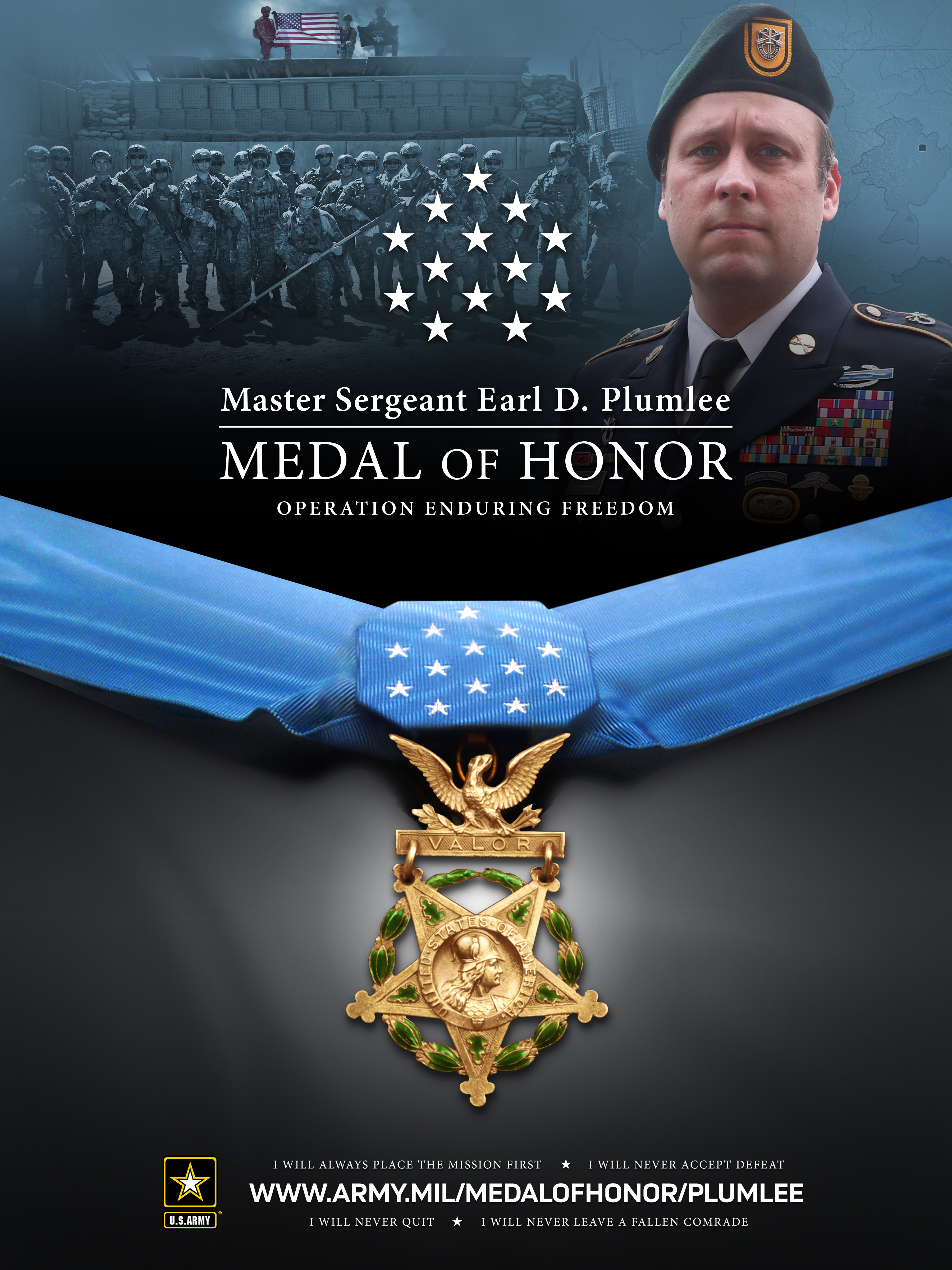
Operation Enduring FreedomMaster Sergeant Earl D. Plumlee
hometown
Clinton, Oklahoma
Enlistment date
1998
Military Occupation (MOS)
Operations (Team) Sergeant 18Z
Unit
1st Special Forces Group (Airborne)
Deployments
Operation Iraqi Freedom (2005 and 2008), Operation Enduring Freedom (2013)
Master Sgt. Earl Plumlee was born in Clinton, Oklahoma. He grew up working on his family’s cattle ranch and oil field instrument company. He began his military career by joining the Oklahoma National Guard, serving in the 45th Field Artillery Brigade as a rocket artilleryman (13M) during his junior year of high school. After graduating high school in 2000, Plumlee joined the United States Marine Corps. He attended boot camp at Marine Corps Recruit Depot, San Diego, California and Marine Corps School of Infantry. Plumlee was then assigned to Alpha Company, 1st Battalion, 3rd Marine Regiment, located in Kaneohe, Hawaii, where he served his first enlistment in a weapons platoon.
Plumlee deployed to Okinawa, Japan, after the 9/11 attacks occurred. He was sent to Bahrain and served on a Marine Security Element to the 5th Fleet. In 2003, he was deployed to Zamboanga, Philippines, to the Joint Special Operations Task Force-Philippines on Camp Navarro. After returning from this deployment, Plumlee attended the 4th Force Reconnaissance, Recon Indoctrination Program, and was selected to attend the Marine’s Amphibious Reconnaissance Course and became a Basic Reconnaissance Marine. Afterwards, Plumlee attended and graduated from Navy SERE School, Basic Airborne School, the Marine Corps High Risk Personnel Course, and Marine Combat Dive School. Upon returning to the 4th Force Recon, he volunteered for a deployment to Iraq with the 2nd Force Reconnaissance Company.
Plumlee was deployed to Iraq’s Al Anbar region, operating from the Al Asad Airfield from August 2005 to February 2006. Upon returning from this deployment, he attended Military Free Fall School. From there, he was promoted to Recon team leader. In 2007, he married his wife, Terrie. Following his wedding, Plumlee volunteered to deploy to Iraq again in 2008. During this deployment, he was selected and recognized as the Marine Corps Recon Team Leader of the Year. After returning from Iraq, Plumlee decided to make a change in his career trajectory and joined the U.S. Army under the 18X program in January 2009. Upon successful completion of the Special Forces Assessment and Selection, he was chosen to attend the Special Forces Qualification Course, where he had the unique opportunity to attend SERE School for a second time.
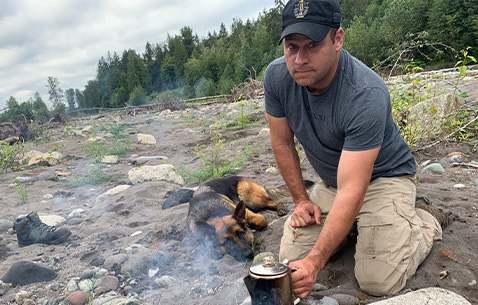
In 2009, successfully graduated SFQC as a Special Forces weapons sergeant (18B) and was assigned to 4th Battalion, 1st Special Forces Group (Airborne). There, he served in various rotations through the Indo-Pacific area of responsibility. Plumlee deployed to Afghanistan in April 2013, where his unit was tasked with conducting stability operations. Later in this deployment, he was located at Forward Operating Base Ghazni, which was subject to a complex attack on Aug. 28, 2013.
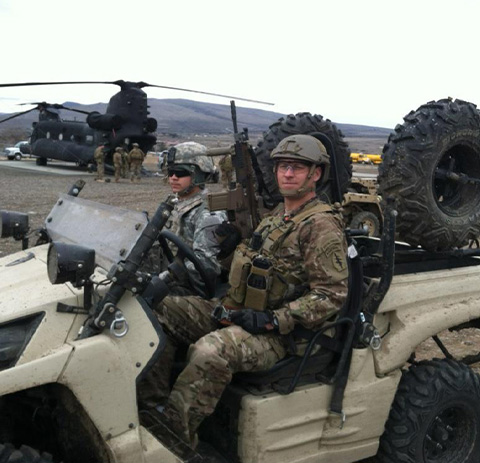
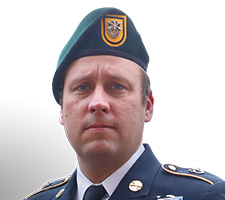
PHOTO: Then-Staff Sgt. Earl Plumlee, poses for a photo during pre-deployment training, 2013, Yakima, Wash. (Photo Credit: U.S. Army)
After returning from Afghanistan, Plumlee completed nine months of physical rehabilitation, while continuing to serve in the 4th Battalion, 1st SFG (A).
In 2015, Plumlee was stationed in Okinawa, Japan, with the 1st Battalion, 1st SFG (A), where he served in the INDOPACOM-Crisis Response Force. There he served on foreign details for President Obama and President Trump. In 2018, he was selected for promotion to master sergeant and ended his time in Okinawa. He and his family returned to Joint Base Lewis-McChord, Washington, where he served in the 1st SFG (A) headquarters. In August 2020, he was selected to become a team sergeant at 3rd Battalion 1st SFG (A), where he continues to serve.
His awards and decorations include the Silver Star, the Bronze Star Medal, the Purple Heart, the Meritorious Service Medal, the Army Achievement Medal, two Navy Achievement Medals, the Combat Action Ribbon, four Army Good Conduct Medals, two Marine Corps Good Conduct Medals, the National Defense Service Medal, the Armed Forces Expeditionary Medal, the Afghanistan Campaign Medal with Campaign Star, the Iraq Campaign Medal with Campaign Star, the Iraq Campaign Medal with Arrowhead Device, the Global War on Terrorism Expeditionary Medal, the Global War on Terrorism Service Medal, the Marine Corps Expeditionary Medal, the Armed Forces Reserve Medal with "M" Device, three Noncommissioned Officer Professional Development Ribbons, the Army Service Ribbon, the Overseas Service Ribbon, four Sea Service Deployment Ribbons, the NATO Medal, two Navy Unit Commendations, the Marine Unit Commendation, the Special Forces Tab, the Marine Corps Combatant Dive Badge, the Combat Infantryman Badge, the Military Free-Fall Parachute Badge and the Indonesian Parachutist Badge.
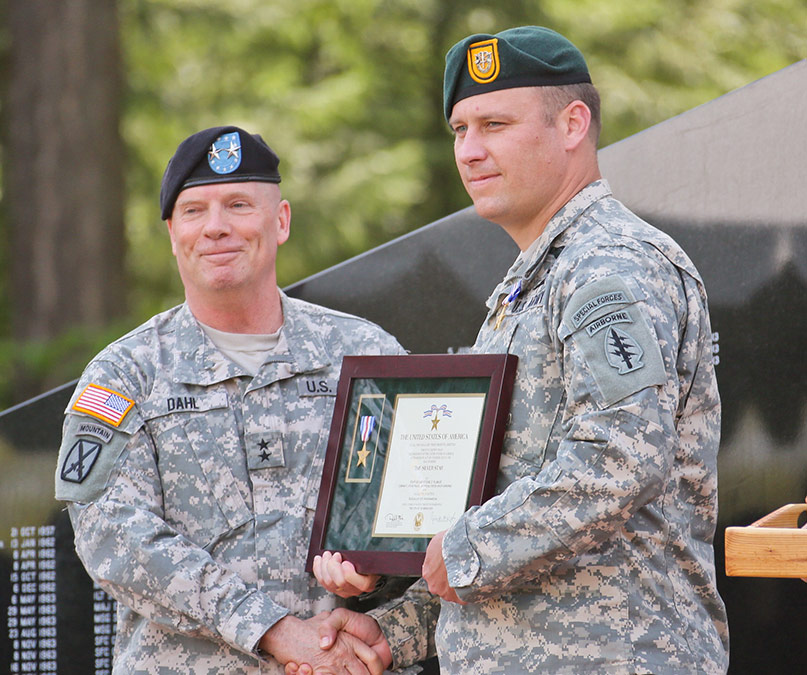
IMAGE: Then-Sgt. 1st Class Earl D. Plumlee, assigned to 1st Special Forces Group (Airborne), is presented the Silver Star Medal by Maj. Gen. Kenneth R. Dahl, I Corps Deputy Commanding General, during a ceremony at the 1st SFG (A), Joint Base Lewis-McChord, Wash. (Photo Credit: U.S. Army).
The Battle
Aug. 28, 2013 | Forward Operating Base Ghazni | Afghanistan
1st Special Forces Group (Airborne)
Then-Staff Sgt. Earl D. Plumlee distinguished himself by acts of gallantry and intrepidity above and beyond the call of duty while engaging with the enemy in support of Operation Enduring Freedom in Ghazni Province, Afghanistan, on Aug. 28, 2013.
Plumlee served as a weapons sergeant assigned to Charlie Company, 4th Battalion, 1st Special Forces Group (Airborne), at Forward Operating Base Ghazni, when the complex was attacked. Plumlee instantly responded to a massive explosion that caused a 60-foot breach in the base’s perimeter wall. Ten insurgents wearing Afghan National Army uniforms and suicide vests poured through the breach.
Plumlee and five other special operations Soldiers, intent on defending the base, mounted two vehicles and raced toward the detonation site. Plumlee’s driver purposefully maneuvered the vehicle into enemy fire to shield three dismounted teammates, two of whom were injured, placing the vehicle under effective enemy fire from the front and right side.
Using his body to shield the driver from enemy fire, Plumlee exited the vehicle while simultaneously drawing his pistol and engaging an insurgent 15 meters to the vehicle’s right. Without cover and with complete disregard for his safety, he advanced toward the enemy force, engaging multiple insurgents with only his pistol. Upon reaching cover, he killed two insurgents.
Plumlee left cover and continued to advance alone. Moving forward, he engaged several combatants at close range. Under intense enemy fire, Plumlee temporarily withdrew to cover, where he joined another Soldier.
Plumlee, ignoring his injuries, quickly regained his bearings and reengaged the enemy. Intense enemy fire once again forced the two Soldiers to temporarily withdraw. Undeterred and resolute, Plumlee joined a small group of American and coalition soldiers moving from cover to counterattack the infiltrators. As the coalition forces advanced, Plumlee engaged an insurgent to his front-left.
"The strongest emotion I had from that day was the last time we were pushing down and had really gotten organized we were moving as a really aggressive, synced up stack, moving right into the chaos,” Plumlee said. “It was probably the proudest moment of my career, just to be with those guys, at that time, on that day was just awesome."
- Master Sergeant Earl D. Plumlee
Plumlee then ran to a wounded Soldier, carried him to safety, and rendered first aid. Afterwards, he organized three coalition members in a defensive stance as he methodically cleared the area, remained in a security posture and continued to scan for any remaining threats.
Throughout the entire engagement, Plumlee repeatedly placed himself in extreme danger to protect his team and the base, and to defeat the enemy. Plumlee’ s extraordinary heroism and selflessness beyond the call of duty were in keeping with the highest traditions of military service and reflect great credit upon himself, his unit and the United States Army.
The Quiet Professionals
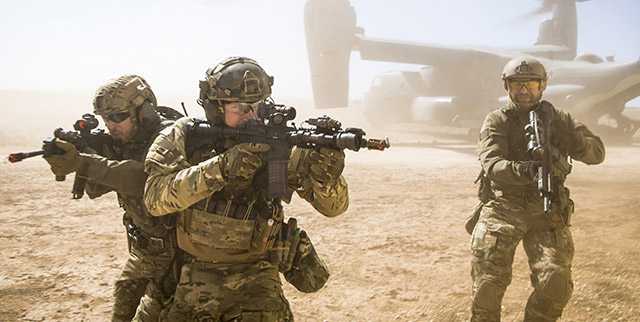
Special Forces are elite teams consisting of mature, intense, highly-trained operators. SF Operators receive specialized training in advanced weapons, language, demolitions, combat medicine, military free-fall, and advanced combat tactics. Today’s quiet professional operates in autonomous environments as the most trusted force in America’s Army.
The Ceremony
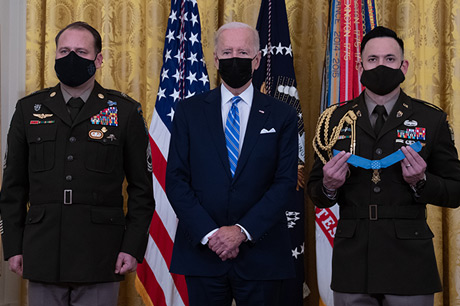
"Now, Master Sgt. Plumlee, this recognition has been too long delayed for you and your family, and no one will ever forget how you sprang into action when the enemy attacked our base. I’m grateful for your continued service and dedication to the country."
PRESIDENT JOSEPH R BIDEN,
White House Medal of Honor Ceremony, December 16, 2021
RELATED STORIES FROM ARMY.MIL
1st Special Forces Group (Airborne)
The 1st Special Forces Group (Airborne) lineage can be traced to the First Special Service Force, which was formed during World War II. This combined Canadian-American unit, known as the “Devil’s Brigade,” distinguished itself through daring and successful raids within the Pacific and Mediterranean theaters of operation. Detachment 101 of the Office of Strategic Services is also considered a predecessor of the 1st SFG (A). This unit raised and led a guerrilla force known as the “Kachin Rangers,” which wrought havoc behind Japanese lines in Southeast Asia.
The modern 1st SFG (A) was activated on June 24, 1957, and stationed at Fort Buckner, Okinawa. For the next 17 years, the 1st SFG (A) carried out a variety of missions in the Asia-Pacific region, including civic actions, foreign internal defense, counterinsurgency, reconnaissance and disaster relief. The 1st SFG (A) saw extensive combat in Vietnam as well as in Laos, Thailand and Cambodia. Soldiers from the 1st SFG (A) earned 296 awards for valor in Southeast Asia, and the group was awarded the Meritorious Unit Citation.
The 1st SFG (A) fought natural disasters as well as the enemy; teams deployed to the Philippines in 1972 and in 1973 to provide disaster relief for victims of floods and famine. For this humanitarian service, the 1st SFG (A) received the Philippines’
Insignia
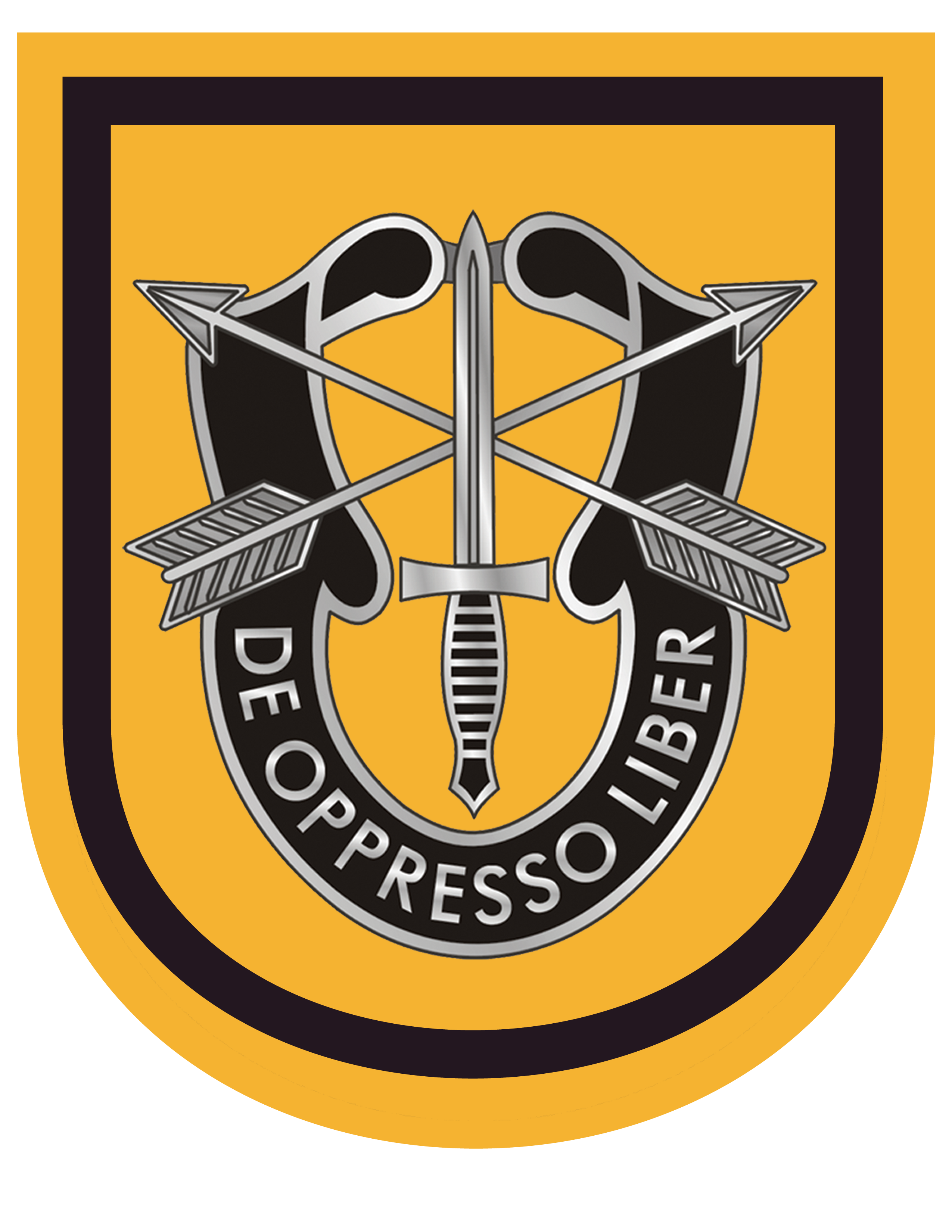
TOP: The U.S. Army Special Forces crest features crossed silver arrows, a V-42 stiletto dagger, and a black scroll bearing the Latin motto "De Oppresso Liber." Adapted from the collar insignia of the World War II First Special Service Force, representing unconventional warfare heritage. V-42 Stiletto Dagger centered over the arrows pointing upward, symbolizing the elite fighting knife issued specifically to the First Special Service Force. Motto Translation: Commonly translated as "To Liberate the Oppressed" or "From Oppression, We Will Liberate Them". Core Mission: Reflects the Green Berets' primary role of training, advising, and enabling indigenous resistance and foreign forces to fight for their own freedom.
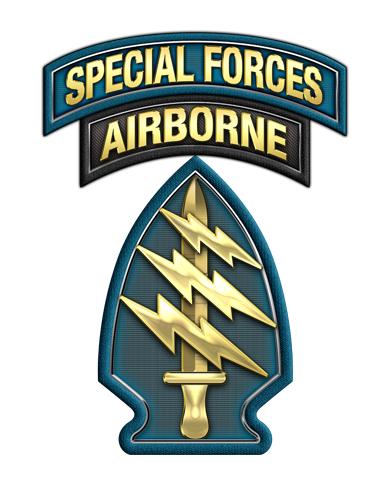
BOTTOM: The U.S. Army Special Forces shoulder sleeve insignia features an arrowhead, a dagger, and three lightning flashes. Design and symbolism represents basic American Indian wilderness and survival skills. The dagger symbolizes the secret, unconventional style of operations. Lightning Flashes: Highlights fast strike capabilities via land, water, or air.
Presidential Unit Citation.
The 1st SFG (A) was inactivated on June 28, 1974, as part of a general reduction of special operations forces. Ten years later, recognizing the critical role that Special Forces perform in both peace and war, the Army reactivated the 1st SFG (A). On March 2, 1984, the 1st Battalion was organized at Fort Bragg, North Carolina, and posted to Torii Station, Okinawa. The Group Headquarters, 2nd Battalion and 3rd Battalion were reactivated at Fort Lewis, Washington, on Sept. 4, 1984.
The 1st SFG (A) activated the Group Support Battalion on June 30, 2006, in order to provide increased expeditionary logistical capabilities.
The 1st SFG (A) activated the 4th Battalion on Aug. 15, 2011, to enhance the group’s expeditionary capabilities and better support the unit’s varied mission set.
Since Sept. 11, 2001, 1st SFG (A) personnel have played a vital role in fighting terrorism and violent terrorist organizations around the globe by participating in Operation Enduring Freedom–Afghanistan, Operation Enduring Freedom–Philippines, Operation Iraqi Freedom, Operation New Dawn, Operation Inherent Resolve, and Operation Resolute Support. In the ensuing years, the 1st SFG (A) continued to conduct an array of engagement and contingency missions throughout the Pacific.
Operation Inherent Resolve
On Oct. 14, 2014, the Department of Defense formally established the Combined Joint Task Force - Operation Inherent Resolve (CJTF-OIR) in order to formalize ongoing military actions against the rising threat posed by ISIS in Iraq and Syria. Fueled by sectarian conflicts and division, ISIS ascended from relative obscurity in 2013 to propagate an extremist socio-political ideology, and claimed to have created an Islamic caliphate. Its’ successful acquisition of conventional weapons, establishment of armed formations, rapid territorial growth and unconscionable atrocities shocked the world and destabilized the region. By June 2014, the security situation in Iraq had deteriorated with the Iraqi cities of Mosul and Tikrit falling in rapid succession to ISIS aggressors.
CJTF-OIR was established by the United States Army Central Command (ARCENT), Camp Arifjan, Kuwait. On June 24, 2014, ARCENT was designated as the Joint Forces Land Component Command (JFLCC) for the conduct of operations in Iraq. This designation established the first operational headquarters since the departure of U.S. troops from the region in 2011. By August, JFLCC was engaged, taking the fight to ISIS via air operations. Defensive and offensive operations rapidly matured with the rescue of innocent Yazidi victims trapped on Sinjar Mountain, the recapture of the Mosul and Haditha Dams and the defense of Baghdad and Kirkuk. On Sept. 17, 2014, ARCENT was re-designated the Combined Forces Land Component Command. The command was authorized to conduct Combined Joint Operations in Iraq, which ultimately led to the formal establishment of CJTF-OIR. As CJTF-OIR grew, it encompassed the efforts and contributions of more than sixty Coalition partners throughout the Combined Joint Operations Area (CJOA) of Iraq and Syria.
III Corps assumed authority of CJTF-OIR from ARCENT on Sept. 22, 2015 and immediately initiated an aggressive plan to increase pressure on ISIS and bring new capabilities to bear throughout the theater of operations. Logisticians sustained the CJTF and delivered more than 146,000 tons of supplies and materiel with 1,700 ground and air movements. Additionally, more than $700 million worth of logistical contracts were executed to sustain operations throughout the CJOA.
Coalition fires were directed at ISIS leadership and infrastructure. Deliberate and dynamic precision airstrikes targeted ISIS economic infrastructure significantly degrading its ability to govern. More than 15,000 coalition airstrikes destroyed enemy military capabilities and provided freedom of maneuver to regional security and partner forces. Operation Tidal Wave II deprived ISIS of 80% of its oil collection facilities as well as $25 million a month in oil revenue, which negatively impacted ISIS military operations and halted enemy expansion. The adherence to strict rules of engagement, and the principles of necessity, distinction, proportionality and humanity, prevented unnecessary suffering among non-combatants in the conflict zones. Subsequent operations resulted in a dramatic contraction of ISIS controlled areas with the recovery of over 29,000 square kilometers in Syria and Iraq.
Increases in operational tempo, training and support to Iraqi Security Forces and Syrian opposition groups provided the foundation for broader strategic success. Iraqi and Syrian “Train and Equip Funds” provided the necessary assets and capabilities to achieve increasingly higher levels of partner participation. With comprehensive and consistent Coalition support, partner forces steadily gained the confidence needed to fight and win against ISIS. With CJTF-OIR’s operational support, 10,000 fighting personnel comprised of police, counterterrorism units and local tribal fighters acted in concert to liberate Ramadi in December 2015.
Following Ramadi’s liberation, Syrian Democratic Forces (SDF), supported by CJTF-OIR Advise and Assist teams, reclaimed Shaddadi, a town in northeastern Syria. Shaddadi served as a critical node for training, logistics and revenue and was the main supply artery between the ISIS capital Raqqa and the Iraqi city of Mosul. Peshmerga forces, supported by CJTF-OIR elements, liberated Sinjar and numerous ISIS controlled towns east of Mosul. After 28 days of fighting, Iraqi forces recaptured Fallujah on June 26, 2016, which forced ISIS further away from Baghdad and paved the way for the liberation of the Euphrates River Valley. Following each success in Syria and Iraq, CJTF-OIR trained Wide Area Security Forces, assumed the responsibility for liberated areas, and enabled military formations to rest and transition to the next military objective.
XVIII Airborne Corps assumed authority from III Corps, on Aug. 21, 2016. The transfer of authority sustained and accelerated the plan to degrade and destroy ISIS. On Aug. 25, 2016, Iraqi elements seized the airfield at Qayyarah, thus positioning forces within close logistical striking distance of Mosul. Following a brief strategic pause, Iraqi forces, again supported by coalition fires, air support and targeting teams, began the battle for Mosul on Oct. 17, 2016, which cleared the eastern half of the city by Jan. 24, 2017.
In Syria, CJTF-OIR expanded the train and equip program and worked with Vetted Syrian Opposition (VSO) troops in multiple regions. This anti-ISIS group fought to secure the strategic isolation of Raqqa by clearing the city of Manbij on Aug. 15, 2016. Like their Iraqi counterparts, VSO partnered forces politically organized, policed and patrolled on previously ISIS-held ground to secure liberated territories. Near Raqqa, SDF forces relied upon Coalition airlift capabilities to transition combat forces across Lake Assad to encircle the Tabqah Dam, effectively isolating the city from the west as of April 2017. SDF began the assault on the city of Raqqa on June 6, 2017, and continue to make steady gains despite heavy resistance.
After a brief refit and consolidation of gains in East Mosul, Iraqi forces resumed the offensive on Feb. 19, 2017 to take the western side of the city. Iraqi formations fought through a multi-layered cordon of defenses, and engaged in house-to-house fighting. After nearly nine months of battle Iraqi Prime Minister Haider Al-Abadi declared the city of Mosul liberated on July 10, 2017. Coalition partners supported the Iraqi effort with observation, selective fires, and logistics while strategic decisions in the battle were made and implemented by the Iraqi Government and Commanders From October 2014 to July 2017, CJTF-OIR, Coalition, Syrian and Iraqi partnered forces working together have made enormous progress denying ISIS aspirations. Coalition forces have defeated insurgent counterattacks, reclaimed thousands of square kilometers and significantly weakened the ISIS terror infrastructure in Iraq and Syria. One Mission, Many Nations!
Official Citation
The President of the United States of America, authorized by Act of Congress, March 3, 1863, has posthumously awarded in the name of Congress the Medal of Honor to
Master Sergeant Earl D. Plumlee
United States Army
For conspicuous gallantry and intrepidity at the risk of his life above and beyond the call of duty:
Staff Sergeant Earl D. Plumlee distinguished himself by acts of gallantry above and beyond the call of duty on August 28th, 2013, while serving as a weapons sergeant, C company, 4th Battalion, 1st Special Forces Group (Airborne) in support of Enduring Freedom.
Sergeant Plumlee instantly responded to an enemy attack on Forward Operating Base Ghazni — Ghazni Province, Afghanistan — that began with an explosion that tore a 60-foot breach in the base’s perimeter wall.
Ten insurgents wearing Afghan National Army uniforms and suicide vests poured through the breach. Sergeant Plumlee and five others mounted two vehicles and raced toward the explosion. When his vehicle was engaged by enemy fire, Sergeant Plumlee reacted instinctively, using his body to shield the driver prior to exiting the vehicle and engaging an enemy insurgent 15 meters to the vehicle’s right with his pistol.
Without cover and in complete disregard for his own safety, he advanced on the enemy, engaging multiple insurgents with only his pistol. Upon reaching cover, he killed two insurgents — one with a grenade and the other by detonating the insurgent’s suicide vest using precision sniper fire.
Again, disregarding his own safety, Sergeant Plumlee advanced alone against the enemy, engaging several insurgents at close range, including one whose suicide vest exploded a mere seven meters from his position.
Under intense enemy fire, Sergeant Plumlee temporarily withdrew to cover, where he joined up with another soldier and, together, they mounted another counterattack
Under fierce enemy fire, Sergeant Plumlee again moved from cover and attacked the enemy forces, advancing within seven meters of a previously wounded insurgent who detonated his suicide vest, blowing Sergeant Plumlee back against a nearby wall.
Sergeant Plumlee, ignoring his injuries, quickly regained his faculties and reengaged the enemy forces.
Intense enemy fire once again forced the two soldiers to temporarily withdraw. Undeterred, Sergeant Plumlee joined a small group of American and Polish soldiers, who moved from cover to once again counterattack the infiltrators.
As the force advanced, Sergeant Plumlee engaged an insurgent to his front left. He then swung around and engaged another insurgent who charged the group from the rear. The insurgent detonated his suicide vest, mortally wounding a U.S. .
Sergeant Plumlee, again, with complete disregard for his own safety, ran to the wounded soldier, carried him to safety, and rendered first aid. He then methodically cleared the area, remained in a security posture, and continued to scan for any remaining threats.
Staff Sergeant Earl D. Plumlee’s extraordinary heroism and devotion to duty are in keeping with the finest traditions of military service and reflect great credit upon himself, the Special Forces Regiment, and the United States Army.
U.S. Army Master Sgt. Earl D. Plumlee stands as the citation is read before receiving the Medal of Honor from President Joseph R. Biden Jr. during a ceremony at the White House in Washington, D.C., Dec. 16, 2021. Master Sgt. Plumlee was awarded the Medal of Honor for actions of valor during Operation Enduring Freedom while serving as a weapon’s sergeant with Charlie Company, 4th Battalion, 1st Special Forces Group (Airborne), near Ghazni, Afghanistan, Aug. 28, 2013. (U.S. Army photo by Laura Buchta).
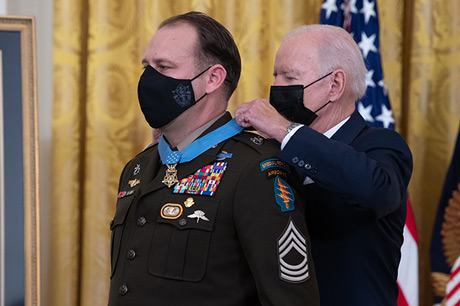
President Joseph R. Biden Jr. presents the Medal of Honor to U.S. Army Master Sgt. Earl D. Plumlee during a ceremony at the White House in Washington, D.C., Dec. 16, 2021. Master Sgt. Plumlee was awarded the Medal of Honor for actions of valor during Operation Enduring Freedom while serving as a weapon’s sergeant with Charlie Company, 4th Battalion, 1st Special Forces Group (Airborne), near Ghazni, Afghanistan, Aug. 28, 2013. (U.S. Army photo by Laura Buchta).
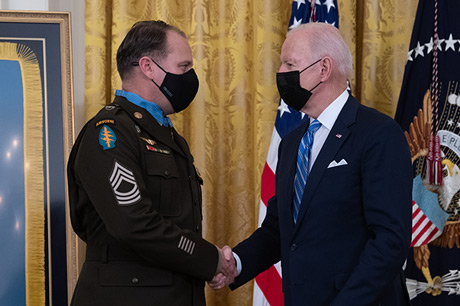
U.S. Army Master Sgt. Earl D. Plumlee shakes hands with President Joseph R. Biden Jr. during a Medal of Honor ceremony at the White House in Washington, D.C., Dec. 16, 2021. Master Sgt. Plumlee was awarded the Medal of Honor for actions of valor during Operation Enduring Freedom while serving as a weapon’s sergeant with Charlie Company, 4th Battalion, 1st Special Forces Group (Airborne), near Ghazni, Afghanistan, Aug. 28, 2013. (U.S. Army photo by Laura Buchta).
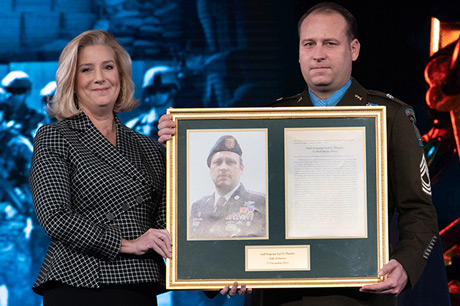
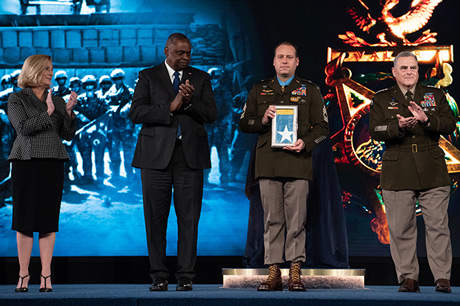
Secretary of the U.S. Army Christine E. Wormuth presents the Medal of Honor plaque to U.S. Army Master Sgt. Earl D. Plumlee during a Medal of Honor Induction Ceremony at Joint Base Myer-Henderson Hall, Va., Dec. 17, 2021. Master Sgt. Plumlee was awarded the Medal of Honor for actions of valor during Operation Enduring Freedom while serving as a weapon’s sergeant with Charlie Company, 4th Battalion, 1st Special Forces Group (Airborne), near Ghazni, Afghanistan, Aug. 28, 2013. (U.S. Army photo by Laura Buchta).
Secretary of the U.S. Army Christine E. Wormuth, Secretary of Defense Lloyd J. Austin III and Chairman of the Joint Chiefs of Staff U.S. Army Gen. Mark A. Milley present the Medal of Honor flag to U.S. Army Master Sgt. Earl D. Plumlee during a Medal of Honor Induction Ceremony at Joint Base Myer-Henderson Hall, Va., Dec. 17, 2021. Master Sgt. Plumlee was awarded the Medal of Honor for actions of valor during Operation Enduring Freedom while serving as a weapon’s sergeant with Charlie Company, 4th Battalion, 1st Special Forces Group (Airborne), near Ghazni, Afghanistan, Aug. 28, 2013. (U.S. Army photo by Laura Buchta).
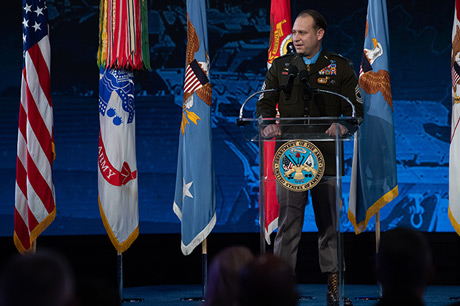
U.S. Army Master Sgt. Earl D. Plumlee gives his remarks during a Medal of Honor Induction Ceremony at Joint Base Myer-Henderson Hall, Va., Dec. 17, 2021. Master Sgt. Plumlee was awarded the Medal of Honor for actions of valor during Operation Enduring Freedom while serving as a weapon’s sergeant with Charlie Company, 4th Battalion, 1st Special Forces Group (Airborne), near Ghazni, Afghanistan, Aug. 28, 2013. (U.S. Army photo by Laura Buchta).