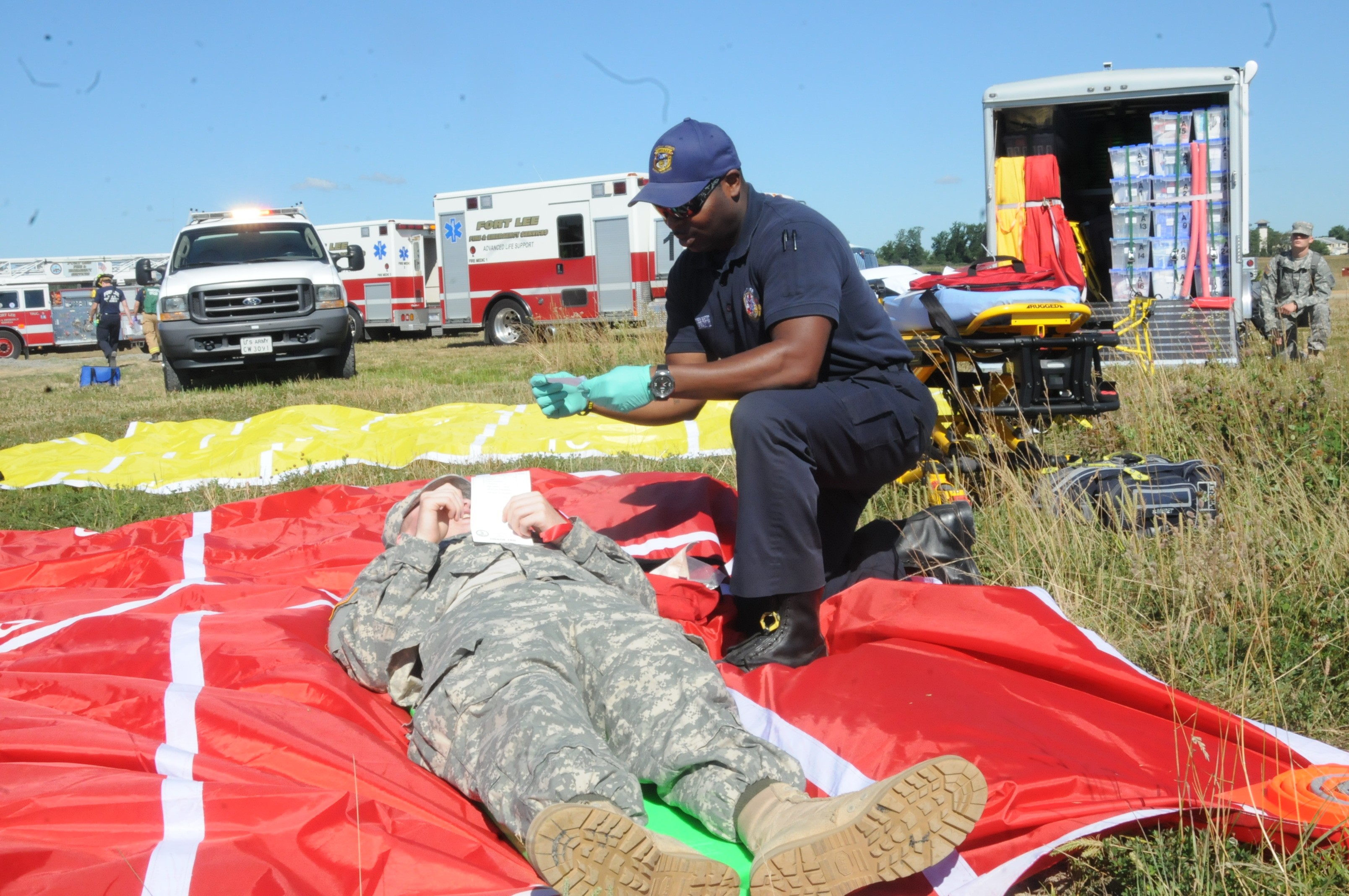

FORT LEE, Va. (June 28, 2012) -- Fort Lee Fire and Emergency Services conducted its first mass casualty exercise Tuesday at the Downer Range Complex.
The DRC is a recovery vehicle training facility located in the northern region of Fort Lee adjacent to the Petersburg federal corrections complex.
Brian Harness, assistant chief, FES, said the exercise was part of a quarterly training program that helps them prepare for a variety of emergency situations that can arise on the installation.
"It allows us to test our capabilities and our agreements with outside agencies in the surrounding communities who come in to help us out, whether it is a man-made or natural disaster here," he said.
Life Evac, a contract helicopter service and Virginia State Police Medflight, the state's aerial evacuation service, also participated in the exercise.
The training was conducted using a scenario in which a winch snapped from an M88 recovery vehicle, injuring 20 or more Soldiers, said 1st Lt. Walter Carter, the 59th Ordnance Brigade's assistant operations officer. The goals were to respond quickly and to determine where to evacuate the casualties based on their injuries and the availability of medical facilities. Harness said the location of the DRC made the exercise even more challenging.
"The complex is geographically separated from the rest of the post," he said. "On the other side of post, we have the fires stations staffed over there so the distance to respond out here and the ground conditions is what really makes it different.'
The exercise scenario required FES personnel to respond not to a building but to a field site where the recovery training takes place.
During the exercise, several FES vehicles and emergency personnel converged on the field site while the medical evacuation helicopters whizzed above. They were required to assess the situation and take the appropriate actions, said Bob Sperberg, assistant fire chief.
"The first thing we had to do is triage the patients, determine the extent of the injuries," he said. "Then we had to arrange for the treatment of those patients to begin and coordinate for their transportation to area hospitals."
Harness said he was pleased with the effort.
"It went very well," he said. "Everything came into play and they responded well. I think that can be attributed to the training that we conduct quarterly."
Sperberg said a further assessment and performance evaluation will take place at a later date.
.
Social Sharing