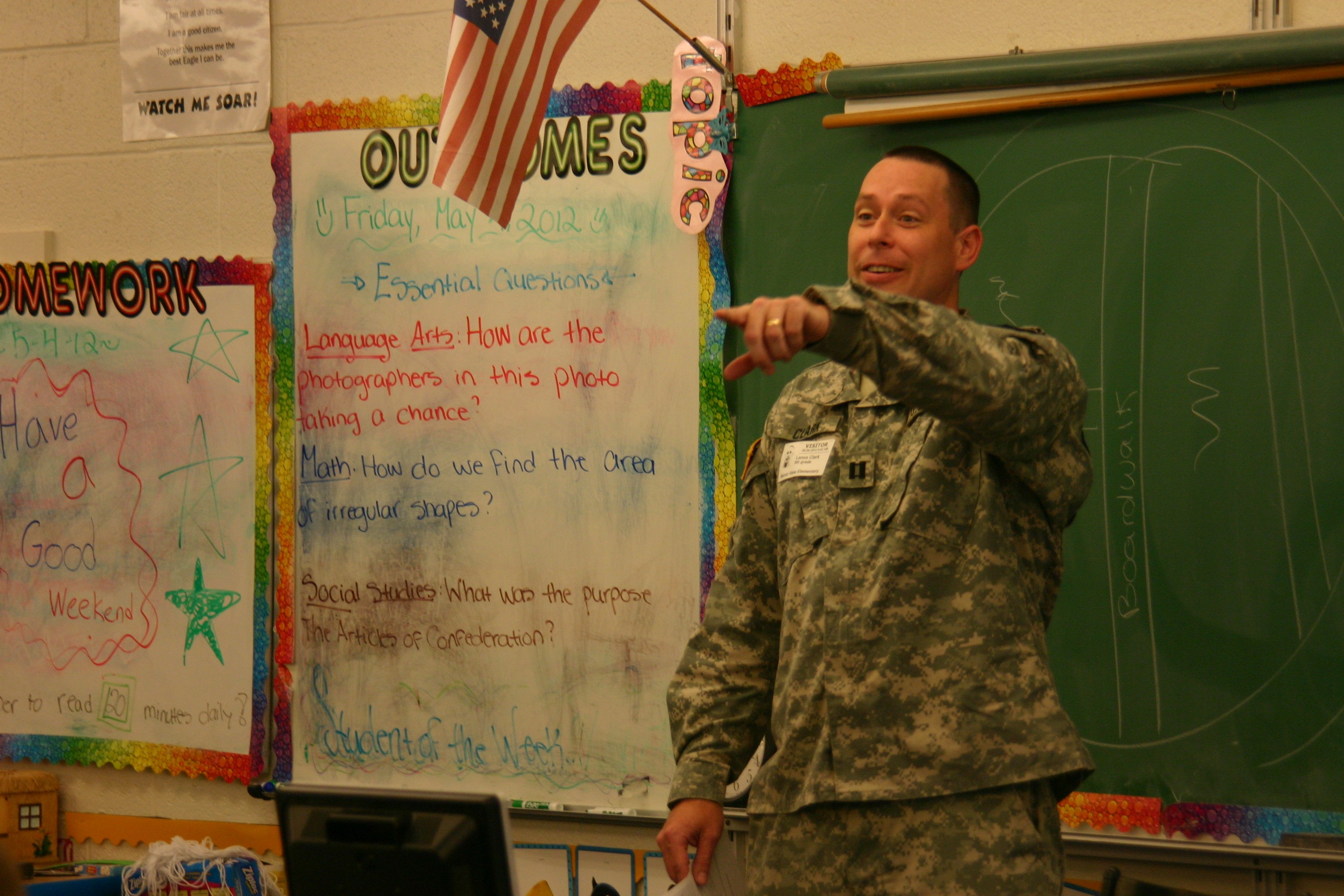
FORT GEORGE G. MEADE, Md. (May 10, 2012) -- As chief of military justice at Fort Meade's Office of the Staff Judge Advocate, Capt. Lance Clark has spent his fair share of time in the courtroom.
Friday morning, however, he didn't face a jury and judge. Instead, he addressed a group of curious fifth-graders at Manor View Elementary School.
"The courtroom is harder, but the classroom of fifth-graders is unscripted, you don't know where it's going," he said. "I enjoy it. It's fun to come out and work with kids."
In celebration of Law Day, Clark spoke to the students about the courtroom and individuals in the court system. The hourlong lesson focused on this year's American Bar Association theme of "No Courts, No Justice, No Freedom."
"Law Day is the one day a year where we try to emphasize community service and education of the public as to the law," Clark said.
Law Day, which was founded in 1958 by President Dwight Eisenhower, is held annually on May 1. Each year commemorates a different theme to teach the importance of the legal and judicial system. This year's theme focused on the courtroom and the historic role that courts have played in protecting rights and liberties in America.
For the group of more than 30 fifth-graders, this meant learning the key players in the courtroom and understanding how the judicial system works.
Clark opened his lesson by discussing the importance of trials and the kind of cases that can be presented in a courtroom, with the various penalties for each of the crimes. Using a photograph of a courtroom, Clark talked about all of the people involved in the proceedings, from the judge to the court reporter.
When identifying each person in the photo, Clark explained the roles they each play in the judicial system and answered dozens of questions posed by the young students about the court system.
"They had some great questions, they were very insightful," Clark said. "It was very good to talk to them about the process and educate them a little bit."
The most popular questions centered on innocent people found guilty, the appeal process, and the responsibilities of lawyers and judges.
"I learned that lawyers have to tell the truth," said student Jacob Wright.
Samantha Dixon, who said she may want to be a lawyer, enjoyed learning about the process and jury selection and the restrictions imposed on the judge.
"I learned that if the judge knows the defendant, they'll be assigned to another case," Samantha said.
Several students said they liked Clark's presentation, noting that he wasn't what they expected when they think of a lawyer.
"He was nice," Samantha said. "I thought lawyers were supposed to be mean and yell a lot. That's what they make it seem like on TV."
At the end of the lesson, a quick poll of the students showed that most of the class thought that the bailiff, or sheriff, is the most important person in the court room.
Clark, however, quickly explained that no one individual is more important than another.
"They're all important," he told the class. "You need everybody."
Social Sharing