
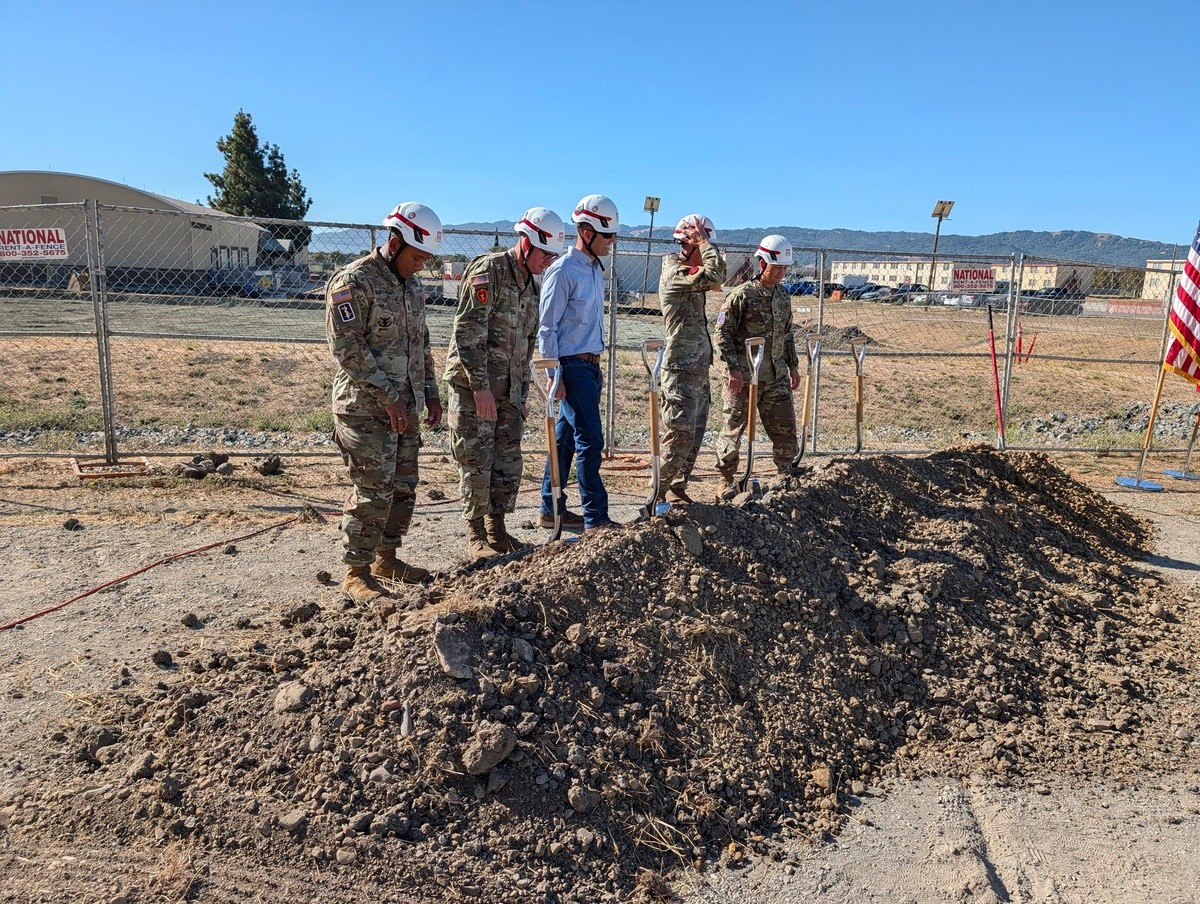

DUBLIN, Calif. — Military leaders, project engineers, and regional partners gathered at Parks Reserve Forces Training Area (Camp Parks) on Sept. 29, 2026, for a groundbreaking for a $36.5 million state-of-the-art barracks complex.
The project—designated as the Fiscal Year 2025 Permanent Party Advanced Skills Training (AST) Barracks Facility—represents the significant Army Reserve investment dedicated to barracks modernizing, enhancing Soldier quality of life, and strengthening the profession.
The official party for the ceremony included Maj. Gen. Windsor S. Buzza, Commanding General of the 63rd Readiness Division; Col. Jason R. McKenzie, Garrison Commander of U.S. Army Garrison Fort Hunter Liggett; and Camp Parks Commander Lt. Col. Tony S. Ibrahim and Command Sgt. Maj. David Oduro-Boafo; and Ryan Larson, Chief of the Construction Division for the U.S. Army Corps of Engineers Sacramento District.
Spanning approximately 48,000 square feet across two stories, the new facility will provide modern living accommodation for up to 300 Soldiers visiting Camp Parks for training, with a 172 bed capacity, expandable to 180. Designed to replace aging legacy facilities, the complex features 44 two-bedroom suites and 28 three-bedroom suites, ensuring occupants have individualized sleeping quarters and private bathrooms. The facility also incorporates shared dayrooms and lounges, high-efficiency HVAC and environmental controls, and robust digital connectivity infrastructure.
The ceremony opened with an invocation delivered by Installation Chaplain Maj. Evelio Rodriguez, followed by the national anthem and official addresses from installation leadership and engineering partners.
"Today is not merely about clearing dirt, pouring concrete, or raising steel—it is about delivering on a promise," said Lt. Col. Tony S. Ibrahim, underscoring the vital compact between the Army and its service members and linking the project to nationwide standards. "Every single day, we ask our Soldiers to undergo rigorous training and maintain continuous readiness to deploy into complex environments. In return, the Army owes them modern, dignified, and safe living conditions. Under our enterprise housing initiatives, clean, safe, and functional housing is recognized not as an afterthought, but as a direct driver of Soldier readiness, morale, and retention. This facility has been engineered from the ground up to respect Soldiers' privacy, foster unit cohesion, and provide the restorative environment they have earned."
Engineering Partnerships in Action
The U.S. Army Corps of Engineers Sacramento District is managing the barracks construction on behalf of the Army Reserve, following planning and design work led by the USACE Louisville District.
Highlighting the critical link between engineering execution and operational readiness, Ryan Larson, Chief of the Construction Division for the USACE Sacramento District, underscored the collaborative effort required to bring the project to fruition.
“This project is ultimately about providing Soldiers with the facilities they need to train and accomplish their missions,” Larson said. “Breaking ground is an important milestone because it represents the transition from years of planning and design to putting that work into the ground. Our team looks forward to delivering a quality facility that supports the Army’s training mission here at Camp Parks.”
A Commander's Perspective: Decades of Evolution and Readiness
In his keynote address, Maj. Gen. Windsor S. Buzza drew upon his deep personal history with Camp Parks, sharing reflections from his early career as a young officer arriving at the installation three decades ago.
"Over the last 30 years, Camp Parks has changed considerably, but the mission of the people and the Army has been constant, and that’s to build readiness," said Buzza. "So we invest money over time to meet what the requirements are as they change for building readiness. And this is just the latest example of us investing in our future for tomorrow and in our Soldiers."
Buzza pointed out how the new structure builds upon ongoing campus modernization, bringing a much-needed evolution from open-bay legacy quarters to modern individualized rooms.
"What we're going to build here is going to be much like [the neighboring building] on the outside, but a little bit different on the inside, because the rooms will be a little more individualized, which is good from a Soldier perspective," Buzza said, drawing laughs from attendees as he recalled the realities of sleeping in open-room barracks and the familiar chorus of snoring echoing across the hall.
Looking to the future, Buzza noted that the aging World War II-era wooden barracks situated nearby are slated to eventually make way for continued modernization across the footprint. He emphasized that delivering complex construction projects requires dedicated inter-agency collaboration.
"I want to reiterate how much of a team effort it is to bring something like this together," Buzza emphasized. "Project management is a thing—it doesn’t just happen on its own. So an appreciation for everybody who has pitched in and gripped hands alongside of us to get to where we are, and in anticipation of this project going smooth sailing forward so it gets completed on time—maybe ahead of schedule."
Buzza then rallied the crowd with the 63rd Readiness Division's historic motto, "Blood and Fire," as he invited the party to take up their shovels.
A Broader Modernization Campaign
The Camp Parks project represents one tangible milestone within a multi-billion-dollar campaign across the Department of War and U.S. Army to overhaul unaccompanied personnel housing. Under dedicated initiatives and aggressive budgetary priorities—including funding dedicated strictly to barracks sustainment, restoration, and modern construction—the service is driving toward strict performance targets: achieving 100 percent compliance with published habitability standards, 98 percent compliance with unaccompanied housing privacy standards, and ensuring at least 93 percent of government-owned housing achieves a Building Condition Index (BCI) score of 80 percent or greater.
By partnering with private industry to expedite timelines, projects like the Camp Parks AST barracks demonstrate how modern construction practices are bypassing traditional maintenance bottlenecks to deliver immediate quality-of-life improvements.
Following the formal addresses, members of the official party donned hard hats and gripped ceremonial chrome shovels at the dirt berm. Joined by representatives from USACE, the leadership team turned the first shovels of soil to signify the formal start of construction.
The ceremony concluded with all attendees joining in the traditional singing of "The Army Song."
Site preparations and initial grading are underway, with construction scheduled for completion in May 2028.
*Editor's Note / Attribution Footnote: Portions of this article—including project specifications, construction timelines, and commentary from Ryan Larson, Chief of the Construction Division for the U.S. Army Corps of Engineers Sacramento District—were adapted and folded into this report from initial reporting by Lt. Col. Kara Greene, U.S. Army Corps of Engineers Sacramento District Public Affairs.
Social Sharing