

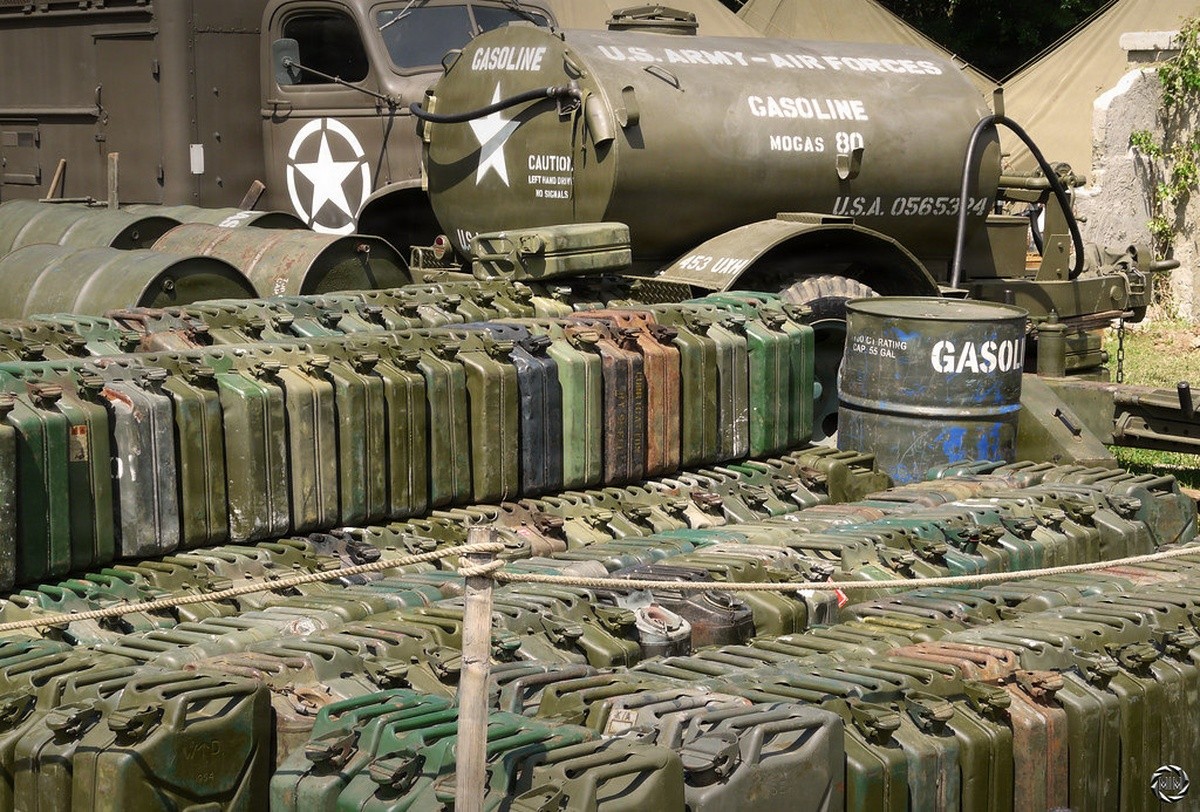
The ‘Red Ball Express’ was an important military operation from World War II that has become a symbol for the strength and adaptability of U.S. Army logistics.
Beginning Aug. 25, 1944, U.S. Army forces under the 12th Army Group and Communications Zone (COMMZ) established a new convoy system to match pace with the rapidly advancing Allied armies.
In many ways, the system that became known as the ‘Red Ball Express’ is the result of bad luck, inaccurate planning assumptions, and ‘catastrophic success.’ The Allied decision to land on the Normandy peninsula in June 1944 was based in many ways around quickly capturing the deep-water port of Cherbourg.
Stiff German resistance and subsequent sabotage of port infrastructure forced all personnel, equipment, and supplies to instead come ‘over the beach’ and via one (originally two) artificial harbor called ‘Mulberries.’
This constraint on Allied, especially American, logistics came to head in August with the massive breakout from the Normandy hedgerows into open terrain, led by elements of Lt. Gen. George S. Patton’s 3rd U.S. Army. By late August 1944, gas guzzling tanks and other vehicles were being forced to slow or stop due to lack of supplies.
To meet this unprecedented, large scale logistical challenge, Army logisticians developed a tightly controlled network of roads and convoys to expedite the delivery of key supplies to the front lines.
The term "Red Ball" originated from American railroad slang, referring to express freight that had priority over other shipments. The name was adopted for this military operation to signify the urgency of the supplies being transported.
The trucks used in the operation were marked with a red ball symbol, indicating their priority status on the roads. The first iteration of this operation went from Aug. 25, 1944, and continued until Nov. 16, 1944.
At its peak, the Red Ball Express operated 5,958 trucks, delivering approximately 12,500 tons of supplies daily. The convoy system was crucial for maintaining the supply lines as traditional transportation methods, such as railroads, were heavily damaged or destroyed during the war. The trucks traveled on a one-way route from supply depots in Normandy to the front lines, ensuring that supplies reached the troops quickly and efficiently.
A significant aspect of the Red Ball Express was the involvement of African American soldiers, who made up about 75% of the drivers in the Quartermaster truck companies and battalions, along with the Transportation Corps movement and management divisions, that formed the backbone of the convoy operations.
Ultimately, the Red Ball Express played a critical role in the success of Allied operations in Europe, delivering over 412,000 tons of supplies during its operation. It helped sustain the momentum of the Allied advance into Germany and is remembered as a significant logistical achievement of World War II.
For military planners and sustainment professionals, the Red Ball Express is a key part of our Army history and heritage. Like much of World War II, its story is both complex and layered, but well worth a deep dive into its causes and solutions developed in the midst of total war. For more information, see:
(Army University Films) – documentary – France ’44: The Red Ball Express - https://www.armyupress.army.mil/Films/France-44-The-Red-Ball-Express/
(US Army Transportation School) – article – ‘Keep in Rolling’ - https://transportation.army.mil/history/studies/red_ball_express.html
(First Division Museum at Cantigny) – resource page – The Red Ball Express - https://www.fdmuseum.org/collection/online-exhibits/red-ball-express/
(Center for Military History) – official Army history – Logistical Support of Armies, Vol 1 - https://history.army.mil/Portals/143/Images/Publications/Publication%20By%20Title%20Images/L%20Pdf/CMH_Pub_7-2-1.pdf
Social Sharing