
Background
In large-scale combat operations (LSCO), the U.S. military must rapidly move and maneuver forces across both intertheater and intratheater environments. The complexity of this requirement — integrating routing, scheduling, sequencing, and loading of personnel and equipment — is compounded when adversaries seek to disrupt the flow of forces. Sealift remains the primary means of transporting heavy combat equipment, making embarkation planning a critical enabler of operational success.
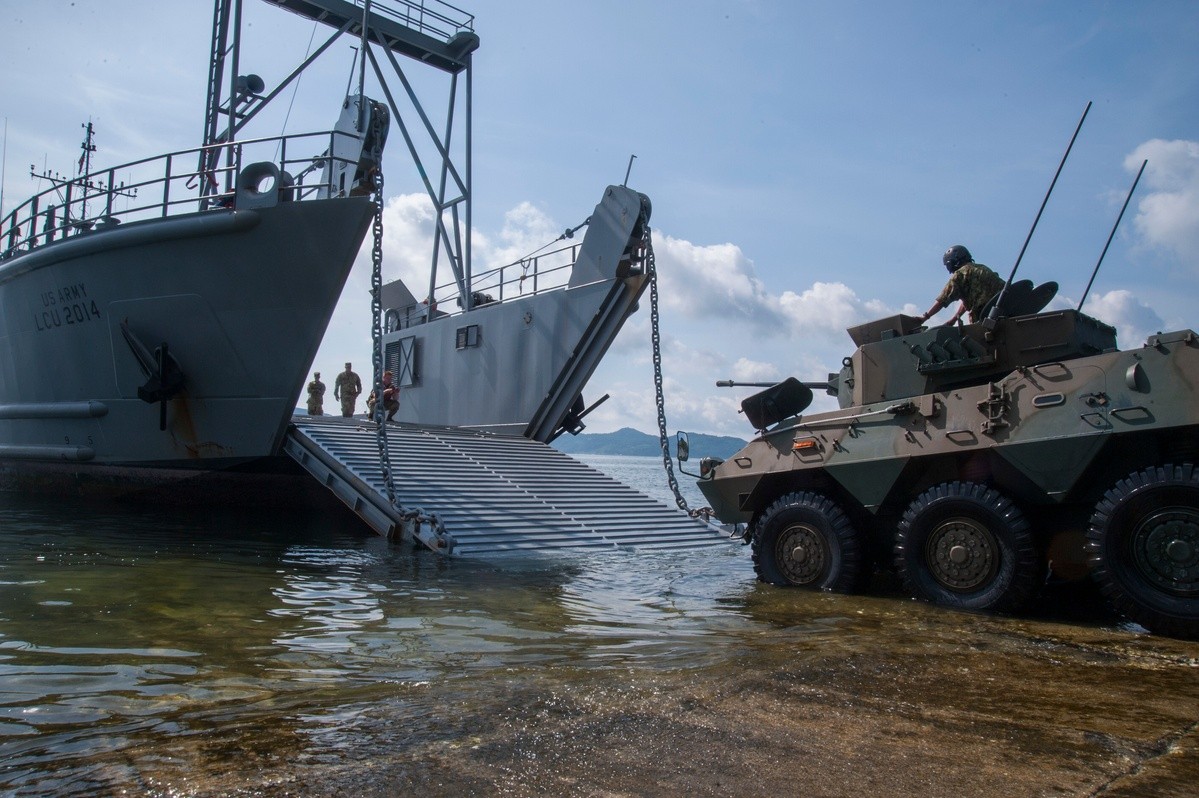
Amphibious ships such as the Wasp- and Whidbey Island-class vessels feature large well decks designed for expeditionary operations, while logistics support vessels and landing craft introduce different deck geometries, access points, and balance constraints. These physical differences directly influence how equipment can be staged, accessed, and offloaded during contested landings.
In contested environments, the landing force’s ability to rapidly transition from ship to shore often determines its initial combat effectiveness. To support the scheme of maneuver, equipment must be positioned to fit safely aboard the vessel and to be removed from it in the correct tactical order. Achieving this balance between feasibility and maneuver priority remains a persistent challenge for embarkation planners.
Problem
Combat loading differs fundamentally from administrative loading. Units must land in formation and be prepared to fight immediately upon arrival. While the Integrated Computerized Deployment System (ICODES) Single Load Planner is the Department of War program of record for load planning, its automated stowage functions are designed primarily to ensure safety and compliance with vessel constraints.
ICODES effectively verifies requirements such as load balance, stability, and separation rules. However, it does not automatically optimize layouts based on the tactical mission upon offloading. As a result, system-generated plans often place high-priority combat assets behind lower-priority equipment or deeper in the vessel where access is restricted by ramps or deck geometry.
To correct these issues, planners frequently must manually reorganize layouts to align them with maneuver priorities. This process is time consuming, increases planning complexity, and introduces risk, particularly in LSCO scenarios where timelines are compressed and adaptability is essential. The lack of automated support for tactical prioritization represents a significant gap between feasibility checking and operational readiness. The article “Automated Vessel Selection and Combat Load Planning,” published in the fall 2024 issue of Army Sustainment, envisioned the creation of a model to leverage advanced algorithms to provide automated combat loading capability.
A central operational challenge is translating maneuver sequencing into physical placement. Combat loading must reflect multiple levels of prioritization derived from the operational plan: unit-level priorities (e.g., lead maneuver elements), functional group priorities (e.g., engineers, air defense, armor), and in some cases, item-level priorities within units (e.g., breaching vehicles or command platforms). While infantry or lead vehicles must be closest to access points, supporting task force elements must also be positioned to sustain momentum once ashore. Current tools are unable to systematically account for these layered priorities, leaving planners to manually approximate how sequencing intent should map to stowage decisions.
Model Concept
To address this gap, recent research developed an optimization-based enhancement to combat load planning that embeds tactical priority directly into stowage decisions. Rather than replacing ICODES, this algorithm is designed to complement existing systems by generating high-quality initial layouts that already reflect both vessel constraints and maneuver priorities.
A central feature of the approach is its flexible definition of groups. In this context, a group represents any collection of equipment items that planners want to keep spatially close during loading and offloading. Groups are not limited to a single organizational structure; they can represent squads, platoons, company-level assets, functional capabilities such as engineering or air defense elements, or combinations of organizational and functional groupings. This flexibility allows planners to tailor load plans to mission-specific requirements while preserving unit integrity.
Each group is assigned a priority based on the planned scheme of maneuver. Higher-priority groups correspond to elements that must offload earlier to establish combat power, such as lead maneuver units or critical enablers. In addition to group-level priorities, individual equipment items within each group may also receive relative priorities. This allows planners to control internal positioning, encouraging, for example, key vehicles such as breaching assets, command platforms, or air defense systems to be more accessible than other equipment within the same unit. These priorities determine how closely equipment is placed to the vessel’s primary offloading point. As a result, high-priority equipment may be positioned closer to ramps or access points, while lower-priority groups retain greater placement flexibility. The model seeks to preserve group cohesion and ensure that priority relationships are respected in the final layout.
By automating the initial priority-driven placement decisions, the optimization approach provides planners with a tactically aligned starting point that already satisfies vessel balance and space requirements. This reduces the need for extensive manual reconfiguration, allowing planners to focus on mission-specific adjustments rather than basic feasibility corrections.
Performance
Testing across a wide range of realistic vessels and unit configurations has shown that automated, priority-aware load planning significantly improves both reliability and planning efficiency. Traditional off-the-shelf optimization methods have struggled to consistently produce usable load plans under realistic conditions, successfully generating balanced and tactically aligned layouts only about 60% of the time. Performance has declined further as ships have become more heavily loaded or as the problem size has increased.
In contrast, the new algorithm has produced workable, combat-ready load plans in the overwhelming majority of test cases. These plans have consistently met vessel balance requirements while preserving the intended offload priority relationships for higher-priority units, positioning them for earlier debarkation even when exact sequencing is constrained by physical layout realities. Importantly, this improved reliability has not come at the cost of excessive computation time; most plans have been generated in just a few minutes.
From an operational perspective, the key advantage of this approach is its ability to reflect how planners already think about combat loading. High-priority units are placed where they can disembark first, while lower-priority equipment is adjusted to maintain ship stability. The result is a load plan that supports rapid offload, maintains unit integrity, and reduces the need for extensive manual rework.
Implications for Planners
The computational results demonstrate that algorithm-driven planning can reliably generate load configurations that align with tactical intent while satisfying vessel feasibility requirements. Importantly, this capability does not replace the expertise of embarkation planners. Instead, it enhances their effectiveness by providing a high-quality, tactically informed baseline layout. With a prioritized and balanced load plan generated automatically, planners can devote their time to higher-level considerations such as risk tradeoffs, refinements to how priorities translate into practical offload order, and coordination with supported units. This reduces planning timelines, lowers cognitive burden, and improves confidence that the final load plan will support a rapid transition to combat operations.
Future
As contested logistics become increasingly complex, combat loading must evolve to keep pace with operational demands. Having funded the research, the Army already owns the intellectual property underlying this optimization capability, enabling future integration and scaling across planning systems. By embedding maneuver priorities directly into automated load planning, this approach enhances readiness for LSCO environments, where timing, access, and sequencing are crucial. It empowers planners with better tools, reduces reliance on manual rework, and improves the Army’s ability to project combat power rapidly and effectively from ship to shore.
--------------------
MAJ William Kirschenman recently completed a Ph.D. in operations research at North Carolina State University as part of the Army’s Advanced Civil Schooling program. He previously served as a combat operations analyst at The Research and Analysis Center under Army Futures Command. He was commissioned as a lieutenant in the Engineer branch from the U.S. Military Academy and became an operations research analyst after 10 years as an engineer officer. He holds a Master of Science degree in operations research from George Mason University.
Mr. John Constantino is an undergraduate researcher in the Department of Industrial and Systems Engineering at North Carolina State University in Raleigh, North Carolina.
Dr. Hans Sebastian (Seb) Heese holds the Owens Distinguished Professorship of Supply Chain Management at the Poole College of Management at North Carolina State University. Previously, he was dean of EBS Business School in Wiesbaden, Germany, where he also served as executive director of the Institute for Supply Chain Management and held the SGL Carbon Endowed Chair of Supply Chain Management. Prior to EBS, he served on the faculty at the Kelley School of Business at Indiana University. He holds a Ph.D. from the University of North Carolina at Chapel Hill.
Dr. Russell King is the Dopaco Distinguished Professor at North Carolina State University. He previously served as director of the Center for Additive Manufacturing and Logistics and is currently the director of Graduate Programs for the Industrial and Systems Engineering department. He received his Ph.D. in industrial engineering from the University of Florida.
Dr. Brandon McConnell is a research associate professor in the Industrial and Systems Engineering Department at North Carolina State University (NCSU). He is a former Army officer with multiple combat tours in Iraq. He was commissioned as a lieutenant in the Infantry Branch from the U.S. Military Academy. He holds a Ph.D. in operations research from NCSU.
--------------------
This article was published in the summer 2026 edition of Army Sustainment Professional Bulletin.
RELATED LINKS
Army Sustainment on Line of Departure
-------------------------------------------------------------------------------------------------
Social Sharing