
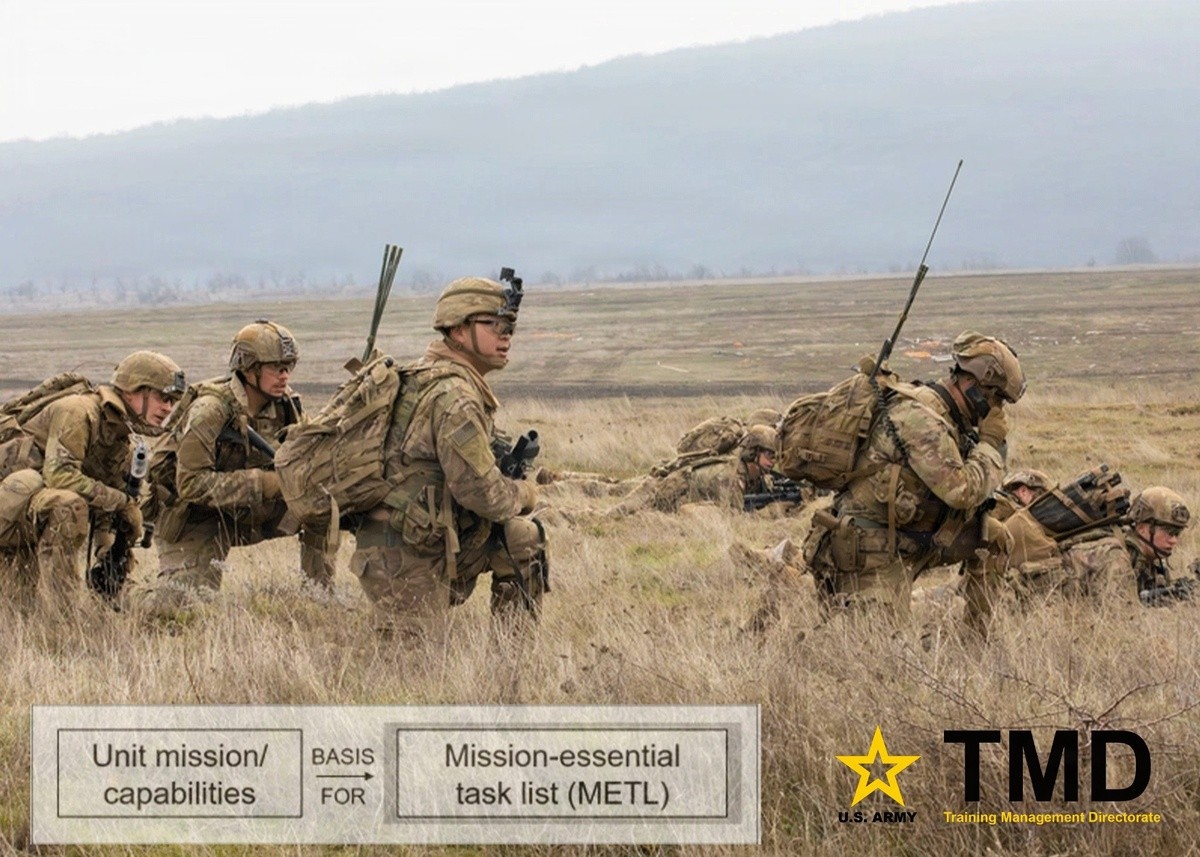
Prioritized training is the concept of doing the essential things first. In the Army, this means mission focus. All organizations in the Army have a purpose for which they are designed. Mission focus directs the commander to identify the tasks in which the unit must be proficient in order to successfully accomplish their mission, providing a clear vision of their training expectations and the proficiencies to achieve. However, due to time and resource limitations, units are rarely able to achieve and sustain fully trained proficiency on all mission-essential tasks (METs) simultaneously. Commanders therefore use a prioritized training approach to achieve proficiencies based on their unit’s mission and corresponding mission-essential task list (METL). In other words, mission focus determines which tasks to resource and train for the upcoming training cycle.
Since units cannot achieve proficiency on all tasks at once, commanders must optimize limited training time and resources. To focus this effort, the commander in dialogue with the next higher echelon commander determines the priorities for each proficiency (mission-essential tasks, weapons qualification, and collective live-fire tasks) based on mission requirements. Similarly, commanders determine and establish training priorities in preparation for operational deployments, combat training center rotations, or daily services for installation support. Prioritized training must link to the unit’s mission. Every unit is unique, but the fundamentals of shoot, move, communicate, and survive apply to all types of formations and serve as the basis for prioritization. A basic task training focus provides the foundation to build proficiency in individual tasks as the unit progresses to more complex tasks.
Prioritization of tasks directly impacts planning and preparation. In the training management cycle, planning aligns training tasks with resources over time. The commander and staff develop and resource a plan to achieve necessary MET proficiency levels. The standards required to achieve task proficiency are prescribed in Army training and evaluation outlines (T&EOs) for tasks and applicable weapon system publications.
Once the commander assesses the unit’s training proficiencies, leaders of echelons below company level (platoons, squads, crews, teams, and other small units) select and prioritize the collective tasks that are most critical to the accomplishment of their company’s prioritized METs. These critical collective tasks below company level are battle tasks, which can include high-payoff tasks or battle drills. Company commanders are responsible for the proper nesting of battle tasks to METs. Task prioritization continues as noncommissioned officers identify the individual tasks Soldiers train. These include military occupational specialty (known as MOS)-specific tasks, Army warrior tasks, and physical readiness training. Prioritization of tasks ensures the right tasks to train nest from the highest echelon to the lowest.

When planning and preparation are complete, execution begins. Execution is the implementation of the long-range training guidance. It is the deliberate and purposeful accomplishment of each training event’s training objectives. Executing increasingly challenging training events to the prescribed standard builds the training proficiency required. It also develops increasingly capable, confident and lethal Soldiers, leaders, and units.
Prioritized training acknowledges that mission, limited time, and resources dictate that units train prioritized tasks from the METL first. Prioritized training also acknowledges that units should strive to reach mastery on all tasks. Task proficiency is achieved by the unit’s ability to perform MET training to standard. The goal of execution is task mastery, however, which is not a training proficiency rating but a concept that requires full understanding of a task, its component parts, its underlying principles, its importance, and its support to the larger mission. To build task mastery, units focus on fundamentals at individual, crew, squad, and platoon levels before proceeding to higher-level collective tasks. Organizations then gradually increase the difficulty of conditions under which the prioritized task is trained to include limited visibility, degraded communications, loss of key leaders, and unexpected changes in an operational environment. Task mastery goes beyond executing a task to standard through constant repetition. It entails successfully executing multiple iterations under challenging and dynamic conditions while adjusting for changes and making the best use of resources.

Effective training begins with prioritization and planning. Mission focus determines which tasks to resource and train for the upcoming training cycle. Commanders provide prioritized METs, weapons qualifications, collective live-fire tasks, and the commander’s assessment of the unit’s training proficiencies. Commanders also provide clear and concise guidance on what is trained, when it is trained, who is trained and why, clearly articulating the mission focus and associated tasks. Published training guidance provides subordinate commanders and leaders a clear vision of their training expectations, giving the unit direction, purpose, and motivation.
The Training Management Directorate (TMD), under Combined Arms Command, maintains training management podcasts, tutorials, and tools to help commanders and small unit leaders build sound training plans, conduct more efficient and informative training meetings and briefings, and successfully plan, prepare, execute, evaluate, and assess training exercises. Visit us today at https://atn.army.mil/.
Social Sharing