


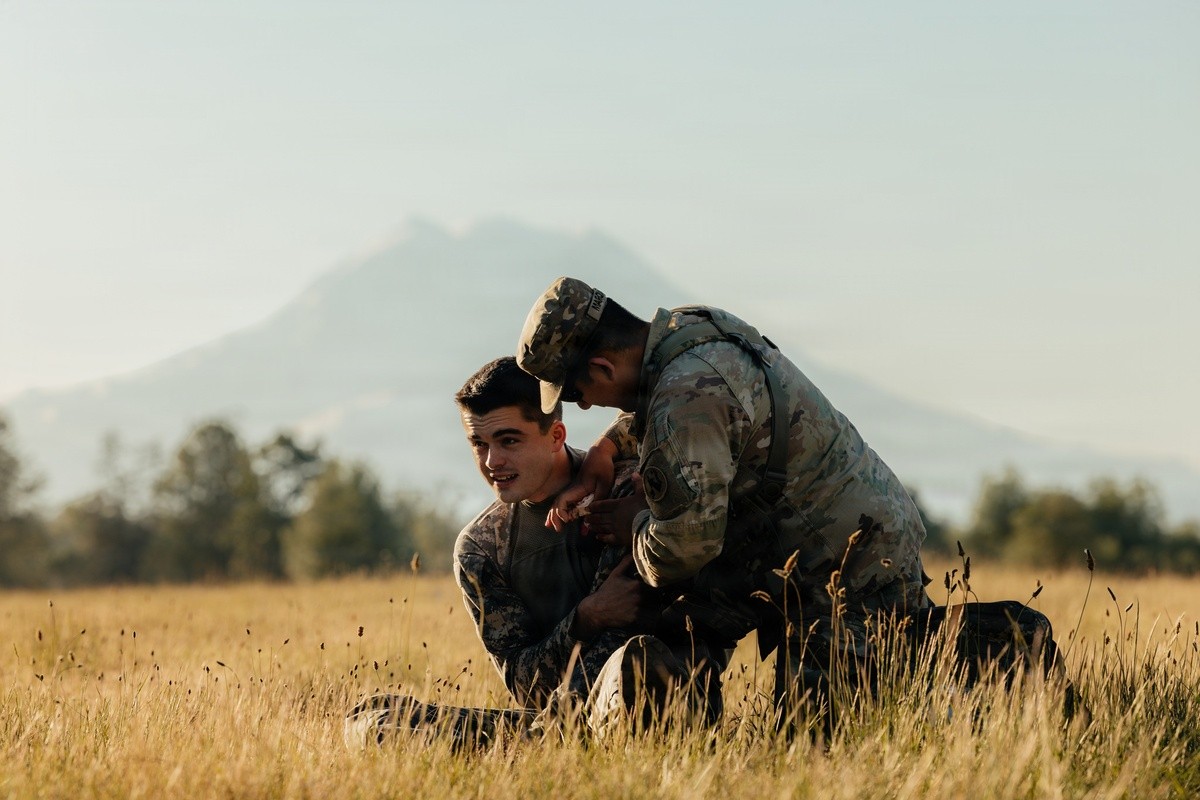

Medical Exercise Strengthens Expeditionary Care and Multi-Domain Readiness at JBLM
JOINT BASE LEWIS-MCCHORD, Wash. — Soldiers from 7th Infantry Division (Multi-Domain Command-Pacific) (7ID MDC-PAC) participated in a medical exercise using the latest technology at Joint Base Lewis-McChord from June 1-3, 2026.
The 7ID (MDC-PAC) Medical Exercise was designed to build a capable, integrated, and expeditionary medical force prepared to operate in complex environments. The exercise brought together Expeditionary Care Teams (ECTs), Role 1 (triage) and Role 2 (advanced medical care) medical capabilities, and a wide range of supporting units training in a simulated Indo-Pacific Command (INDOPACOM) operational setting.
The mission of MDC-PAC medical forces was to establish and operate expeditionary care systems that synchronize standard and non-standard medical capabilities. Through realistic home-station training, Division Surgeon Team evaluators assessed ECTs, Role I, Role II, and force health protection elements as they executed mission-essential tasks under simulated combat conditions. The exercise emphasized innovation and adaptability. “The purpose of this exercise is to prove concepts of 7th ID (MDC-PAC) Expeditionary Care Team (ECT), drone Class VIII A and B delivery, and non-standard MEDEVAC platforms through a multi-echelon, multi-role, and multi-domain medical exercise on JBLM,” said Sgt. Maj. Jesse Flemming, Division Surgeon.
Participants trained to replicate the challenges of distributed operations across the Indo-Pacific region. “Integrating medical support from echelons above brigade into a medically focused division exercise allows for units to train as they would fight in theater while on home station,” said Flemming. The ECT concept played a central role in the exercise. The teams were designed to close critical gaps in medical support by providing both Role I and Role II capabilities in austere and geographically dispersed environments. Their ability to rapidly establish treatment sites, stabilize patients, and coordinate evacuation enhanced survivability in scenarios where traditional medical infrastructure may be unavailable or contested.
Innovation and emerging technology were also key components of the training. Soldiers from the 7th ID (MDC-PAC) Bayonet’s Edge Innovations Lab employed unmanned aerial systems to deliver medical supplies and support forward operations. “I was able to practice precise payload drops with the MONARK drone and work in a beneficial field environment,” said Cpl. Jake Steltenpohl, a 7th ID (MDC-PAC) Bayonet’s Edge Innovations Lab soldier. “The most challenging part of the training has been making minute corrections on the spot and adapting to last-minute changes,” Steltenpohl said. The exercise also emphasizes teamwork and integration across units and specialties. “I’ve learned to work more effectively under pressure in a field environment and how to collaborate with other units and MOSs to meet their needs,” Steltenpohl said.
Multiple units contributed specialized capabilities to the training environment. Charlie Company, 1163d Task Force Support Battalion, focused on testing patient flow between ECT and Role II operations, including evacuation via air MEDEVAC and medical logistics resupply using unmanned systems. The 105th Surgical Detachment assessed its capacity to augment Role II care through surgical and nursing operations, while the 16th Combat Aviation Brigade facilitated medical evacuation and treatment integration with higher echelons. Additional units, such as the 98th Combat Operational Stress Control team, provided behavioral health support, and the Veterinary Readiness Activity trained in military working dog care. These diverse roles ensured that medical personnel were prepared to handle a wide range of scenarios.
The 7ID (MDC-PAC) Medical Exercise prepares Soldiers to operate effectively in contested, multi-domain environments. By validating emerging concepts, testing unit capabilities, and integrating across formations, the exercise ensures readiness to support warfighters and accomplish the mission in the Indo-Pacific theater.
As a theater enabling command and a joint force enabler, 7th ID (MDC-PAC) plays a vital role in providing the Joint Force cross-domain solutions designed to create multiple dilemmas and neutralize adversary anti-access and area denial networks.
Social Sharing