Fort McCoy, Wis., was established in 1909. Here is a look back at some installation history from April 2026 and back.
80 Years Ago — April 1946
FROM THE APRIL 5, 1946, EDITION OF THE REAL MCCOY NEWSPAPER: Army offers 600 WAC specialists ETO service (By Newspaper Staff) — Overseas service is now being offered to enlisted personnel of the Women’s Army Corps, the War Department announced, for those with specialized categories.
“Opportunity to be selected overseas duty has been offered widely to WACs who meet the distribution when they became surplus and those not on active duty,” Maj. Gen. W. E. Paul, Assistant Chief of Staff (G-1), commented.
Previously not more than 600 WACs from the 1,000 overseas have been selected to fill these needs and all enlisted men now in the Army will be screened for overseas duty in this connection. The Army expects to secure more volunteers than are required.
In filling these overseas needs from the continental United States, WACs with various types of experience, including clerks, stenographers, telephone operators, and other categories, and more types are being sought.
Women’s Army Corps is the only enlisted component of the Army open to women. It was stated that there are some additional thousands needed. WACs are no longer needed for assignment in offices or as clerical workers in the United States. These women have been transferred to other services and units.
FROM THE APRIL 5, 1946, EDITION OF THE REAL MCCOY NEWSPAPER: Hero of Rhine Crossing ends service career (By Newspaper Staff) — Capt. Allen Safford, who served 18 months overseas where he was awarded the Silver Star and the Bronze Star with oak leaf cluster, received his discharge here Tuesday. Safford, a resident of Coulee, Minn., spent almost three years in the Army.
Capt. Safford, who is 24 years old, was inducted into the Army on June 24, 1943, and was immediately sent to Maryland. From there he was transferred to officers training school at Fort Benning, Ga. He graduated from the school as a second lieutenant. Capt. Safford, who is 24 years old, was born in La Crosse, Wis. and attended high school in West Salem. He entered service as a private and was promoted to corporal before entering officers candidate school.
He served with the 9th Army during the drive on Germany in the Rhine Crossing. He is credited with heroic service in the capture of a German village during the crossing of the Rhine, where he assisted in the capture of German prisoners. His heroic action won him the Silver Star and Bronze Star.
Besides the Silver Star and the Bronze Star with oak leaf cluster, he holds the ETO ribbon with three battle stars, the American Defense ribbon and the Victory medal.
Following his discharge, Safford will return to college to complete his education. He entered after three years at Newton State Teachers college.
FROM THE APRIL 5, 1946, EDITION OF THE REAL MCCOY NEWSPAPER: Army Day — 1946 (By Newspaper Staff) — Tomorrow, April 6, has been set aside by Presidential proclamation as Army Day, the first peacetime Army Day in five years. This Army Day 1946 the nation pays tribute to the armed force which played so great a part in bringing victory and peace.
On this day the nation, and particularly the men and women of the Armed forces can well give thought to the accomplishments in the various fields of service which the Army has contributed and to the prospects of using the Army toward greater technical and scientific developments in the new battle of maintaining the peace.
The Army in which the veterans of two World Wars served, is a means of preserving another war — which no one wants, a sure means of contributing to the peacetime well-being of the people—which everyone wants.
Let us look at some of the accomplishments of the Army in the past development of a nation eager for a more abundant life in a world of peace and progress.
For example, modern transportation — a means of better communication — has been developed in large measure by the Army and is still being improved. This includes roads, railroads, and the building of bridges and ports. This has contributed to the development of agriculture, industry and commerce.
The Army has contributed greatly to the development of aviation. In both military and civil fields, the Army has made advances in aircraft design, navigation, and safety.
The Army has aided in the development of modern medicine. The use of antibiotics, improvements in surgery, and the prevention and cure of disease have been greatly advanced through Army medical research.
The Army has been a leader in engineering projects. The building of dams, roads, and other public works has helped to improve the nation’s infrastructure.
The Army has played a role in education and training. Many young men have received technical training and education through their service, preparing them for civilian careers.
The Army’s contributions to American life have been many and varied. They include improvements in transportation, aviation, medicine, engineering, and education.
And with it all the Army’s major peacetime mission is to secure the world’s peace through strength and preparedness.
The immediate objective of this nation is to hold the victory and maintain the peace. We, the members of the Army must—THE WILL, the power. That is our pledge to America on this Army Day, 1946.
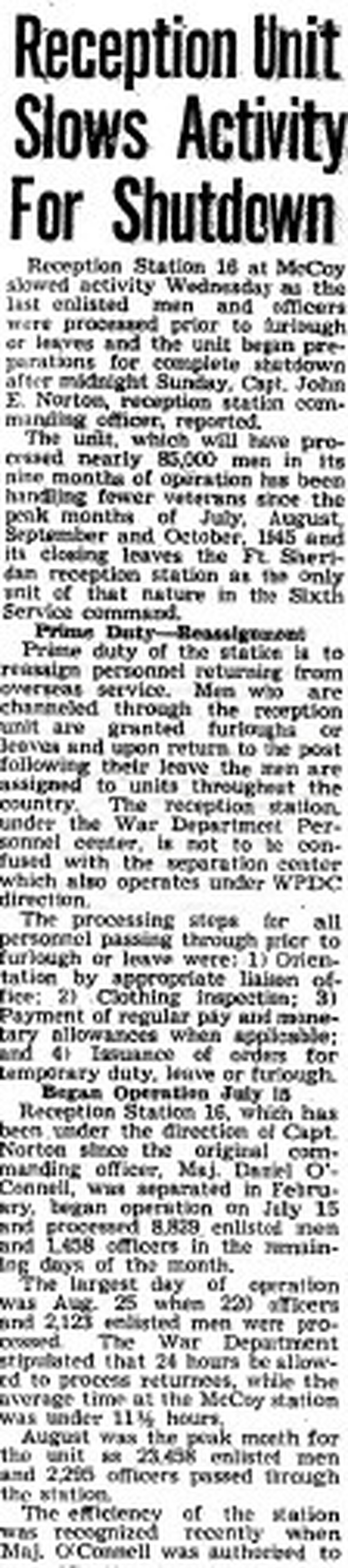
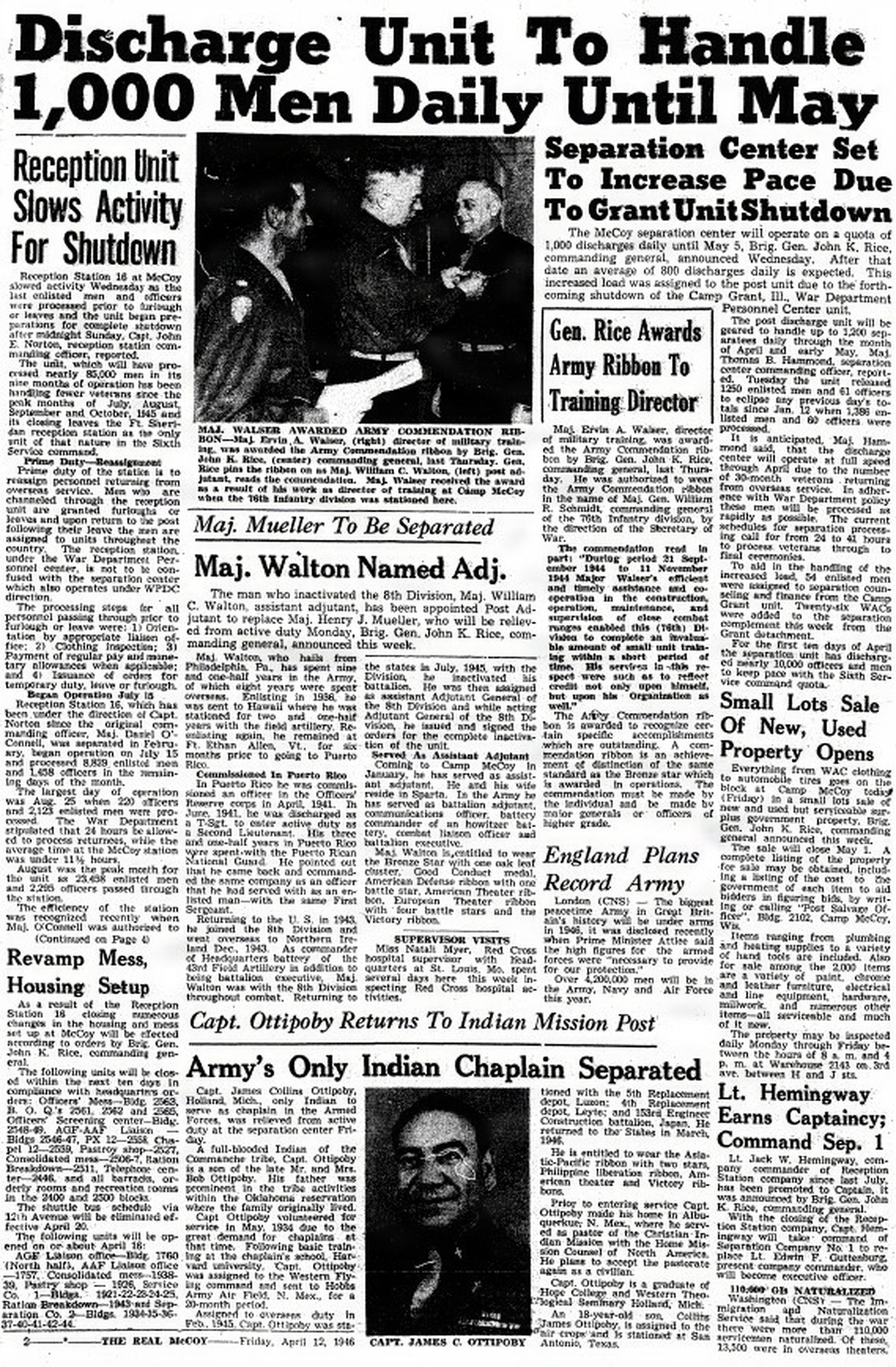
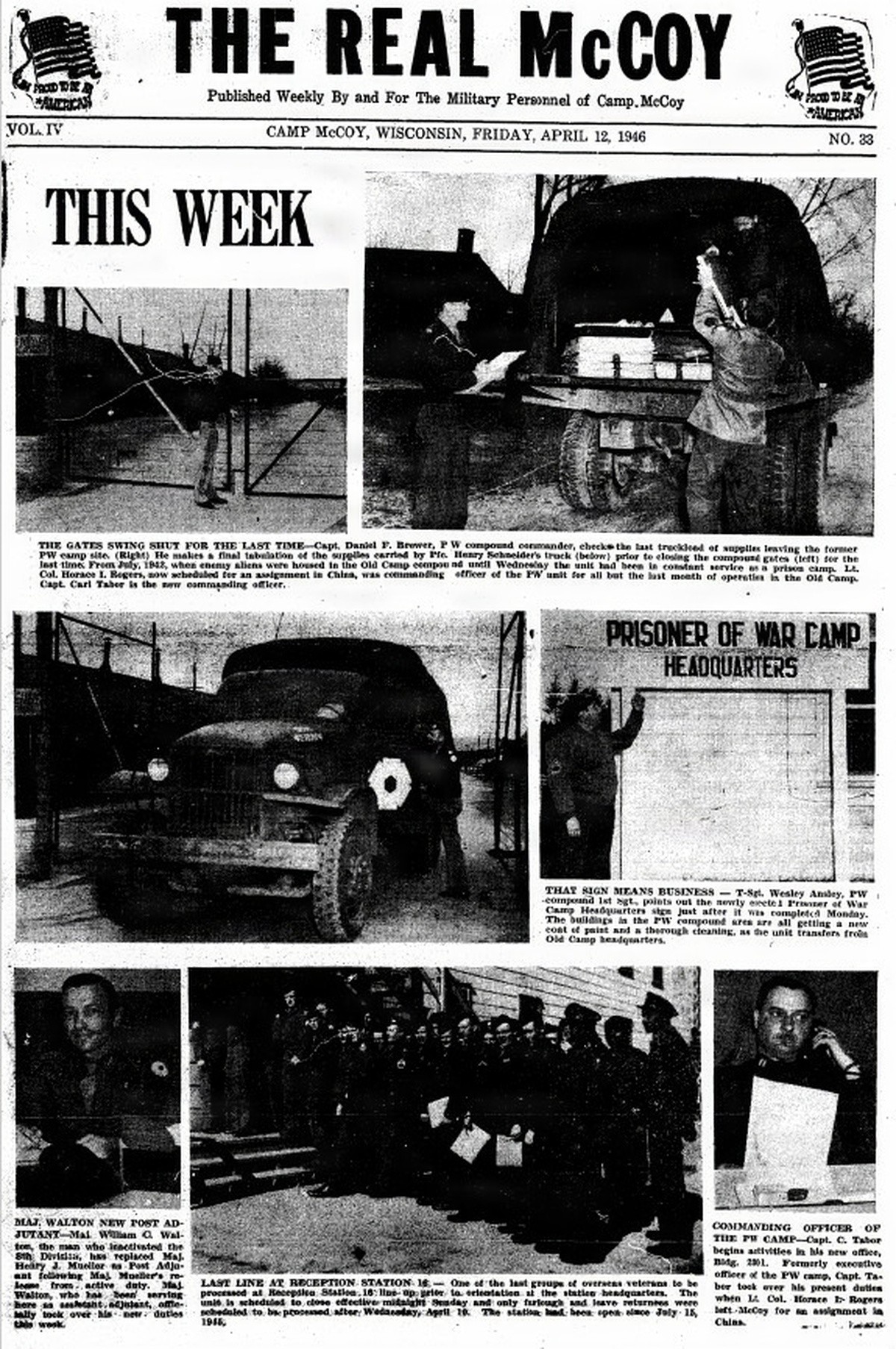
FROM THE APRIL 12, 1946, EDITION OF THE REAL MCCOY NEWSPAPER: Reception unit slows activity for shutdown (By Newspaper Staff) — Reception Station 16 at McCoy slowed activity Wednesday as the last enlisted men and officers were processed prior to furlough or leaves and the unit began preparing for complete shutdown after midnight Sunday, Capt. John A. Nordyke, reception station commanding officer, reported.
The unit, which will have processed nearly 85,000 men in its nine months of operation has been handicapped several times since peak months of July, August, September and October, 145 and 148 enlisted men to be sent in the Army Air Corps was the only service open to them at the local service command.
Prime duty — Reassignment: Prime duty of the station is to reassign personnel returning from overseas service. Men are channeled through the reception unit and granted furloughs or leaves are spent returning to post pending their leave to the new assignment. New replacements have also been received and processed at the station.
The processing steps for all personnel passing through prior to furlough or leave were: 1. Orientation by appropriate liaison officers; 2. Pre-paragraph inspections; 3. Payment of regular pay and allowances when applicable; and 4. Issuance of orders for temporary duty, leave or furlough.
Reception Station 16, which has been under the direction of Capt. Nordyke since December 1945, processed 85,000 enlisted men.
The largest day of operation was August 25 when 220 officers and 1,230 enlisted men were processed. The average per month stipulated that 24 houses be available to process returnees, while the average time at the McCoy station was from 11 1/2 hours.
August 15, the peak month for the unit was 23,485 enlisted men and 2,065 officers passed through the station.
The efficiency of the station was recognized recently when the command received a letter of commendation.
FROM THE APRIL 12, 1946, EDITION OF THE REAL MCCOY NEWSPAPER: Survives Death March; Infantry vet joins RA (By Newspaper Staff) — Sgt. Francis Ginn, Blue River, Minn., who survived 42 months of torture as a prisoner of the Japanese in the Philippines and on the infamous Bataan Death March, arrived here Wednesday after being received at Camp Stoneman, Calif.
Ginn, who originally enlisted in 1941, fell into Japanese hands at Bataan and stayed on the Death March from Bataan to Bilibid Prison where he remained for two months. He had shipped to the Philippines to join the 31st Infantry regiment of the Philippine Division shortly after his arrival and was then inducted into the Philippine Scouts.
After spending his 90-day enlistment furlough, Sgt. Ginn will be stationed at Fort Sheridan, Ill., with the recruiting service. Ginn has returned to the United States after rather extensive service in the Philippines, and during the war was assigned to various duties.
During his service, Ginn saw action in Bataan and Corregidor. He endured the hardships of the Death March and subsequent imprisonment. Ginn, who enlisted from Blue River, Minn., is proud of his service and plans to continue his Army career by joining the Regular Army.
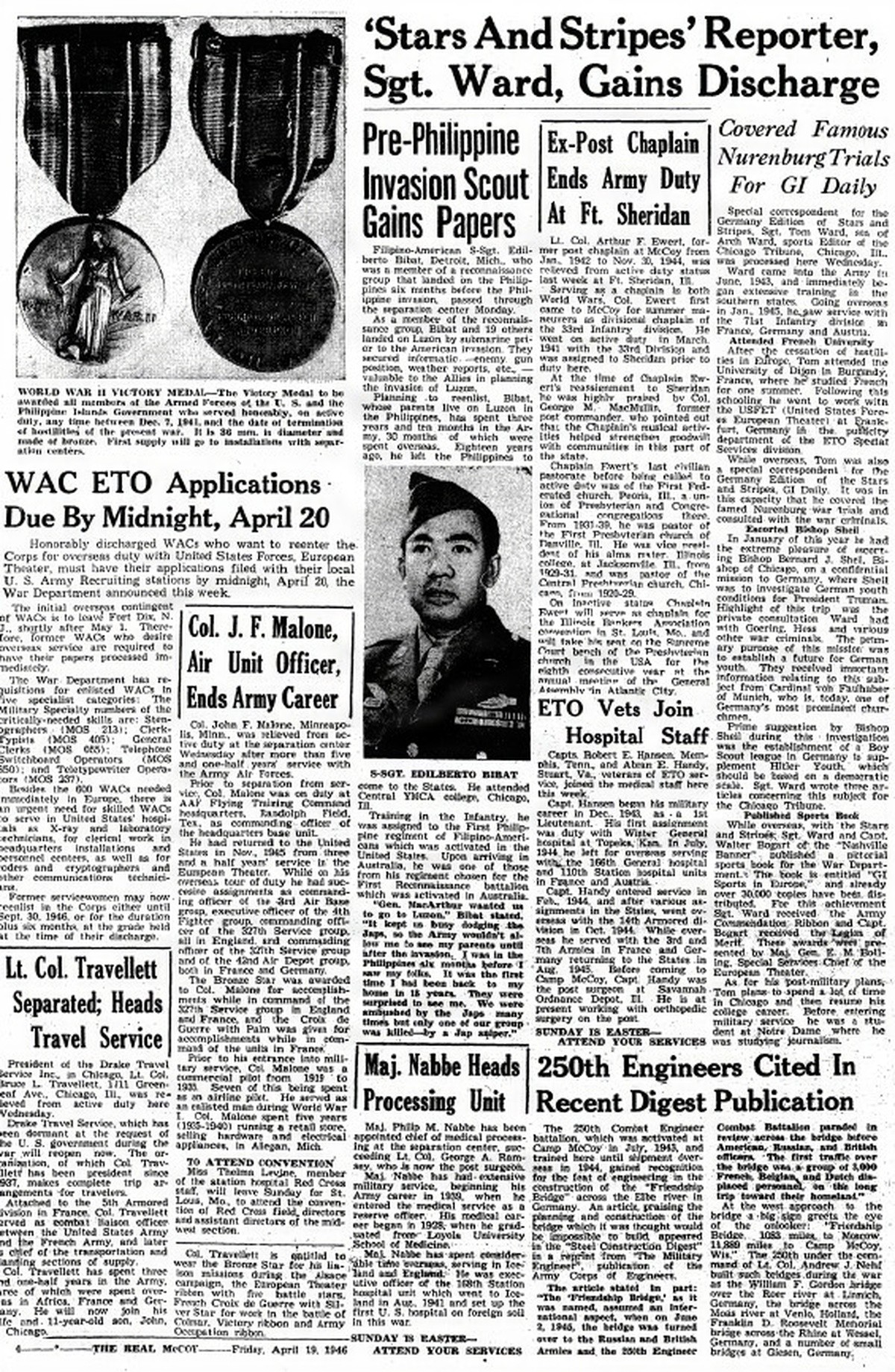
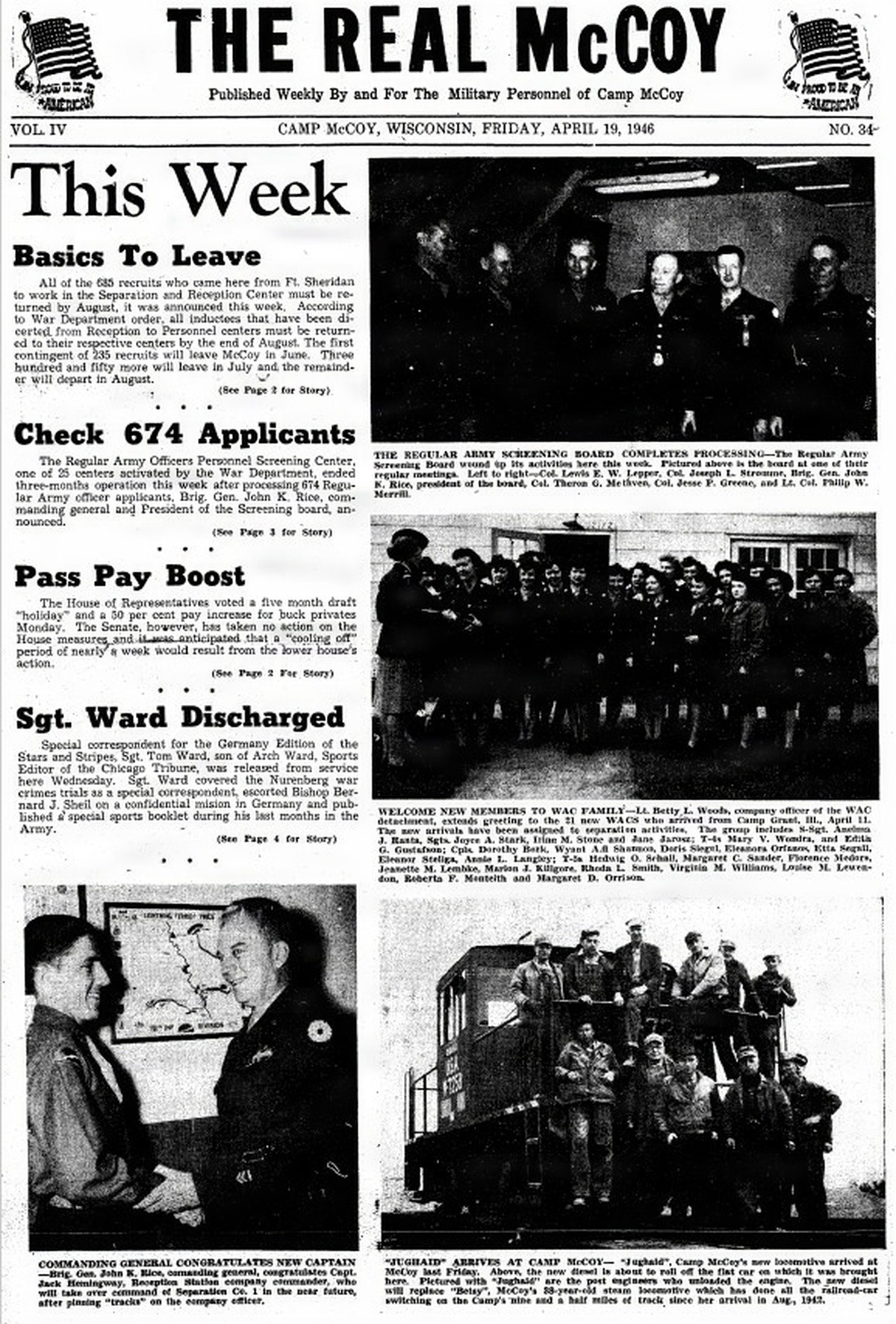
FROM THE APRIL 19, 1946, EDITION OF THE REAL MCCOY NEWSPAPER: Pre-Philippine invasion scout gains papers (By Newspaper Staff) — Filipino-American Staff Sgt. Eddie Bital, Detroit, Mich., who was a member of a reconnaissance group that landed on the Philippine Islands before the Philippine invasion, passed through the separation center Monday.
As a member of the reconnaissance group, Bital landed on Luzon by submarine prior to the American assault. They secured information regarding enemy positions and installations, paving the way for the Allied invasion of Luzon.
Bital, 25, enlisted in the Philippine Scouts and served five years and ten months in the Army, 30 months of which were spent overseas. He was captured by the Japanese and later escaped.
Training in the infantry, he was assigned to the 1st Philippine Regiment of Filipino-American troops which was activated in the United States. Upon arriving in Australia, he was one of those selected to become members of the First Reconnaissance Battalion which was activated in Australia.
Bital served in the Philippines with the 1st Reconnaissance Battalion, landing on Luzon prior to the invasion. He gathered vital intelligence on enemy defenses. He plans to return to civilian life after completing his service and looks forward to rejoining his family.
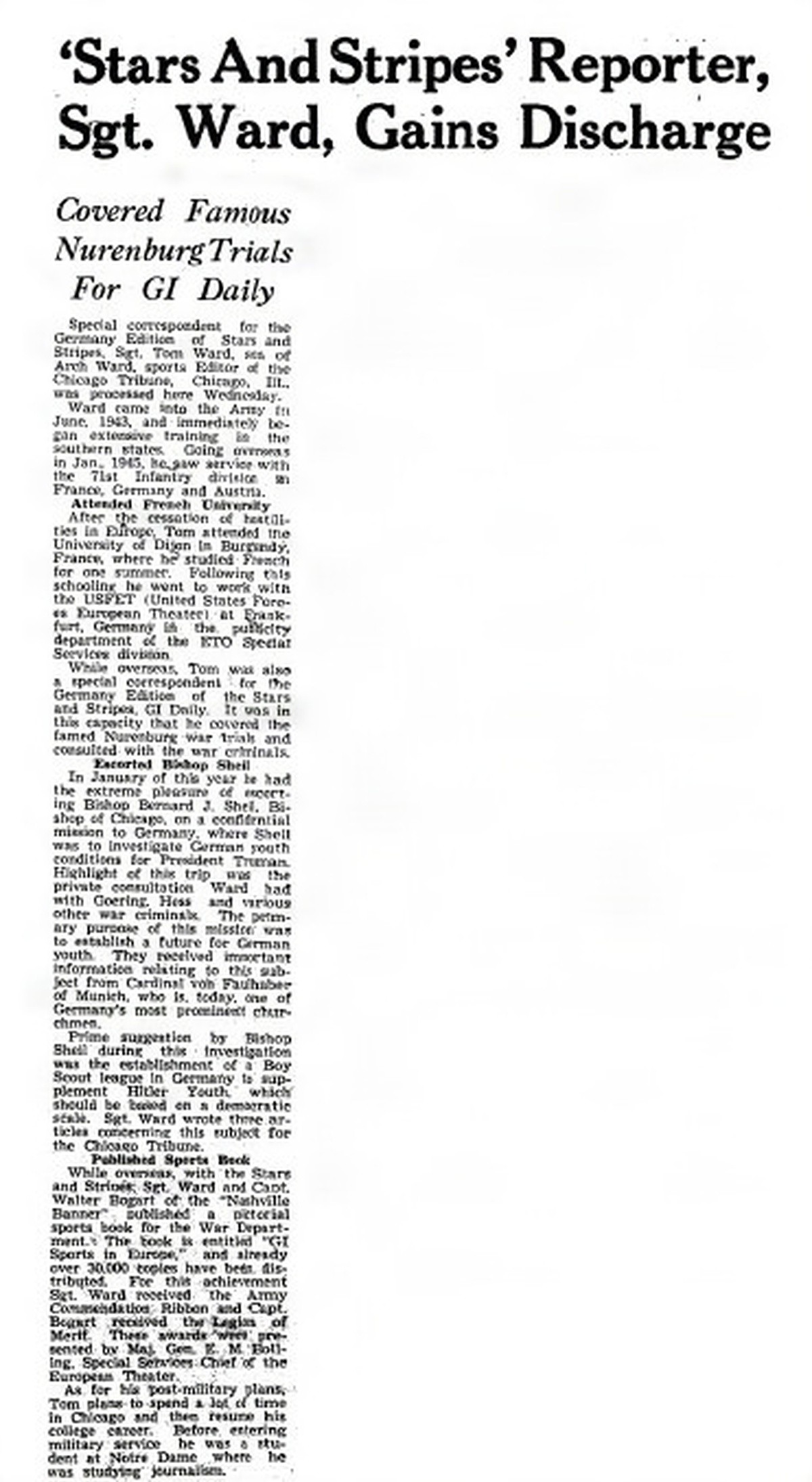
FROM THE APRIL 19, 1946, EDITION OF THE REAL MCCOY NEWSPAPER: ‘Stars And Stripes’ Reporter, Sgt. Ward, gains discharge; covered famous Nurenberg Trials for GI Daily (By Newspaper Staff) — Special correspondent for the Germany Edition of Stars and Stripes, Sgt. Ward, son of Arch Ward, sports editor of the Chicago Tribune, received his discharge here Wednesday.
Ward came into the Army in June 1943 and immediately became interested in writing for the southern states. Going overseas in January 1945, he saw service with the 1st Infantry Division in France, Belgium, and Austria.
After the German collapse, Ward was assigned to the editorial staff of the Stars and Stripes in Paris. He covered the famous Nurenberg war trials and received wide acclaim for his work.
In January of this year, he had an exclusive interview with Hermann Goering, Nazi leader, at the prison in Nurenberg. He also interviewed other high-ranking Nazi officials.
Ward wrote many stories on the war crimes trials and the aftermath of the war. His reporting was widely read by American servicemen overseas.
After the war, Ward returned to the United States and is now resuming his career in journalism. He plans to continue writing and may return to newspaper work with the Chicago Tribune.
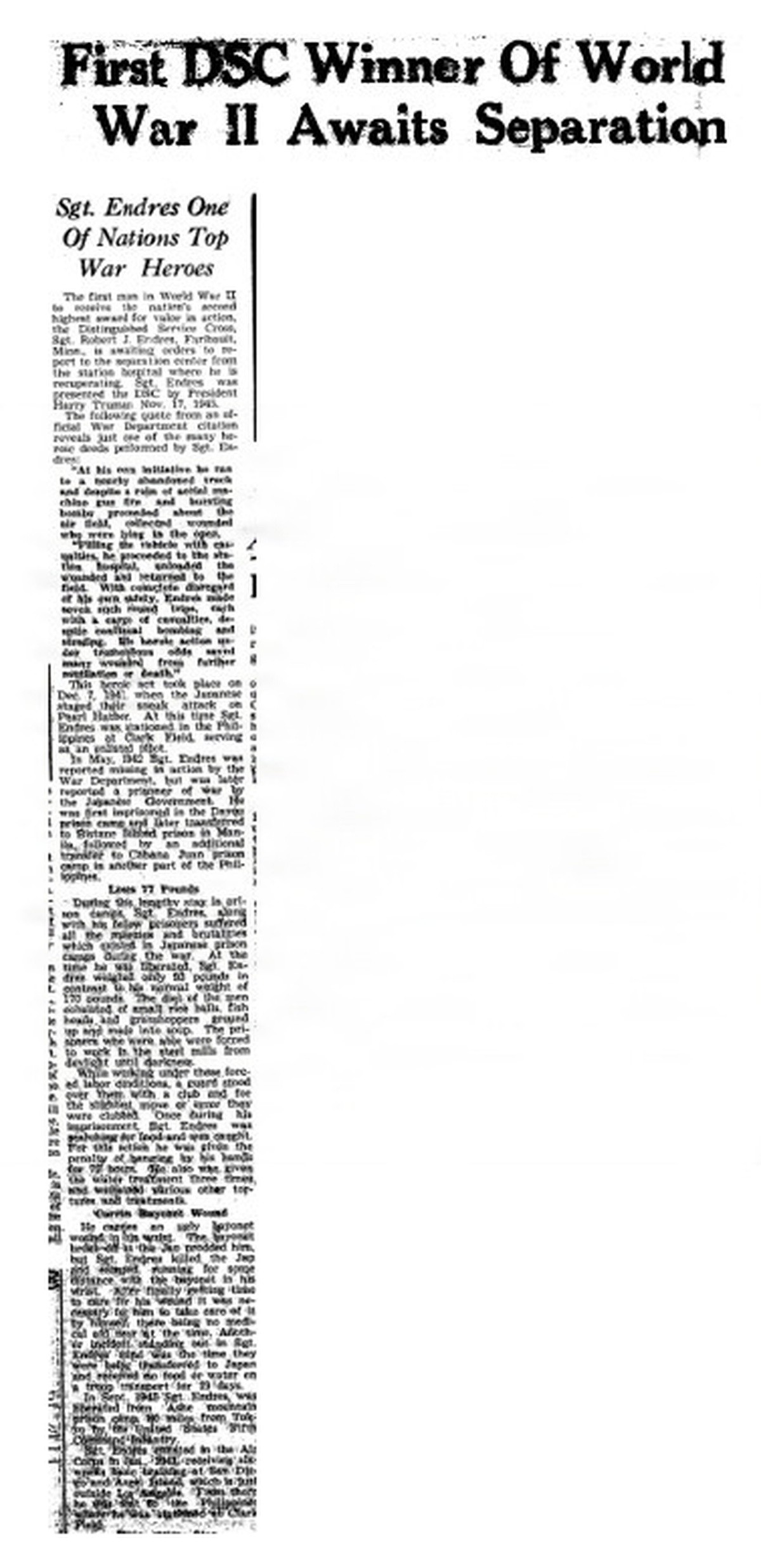
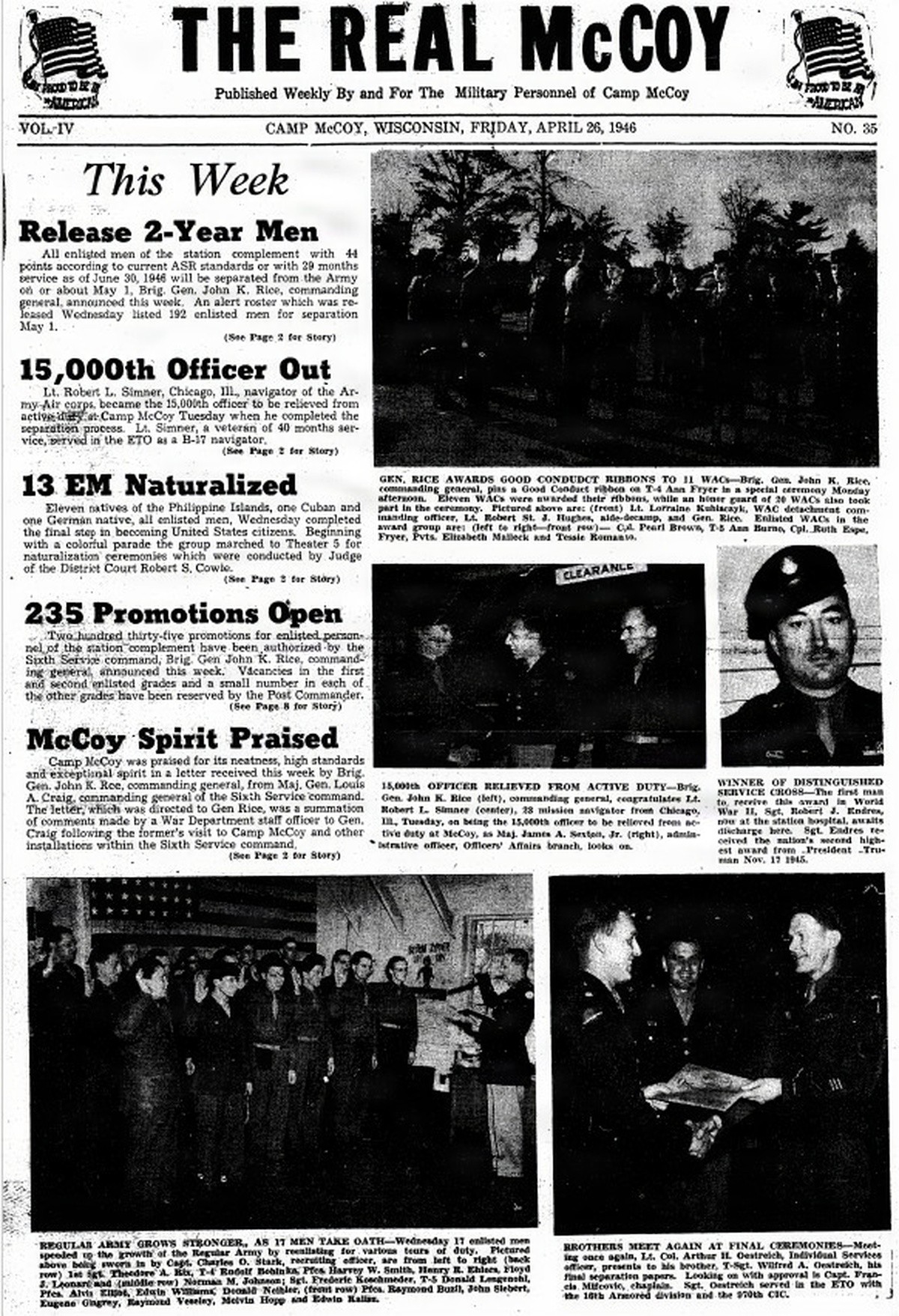
FROM THE APRIL 26, 1946, EDITION OF THE REAL MCCOY NEWSPAPER: First DSC winner of World War II awaits separation; Sgt. Endres one of nation’s top war heroes (By Newspaper Staff) — The first man in World War II to receive the nation’s second highest award for valor is now awaiting separation service. Sgt. Robert J. Endres, formerly of Illinois, received the Distinguished Service Cross for extraordinary heroism in action against enemy forces in the Philippine Islands.
Endres was one of the first Americans to engage the enemy following the Japanese attack. During fierce fighting, he displayed outstanding courage and leadership while under heavy fire.
“At his own initiative he rushed a heavily defended enemy position and assaulted it despite intense hostile fire,” the citation stated. “He continued to lead his men forward, encouraging them to advance against strong enemy resistance.”
Endres repeatedly exposed himself to enemy fire while directing his unit and evacuating wounded soldiers. His actions contributed materially to the success of the engagement and the saving of numerous lives.
He later endured the hardships of the early Pacific campaigns and continued to serve with distinction throughout the war.
Sgt. Endres, who has spent several years overseas, is now awaiting discharge at the separation center. He plans to return to civilian life following his release from the service.
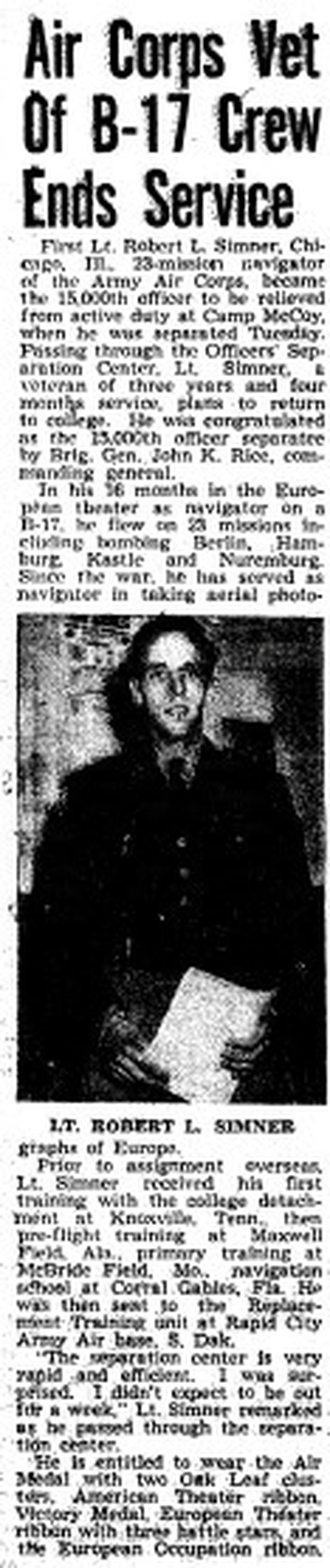
FROM THE APRIL 26, 1946, EDITION OF THE REAL MCCOY NEWSPAPER: Air Corps vet of B-17 crew ends service (By Newspaper Staff) — First Lt. Robert L. Simmer, 23-month veteran of the Army Air Corps, became the 15,000th officer to be relieved from active duty at Camp McCoy.
When he was separated Tuesday, Lt. Simmer, a veteran of three years and four months service, leaves to return to college. He was congratulated on the 15,000th officer separated by Brig. Gen. John R. Rice, commanding general.
In his 16 months in the European theater as navigator on a B-17, he flew 25 missions including bombing Berlin, Hamburg, Brunswick, Kassel and Nuremburg. Since the war, he has served as navigator in taking aerial photographs of Europe.
Flew 25 missions over Europe: Lt. Simmer received his first training with the college detachment at Knoxville, Tenn. Then pre-flight training at Maxwell Field, Ala.; primary training at Maxwell Field; basic training at another base, and advanced training at Fort Worth, Texas.
After receiving his wings, he went overseas and flew with a bombardment group in England. He is entitled to wear the Air Medal with two oak leaf clusters, American Theater Ribbon, European-African-Middle Eastern Theater Ribbon, and the European Occupation Ribbon.
75 Years Ago — April 1951
FROM THE APRIL 20, 1951, EDITION OF THE REAL MCCOY NEWSPAPER: 70 to be initiated into ‘Order of the Boar’ (Camp McCoy Public Information Office) — Approximately 70 post officers will be initiated into a unique fraternal organization — “The Order of the Boar” — at ceremonies and a dinner to be held Saturday at 1800 at Building No. 1071 in the U.S. Army hospital here. Thirty guests are expected from the Chicago chapter.
Lt. Col. Aurel P. Clark, executive officer of the hospital, is chairman of the program committee which includes Lt. Col. Frederick R. Jorbin, Capt. James L. Frank and Capt. Paul A. LaPointe. Other members of the McCoy sub-chapter, which is affiliated with the Chicago chapter, are Col. Samuel A. Cohen, and Captains William A. Graber, James T. McRee, Walter N. Price, Charles L. Tackett and Earl E. Reynolds.
“Shoots” is the name given to candidates for the Order of the Boar. Officers who have been invited to become candidates for the Order include Brig. Gen. Thomas E. Lewis, Col. Peter C. Bullard, Col. Claude A. Billingsley, Col. Elmer L. Lentz, Col. James I. Crow, Lt. Col. Terence S. Lightfoot, Lt. Col. Henry J. Knight, Lt. Col. Kenneth E. Thomas, Lt. Col. Ralph H. Watson, etc. Among the guests expected are Maj. Gen. George F. Lull, the Boar of the Chicago chapter; Col. A. S. Behrman, the Vice Boar; Col. Eugene Biolick, custodian of the Boar, and Lt. Col. Frank H. Chesrow, secretary and treasurer. Brig. Gen. Carl B. Steinhorst may also be present from Chicago.
The Order of the Boar was founded in 1928 by the first class in military sanitation and field duty at the Medical Field Service School, Carlisle Barracks, Pa. Several chapters have been established throughout the U.S., and its restricted membership now runs into the hundreds.
40 Years Ago — April 1986
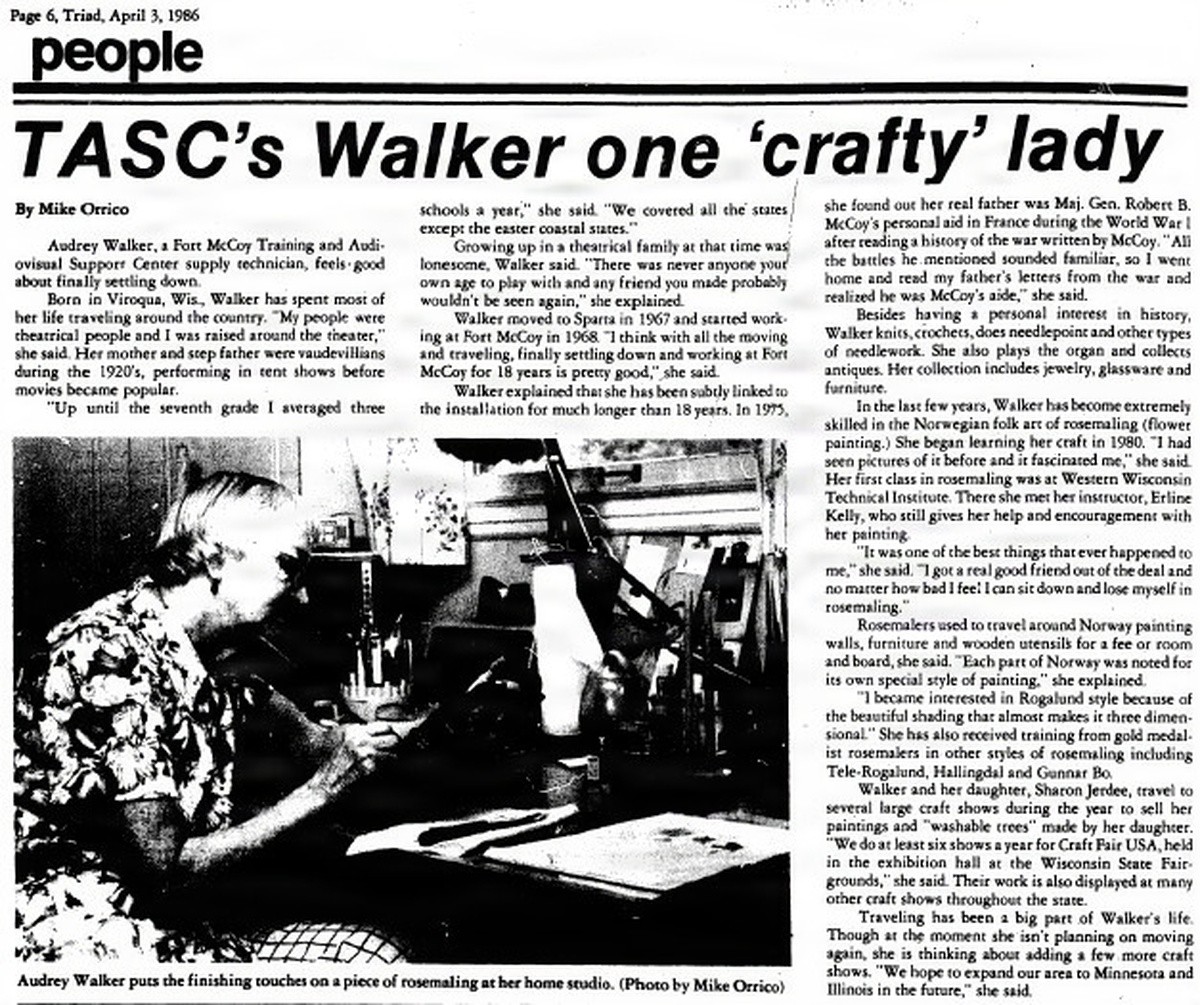
FROM THE APRIL 3, 1986, EDITION OF THE TRIAD NEWSPAPER: TASC’s Walker one ‘crafty’ lady (By Mike Oricco, Newspaper Staff) — Audrey Walker, a Fort McCoy Training and Doctrine Command (TRADOC) supply technician, feels good about finally settling down. Born in Virgina, Wis., Walker has spent most of her life traveling around the country.
“My people were theatrical people, and I was raised around the theater,” she said. Her mother and stepfather were vaudevillians during the 1920’s, performing in tent shows before movies became popular.
“Up until the seventh grade I averaged three schools a year,” she said. “We covered all the states except the eastern coastal states.”
Growing up in a theatrical family at that time was awesome, Walker said. “There was never anyone your own age to play with and my friend you made probably wouldn’t be seen again,” she explained.
Walker moved to Sparta in 1967 and started working at Fort McCoy in 1968. “I think with all the moving and traveling, I finally settled down and working at Fort McCoy for 18 years is pretty good,” she said.
Walker explained that she has been subtly linked to the installation for much longer than 18 years. In 1975, she found out her real father was Maj. Gen. Robert B. McCoy’s personal aide in France during World War I after reading a history of the war written by McCoy. “All the battles he mentioned sounded familiar, so I went home and read my father’s letters from the war and realized he was McCoy’s aide,” she said.
Besides having a personal interest in history, Walker knits, crochets, does needlepoint and other types of needlework. She also plays the organ and collects antiques. Her collection includes jewelry, glassware and furniture.
In the last few years, Walker has become extremely skilled in the Norwegian folk art of rosemaling (flower painting). She began learning her craft in 1980. “I had seen pictures of it before and it fascinated me,” she said. Her first class in rosemaling was at Western Wisconsin Technical Institute. There she met her instructor, Erline Kelly, who still gives her help and encouragement with her painting.
“It was one of the best things that ever happened to me,” she said. “I got a real good friend out of the deal and no matter how bad I feel I can sit down and lose myself in rosemaling.” Rosemalers used to travel around Norway painting walls, furniture and wooden utensils for a fee or room and board, she said. “Each part of Norway was noted for its own special style of painting,” she explained.
“I became interested in Rogaland style because of the beautiful shading that almost makes it three dimensional.” She has also received training from other instructors in other styles of rosemaling including Telemark, Hallingdal and Gudbrandsdal.
Walker and her daughter, Sharon Rode, travel to several large craft shows during the year to sell her paintings and “washable trees” made by her daughter. “We do at least six shows a year for Craft Fair USA, held in the exhibition hall at the Wisconsin State Fairgrounds,” she said. Their work is also displayed at many other craft shows throughout the state.
Together they have been the past of Walker’s life. Though at the moment she isn’t planning on moving again, she is thinking about adding a few more craft shows. “We hope to expand our area to Minnesota and Illinois in the future,” she said.
FROM THE APRIL 17, 1986, EDITON OF THE TRIAD NEWSPAPER: Gundlach: ‘I’m glad I could help’ (By Mike Oricco) — Dave Gundlach shrugged and said he just happened to be in the right spot, but his efforts saved Steve Kabat’s life.
Monday, April 7, Kabat, from La Crosse, nearly drowned in the main channel of the Mississippi when turbulent waters capsized his canoe and sucked him underneath a barge. Gundlach, an electrical engineering intern working for the Directorate of Engineering and Housing, helped pull Kabat from the river.
Gundlach had purchased a new boat motor and was trying it out on the river. “I saw two canoes, one was tipped over and somebody was swimming towards the shore,” Gundlach said. The canoers were in front of a barge docked against the shore, he added.
“I went over there at first to see if they needed help with the canoe,” Gundlach explained. “I could see the one guy had made it to shore.”
When he got to the canoes he was told another person, Kabat, was still in the water. Gundlach went down upstream to look for him. “I saw the wake out from a few times and I didn’t see anybody, but on my way back I saw a lifevest floating in the water.”
He couldn’t see anyone in the lifevest until he got closer. Only the top of Kabat’s head was sticking out of the water and he was unconscious, Gundlach explained.
“He tried to pull him into his boat but the current swept them into a barge section behind them. ‘I had a hold of him trying to keep him from going underneath the barge,’ he said. ‘I couldn’t pull him out of the water by myself. All I could do was keep his head above the water and try to keep my boat from crushing him against the barge.’”
Gundlach said he was scared, but he kept trying to get Kabat out of the water. “I almost stepped on the boat and then the would slip and fall in again,” he said. Finally, to Gundlach’s surprise, Kabat regained consciousness and was able to help him into the boat. Kabat was also surprised, Gundlach said. Kabat’s first words were, “Boy, I’m not dead yet!”
Once Kabat was in Gundlach’s boat, they were taken ashore where another person helped them to the shore. Kabat was then put in an ambulance and taken to a hospital, Gundlach said. Kabat managed to get through his ordeal with only minor scratches. He said he feels lucky to be alive and glad Gundlach came by when he did. “I don’t plan on canoeing in the main channel anymore,” Kabat said.
For his part, Gundlach doesn’t consider himself a hero. “I’m just glad the guy came to and was okay,” he said. When I first saw him I thought he was dead, floating in the water like that.” Gundlach does feel good about what he did. “I’m glad I could help out,” he said. “I hope that if somebody finds me floating in the water they do the same.”
30 Years Ago — April 1996
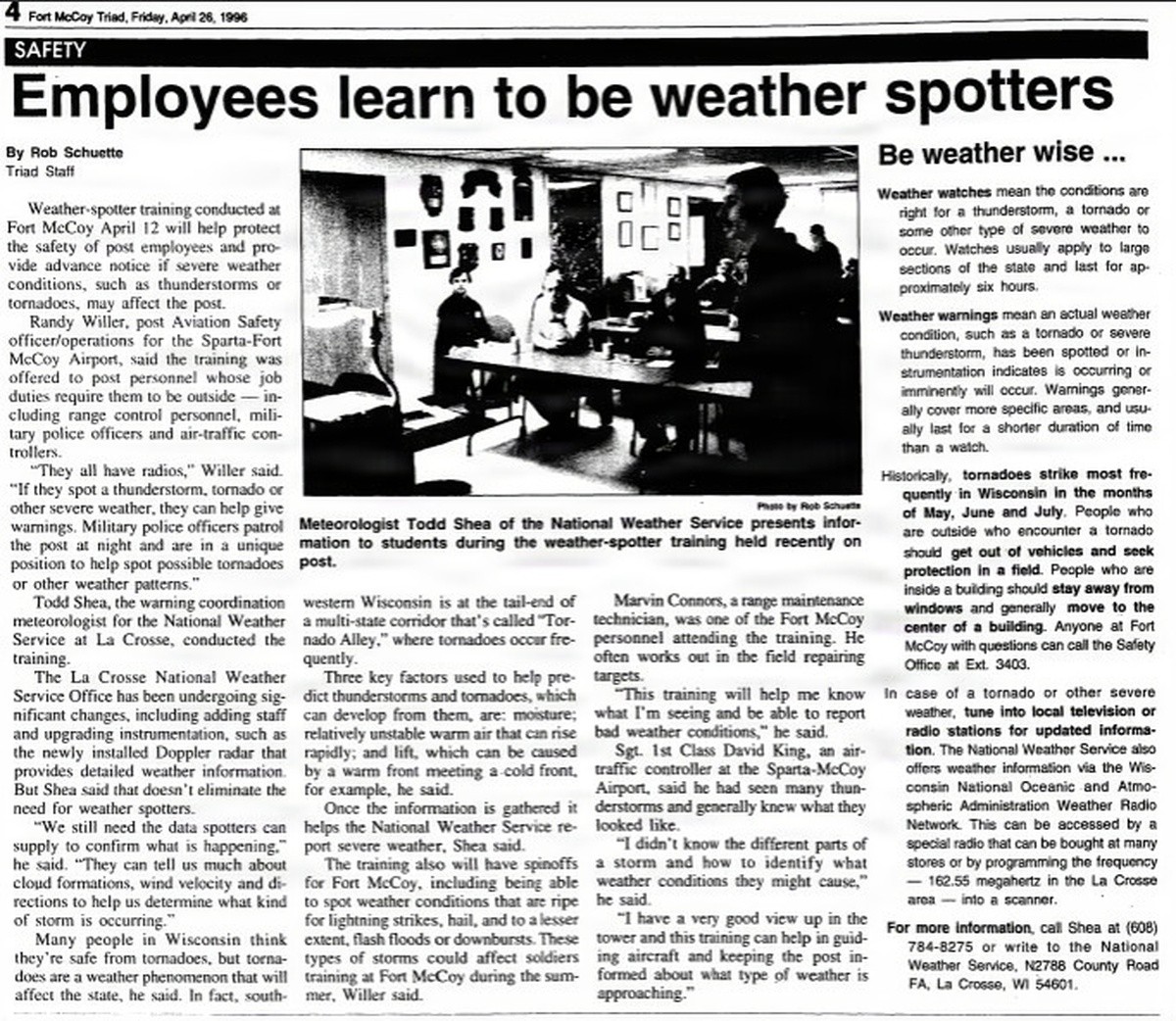
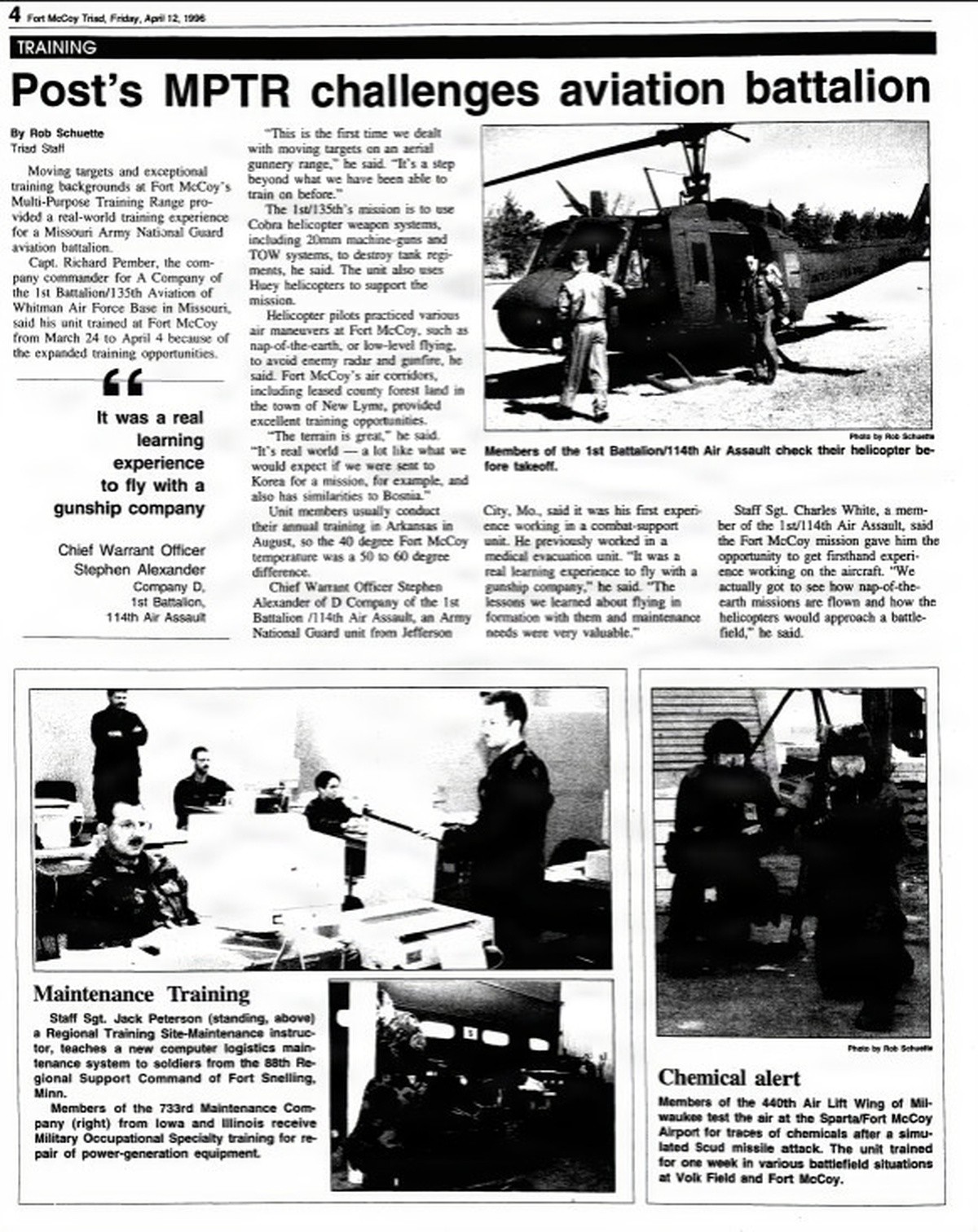
FROM THE APRIL 26, 1996, EDITION OF THE TRIAD NEWSPAPER: Employees learn to be weather spotters (By Rob Schuette, Triad Staff) — Weather-spotter training conducted at Fort McCoy April 12 will help protect the safety of post employees and provide advance notice if severe weather conditions, such as thunderstorms or tornadoes, may affect the post.
Randy Willer, post aviation state safety officer for the Sparta-Fort McCoy Airport, said the training was offered to post personnel whose job duties require them to be outside — including range control personnel, military police officers and air-traffic controllers.
“They all have radios,” Willer said. “If they spot a thunderstorm, tornado or other severe weather, they can help give warnings. Military police officers patrol the post at night and are in a unique position to help spot possible tornadoes or other weather patterns.” Todd Shea, the warning coordination meteorologist for the National Weather Service at La Crosse, conducted the training.
The La Crosse National Weather Service Office has been undergoing significant changes, including adding star and upgrading instrumentation, such as the newly installed Doppler radar that provides detailed weather information. But Shea said that doesn’t eliminate the need for weather spotters.
“We still need the data spotters can supply to confirm what is happening,” he said. “They can tell us much about cloud formations, wind velocity and directions to help us determine what kind of storm is occurring.”
Many people in Wisconsin think they’re safe from tornadoes, but tornadoes are a weather phenomenon that will affect the state, he said. In fact, southern Wisconsin is at the tail-end of what is sometimes called a “tornado alley,” where tornadoes occur frequently.
Three key factors used to help predict thunderstorms and tornadoes, which can develop from them, are: moisture, relatively unstable warm air that can rise rapidly; and lift, which can be caused by a warm front meeting a cold front, for example, he said.
Once the information is gathered, the National Weather Service reports severe weather, Shea said.
The training also will have spotters report weather conditions that are likely to produce severe weather. These types of storms could affect soldiers training at Fort McCoy during the summer, Willer said.
Marvin Connors, a range maintenance technician, was one of the Fort McCoy personnel attending the training. He often works out in the field repairing targets. “This training will help me know what I’m seeing and be able to report bad weather conditions,” he said.
Sgt. 1st Class David King, an air-traffic controller at the Sparta-McCoy Airport, said he had seen many thunderstorms and generally knew what they looked like.
“I didn’t know the different parts of a storm and how to identify what weather conditions they might cause,” he said.
“I have a very good view up in the tower and this training can help in guiding aircraft and keeping the post informed about what type of weather is approaching.”
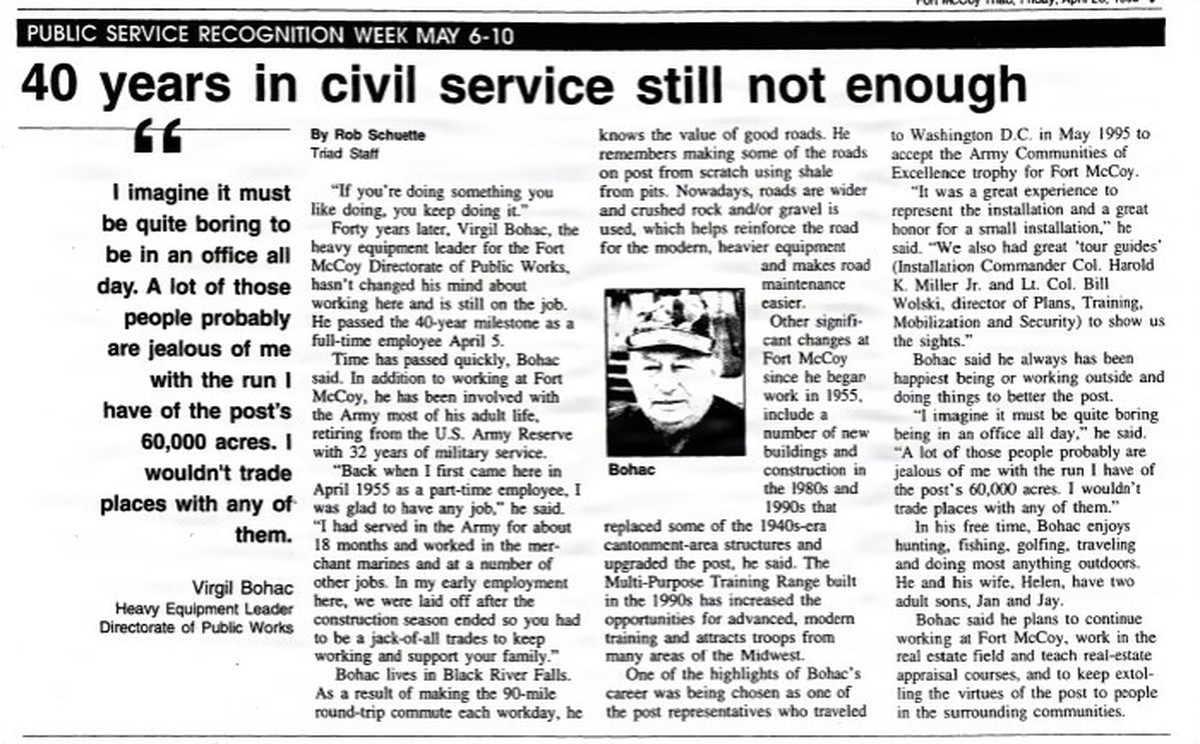
FROM THE APRIL 26, 1996, EDITION OF THE TRIAD NEWSPAPER: 40 years in civil service still not enough (By Rob Schuette, Triad Staff) — “If you’re doing something you like doing, you keep doing it.”
Forty years later, Virgil Bohac, the heavy equipment leader for the Fort McCoy Directorate of Public Works, hasn’t changed his mind about working here and is still on the job.
He passed the 40-year milestone as a full-time employee April 5.
Time has passed quickly, Bohac said. In addition to working at Fort McCoy, he has been involved with the Army most of his adult life, retiring from the U.S. Army Reserve with 32 years of military service.
“Back when I first came here in April 1955 as a part-time employee, I was glad to have any job,” he said. “I had served in the Army for about 18 months and worked in the motor pool that maintains and at a number of other jobs. In my early employment here, we were laid off after the construction season ended so you had to be a jack-of-all-trades to keep working and support your family.”
Bohac lives in Black River Falls. As a result of making the 90-mile round-trip commute each workday, he knows the value of good roads. He remembers making some of the roads on post from scratch using shale from pits. Nowadays, roads are wider and crushed rock and/or gravel is used, which helps reinforce the road for the modern, heavier equipment and makes road maintenance easier.
Other significant changes at Fort McCoy since he began work in 1955 include a number of new buildings and construction of the 1980s and 1990s that replaced some of the 1940s-era cantonment-area structures and upgraded the post, he said. The Multi-Purpose Training Range built in the 1990s has increased the opportunities for advanced, modern training and attracts troops from many areas of the Midwest.
One of the highlights of Bohac’s career was being chosen as one of the post representatives who traveled to Washington D.C. in May 1995 to accept the Army Communities of Excellence trophy for Fort McCoy.
“It was a great experience to represent the installation and a great honor for a small installation,” he said. “We also had great tour guides” (Installation Commander Col. Harold K. Miller Jr. and Lt. Col. Bill Wolsky, director of Plans, Training, Mobilization and Security) to show us the sights.
Bohac said he always has been happiest being or working outside and doing things to better the post.
“I imagine it must be quite boring to be in an office all day,” he said. “A lot of those people probably are jealous of me with the run I have of the post’s 60,000 acres. I wouldn’t trade places with any of them.”
In his free time, Bohac enjoys hunting, fishing, golfing, traveling and doing most anything outdoors. He and his wife, Helen, have two adult sons, Jan and Ray.
Bohac said he plans to continue working at Fort McCoy, work in the real estate field and teach real-estate appraisal courses, and to keep extolling the virtues of the post to people in the surrounding communities.
20 Years Ago — April 2006
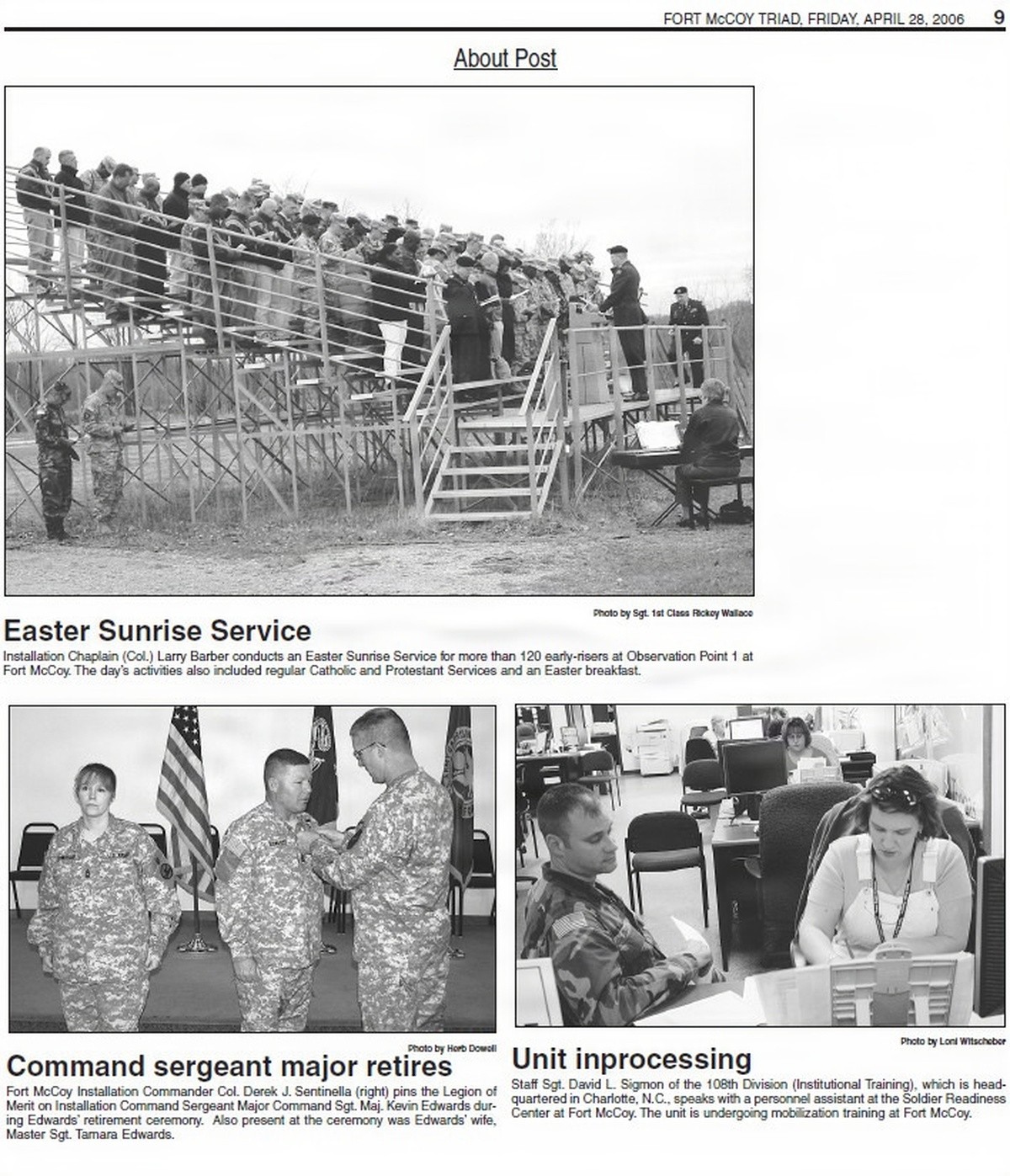
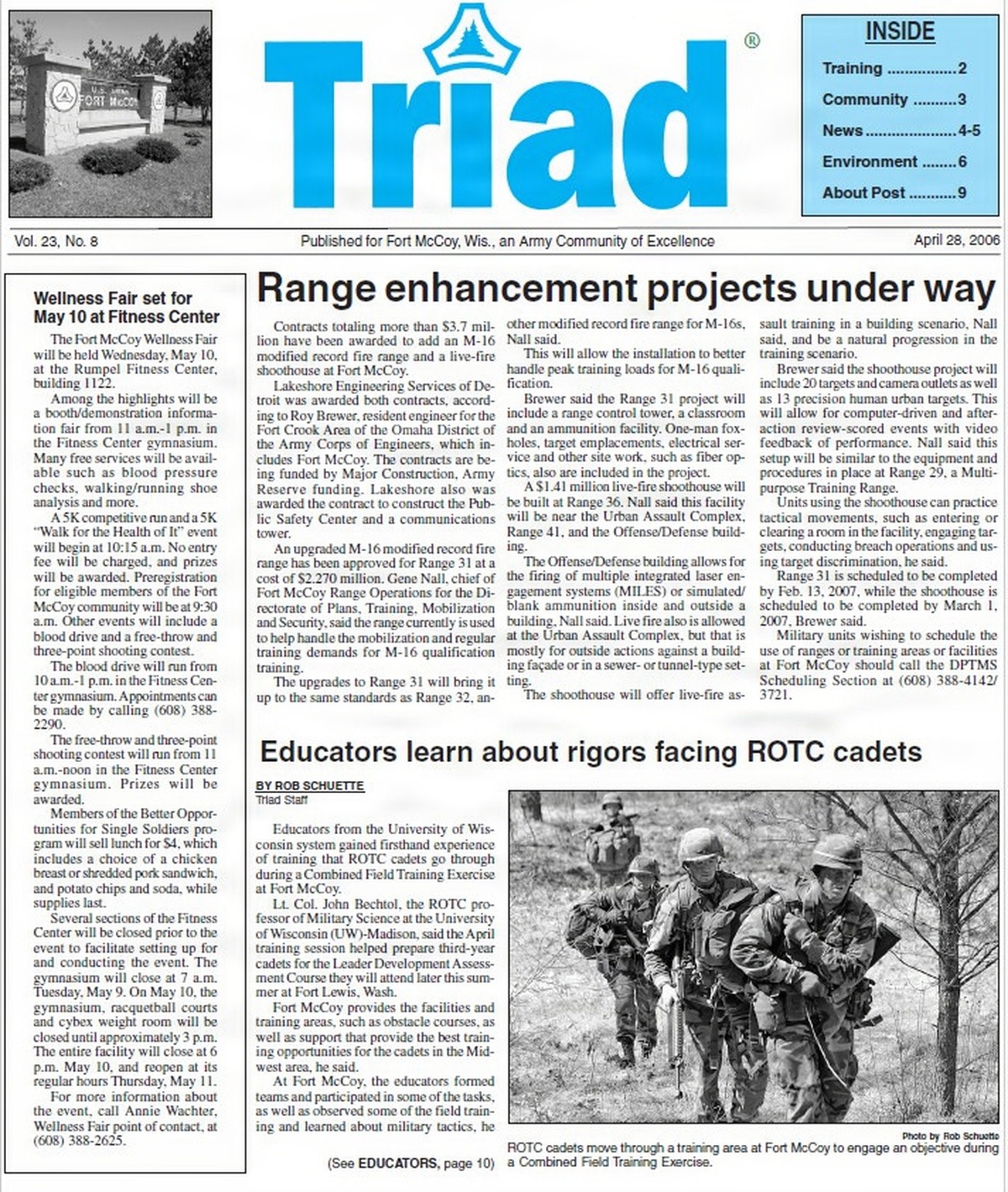
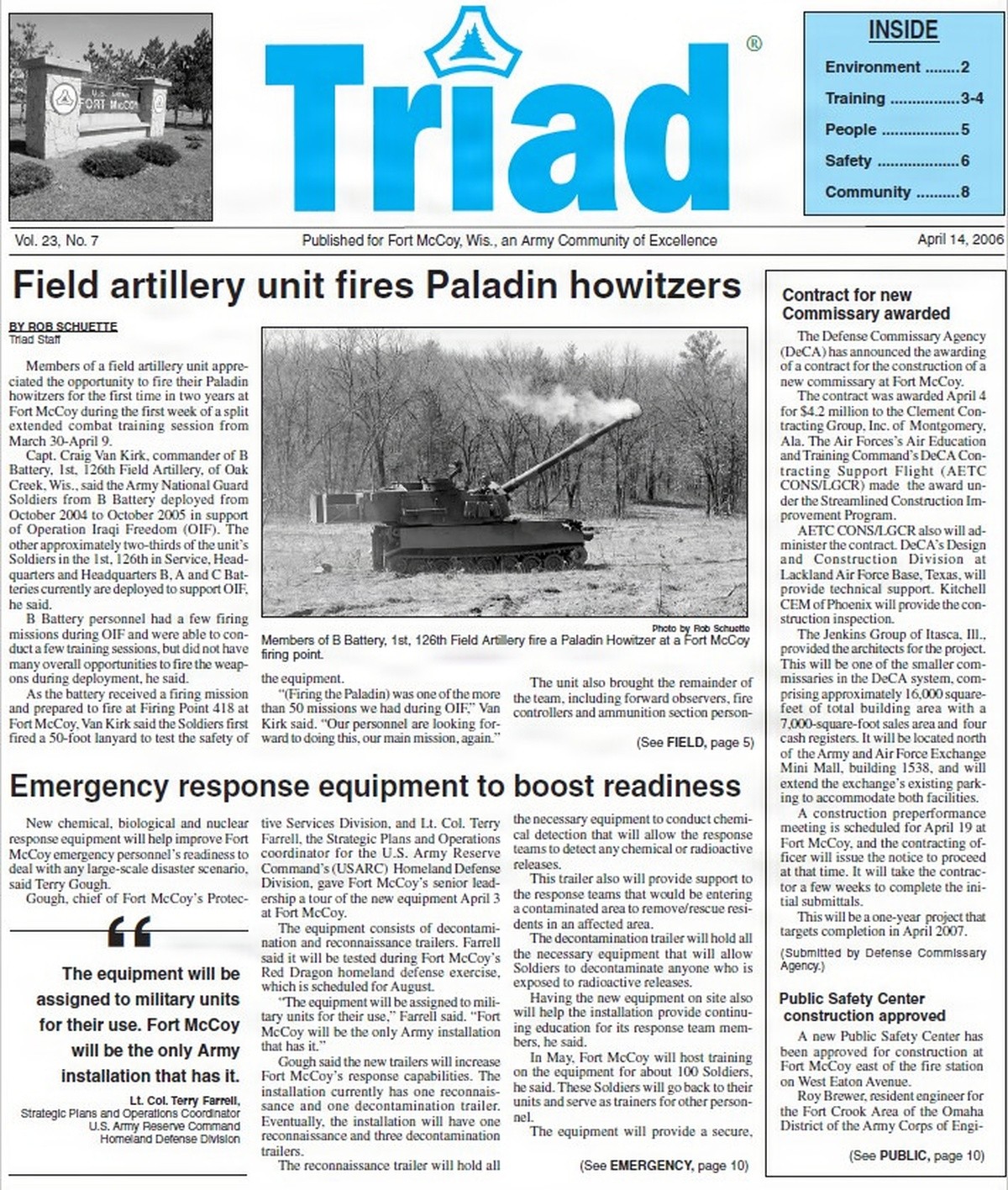
FROM THE APRIL 14, 2006, EDITION OF THE TRIAD NEWSPAPER: Field artillery unit fires Paladin Howitzers (By Rob Schuette, Triad Staff) — Members of a field artillery unit appreciated the opportunity to fire their Paladin howitzers for the first time in two years at Fort McCoy during the first week of a split extended combat training session from March 30-April 9.
Capt. Craig Van Kirk, commander of B Battery, 1st, 126th Field Artillery, of Oak Creek, Wis., said the Army National Guard Soldiers from B Battery deployed from October 2004 to October 2005 in support of Operation Iraqi Freedom (OIF). The other approximately two-thirds of the unit’s Soldiers in the 1st, 126th in Service, Headquarters and Headquarters B, A and C Batteries currently are deployed to support OIF, he said.
B Battery personnel had a few firing missions during OIF and were able to conduct a few training sessions, but did not have many overall opportunities to fire the weapons during deployment, he said.
As the battery received a firing mission and prepared to fire at Firing Point 418 at Fort McCoy, Van Kirk said the Soldiers first fired a 50-foot lanyard to test the safety of the equipment.
“(Firing the Paladin) was one of the more than 50 missions we had during OIF,” Van Kirk said. “Our personnel are looking forward to doing this, our main mission, again.”
The unit also brought the remainder of the team, including forward observers, fire controllers and ammunition section personnel to Fort McCoy to assemble the entire team needed to conduct a firing mission, he said.
Maj. Dean Nienhuis, the unit’s S-3 or planning officer, said the unit’s members training during the second week of the split extended combat training in August, Nienhuis said. The training will include crew-served weapons, such as the MK-19 grenade launcher and machine-gun qualification.
Sgt. Timothy Tippett, the platoon sergeant for B Battery, said the training at Fort were happy to return from OIF duty and looked forward to resuming training together. After units return from deployments, Soldiers do not have to return to military drills for 90 days and are stabilized from further mobilizations for a minimum of six months.
Unit members will do more Soldier skills McCoy was an opportunity for unit members to train together and redevelop teamwork.
“Many of the unit members haven’t seen each other since we returned,” Tippett said. “This gives them a chance to get back together and work together to accomplish our mission.”
10 Years Ago — April 2016
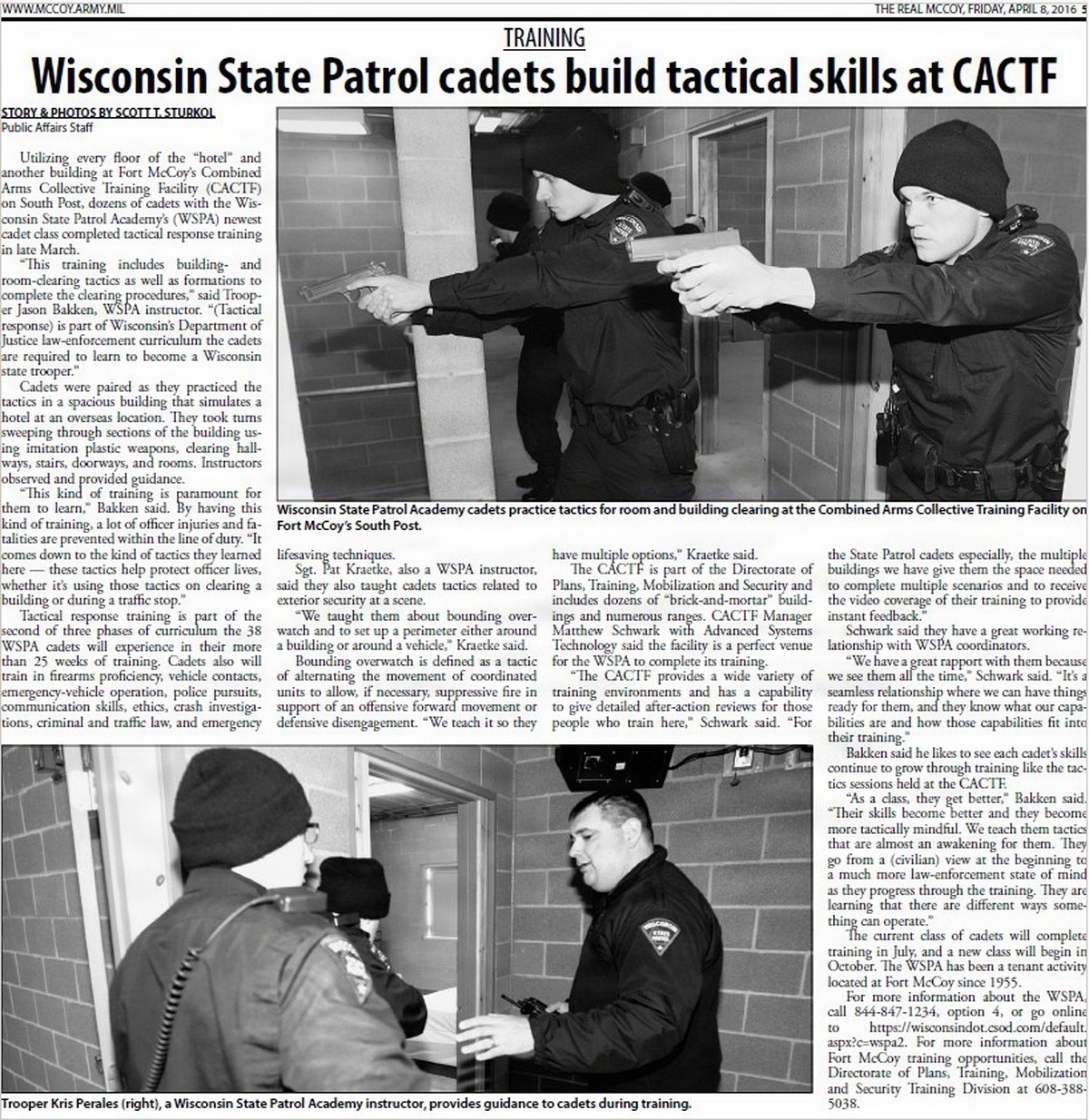
FROM THE APRIL 22, 2016, EDITION OF THE REALMCCOY NEWSPAPER: Federal, state agencies partner for fire-suppression training (By Scott T. Sturkol, Newspaper Staff) — Fort McCoy’s fi re and forestry officials, members of the Wisconsin Department of Natural Resources (WDNR), and aircrew and Blackhawk helicopters with the 1st Battalion, 147th Aviation Regiment of Madison, Wis., teamed April 12 to complete prescribed-burn and conduct fi re-suppression training on Range 29 on the installations North Post.
The event marked the first time the helicopter crews used Lost Lake on North Post as a dipping site for the water buckets attached to the Blackhawks and was the fifth-consecutive year the training was held on post, according to Forestry Technician Charles Mentzel with the Directorate of Public Works (DPW) Environmental Division Natural Resources Branch (NRB).
Forester James Kerkman, also with the NRB, said Fort McCoy is the ideal place to hold fire-suppression training.
“We are a military training base, have the facilities to support the helicopters, and the land base to do the training,” Kerkman said. “The water source also is on the installation, so helicopters didn’t have to cross any public roadways while carrying water to the fire.”
Prescribed burns typically are completed every spring and fall through a combined eff ort of several post organizations, including DPW; the Directorate of Emergency Services; and the Directorate of Plans, Training, Mobilization and Security.
Th is effort was supported by those same agencies, and the WDNR also provided two air-attack airplanes to provide reconnaissance and ground-communications capability.
As of mid-April, more than 1,000 acres have been burned as part of the post’s prescribed-burn program, Mentzel said.
5 Years Ago — April 2021
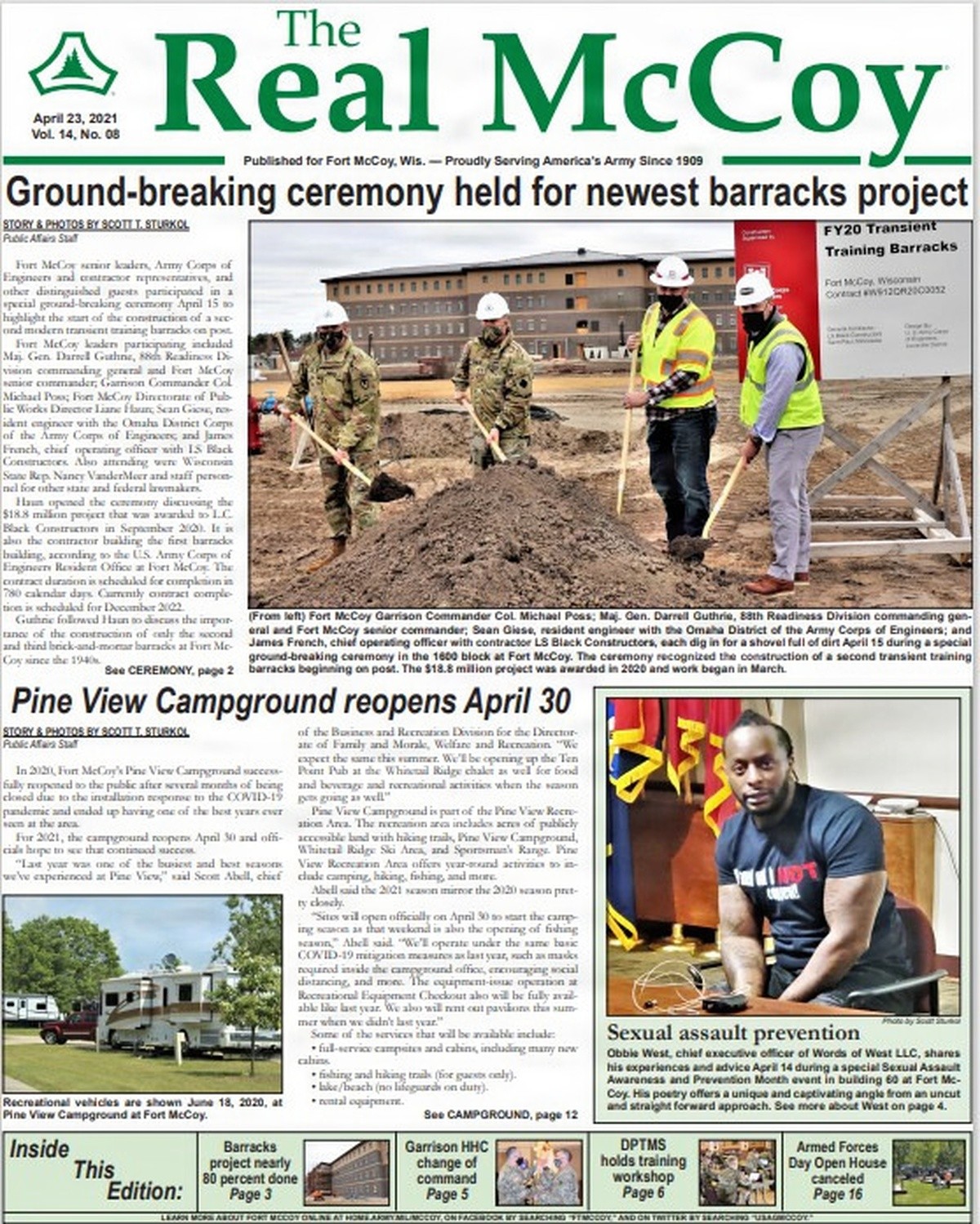
FROM THE APRIL 23, 2021, EDITION OF THE REAL MCCOY NEWSPAPER: Ground-breaking ceremony held for newest barracks project at Fort McCoy (By Scott T. Sturkol, Newspaper Staff) — Fort McCoy senior leaders, Army Corps of Engineers and contractor representatives, and other distinguished guests participated in a special ground-breaking ceremony April 15 to highlight the start of the construction of a second modern transient training barracks on post.
Fort McCoy leaders participating included Maj. Gen. Darrell Guthrie, 88th Readiness Division commanding general and Fort McCoy senior commander; Garrison Commander Col. Michael Poss; Fort McCoy Directorate of Public Works Director Liane Haun; Sean Giese, resident engineer with the Omaha District Corps of the Army Corps of Engineers; and James French, chief operating officer with LS Black Constructors. Also attending were Wisconsin State Rep. Nancy VanderMeer and staff personnel for other state and federal lawmakers.
Haun opened the ceremony discussing the $18.8 million project that was awarded to L.C. Black Constructors in September 2020. It is also the contractor building the first barracks building, according to the U.S. Army Corps of Engineers Resident Office at Fort McCoy. The contract duration is scheduled for completion in 780 calendar days. Currently contract completion is scheduled for December 2022.
Guthrie followed Haun to discuss the importance of the construction of only the second and third brick-and-mortar barracks at Fort McCoy since the 1940s.
“Projects like the transient training barracks complex are a direct result of the continued support for Fort McCoy,” Guthrie said. “And they enhance the ability of the Army, and especially the Army Reserve, to train here at Fort McCoy. The United States Army Reserve is the key customer for Fort McCoy. Its economic impact alone in Wisconsin is $323 million a year.”
Poss followed Guthrie and highlighted how construction projects like the barracks projects add to a big economic impact in the local area. Fort McCoy’s total economic impact for fiscal year 2020 was an estimated $1.479 billion, above the $1.184 billion reported for fiscal year 2019.
Poss also said that despite the difficulty the pandemic presented, Fort McCoy trained more than 60,000 troops in fiscal year 2020 and continues to strive forward with continued training and infrastructure improvements like the barracks projects.
“Fort McCoy continues to demonstrate its resolve to be a preferred training location for the Army Reserve, the National Guard, active Army, and joint services,” Poss said. “Our efforts today ensure that Fort McCoy’s relevance as a Total Force Training Center are here for many years to come.”
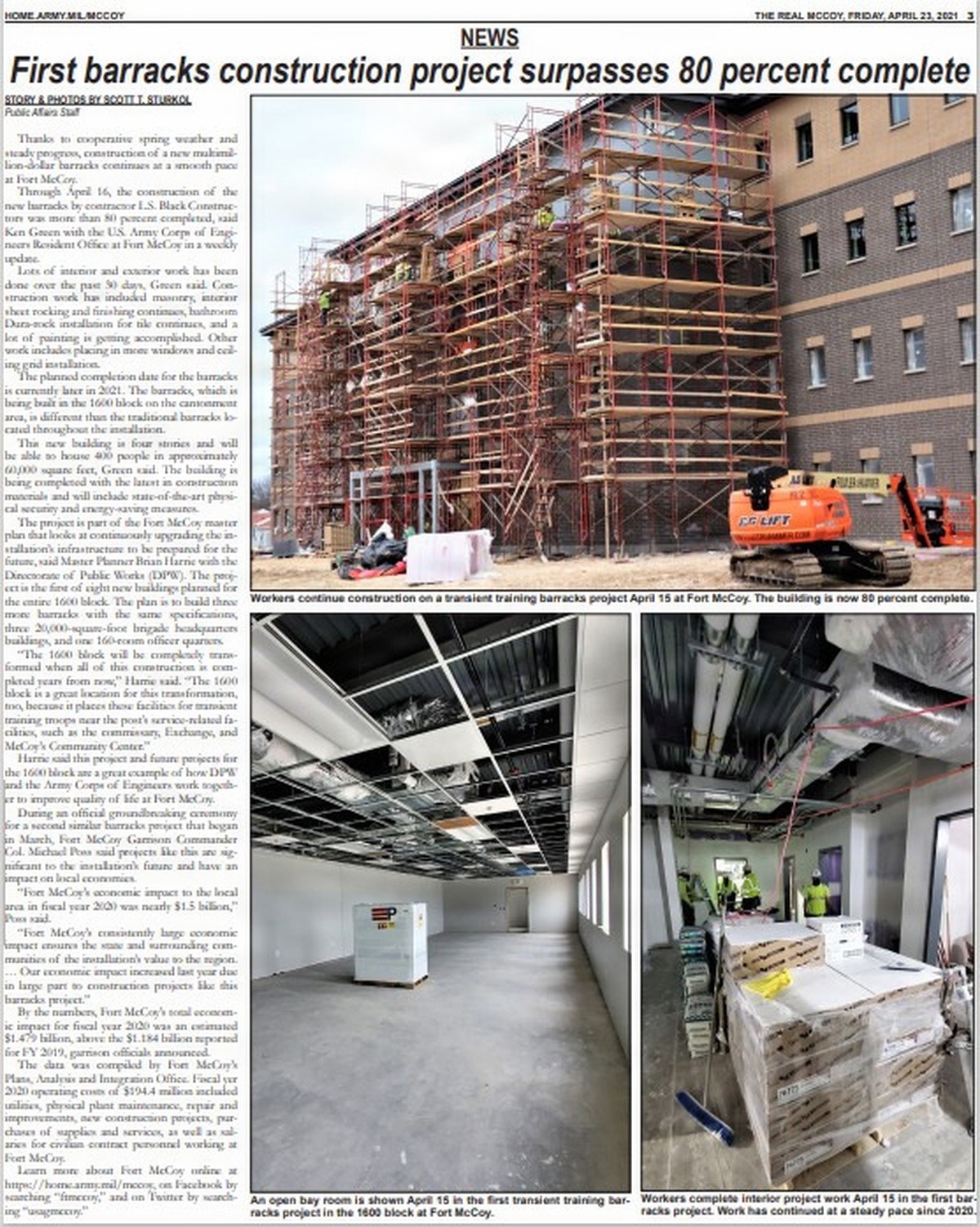
Guthrie, Poss, French, and Giese also performed a ceremonial breaking of the ground with shovels at the construction site. Numerous attendees also received a tour of the construction site of the first barracks project, which is more than 80 percent complete. A ceremony for the first project was not held in 2020 because it would have happened just as the COVID-19 pandemic began.
Ground preparation and infrastructure construction for the second barracks has been ongoing since early March. Like the first barracks project, the second also will be four stories and will be able to house 400 people in approximately 60,000 square feet.
The building also will be built with the latest in construction materials and will include state-of-the-art physical security and energy-saving measures.
Fort McCoy’s motto beginning in 2026 is “Training the Total Force and Shaping the Future since 1909.”
The installation’s mission: “Fort McCoy strengthens Total Force Readiness by serving as a training center, Mobilization Force Generation Installation, and Strategic Support Area enabling warfighter lethality to deploy, fight, and win our nation’s wars.”
And Fort McCoy’s vision is, “To be the premier training center supporting the most capable, combat-ready, and lethal armed forces.”
Located in the heart of the upper Midwest, Fort McCoy is the only U.S. Army installation in Wisconsin. The installation has provided support and facilities for the field and classroom training of more than 100,000 military personnel from all services nearly every year since 1984.
Learn more about Fort McCoy online at https://home.army.mil/mccoy, on Facebook by searching “ftmccoy,” on Flickr at https://www.flickr.com/photos/fortmccoywi, and on X (formerly Twitter) by searching “usagmccoy.” Also try downloading the My Army Post app to your smartphone and set “Fort McCoy” or another installation as your preferred base. Fort McCoy is also part of Army’s Installation Management Command where “We Are The Army’s Home.”









Social Sharing