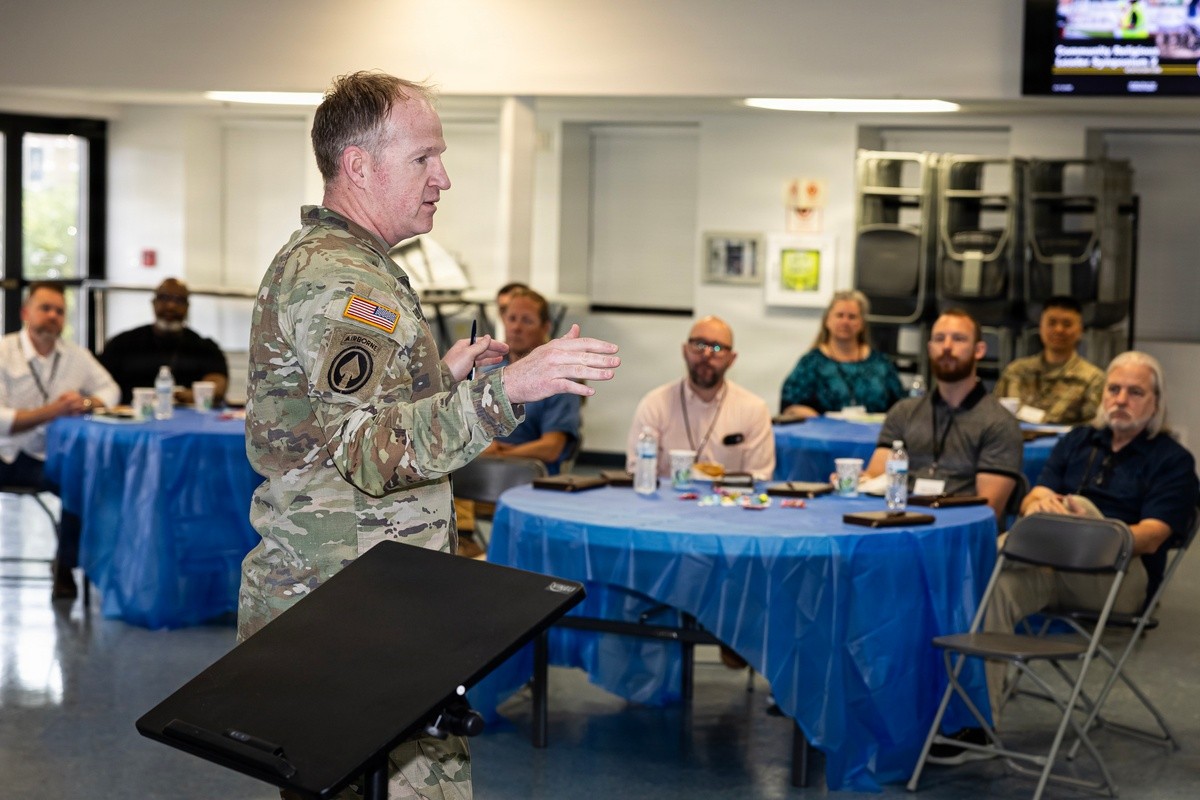

FORT LEE, Va. — The Fort Lee Religious Support Office executed a second Community Religious Leader Symposium April 15 at Memorial Chapel as part of its faith and community partnership program.
Attendees included about thirty representative(s) from local faith groups, emergency services personnel and chaplains from regional and partner military organizations.
The Fort Lee Directorate of Public Works provided a guided bus tour of the installation to better build and strengthen relationships with community religious leaders and faith communities.
Permanent party Soldiers, their families, and some trainees attend churches in the communities outside of Fort Lee, so it is important for church leaders to see where military families live and where service members train at Fort Lee, Fort Lee Garrison Commander Rich Bendelewski said to the symposium attendees.
About 60% of FLVA service members who seek religious support go off post at local churches, synagogues, mosques, etc., in the greater FLVA area, according to a recent community needs survey. The other 40% go on post, mostly Advanced Individual Training students, with a weekly attendance between 725 to 750.
Lt. Gen. Michelle K. Donahue, the U.S. Army Deputy Chief of Staff, G-4, had a vision when she was the Fort Lee senior mission commander (2023-2025) to not just integrate into outside communities but to help integrate those communities into Fort Lee, Bendelewski said.
The faith and community partnership program is an extension of that vision.
“[Fort Lee has a vision] to really open our gates to you, to open our gates to the schools and communities around us, so you can see what it’s like to be in the military,” Bendelewski said to the community leaders. “It looks like any other community out there. We have churches. We have shopping centers. We have grocery stores. This is your opportunity to see the installation.”
The symposium also served as an opportunity for a number of these faith community leaders to meet one another and build toward collaboration in case there was a community-wide emergency event.
“It’s not every day that we have these opportunities to come together and build connections and relationships,” said Col. Scott Koeman, the Combined Arms Support Command and Fort Lee senior command chaplain. “We have a great representation not only of local clergy but also chaplains, so together we as a community are interlinked, and we will in times of crisis find ourselves working together.”
Sean Bendele, the Fort Lee casualty operations coordinator, also provided training at the symposium on casualty assistance center services toward ensuring the proper care and disposition of a Soldier's remains and personal effects.
Most of the attendees affirmed they have either officiated or have been part of military funeral honors.
Social Sharing