
Over 4,500 marchers participated in a successful 37th annual Bataan Memorial Death March at White Sands Missile Range, New Mexico, March 21, thanks to the hard work of the dedicated volunteers and support staff.
The Bataan Memorial Death March honors a special group of World War II heroes responsible for the defense of the islands of Luzon, Corregidor and the harbor defense forts of the Philippines. On April 9, 1942, tens of thousands of American and Filipino Soldiers surrendered to Japanese forces. The Americans were Army, Army Air Corps, Navy and Marines. Among those seized were members of the 200th Coast Artillery, New Mexico National Guard.
Col. Andrew "Drew" Morgan, Senior Commander of White Sands Missile Range, addressed the audience at the opening ceremony, encouraging everyone to reflect on this somber moment in history. He emphasized the importance of remembering Bataan and honoring the bravery and resilience of those who endured it.
"Eighty-four years ago, in the crucible of conflict, a terrible chapter in military history unfolded—the Bataan Death March—a trial of unimaginable suffering," said Morgan. "But it was also a testament to the unbreakable spirit of human will."
Because of the forecast for sweltering temperatures, White Sands Missile Range leadership made the difficult decision to shift all participants to a 15.6-mile "Honorary Distance." This change prioritized participant safety while preserving the essence of the event.
This decision to shift to the 15.6 mile distance reduced the number medical disqualifications to 79 with most related to foot care and leg cramps. In addition, no air or ground transports to local hospitals was required, and no accidents or injuries to the workforce or volunteers.
McAfee U.S. Army Health Clinic Commander Lt. Col. Joseph J. Pavelites said there were no serious injuries and no medical evacuations to hospitals needed.
“Weather reports combined with heat injury modeling techniques informed the commander on risks so that he could engage optimal mitigation strategies,” Pavelites said.
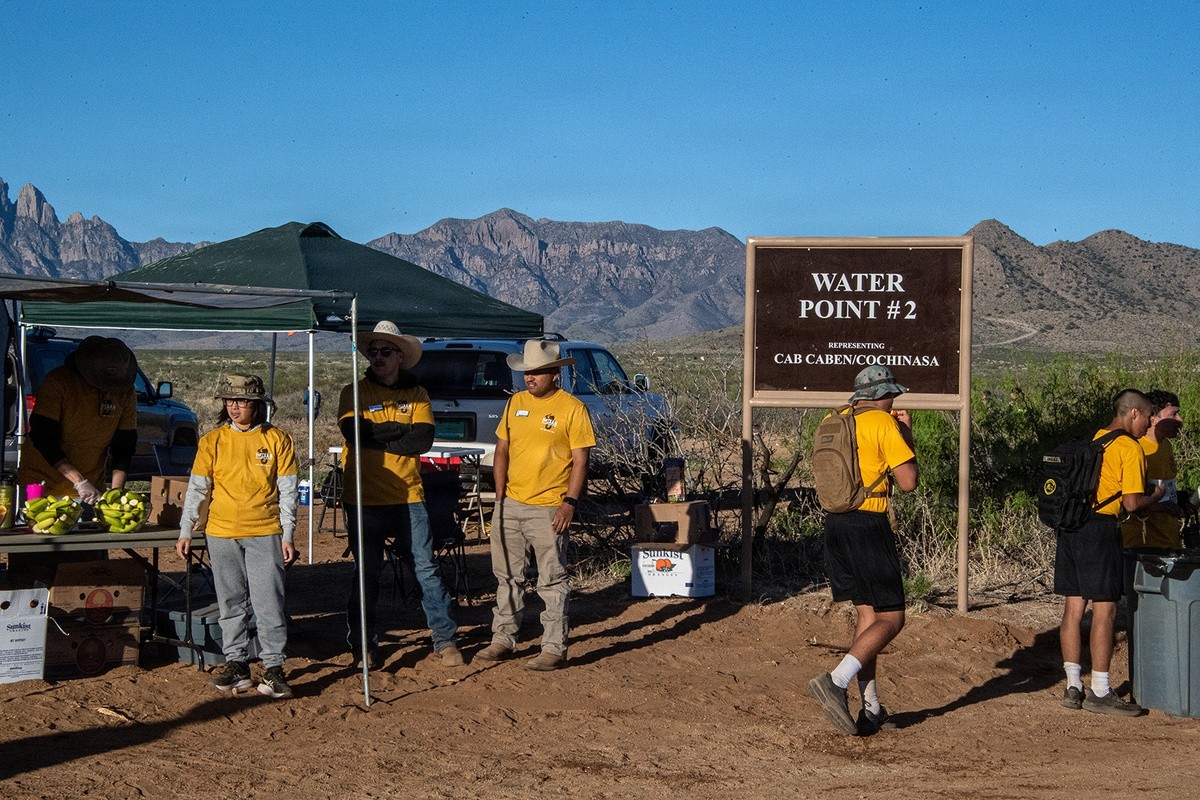
These heat injury risk mitigation strategies included shortening the course to the Honorary Route only, providing ice immersion tanks along the route to help lower core body temperatures, ice sheets, water misters on the route, numerous hydration points and increasing medical personnel during the event.
He also listed medical organizations that contributed to Bataan 2026: McAfee Army Health Clinic, BorderRac, University of New Mexico Hospital System, William Beaumont Army Medical Center, Fort Bliss, Texas, 1st Armored Division, New Mexico Department of Health, Sierra Vista Hospital, Future Healthcare Professionals, American Medical Response.
Morgan and Col. Don Mozer, WSMR Garrison Commander, presented medals to the following teams:
The first place ROTC Heavy Division went to Norwich University Alpha Team, second place ROTC Heavy Division went to Norwich University Bravo Team, and third place ROTC Heavy Division went to Texas State University Alpha Team. The first place ROTC Light Division went to University of Minnesota. The first place for Junior ROTC went to New Mexico Military Institute.
Mozer also recognized those who work behind the scenes to include the close to 2,000 volunteers who help make the event possible.
“I want to thank all the amazing volunteers who step up every year to help. Without them this event would not be possible,” Mozer said.
He also recognized the WSMR FMWR team for all their hard work.
“To our sponsors, our medical and security teams as well, thank you all for the job well done.”
The following is the Estimated Support Staff and Volunteers: of the 1,241 support staff and 466 volunteers; 429 were medical service related, 149 were emergency services related, 64 were Garrison operational support, nine were Mission Command Support, four were White Sands Test Center Range Operations for Air Space Coordination, 40 were New Mexico State University ROTC Army, 20 were NMSU ROTC Air Force, 10 were WSMR Navy, 25 were 1 AD Fort Bliss, Texas, two were Holloman Air Force Base Aviation refueling team, 23 Mesilla Valley Ham Radio Operators.
Organizations that supported the event include:
White Sands Missile Range, NM: McAfee U.S. Army Health Clinic; Navy Detachment; 2-6 ADA AMD Detachment and USAG WSMR Garrison.
Fort Bliss, TX: 1st Armored Division; William Beaumont Army Medical Center; 1st Combat Aviation Brigade; 93rd MP; and 1st AD Band.
Holloman Air Force Base, NM: 49th Wing and 49th Security Forces.
The New Mexico National Guard.
The NMSU Army and Air Force ROTC.
The New Mexico DHS Disaster Medical Assistance Team, University of New Mexico - University Healthcare Emergency Response Team.
The New Mexico Department of Health, Bureau of Health Emergency Management.
The Center for Health Protection, BorderRAC and Texas Task Force 9.
Law Enforcement: The New Mexico State Police; The Las Cruces Police Department; The Dona Ana County Sheriff’s Office; and the New Mexico Department of Game and Fish.
Supporting Hospitals and Ambulance: William Beaumont Army Medical Center Fort Bliss, Texas; Mountain View Regional Medical Center Las Cruces; Memorial Medical Center Las Cruces; Three Crosses Regional Hospital Las Cruces; The American Medical Response Ambulance; The Truth or Consequence Hospital Ambulance and Elite Ambulance.
Centralized Command and Coordination
At the center of the operation is the Directorate of Plans, Training, Mobilization, and Security, headed by Director Jim Sykes, who oversaw event planning and coordination.
The Emergency Operations Center, managed by this directorate, coordinated interagency collaboration, monitored traffic participant flow. It was also responsible for emergency management and transportation logistics. The Transportation and Evacuation team within the directorate orchestrated vehicle movements and directed both military and civilian personnel, ensuring the efficient and safe transport of participants and equipment.
Medical and Life Safety Support
To ensure the health and safety of all participants, the McAfee U.S. Army Health Clinic provided overall medical coordination for the event, organizing on-site medical stations, managing medical volunteers, and establishing emergency protocols. This clinic leads a comprehensive, multi-layered emergency response network.
BorderRAC and the Texas Emergency Medical Task Force 9 were responsible for finish-line medical care and operated a dedicated civilian field hospital to handle emergencies as participants complete the march.
Along the route, the University Hospital Emergency Response Team and the Disaster Medical Assistance Team provided immediate medical attention and responded to incidents as they arose.
Logistics and Infrastructure: The backbone of the event
The march requires extensive logistical demands to support thousands of visitors at WSMR. The WSMR Family, Morale, Welfare, and Recreation team oversaw registration and packet pickup for thousands of marchers, coordinated volunteers, and managed essential services, including sanitation and water.
Meanwhile, the Directorate of Public Works prepared the march route, installed physical barriers, and ensured that vital utilities, such as water and power, were available along the route, supporting a seamless and safe experience for all participants.
Security and Intelligence
The Directorate of Emergency Services combined the efforts of multiple organizations to coordinate law enforcement and crowd management. Intelligence efforts include daily coordination with the FBI, Army Counterintelligence, and WSMR Physical Security for ongoing threat assessments. Aerial surveillance teams provided real-time emergency response and enhanced situational awareness by monitoring the area from the air.
In addition, Fire and Emergency Services expands the team for the event, and the safety team inspects the route for hazards daily.
Meticulous Preparation
Teams spend the week before the event preparing the route, setting up sanitation, conducting communication drills, and performing safety sweeps measures that ensure a safe and respectful experience for all.
The legacy of the Bataan Memorial Death March endures through the dedication of many. Each year organizations unite to transform remembrance into a living act of honor, ensuring every step pays tribute to the past and inspires hope for future generations.
Remember Bataan! Never Forget.
Social Sharing