


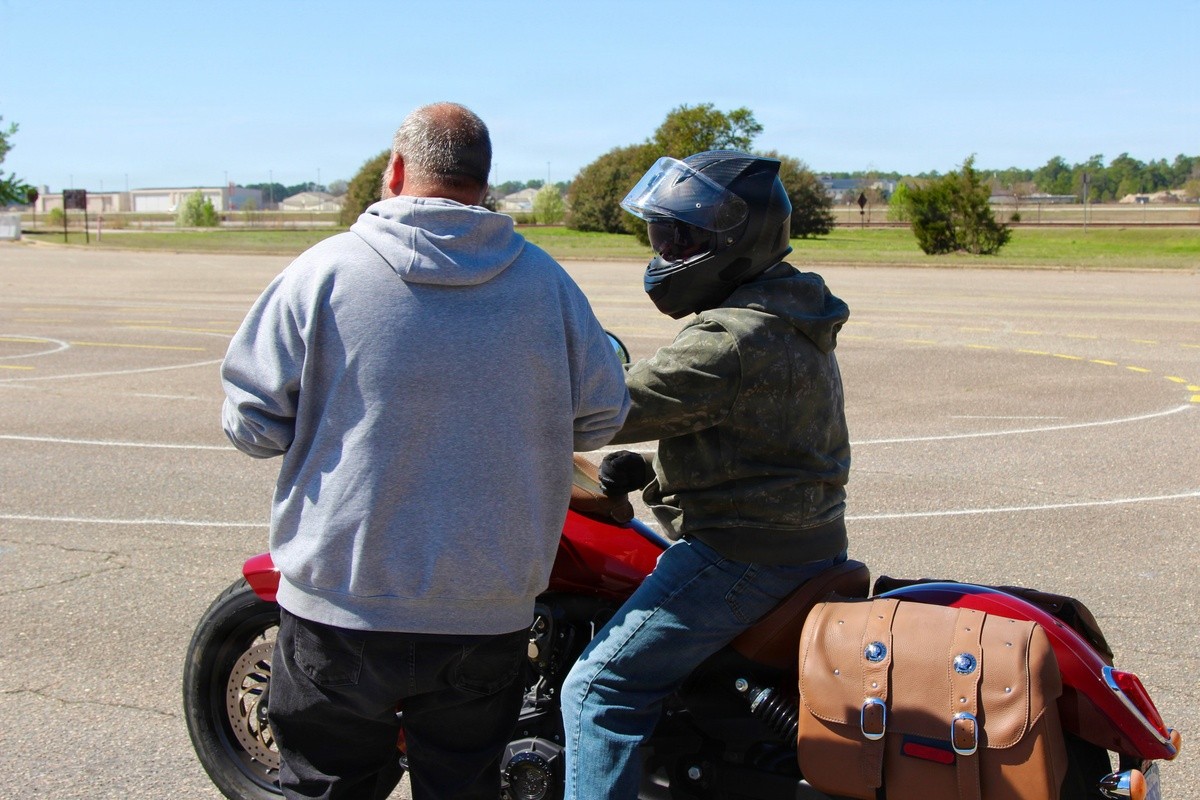
FORT BRAGG, N.C. — Every rider knows it only takes a split second for things to go wrong. At Fort Bragg, motorcycle safety training is designed to prepare Soldiers for these moments by building the skills, awareness and control needed to stay upright when it matters most.
Motorcycle safety training at Fort Bragg goes far beyond simply learning how to ride. It builds disciplined riders who understand the mechanics of the bike and the responsibility that comes with it, both on and off duty. Having taken the course, I saw firsthand how comprehensive the MSF program at Fort Bragg is.
“Motorcycle safety training plays a critical role in ensuring the overall readiness of Army Soldiers,” Davita Heard Melvin, Safety and Occupational Health Specialist with the Garrison Safety Office, said. “By emphasizing training, the Army takes an important step toward safeguarding its most valuable resource: its people.”
Training begins in the classroom, where riders develop the mental framework behind every decision they make on the road. Through guided instruction, real-world scenarios and reaction-based exercises, students learn to identify hazards before they become threats.
Concepts like inattentional blindness, risk management and hazard perception are introduced alongside a deeper understanding of motorcycle dynamics. Exercises focused on peripheral vision and reaction time reinforce the reality that riding demands constant awareness and leaves little room for error.
Rather than memorizing information, riders are pushed to think through real situations, from unpredictable drivers to poor road conditions and sudden obstacles.
“It’s about training the mind before ever relying on the machine,” Andrew Hedgecock, Fort Bragg Lead Rider Coach, said.
This combination of classroom instruction and scenario-based learning builds decision-making skills that translate directly to the road.
Outside, that classroom knowledge is put into action. Soldiers begin translating concepts into controlled movement, building precision, confidence and consistency through repetition and muscle memory.
Rider coaches emphasize that where you look and how you react can determine everything.
“Look up and turn your head,” Hedgecock said. “Where your eyes go, the bike follows.”
Riders work through exercises such as:
- Friction zone control, mastering low-speed balance and clutch coordination
- Cone weaving drills, refining body positioning and counterweighting
- Quick stops and emergency braking, reinforcing fast, controlled response
- Swerving techniques, teaching riders to avoid sudden hazards without hesitation
- Shifting and throttle control, building smooth, predictable power delivery
Each drill is intentional. Each repetition builds the ability to react instinctively when it matters most.
“Continuous training allows riders to become more proficient in the skills they need every time they ride,” Danielle Stansell, Fort Bragg Rider Coach, said. “It’s great to have fun, but you want to do the things you love safely.”
Some students, including myself, practiced the drills on multiple different bikes, which taught me how different clutch engagement, throttle sensitivity and weight distribution affect control. The adaptability across different bikes translates directly to real-world riding, where no two bikes or situations feel the same.
“Slow is smooth, and smooth is fast,” Hedgecock said. “Controlled inputs lead to better results.”
That control, developed at low speeds and in controlled environments, is what keeps riders composed when situations escalate on the road.
“Friction zone is everything,” he added. “That’s where riders really start to feel in control of the bike.”
According to the U.S. Army Combat Readiness Center, Soldiers who complete required motorcycle safety training are over 30 percent less likely to be involved in a motorcycle accident compared to untrained riders. Units with full training compliance consistently experience fewer injuries and fatalities.
“Hands-on training gives riders the opportunity to practice emergency maneuvers in a controlled environment,” Melvin said. “Those skills can make the difference between a close call and a serious accident.”
Fort Bragg offers multiple levels of motorcycle training to meet riders where they are in their experience. The Basic Rider Course introduces foundational skills like braking, cornering and traffic strategy, while the Advanced Rider Course builds on those fundamentals with more complex techniques, including advanced cornering, high-speed braking and hazard response. Even experienced riders benefit from this continued training.
“Training transforms risk awareness into actionable habits,” Melvin said. “By equipping riders with the skills, knowledge and mindset to recognize and manage hazards, training significantly lowers the likelihood of accidents.”
Rider coaches also emphasize the importance of mindset once riders leave the training range.
“Be a defensive rider,” Stansell said. “You have to stay vigilant and aware of everything moving around you. Practice your skills and surround yourself with riders who value your life as much as they value their own.”
When accidents do occur, the impact extends far beyond the individual.
A single incident can reduce unit strength, increase workload on fellow Soldiers and affect morale across an entire formation. The loss of a trained Soldier directly impacts mission capability.
The Army requires all riders to complete approved training, regardless of whether they ride on or off duty, reinforcing a culture that prioritizes safety and accountability.
For Soldiers, completing rider training reflects a commitment to protecting themselves and those around them. For leaders, it is an opportunity to set the standard by enforcing requirements, mentoring riders and actively reducing risk within their formations.
“Completing rider training is a clear demonstration of a Soldier’s commitment to safety,” Melvin said. “It’s about honoring your responsibility to yourself, your loved ones and your battle buddies.”
A rider’s commitment to safety does not end with initial training. It’s continuous.
“Experience can sometimes lead to complacency,” Melvin said. “But ongoing training reinforces safe habits, sharpens critical skills and keeps riders prepared for evolving risks.”
For many riders, this training is more than a requirement. It is the mindset that every ride carries risk and every decision matters. Safety does not end when the duty day does.
For Stansell, that passion is what keeps her coming back.
“The most rewarding part is seeing riders’ confidence grow,” she said. “I love being able to share something I enjoy every day and help others build that same confidence.”
For Hedgecock, it’s about the impact he can make on each rider who comes through the course.
“I’ve always had a passion for motorcycles,” he said. “Helping riders build confidence and take control of the bike is the best part of what I do.”
At Fort Bragg, motorcycle safety training ensures that Soldiers ride smart, ride prepared, and most importantly, ride home.
Social Sharing