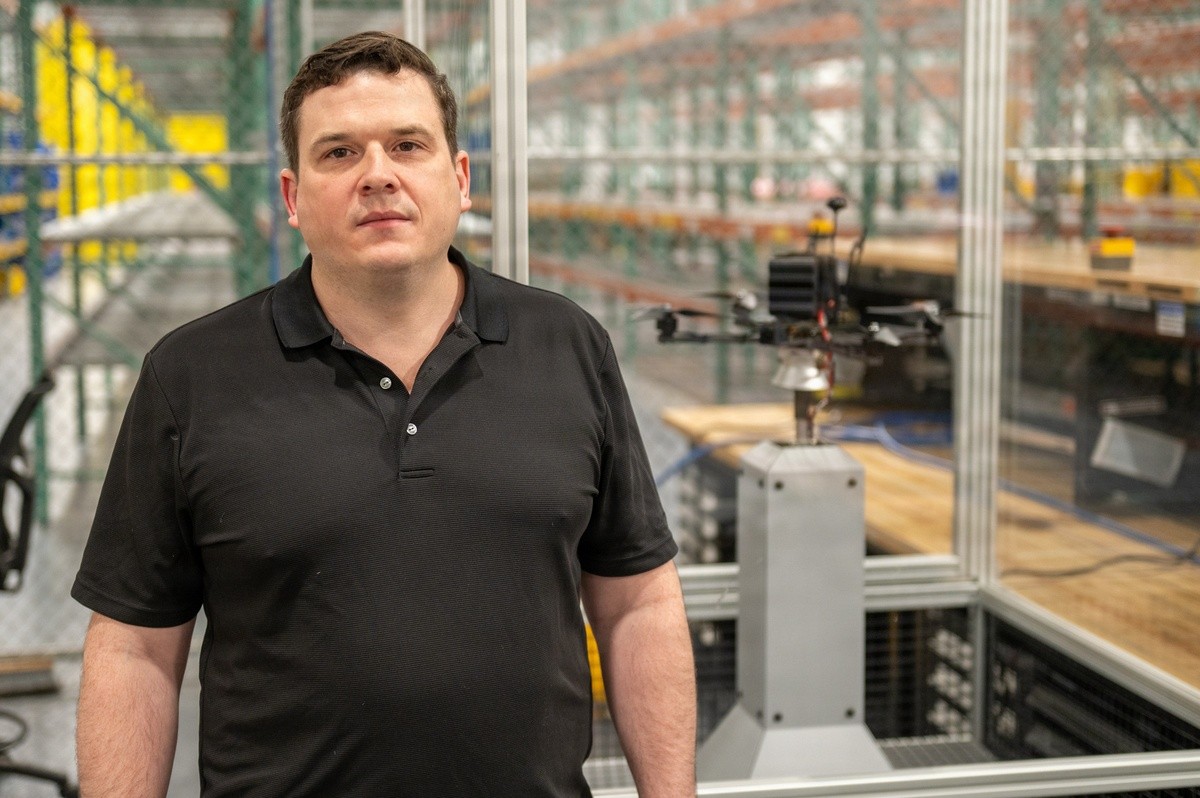


Tobyhanna Army Depot recently observed National Engineers Week by showcasing some of Team Tobyhanna's finest members of the engineering community.
Electronic Engineer Corey Katsak began his career journey at Luzerne County Community College. In 2007, while still a student, recruiters from Tobyhanna Army Depot (TYAD) visited campus and introduced him to what was then called the Student Career Experience Program.
“They recruited me right from the college,” said Katsak. “That’s how I ended up getting started here when I was 19.”
Although he initially pursued a degree in cybersecurity, he quickly realized it wasn’t the right fit. He then switched his major to Electronic Engineering Technology and graduated with his associate degree. Afterward, he began working in TYAD’s SATCOM Strategic Systems shop. After two years in SATCOM, he decided he wanted to complete his four-year degree.
Instead of allowing him to leave, Tobyhanna worked with Katsak so that he could transition to an engineering intern role while attending Wilkes University to complete his bachelor’s degree. By 2009, he had fully transitioned into an engineering position and he’s been serving in engineering roles at Tobyhanna ever since.
At Tobyhanna, Katsak said most engineers fall into either electrical or mechanical disciplines.
“We obviously work more with electronics,” said Katsak. “The degrees aren’t all that different. They're just specialized interpretations of engineering principles.”
In simple terms, electrical engineers focus on electronics and systems involving electrical components, circuits, and magnetics, while mechanical engineers concentrate more on physical systems like heat transfer and mechanical structures.
For years, Katsak served as a commodity lead. His day-to-day responsibilities included assisting shop personnel with technical issues, addressing inspection failures, solving complex system challenges, and working closely with the depot’s Strategic Initiatives Office to help bring in new workload.
“A big portion of my job was working with new customers and explaining what our capabilities are and what we would need to bring their work here,” said Katsak.
Katsak said that role differs somewhat from engineering positions in private industry.
“In industry, engineers are typically doing more hands-on technical work. Here, part of my role involved helping shape new opportunities for the depot.”
When TYAD’s Directorate of Engineering & Cyber began forming what became the Technology Center initiative, which aimed to consolidate work in terms of technological commonality opposed to individual systems, he transitioned into that group. From there, he was selected to support the installation’s growing small uncrewed aircraft systems (sUAS) mission.
“[The depot] needed an engineer and I was coming into the Technology Center area at the time,” said Katsak. “I got picked and then asked to stay with it.”
Katsak said his work has shifted significantly to more design-focused efforts. One of his recent projects involved designing electric motors for sUAS.
“We want to eventually build them here,” said Katsak. “To do that, we needed the technical data. That’s why I had to design one.”
Most UAS motors currently come from overseas manufacturers. Designing motors in-house supports broader Army efforts to strengthen domestic manufacturing capabilities.
“It’s never been done here before,” said Katsak. “There are very few U.S. manufacturers for these types of motors.”
The long-term goal is to machine and assemble them at Tobyhanna, building capability from the ground up.
Katsak said that although he never served in the military himself, service runs in his family.
“My dad was in the Air Force,” he said. “And my grandfather worked here at Tobyhanna for more than 40 years.”
His grandfather was a World War II Army Veteran and also worked at Tobyhanna from the depot’s early years until the mid-1990s, retiring as a work leader. Katsak said that legacy adds meaning to his own work.
“I think it’s more rewarding than working for a company that’s just selling products to make money,” said Katsak. “We get to work on things that are different and interesting.”
Right now, Katsak said the most rewarding part about what he does is the creativity involved in sUAS development.
“This project gives me more ability to be creative than I normally had before,” said Katsak. “Designing motors and working with drones is just fun.”
Chemical Engineer April Viola plays a vital role in the depot's mission providing superior readiness to the joint warfighter. Her interdisciplinary expertise is twofold: she provides critical support for refinishing operations like electroplating, painting, and sandblasting while also ensuring the appropriate use of hazardous materials across hundreds of different missions on the installation.
Though she comes from a long line of professional engineers, the University of Pittsburgh and Northampton Community College graduate found that a career in the chemical discipline came as a surprise.
“Math was always my favorite subject when I was a kid and I actually didn’t like science,” she admitted with a smile. “It wasn’t until high school, when I had a great teacher who taught us to understand instead of memorizing that I found a love of science, particularly chemistry.”
Viola’s first professional position was in the automation validation engineering field, where she wrote code for the pharmaceutical and energy industries. She found the work interesting but ultimately chose to find a role that better suited her natural talents and passion for chemistry.
The Federal Pathways program, designed to create career paths for students and recent graduates, provided Viola with the opportunity to join Team Tobyhanna in late 2020. After six years, she gives the experience rave reviews.
“I truly like my coworkers and supervisors. There is good camaraderie across the organization,” adding that that she appreciates the affirmational culture as well.
“In my time here, I have never experienced any disparities as a woman in a science, technology, engineering or math (STEM) field.”
While her professional life centers on chemical engineering, Viola's personal interests reveal a different side. She enjoys creating art – everything from drawings to embroideries and beyond. Viola is also passionate about her community, citing involvement in her church as a source of joy.
Looking ahead in her engineering career, Viola emphasized a sense of satisfaction right where she is.
“My goals are to get better at the work that I do every day that contributes to the mission.”
To Tobyhanna Lead Mechanical Engineer Scott Kratochvil, the common motivational phrase ‘reach for the stars’ wasn’t just a throwaway line, it was an ambition.
Kratochvil took a keen interest in engineering from an early age and knew pursuing a career in the field was his passion.
“Growing up watching Star Trek and Stargate, I knew I wanted to work for NASA. That was my drive as a kid. I really want to work on something that goes to space and lands on a planet.”
And Kratochvil did exactly that – not every engineer can boast an interplanetary resume, but Kratochvil’s work on the Curiosity Mars rover puts him in that exclusive company. His work concentrated mainly on the rover’s heat shield for what was called the Mars Science Lab at the time. Impressively, Kratochvil did it all before graduating from Montana State University in 2010 with a degree in mechanical engineering.
After graduating, Kratochvil began a 7-year trek across our nation. His journey started in Montana, working for Montana State University’s Space Science Engineering Lab. He then transitioned to a role with the Air Force Research Lab, based out of Boston and then BRAC’d to Albuquerque. There, his responsibilities included designing, developing, and testing satellite instrumentation, as well as managing on-orbit operations for several satellites. In November 2017, Kratochvil was ready for a new challenge and joined the esteemed ranks of Team Tobyhanna.
For the better part of a decade, Kratochvil has been a member of Tobyhanna’s engineering community working many different programs and systems in Tobyhanna’s vast portfolio.
Just as Kratochvil and his team are constantly finding ways to make systems and the processes surrounding them more efficient, the team itself has evolved into a cell that isn’t system specific.
“I’m not the lead engineer of a system – I’m the lead engineer for a group of people who support any system. As long as it’s overhaul, you come to us, we’ll solve your problem. We’re fixers,” said Kratochvil.
This change suggested by the engineers themselves means Kratochvil and his fellow engineers can use their knowledge to its greatest extent while ensuring workload remains balanced across the team and processes remain streamlined across the organization.
This strategy directly aligns with Army transformation initiatives.
Kratochvil genuinely enjoys his work at Tobyhanna. He said the fear of failure, the pressure that can put on engineers, and the stagnation it can cause is not something he feels working at Tobyhanna. Instead, the emphasis on innovation, continuous improvement, and efficiency gives him the freedom to realize his potential, keeps things exciting, and allows him and his fellow engineers the opportunity to see their work come to life to help our nation’s warfighters.
“A big part of what I enjoy about my work is the opportunity to work on all the different systems. I also really enjoy the speed at which things work. I knew from previous experience what efficient programs with calculated levels of risk and failure looked like. You push the boundary, tried new things, and did it fast. You start building out all the puzzle pieces and fix things as they come up. When everything is put together, it’s a sense of accomplishment that you were able to do all of that and see it come together.”
Knowing his work is serving a noble purpose makes it that much sweeter for Kratochvil.
“It’s definitely a case of I don’t do it for myself, but for everyone. I like the challenge and the impact. I like knowing that what I do matters. They say victorious warriors win first, and then go to war. I take pride in doing my part to make sure that Tobyhanna is where the army wins first.”
When he’s not in the office, Kratochvil likes to spend his time woodworking, working on cars, or enjoying retro gaming.
Recognizing the excellence of Tobyhanna Army Depot's engineering community during National Engineers Week directly aligns with Tobyhanna's long-range strategic plan, TOBY2035 - specifically the Invest in Our People line of effort. The goal of Tobyhanna Army Depot’s plan is to strive to position Tobyhanna for success in the coming years as the Department of War's premier worldwide C5ISR readiness provider.
Tobyhanna Army Depot is designated as the Center of Industrial and Technical Excellence for Command, Control, Communications, Computers, Cyber, Intelligence, Surveillance and Reconnaissance (C5ISR), electronics, avionics, and missile guidance and control. Tobyhanna Army Depot provides cradle-to-grave lifecycle support through depot-level repair, systems integration, software and cyber engineering, and field support. A key enabler of operational readiness for Joint and Allied Forces globally, TYAD leverages new and emerging technologies to further expand the Department of War’s organic capabilities for microelectronics, secure communications infrastructure, unmanned aerial systems, Joint All-Domain Command and Control (JADC2), Integrated Air and Missile Defense (IAMD), and the Army’s Next Generation Combat Systems (NGC2). TYAD’s ability to rapidly surge production, deploy field support teams, and scale for contingency or theater-level operations makes it a vital contributor to strategic readiness and operational reach.
Social Sharing