
FORT RUCKER, Ala. – Retirement ceremonies were a steady backdrop in the early years of my career. As a young federal employee, I have attended more than I can count — each one following a familiar rhythm of speeches, plaques, and polite applause. I respect the tradition, but over time the ceremonies have blended together, becoming part of the Army’s familiar battle rhythm.
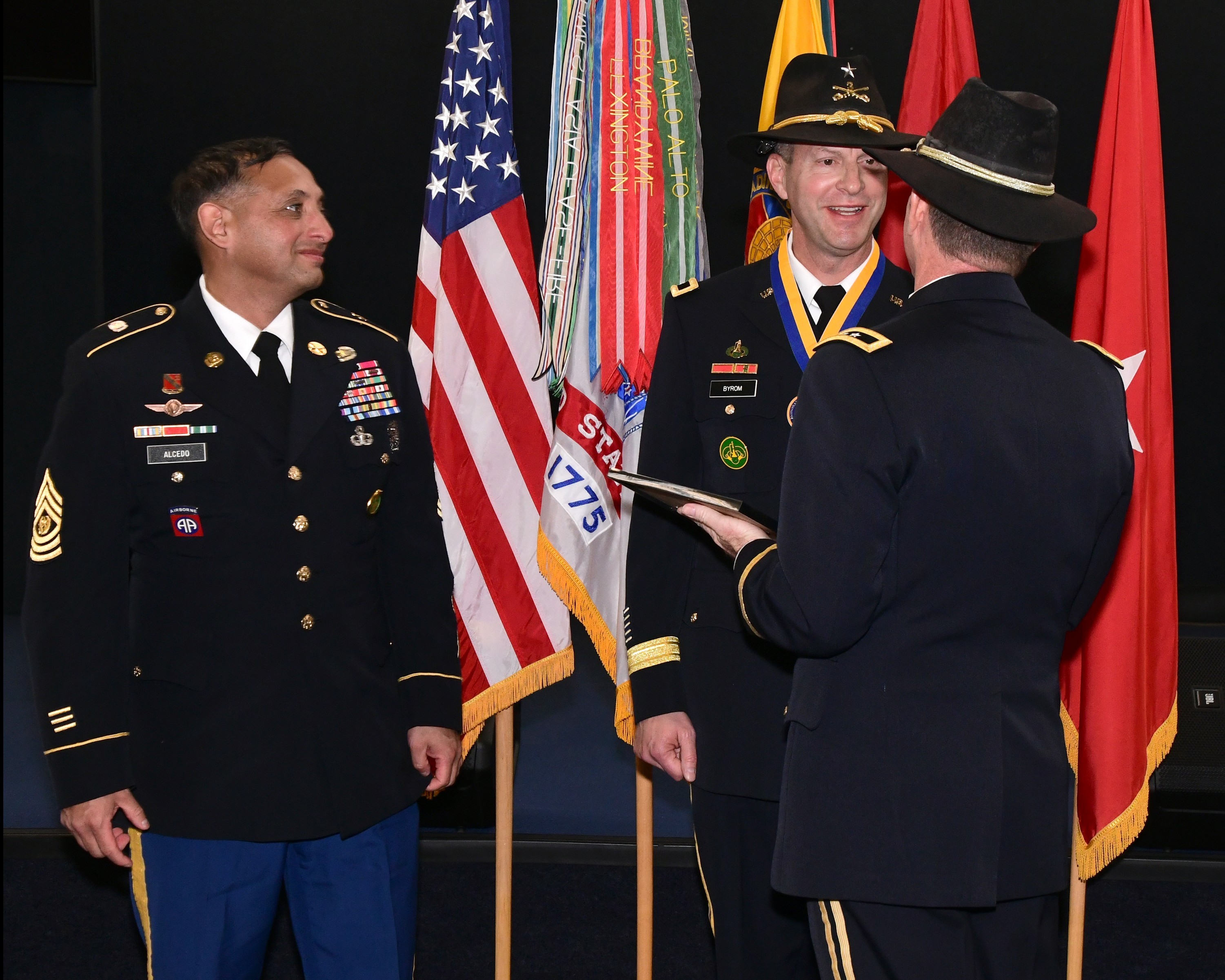
But on Monday, Jan. 12, 2026, at the U.S. Army Aviation Museum, the commanding general of the U.S. Army Combat Readiness Center retired, and the ceremony carried a weight I didn’t expect.
In my five years at the USACRC, I have worked with three commanding generals. Each was a great leader, and their retirement ceremonies full of all necessary pomp and circumstance. But over the past 2 ½ years, I had the pleasure of working closely with Brig. Gen. Jonathan C. Byrom as his writer and editor, shaping his speeches, refining his messages, and helping translate the USACRC mission into words that resonated across the force. Through that work, I saw his leadership up close. He never treated a speech as a requirement or a formality. To him, it was a responsibility — a chance to engage Soldiers, empower leaders, and reinforce the values he expected formations to live by.
That sense of purpose defined his thirty-year career.
Byrom was a cavalry officer through and through. He served in well-known formations like the 3rd Cavalry Regiment and the 11th Armored Cavalry Regiment at the National Training Center — units known for durability, adaptability, and an unyielding focus on readiness. Later, as the Armor Branch chief at Human Resources Command, Byrom shaped the careers of officers across the Army. He went on to serve as the executive officer to the chief of staff of the Army, a role that demands precision, trust, and the ability to operate at the highest levels of the force.
Before taking command of the USACRC, he led the 2nd Multi-Domain Task Force in Wiesbaden, Germany — a formation built for the future fight, integrating intelligence, cyber, space, fires, and maneuver into a single, agile team. It was the kind of assignment that fit him naturally: complex, evolving, and demanding a leader who embraced change rather than resisted it.
That was the core of his legacy; Byrom took risks and built strong, united teams.
He upheld doctrine without being confined by it and he didn’t cling to rigid structures. When the environment shifted, he shifted with it. He empowered his units and subordinate commanders to innovate, to question assumptions, and to think outside the box. He created a climate where even the most junior Soldier or civilian felt like their voice mattered. Byrom’s units and organizations spoke about him with genuine respect. Leaders he mentored carried his philosophy forward, creating Army-wide ripple effects.
What struck me most was the way he acknowledged the invisible labor that keeps the federal workforce moving — the analysts, the administrators, the subject matter experts, the writers, the graphic artists, the quiet professionals who rarely stand in the spotlight. During the change of command ceremony earlier the same day, Byrom spoke about his time at the USACRC and personnel he stated were “some of my favorite people on this planet.” He highlighted individuals — or as he called them, “legends” — that he worked closely with, naming each person in each directorate and acknowledging their impact on him, the USACRC, and the Army. For the first time, I heard someone at that level articulate the value of the work people like me do every day. For the first time in my Army career, I felt truly valued by a leader of his caliber.
When he delivered his farewell remarks — a speech I helped craft but one only he could bring to life — he didn’t talk about himself. He talked about people. He thanked people from each chapter of his life. He thanked his fellow commanders for their support and camaraderie, his leaders for their guidance and mentorship, and his Army civilians for their continuity and expertise. And when he spoke about his family, his voice caught. Not for effect — for sincerity. It was a reminder that behind every great leader is a lifetime of shared sacrifice.
Sitting in that audience, I realized I wasn’t just watching a distinguished career come to a close. I was witnessing the conclusion, the final chapter, of a leadership philosophy that shaped entire formations — and, unexpectedly, me.
I walked into that ceremony thinking retirement events were routine. I walked out understanding that service is built on character, humility, and the ability to build strong teams in the face of constant change. Byrom’s example made me rethink my role in the federal workforce. Even as a young employee, I can contribute to a culture of adaptability. I can help build teams that are resilient, cohesive, and mission focused. I can lead from where I stand, all the way at the bottom.
His retirement didn’t simply mark the end of his time in uniform. It marked the beginning of a new understanding for me: Leadership isn’t defined by rank or position — it’s defined by the legacy you leave in the people you develop.
Social Sharing