Sweeping transformation across the armed forces has been a top priority of 2025, with the U.S. Army Communications-Electronics Command rapidly evolving to become nearly unrecognizable as it adapts at a pace to meet the dynamic needs of our Army. Continuous transformation is characterized by constantly finding new ways to ensure our Soldiers have the most secure, reliable, and lethal equipment possible so they can do what they do best: fight and win our nation’s wars. A Soldier’s right to repair their own equipment wherever they are in the world is imperative to maintaining a ready and lethal force, and CECOM is ensuring Soldiers have what they need to make that possible. Every initiative this year was a deliberate step toward building a more agile, resilient, and dominant force for 2026 and beyond.
Our transformation advanced on three connected fronts. First, we focused on achieving decision dominance, leveraging the power of artificial intelligence and advanced software to give commanders an unparalleled analytical edge. Second, we worked toward ensuring materiel readiness, aggressively modernizing the hardware, logistics, and supply chains that sustain the warfighter. Finally, we focused on building a resilient enterprise, securing our global communications, fortifying our industrial base, and hardening our installations to guarantee our ability to project power against any threat.
Achieving Decision Dominance
Achieving decision dominance begins by empowering the warfighter; and in 2025, CECOM delivered through a focus on “right to repair,” advanced AI integration, and data analytics. The “right to repair” initiative prioritizes the delivery of parts and expertise to maintain systems right where Soldiers are, accelerating response times and bolstering readiness. AI integration is central to this initiative, streamlining processes and giving Soldiers immediate access to pertinent information, while data analytics provides commanders with the clarity required for the best possible data-driven decisions.
CECOM is enhancing mission support within the organization by leveraging all tools and methodologies available including increasing data visibility and adopting data, analytics, and AI within the command. These tools enhance decision making and operational capabilities, further strengthening CECOM’s continuous transformation efforts.
AI Flow
A cornerstone of our AI integration success is AI Flow, a new platform developed in-house that is secure and tailorable to specific functions. CECOM Software Engineering Center data engineers developed an agentic AI platform designed to assist the workforce with their day-to-day work. This platform utilizes a multi-agent system, where specialized AI agents are designed for specific focus areas. In one example, an agent was used to summarize reports from various sources into a daily briefing for senior leaders. The AI Flow agents can provide customized summaries of a user’s documents, and the ability to sync directly with a user’s SharePoint data will be rolled out in phases over the next few months.
AI Flow also provides a collaborative workflow capability that allows multiple AI agents to work together to tackle complex problems. By automating routine cognitive tasks, AI Flow frees our personnel to focus on high-priority, mission-critical functions. This not only boosts efficiency and reduces errors but also fosters a more agile and responsive command, ready to meet the challenges of 2026 and beyond.
Artificial Intelligence Assisted Maintenance
Building directly on AI Flow, one of the most immediate and impactful applications we’ve developed this year has been in the realm of field maintenance. CECOM Integrated Logistics Support Center is collaborating with CECOM SEC to develop Artificial Intelligence Assisted Maintenance by leveraging AI Flow as part of their transformation initiatives. AIAM provides Soldiers with 24/7 access to expert-level troubleshooting, significantly reducing diagnostic time and accelerating the return of equipment to service. AIAM assists Soldiers in resolving routine faults and tasks efficiently and allows CECOM ILSC logistics assistance representatives to concentrate on more complex challenges and specialized support.
AIAM has digitized preventative maintenance checks and services with a built-in workflow, modernizing critical maintenance required to keep our units always ready. Once a Soldier provides the inspection interval they would like to complete, AIAM provides step-by-step instructions and generates a Department of the Army Form 5988 based on user inputs. AIAM then submits the signed copy and conversation history to the supervisor dashboard for review and submission to Global Combat Support Systems-Army. ILSC is providing a way to complete the full process in the system by building direct connections to GCSS-A. Supervisors can also bulk sign and print for convenience while complying with regulation. AIAM is directly contributing to readiness across the force by increasing both efficiency and accuracy.
Army Reprogramming Analysis Team
CECOM SEC’s Army Reprogramming Analysis Team, commonly referred to as ARAT, also developed an AI tool that generates code to alter radio frequency waveforms. The product was a combination of AI Flow and ARAT’s simulation modeling framework tool. The ability to manipulate waveforms on the battlefield significantly enhances our capabilities while keeping our Soldiers safe in contested environments.
Low Code No Code
While our expert engineers at ARAT pushed the boundaries of AI in electronic warfare, we have simultaneously made software innovation more accessible, placing powerful development tools directly into the hands of our Soldiers and support staff. Low Code No Code is another method CECOM SEC is employing to empower users by enabling non-technical personnel to build simplified embedded software functions, rapidly enhancing operational capabilities.
CECOM SEC’s Data Analytics Readiness Team and the CECOM SEC Tech Services Directorate leveraged LCNC technology in collaboration with the Army Audit Agency to develop tools aimed at detecting fraudulent activities involving government-issued credit cards and the Defense Travel System. Out of 17 million Army vouchers, our platform flagged nearly 240,000 for further review in a matter of minutes, helping to deliver new workflows and processes that increase both accuracy and efficiency.
Based around prebuilt components and minimal coding, LCNC accelerates the creation and delivery of software to Soldiers, greatly reducing wait times and boosting efficiency.
Continuous Integration/Continuous Delivery
CECOM SEC is also focused on developing and implementing ways to strengthen software readiness across the force. Continuous Integration/Continuous Delivery helps drive development, security, and operations, known as DevSecOps, for rapid delivery to Soldiers. Instead of software teams using a write, test, deploy method, the Army is relying on automation, cloud functions, and continuous updates to build, secure, and fix applications faster. The cyber domain is constantly changing, and the CI/CD methodology shortens the timeline to provide critical software and updates to tactical network systems. From electronic software and patch delivery to embedded training, CECOM SEC is making sure our Soldiers have what they need to protect their systems regardless of where they are.
Ensuring Materiel Readiness
Small Uncrewed Aircraft Systems
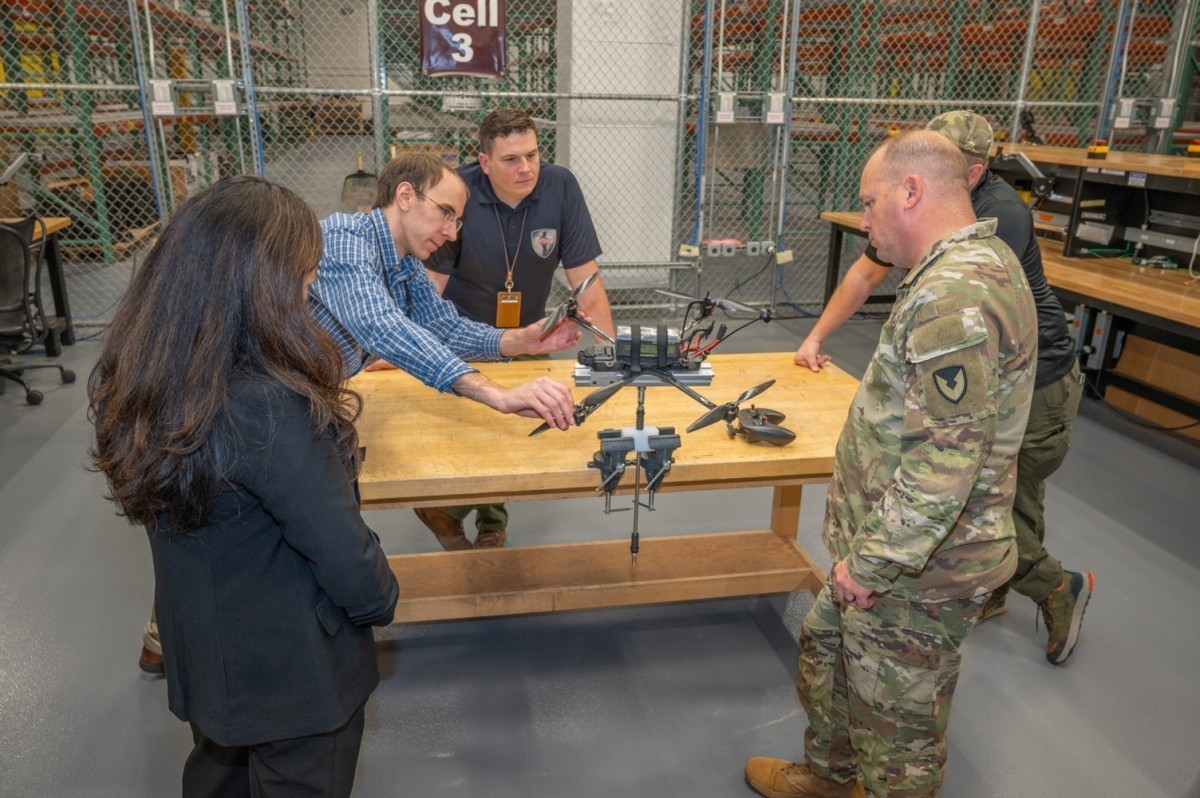
This revolution in software delivery is matched with our aggressive modernization of the hardware in the warfighter's hands. Nowhere is this more evident than with our success in advanced manufacturing and our small uncrewed aircraft system, or sUAS, efforts. sUAS has been at the forefront of the Army’s recent endeavors to facilitate a leaner and more agile force. CECOM Tobyhanna Army Depot is part of a collective effort, led by U.S. Army Materiel Command, that supports delivering the technology to America’s warfighters. Rock Island Arsenal’s Joint Manufacturing and Technology Center provides 3D-printed airframes, while CECOM TYAD provides essential logistics and electronics expertise to complete the integration of first-person view sUAS kits. FPV sUAS are piloted by a Soldier on the ground using a head-mounted screen that relays live video from the drone. In 2025, CECOM TYAD marked a major milestone in the mission to enhance Soldier readiness by completing its first delivery of FPV sUAS. The U.S. Army Signal Corps has a history stretching back almost 70 years in drone technology, and CECOM continues to carry that legacy into the future.
Microelectronics Manufacturing Facility
As we field advanced systems like sUAS, we are also taking decisive action to own the supply chain that builds and sustains them. A critical step in this effort was the official opening of the CECOM TYAD Microelectronics Manufacturing Facility in 2025. It is an exciting expansion of a capability that directly addresses current supply chain challenges. Instead of relying on foreign suppliers to provide microelectronics components, this facility has manufacturing and testing capabilities for circuit cards required by complex military weapons systems ranging from the 1980s through today’s latest developments. Our Soldiers’ ability to repair at the edge is key to American dominance on the battlefield.
Accelerated Accountability and Readiness and Provisioning Modernization
Securing the core components of our technology is one half of the sustainment puzzle; the other is reimagining the process of acquiring and moving all necessary parts to the front lines. Accelerated Accountability and Readiness, or A2R, is the overarching strategy to rapidly sustain new equipment by ensuring it is visible and trackable in the Army's inventory system from day one.
Provisioning is the process of identifying and acquiring repair parts and support equipment to operate and maintain the systems Soldiers rely on. Provisioning modernization is the specific, enabling process that updates cataloging and parts-identification procedures, making it possible for A2R to successfully integrate non-standard and commercial items into the Army supply system to be repaired.
CECOM ILSC has completely overhauled its provisioning process by implementing a modernization plan that addresses limitations and obstacles across their processes in support of the “right to repair” mindset. Their innovative approach addresses provisioning challenges that delay rapid fielding such as version control, high costs, and process rigidity.
For example, as a new mission command capability is fielded to a unit, A2R dictates the equipment must be immediately supportable. The modernized provisioning process includes cataloging the equipment and key components, such as screens and batteries, from the start instead of relying on a lengthy warranty process. Traditional processes and procedures no longer align with the needs of the Army, and CECOM ILSC is ensuring the equipment Soldiers need is rapidly returned to the field.
Medical Logistics in Campaigning
This “right to repair” mindset extends to every facet of Soldier care, including their health. A major 2025 transformation was integrating medical logistics directly into the broader Army sustainment enterprise to ensure medical readiness keeps pace with operational readiness. Medical Logistics in Campaigning, or MiC, is a major transformation initiative led by CECOM Army Medical Logistics Command that seeks to increase medical readiness by closing medical maintenance gaps. CECOM AMLC focused on incorporating MEDLOG operations into the Army’s sustainment system of record, unifying the operational picture for senior leaders. CECOM AMLC tackled support gaps through the new Home-Station Medical Maintenance Support program which provides regional field-level maintenance support to units without authorized biomedical equipment specialists. HMMS increases unit readiness while reducing costs, directly supporting the Army’s top transformation priorities.
CECOM provides support for large-scale exercises around the world. In 2025, CECOM AMLC brought their MiC expertise to major training events across the globe. They provided hands-on training and logistics support to DEFENDER-Europe with 29 allied and partner nations, Operation Orient Shield with Japan Ground Self-Defense Forces, Ulchi Freedom Shield with Republic of Korea forces, and an emergency deployment readiness exercise in Kuwait.
Communications Security Logistics Activity and People Optimization
Ensuring our Soldiers are equipped and healthy is paramount. Securing the information they rely on is just as vital. In 2025, we took major steps to modernize our communications security posture for the challenges of tomorrow. The U.S. Army Information Systems Engineering Command has had a transformative year, marked by significant advancements in communications security and installation resiliency. Communications Security Logistics Activity provides comprehensive logistics and operational support for COMSEC equipment and cryptographic keys and is set to transform its support delivery starting in FY26 to better meet modern challenges. This realignment will see traditional sustainment and logistics functions remain with the CECOM ILSC, while operational missions will shift to CECOM USAISEC. This strategic shift is complemented by a rigorous focus on communications security, with CSLA conducting comprehensive audits and providing global on-the-ground support to protect vital information.
CSLA is only one example of the sweeping transformation and people optimization efforts across CECOM in 2026. After nearly 30 years of interoperability support to Army communication and data processes, CECOM Central Technical Support Facility cased its colors this year, and its mission will now be managed and executed by other organizations. In other people and mission optimization efforts, AMLC ILSC was transferred to CECOM ILSC as the Medical Logistics Directorate. The U.S. Army Medical Materiel Agency was discontinued and integrated into AMLC, and the USAMMA Distribution Operations Center was transferred to the Defense Health Agency. CECOM continues to undergo intense analysis to optimize support to the mission, and the workforce has done an incredible job of not only adapting, but leaning in.
Installation resiliency
While securing our data and cryptographic keys is essential, this digital security must be built upon a physically secure and resilient foundation. Underlying to this entire effort is the concept of installation resiliency, which reimagines Army bases as secure, critical hubs for training, transportation, and sustainment, allowing the force to project power effectively and withstand diverse threats. This transformation involves modernizing installations to meet emerging demands and ensuring they are safe, secure, and resilient against a variety of threats. A key element of this effort is safeguarding reliable energy and water, with USAISEC playing a significant role in providing engineering and cybersecurity support for information technology at installations globally, impacting everything from the Army's metering program to major construction projects.
Industrial Control Network Center of Excellence
A key component of making our installations resilient is modernizing and standardizing the very industrial networks that power our organic industrial base. To spearhead this effort, TYAD was named the Army's Center of Excellence for the industrial control network. The depot will lead the design, implementation, and long-term management of a network that connects industrial production floor machinery across all 23 Army OIB locations. Their work will support data-driven decision making in addition to decreasing downtime by enabling secure, real-time monitoring, and remote access to production equipment. This is a critical part of the Army’s OIB modernization efforts.
Committed to continuously transform
By standardizing our industrial base, securing our installations, and modernizing our software and hardware, we have laid the groundwork for an even more transformative year ahead. Initiatives such as Command and Control Network Optimized for Warfighting are transforming the way the Army does business. C2 NOW provides an integrated information framework that allows commanders to make rapid and data-driven decisions and provides a mobile network for tactical units. Charging forward into 2026, CECOM is ready to provide next-level support to these cutting-edge capabilities. In a rapidly changing technological environment, CECOM focuses on transforming our tools and strengthening our talent while collaborating with the portfolio acquisition executives to anticipate and find solutions for the Army’s evolving needs.
The command’s ability to grow and strengthen relationships in public-private partnerships, or P3s, is also vital to CECOM’s success. Our warfighters deserve our absolute best and CECOM delivers thanks to both internal synergy and powerful external collaboration. CECOM SEC has pursued several P3s to provide technical and engineering support for various military systems, including a $1.2M agreement with ManTech for network modernization and an $801k partnership for the Husky Mounted Detection System. While some partnerships have been successful and others are ongoing, the initiatives showcase a strategic effort to leverage industry expertise.
Our drive comes from our unwavering commitment to our warfighters and our nation. It is our promise to America’s families that we will do everything in our power to keep their loved ones safe by ensuring they have exactly what they need, where and when they need it. Ensuring Soldiers have the right tools wherever they are in the world is critical to our success on the battlefield. Every line of code, every modernized process, and every new piece of hardware is a direct investment in the safety and effectiveness of the American Soldier.
CECOM is embracing transformation and pushing the limits, showing no signs of slowing down in 2026.
Social Sharing