The Perpetual Reset

Download the full article here: No. 26-1082, Optimizing Army Leader Changeover: The Perpetual Reset (Dec 25) [PDF - 2.7 MB]
Executive Summary
Effective Army operations require maintaining operational momentum during leadership transitions. Seamless continuity between outgoing and incoming leaders is critical to achieving this. This article provides insights into mitigating the knowledge gaps that arise during rapid leadership transitions, supporting leaders at all levels with a specific emphasis on battalion staff and company commanders. This article proposes the best practice of implementing a concise one-page continuity brief and a centrally managed digital repository to improve knowledge transfer and ensure continued mission success.
The Perpetual Reset
Leader turnover is inherent to Army operations; personnel rotate to help create effective leaders as missions evolve and operational demands shift. Leadership transitions can introduce friction, potentially impacting unit momentum and effectiveness. While the Army established a formalized transition process, informal processes are frequently utilized in lieu of formal guidance.
Leader Transition Challenges
Leader transitions present challenges like a relay race: each leader must quickly receive the baton while navigating obstacles and preparing for their role. This parallels the challenges of Army leader handovers, where smooth handoffs are critical, yet often result in a stumble, requiring valuable time and energy to regain lost ground.
Effective leader transitions are critical for maintaining operational tempo, yet current Army practices often fall short due to real-world constraints. While doctrinal resources such as the Army Handbook for Leadership Transitions and Army Task Number 158-LDR-8000 exist, a significant gap remains between guidance and operational realities.
Army Regulations outline standard tour lengths. However, the Army’s replacement system is not always synchronized, allowing for the overlap time of a thorough handover between the incoming and outgoing leaders. This leaves leader handovers being limited to days, hours, or eliminating them entirely. The conflict between established practices and operational realities hinders effective knowledge transfer.
Key Issues:
- Competing Priorities and Constrained Timelines: Permanent change of station (PCS) appointments, personal events, continuous operations, and demanding schedules disrupt structured handovers and impede comprehensive two-way knowledge transfer between outgoing and incoming leaders.
- Compressed Transition Periods: The standard left seat, right seat period is generally viewed as two weeks for most positions, extending to 30 days for those assuming command; a distinction largely driven by property accountability requirements. However, these timelines are often unattainable, leading to accelerated knowledge handover and reliance on inadequate continuity resources. Leadership gaps can also occur when incoming leaders arrive after outgoing leaders have left.
- Impact on Readiness: Incoming leaders face pressure to quickly assume responsibilities with incomplete information. Disrupted transitions can hinder immediate operational effectiveness and impact unit readiness.
Analyzing Current Practices
Interviews with Army leaders ranging from Sergeant First Class to Colonel, incorporating feedback from 21 Soldiers, reveal a critical deficiency in standardized knowledge transfer during leadership transitions. While comprehensive handovers are ideal, operational pressures often necessitate flexibility, exposing a gap in minimum standards for information transfer. This inconsistency directly impacts unit readiness and operational effectiveness, highlighting the need for a standardized process that can be effectively implemented despite limited time and competing priorities.
Based on interviews, research, and analysis, incoming leaders require immediate focus on four core priorities to quickly assume their duties:
- understanding personnel
- securing systems access
- grasping the unit’s operational rhythm
- understanding ongoing initiatives
These priorities highlight that a successful handover is not merely about task handover but about transferring understanding.
While effective leadership transitions require attention to these four core priorities, there is a gap in current practices. Understanding personnel, securing systems access, and learning the unit’s operational rhythm happen naturally over time, even independent of a leadership transition.
Personnel assessments happen continuously, systems access is typically granted during standard in-processing procedures, and a new leader’s initial counseling with their supervisor naturally facilitates understanding the unit’s day-to-day operations. However, there is a deficiency in the transfer of knowledge regarding ongoing initiatives. Incoming leaders must independently seek understanding of the status, challenges, and future direction of existing projects when there is no standardized handover process, this can lead to delays and inefficiencies.
Interviewees consistently described fragmented and rushed handovers, relying on informal knowledge sharing and treating their assigned Soldiers as continuity books due to shortcomings in formal processes. While the knowledge of these team members is valuable, incoming leaders require baseline understanding before relying solely on their team’s expertise.
The interviews revealed a critical tension between Army mission requirements, PCS rotations, and the transition process. Although each of these systems functions effectively on its own, combining them can create a complexity that can be difficult to navigate. This necessitates a simplified approach to provide clear and concise information to incoming leaders.
Specifically, interviewees expressed frustration with a lack of insight into ongoing initiatives, leading to duplicated effort and potential mission impacts. This gap in understanding highlighted the need for a concise overview of current projects, their status, and potential challenges. There was a clear search to answer the question, “What am I inheriting?”
Recommendation
The author recommends a revision to the current Army leadership transition handbook by adding a two-pronged solution to address issues identified in the leadership transition process:
- Implement a concise one-page continuity brief
- Develop a readily accessible centrally managed digital repository
One-Page Continuity Brief
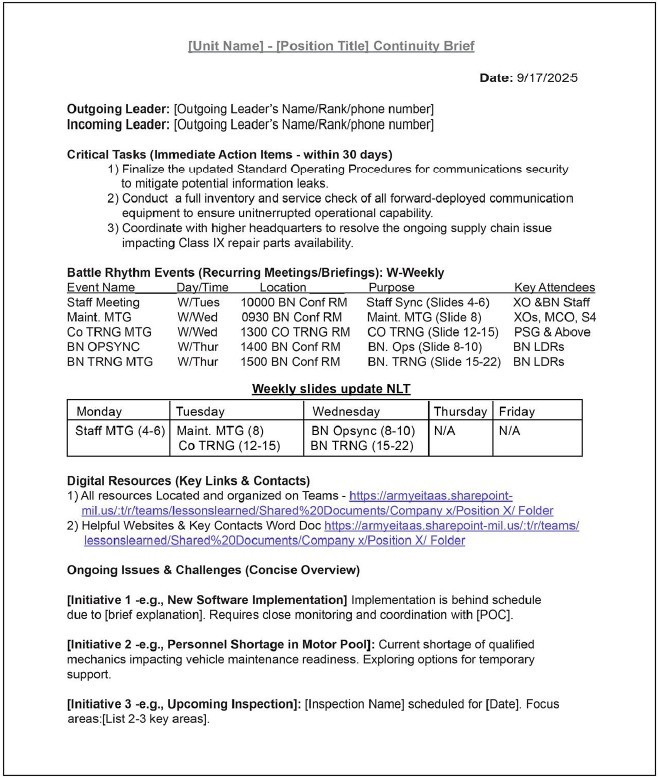
This continuity brief quickly orients incoming leaders, serving as a starting point for their initial actions. Interviewees consistently highlighted the need for a concise overview of the position, essentially a table of contents that prioritizes immediate needs and guides leaders to key information and essential resources. Designed to be understood without additional explanation and limited to one page with bullet points.
The one-page continuity brief may include:
- Critical Tasks: Tasks requiring immediate completion, including deadlines.
- Battle Rhythm Events: A schedule of recurring meetings and briefings.
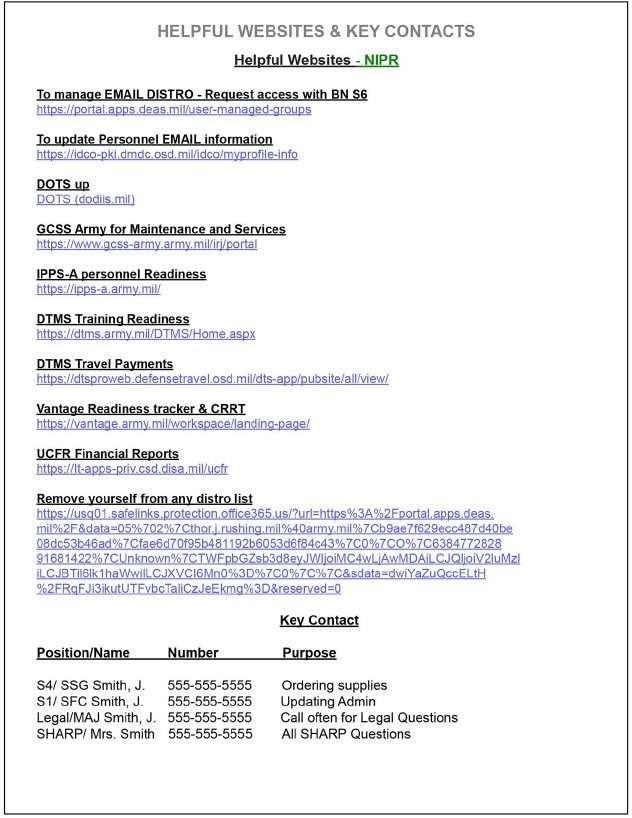
- Digital Resources: Frequently used web addresses, location of the digital repository, and important contacts with brief descriptions.
- Ongoing Initiatives, Issues, and Challenges: A concise overview of the current situation.
Centralized Digital Repository
A digital repository complements the one-page continuity brief, providing more in-depth information. Army units should nest their digital repositories with higher headquarters by using the same media platform, typically shared drives or MS Teams pages. These repositories should have a dedicated space for each position. Leaders handle organizing this space with a consistent and intuitive folder structure, ensuring it is understandable without direct explanation. This hub should hold SOPs, policies, training schedules, reports, AARs, contact lists, and historical data, all clearly dated and labeled as working drafts or completed products. The one-page brief serves as a starting point, directing users to this more detailed information.
This should not create additional work but maximize and organize the value of existing products generated for daily operations, meetings, and training. This transforms routine work into a lasting asset, supporting continuity and providing a critical safety net for disrupted transitions, while still complementing a thorough handover.
Implementation & Sustainment
Successful implementation requires commitment from all levels of leadership. Key steps include:
- Standardization: Establish a standardized template for the one-page brief and folder structure for the repository.
- Education: Train leaders on creating continuity brief and organizing the repository.
- Accountability & Leadership Modeling: Leaders at all levels should use and share these tools, ensuring completion.
This is a continuous process, a perpetual reset requiring attention during every leader transition.
Doctrinal Integration
Implementing this approach within existing Army doctrine is a valuable step towards sustaining effective units, especially during rapid handovers. Current doctrine often assumes optimal transition conditions. However, including a standardized one-page continuity brief template in the Army Leadership Handbook would significantly improve leader transitions, especially during constrained timelines.
Specifically, incorporating guidance for a standardized, one-page continuity brief, that emphasizes a keep it simple approach, into the Army Leadership Handbook would be a beneficial change. Unit SOPs should then adopt a template for this brief, ensuring consistent application leaders can review. A centralized digital repository serves as the digitized equivalent of a traditional continuity book. To ensure a smooth succession, leaders should receive essential information via a concise brief supplemented by an organized digital repository.
These adjustments are not transition overhauls, but rather a refinement of existing processes. This recommended solution equips incoming leaders with essential information for effective leadership handovers.
Conclusion
Effective leader transitions are strategic imperatives that directly affect mission readiness and success. Implementing a turnover process that encompasses a one-page brief, and an organized digital repository helps mitigate risks, preserve knowledge, and improve unit efficiency. Even if you have the time for a thorough transition, a one-page continuity brief still gives the new leader an edge with reflection time. This solution helps ensure incoming leaders are prepared and maintain operational progress. This maximizes the return on investment in leadership and ensures sustained unit effectiveness.
Social Sharing