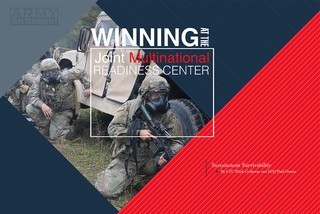
Rotational training units at the Joint Multinational Readiness Center (JMRC) often struggle to counter enemy threats in the rear area, particularly in the brigade support area (BSA). The deactivation of brigade engineer battalions (BEBs) has significantly shifted the responsibility for rear area security to brigade support battalions (BSBs), which must maintain overall mission command of brigade (BDE) sustainment operations. Even before the removal of BEBs from BDE task organizations, BSBs have consistently struggled to remain undetected from enemy forces, establish a cohesive and congruent defensive plan, and manage BDE sustainment operations in a survivable mission command construct. This article highlights the challenges observed in U.S. BDE rotations hosted by the JMRC from 2023 to 2025.
A common challenge for BSBs operating in rotations at the JMRC is remaining undetected from enemy forces in the air, on the ground, and in the electromagnetic spectrum. To reduce the physical signature of BSAs, BSBs often occupy terrain using the cluster method rather than contiguously, with each cluster comprised of two to three bases each typically company organic. However, even in a dispersed configuration across multiple locations in the BDE rear area, company leaders struggle to reduce their formations’ physical signatures. This can be attributed to a lack of driving proficiency, inadequate use of fielded camouflage systems, and limitations in the Integrated Tactical Network (ITN) fielding, restricting BSBs’ ability to use the Tactical Scalable Mobile (TSM) ad hoc network waveform. Company-level bases, even in light support battalions, may have up to 50 pieces of rolling stock that require concealment from enemy ground and air detection. Nevertheless, heavy vehicle operators often lack the necessary proficiency to move their equipment off main and alternate supply routes and into vegetation where they can maximize natural cover and concealment. When natural cover and concealment is limited, doctrine dictates that units use fielded camouflage systems to obscure visual signatures horizontally and vertically. Although BSBs typically have sufficiently fielded camouflage systems, they often underuse them due to difficulties in employment and the need to preserve crew capabilities for rapid displacement. In recent rotations at the JMRC, BSBs fielded with ITN have often lacked sufficient TSM-capable radios to equip every vehicle or command and control (C2) node. As a result, BSBs rely on legacy radio systems that use frequency modulation, making them more susceptible to direction finding by enemy electronic warfare systems.
To address this challenge, BSBs must implement the following courses of action into unit training plans and during combat training center (CTC) rotations:
- Incorporate drivers training in restricted terrain into unit training plans to improve crew proficiency in concealing large vehicles.
- Conduct camouflage net training during support operations (SPO) at home station, focusing on rapid employment and storage at the crew level, and capture validated tactics, techniques, and procedures (TTP) in unit standard operating procedures (SOPs).
- If faced with ITN fielding shortfalls, deliberately choose which vehicles are equipped with ITN-capable mounts to maximize the use of the TSM waveform for communication between company and battalion headquarters elements. Validate capabilities and limitations of chosen ITN-capable vehicles during home station training and refine SOPs to define how far the BSB can stretch across the battlespace.
BSBs routinely use the BSA cluster method to increase sustainment survivability, but this approach further challenges the security of the BSA. The absence of a cohesive and congruent defensive plan in the BSA that complements the BDE’s rear area security plan poses increased risks to forces during large-scale combat operations. The BSA often struggles to secure itself organically, as most BDEs do not allocate additional combat power or capability to the BSB. Consequently, security efforts must come from within the sustainment formation, forcing senior commanders to trade logisticians conducting sustainment functions for security efforts. Each node within the BSA often lacks situational awareness of friendly forces in any direction, and communication with tenants within each base is also problematic. For instance, the BSB base company may not be directly tied in with the field trains command post (FTCP) at the same location. This has led to fratricide from one static security position to another or from static positions on friendly units approaching the BSA perimeter. BSBs struggle to establish a coherent defensive plan, which often lacks essential elements of defense, as outlined in Army Techniques Publication (ATP) 3-21.10, Infantry Rifle Company, and ATP 3-21.20, Infantry Battalion. The lack of orientation of heavy weapons in fighting positions, the increasing trend of not establishing deliberate entry control points, and the disconnected C2 architecture within the BSA have led to routine fratricide events. BSBs often fail to conduct defense rehearsals, preventing their leadership from identifying weaknesses in the overall BSA defensive plan. The opposing force can exploit these weaknesses, allowing them to walk or drive into a BSA unopposed.
To address this challenge, BSBs must implement the following courses of action into unit training plans and during CTC rotations:
- Incorporate engagement area (EA) development into BSA defense plans per ATP 3-90.1, Armor and Mechanized Infantry Company Team, ensuring that EA development is taught and well understood at the platoon leadership level and above prior to entering a CTC rotation.
- Familiarize platoon-level leaders with company-level perimeter defense, as outlined in ATP 3-21.10, and incorporate this into unit training plans.
- Prioritize heavy weapons training at the section level and below to maximize collective proficiency.
- During rotation, ensure that FTCPs are incorporated into the base defense plan and have a clear understanding of security expectations while occupying space within the BSA. This integration must be captured in SOPs and rehearsed during home station training prior to arriving at JMRC.
- Continue to increase pace/frequency of survivability displacement operations with continued appreciation of these outlined considerations.
BSBs often compromise their ability to C2 BDE sustainment operations by dispersing C2 elements to promote survivability in the rear area. A common TTP observed at the JMRC is the deliberate geographical dislocation of the BSB staff (executive officer, S Shops) and the BSB SPO cell, with separation varying from 500 meters to multiple kilometers. Although this dislocation promotes the survivability of the BSB’s mission command, it often compromises synchronization and shared understanding between the BSB staff and SPO. Common operational picture (COP) management between geographically separate mission command nodes proves extremely difficult even for units outfitted with the Army’s newest COP management software and equipment. The lack of synchronization and shared understanding between these entities results in the BSB commander being unable to make informed decisions related to sustainment on behalf of the BDE. Roles and responsibilities are often unclear and not understood between these BSA nodes, particularly in the event one of the nodes is compromised.
To address this challenge, BSBs must implement the following courses of action into unit training plans and during CTC rotations:
- If deliberately dislocating SPO from the BSB staff, ensure each section understands the changes to their roles and responsibilities if the other is compromised.
- Employment of liaison officers from SPO to BSB staff and vice versa serve as an effective way to close the information gap between each element.
- Conduct battalion-level command post exercises, ensuring a split mission command construct between SPO and staff is rehearsed leading up to the CTC.
In conclusion, the challenges faced by BSBs in remaining undetected, establishing a coherent defensive plan, and managing BDE sustainment operations in a dispersed construct are significant and routinely observed at the JMRC. BSBs can address these challenges by integrating austere drivers training to increase equipment survivability, exercising the staff/SPO in a geographically dispersed environment with degraded communication, and emphasizing unit defense tactics at the company level and below. Incorporating these objectives into unit training plans will increase the survivability of sustainment personnel and equipment within BDEs, ultimately contributing to the prolonged endurance of warfighting formations at echelon.
--------------------
LTC Daniel “Mark” Galloway is the senior sustainment observer/coach/trainer at Joint Multinational Readiness Center. He enlisted in the Army as a military policeman in 1991. After four years he joined the U.S. Army Reserve and served Hampton, Virginia, as a police officer. He is a Distinguished Military Graduate from Austin Peay State University and was commissioned a second lieutenant in the Infantry in 2001. He holds a master’s degree from Central Michigan University in Public Administration. His military education includes the U.S. Army Drill Sergeant School, Infantry Officer Basic, Air Assault School, Airborne School, Jumpmaster School, Aerial Delivery Management Officer’s Course, Logistics Captains Career Course, Joint Planners Course, and NATO Planners Course.
MAJ Paul Owens serves as the support battalion S-3 observer/coach/trainer at the Joint Multinational Readiness Center. He is a Distinguished Military Graduate from Texas A&M University where he earned a Bachelor of Business Administration and was commissioned as a second lieutenant in the Transportation Corps in 2015. His notable military education includes the U.S. Army Ranger School, Jumpmaster School, Pathfinder School, Basic Airborne Course, Air Assault School, and Logistics Captains Career Course.
--------------------
This article was published in the fall 2025 issue of Army Sustainment.
RELATED LINKS
The Current issue of Army Sustainment in pdf format
Current Army Sustainment Online Articles
Connect with Army Sustainment on LinkedIn
Connect with Army Sustainment on Facebook
---------------------------------------------------------------------------------------------------------------
Social Sharing