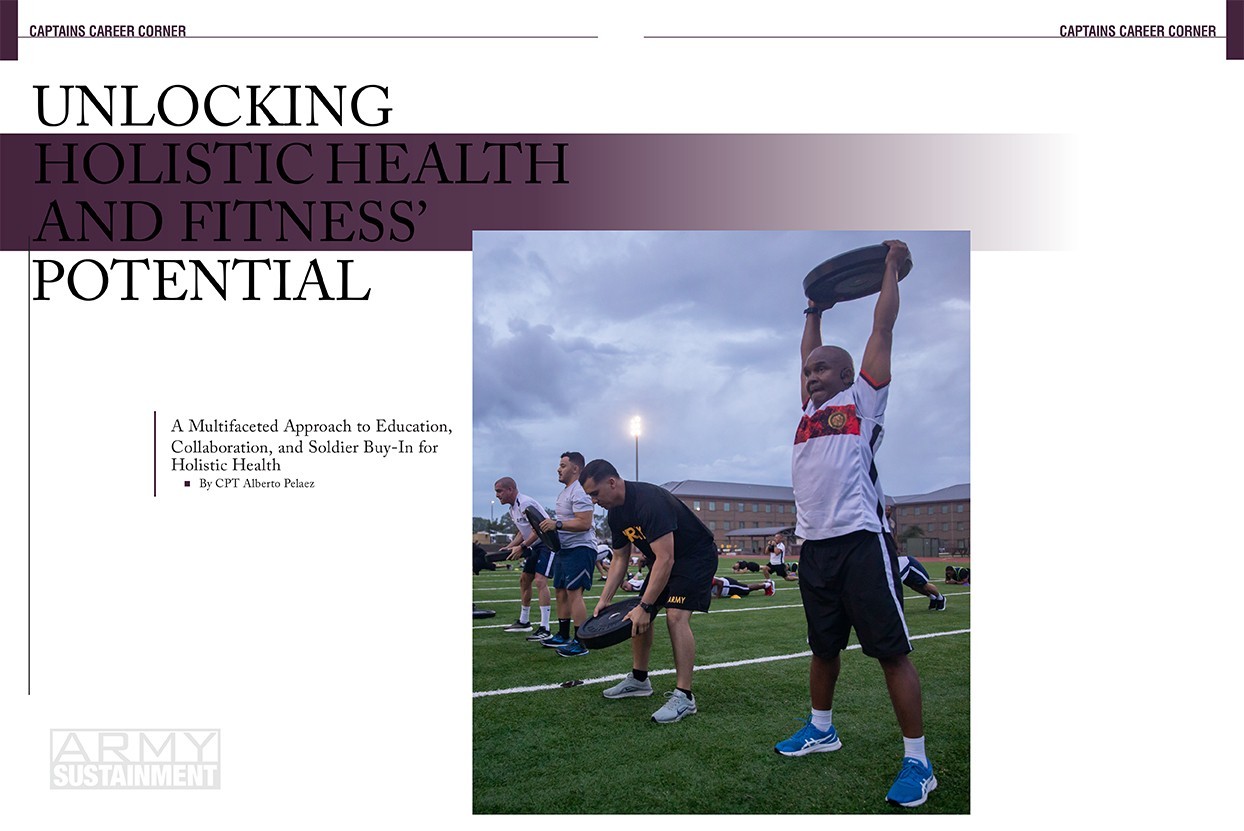
The Holistic Health and Fitness (H2F) program was introduced in 2020 to combat a plethora of health conditions that plague the Army. The H2F program has not been fully implemented but aims to be available across the entire Army by 2030. The program aims to improve physical readiness, nutritional readiness, mental readiness, spiritual readiness, and sleep readiness. However, H2F is presently showing signs of challenges on its journey to becoming the standard Army-wide holistic health program because of a lack of understanding about the program. To overcome widespread misunderstanding of the H2F program, the Army must educate Soldiers, ensure Soldiers collaborate with the H2F personnel, and inspire motivation to embrace the program’s health benefits.
Educating Soldiers on the Fundamentals of H2F
Educating Soldiers on H2F is necessary to help the program succeed across the Army. A study conducted on soldiers attending Israeli Army basic training demonstrated that implementing a nutritional education program in two months of training showed an increase in nutritional knowledge and an alteration in eating habits. Early education helps Soldiers not to feel overwhelmed by the subject matter and more likely to engage with a program’s components. Early education of Soldiers at basic training will help Soldiers understand the H2F program because it will give Soldiers the time to absorb the complexities of the program within their training environment.
Educating Soldiers on the health benefits of the H2F program will financially benefit the Army. In 2023, the War Department spent $1.25 billion on health care. By understanding the health benefits of the H2F program, Soldiers will improve their knowledge of health and apply those learned habits. However, educating Soldiers on the H2F program will require about an hour per day of instruction.
Collaborate with H2F Personnel
Collaborating with H2F personnel is essential in helping Soldiers understand the H2F program. In his army.mil article “Optimizing Performance and Reducing Injury in Infantry OSUT,” LTC Michael B. Moore observes that when Soldiers collaborate with H2F personnel by learning and implementing programs for their units, they acquire “knowledge and habits to maintain their physical readiness, contributing to longer, healthier careers.” Trained H2F personnel serve as guides and coaches for Soldiers and ensure the H2F program is properly understood. In Moore’s article, Infantry Soldiers successfully created workout plans for their units alongside H2F personnel. In addition, H2F personnel are trained experts in their fields and can simplify difficult health concepts for Soldiers. When Soldiers are guided on tasks, they learn from mistakes, implement corrections, and learn even the hardest tasks.
Injuries cost the Army $970 million to $1.8 billion per year. Understanding how to properly exercise through the H2F program leads to fewer injuries. The Army will have to allocate at least one H2F representative per battalion to collaborate with Soldiers.
Inspiring Motivation to Embrace the H2F Program
The use of competition is necessary to motivate Soldiers to engage with the H2F program and understand its benefits for health and readiness. In a study discussed by C.M. Frederick-Recascino and H. Schuster-Smith in their article “Competition and Intrinsic Motivation in Physical Activity: A Comparison of Two Groups,” published in the Journal of Sport Behavior, participants were placed into a competitive sports group and a non-competitive sports group. Those in the competitive sports group were “positively related to higher levels of intrinsic motivation.” Competitive environments create a reason for Soldiers to better themselves; they also motivate Soldiers to understand the rules of the games they play so they can ultimately beat their competition. Posting H2F workout times and scores on a unified app or platform helps units compete with one another and outperform one another. Soldiers can use the H2F app to post their scores to compete with one another. This brings recognition to the Soldier and the unit.
Increasing motivation through H2F will help the Army improve motivation levels and possibly retention rates. Increasing motivation will cost the Army an extra 30 minutes per day for Soldiers to complete the competitive workout within their scheduled morning physical activity routine.
Conclusion
The Army can reduce widespread misunderstanding of the H2F program by educating Soldiers, collaborating with H2F personnel, and motivating units to explore its health benefits. Soldiers must be educated as early and frequently as possible on the H2F program so they are more likely to engage in it. In addition, Soldiers must collaborate with H2F personnel to ensure there is a proper understanding of the program. Lastly, leadership must focus on having Soldiers compete for the best H2F workout results. This, in turn, could increase Soldiers’ desire to understand the program. Overall, the H2F program must be understood by Soldiers to achieve its desired results and to be properly implemented in the Army by 2030.
--------------------
CPT Alberto Pelaez is currently a student in the Captains Career Course at Fort Lee, Virginia. He previously served as a platoon leader at Camp Casey and executive officer at Fort Stewart, Georgia. He was commissioned as an Ordnance lieutenant at Officer Candidate School. He has a Master of Science degree in sports and fitness and is a Doctor of Education. He is currently working on a Master of Divinity degree.
--------------------
This article was published in the fall 2025 issue of Army Sustainment.
RELATED LINKS
The Current issue of Army Sustainment in pdf format
Current Army Sustainment Online Articles
Connect with Army Sustainment on LinkedIn
Connect with Army Sustainment on Facebook
---------------------------------------------------------------------------------------------------------------
Social Sharing