
The Training Management Directorate (TMD) published the fourth in a series of Training Circulars (TCs) to further amplify subjects introduced and discussed in training doctrine publications ADP 7-0 and FM 7-0, Training. Training Circular (TC) 7-0.4, Training and Evaluation Outlines, provides detailed descriptions of training and evaluation outline (T&EO) components and their use. T&EOs are summary documents that outline performance and proficiency standards for individual and collective tasks. They are essential training tools that support successful task execution, and include information on training performance steps, resource requirements, doctrine references, related tasks, and evaluation measures.
TC 7-0.4 contains two chapters:
Chapter One provides a general overview and definition of T&EOs. Developed, approved, and published by responsible proponents and based on Army doctrine, T&EOs provide essential information for training and evaluating task proficiency. T&EOs focus on three key elements: task (the specific action to be performed), conditions (the circumstances under which the task is executed), and standards (the benchmarks for successful task completion). By focusing on these elements, T&EOs ensure that Army training is both goal-oriented and standardized, and by systematically breaking down tasks, T&EOs empower leaders and trainers to effectively plan, design, execute, and evaluate training sessions.
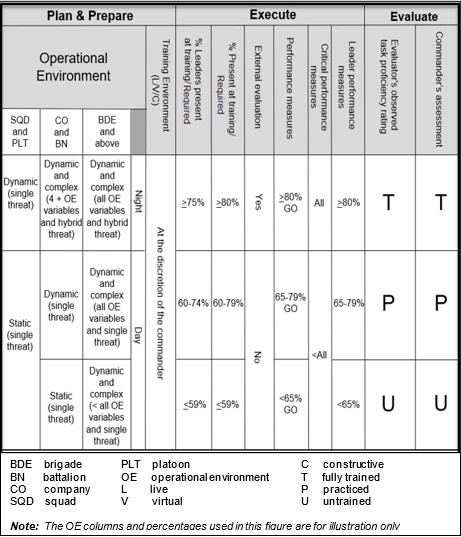
T&EOs serve three primary purposes: standardization of training, evaluating training, and assessing training. Trainers use them to prepare for and practice task execution, helping to educate and familiarize Soldiers with the task's requirements and standards. As Soldiers practice, task standards form the foundation for developing unit-specific tactics and techniques to execute the task effectively during operations.
As tasks are performed during training events, trainers and evaluators use T&EOs to observe and evaluate task proficiency. The T&EO provides the evaluators with the opportunity to identify where, by step or sub step, a unit needs to focus further training. Completed T&EOs provide an important part of feedback to unit commanders.
Finally, commanders integrate T&EO evaluations into their comprehensive assessment of task performance. These evaluations contribute specifically to Mission Essential Task List assessments.
Chapter Two breaks down the components of T&EOs, emphasizing essential elements for trainers, evaluators, and commanders in effectively utilizing T&EOs. This chapter outlines tasks and identifies performance measures, critical performance measures, leader measures, and criteria for evaluation. Since the basic concept of Army T&EOs revolves around providing a structured framework for training and evaluating tasks, T&EOs are designed to ensure standardized training by defining consistent conditions, standards, and performance steps for all tasks. T&EOs guide evaluators through clear criteria for evaluating task proficiency and support resource planning by recommending resources, such as equipment, needed for task execution. T&EOs also facilitate feedback by providing a basis for commanders to assess task proficiency and deliver constructive insights.
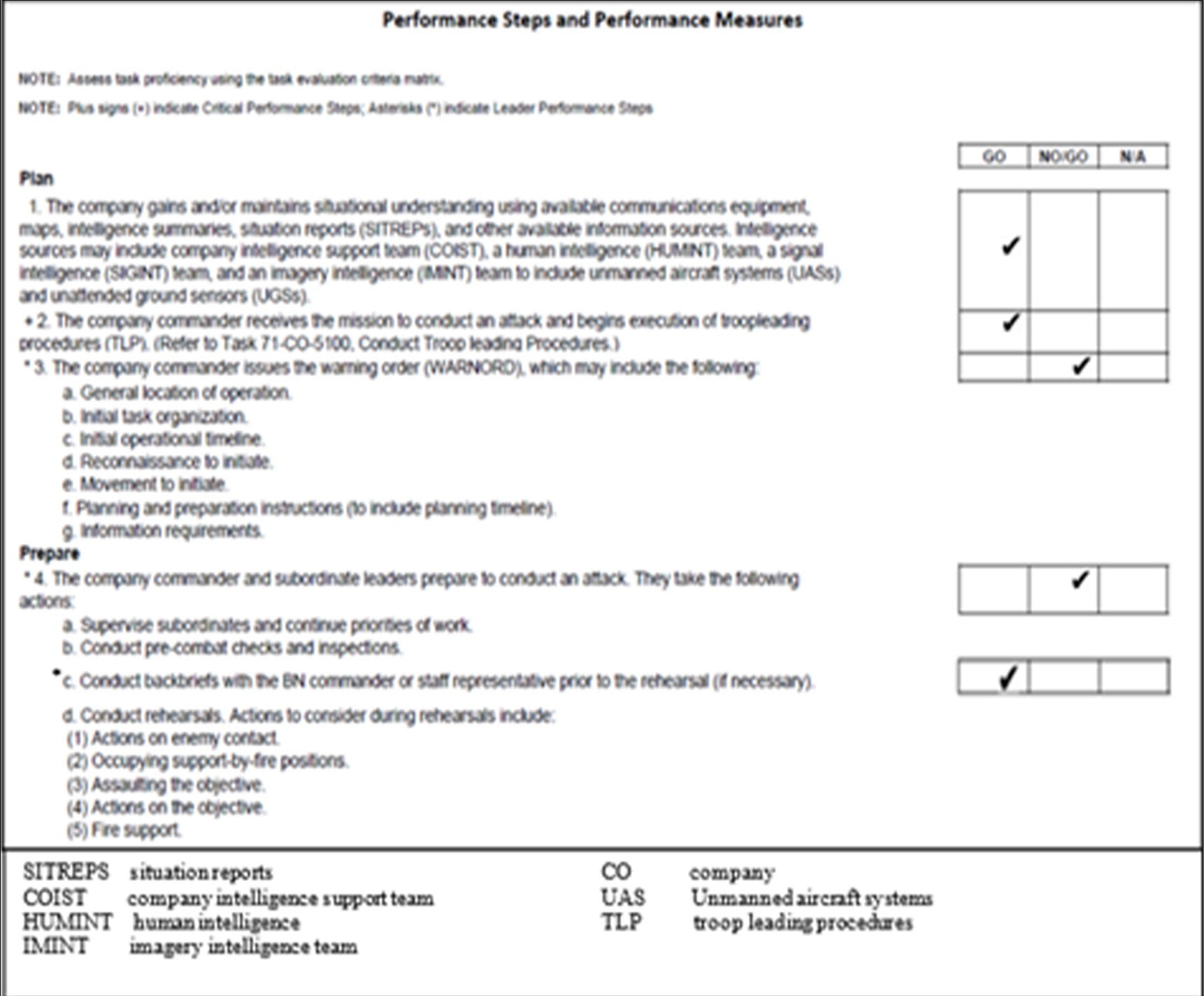
TC 7-0.4 contains one appendix:
Appendix A covers individual tasks, which are slightly different from collective tasks but follow the same structure by emphasizing tasks, conditions, and standards necessary for successful execution. Non-Commissioned Officers play a central role in selecting, sequencing, and planning individual tasks and drills to ensure Soldiers are trained on essential unit-critical tasks that contribute to mission success. This ensures the organization trains on its most important tasks down to the individual Soldier.
TC 7-0.4, Training and Evaluation Outlines, is the fourth in a series of Training Circulars that further expand the discussion of selected topics and provide leaders with detailed information on performing critical leader tasks in the training management process. These TCs include:
TC 7-0.1: After Action Reviews
TC 7-0.2: Training Meetings
TC 7-0.3: Plan an Event
TC 7-0.4: Training and Evaluation Outlines
Interested parties can find a list of Army Training Circular publications at Army Publishing Directorate – Training Circulars. Readers can find all published TCs at the link above or on the Army Training Network (ATN) at https://atn.army.mil.
TMD, part of the Combined Arms Command-Training at Fort Leavenworth, is the Army’s training management proponent. As such, TMD develops Army training doctrine for publication, administers the Army Training Network (ATN), and maintains the Army Training Management System (ATMS). ADP 7-0, FM 7-0, the Platoon Leader's Guide to Training Management, and much more can be found on the ATN Webpage at https://atn.army.mil
Social Sharing