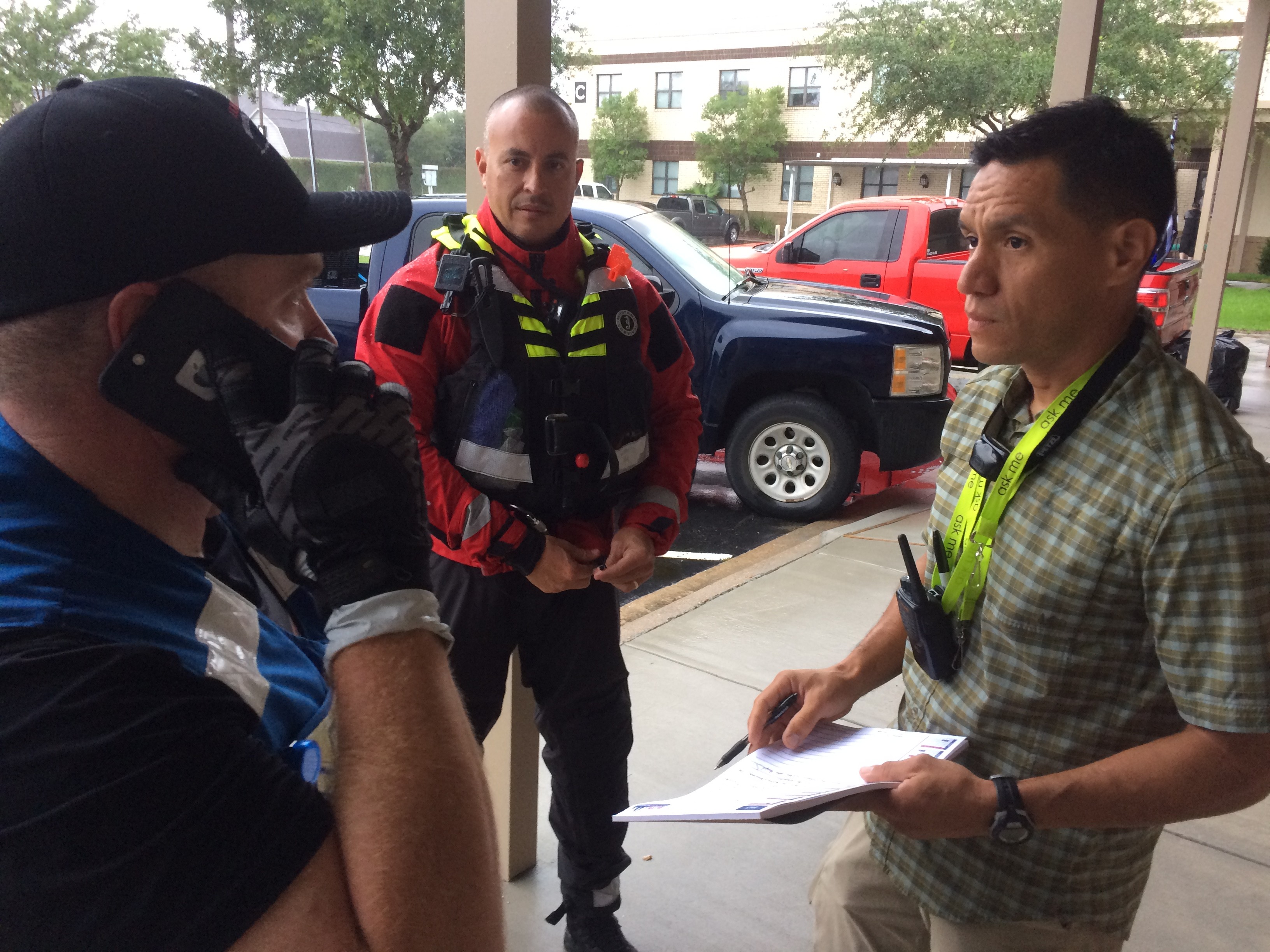
HOUSTON -- Army astronauts are known as heroes for their missions among the stars, but their true bravery shines just as brightly in the face of disaster here on Earth.
In the face of Hurricane Harvey's recent destruction, astronauts and detailed officers of the U.S. Army Space and Missile Defense Command/Army Forces Strategic Command NASA Detachment showed key Army values in action: personal courage and selfless service, as they supported fellow employees of the Lyndon B. Johnson Space Center during rescue and recovery efforts after the hurricane struck the Houston area on Aug 26.
"I am extremely proud of the way that our detachment went to work immediately," said Army Astronaut Lt. Col. Andrew R. Morgan, USASMDC/ARSTRAT NASA Detachment commander. "As you would expect of any Soldier, our detachment has people who 'run to the sound of gunfire' during the crisis phase of a disaster. They stepped forward to assist in sheltering the displaced and jumped immediately into the recovery efforts afterwards."
Morgan, along with Army Astronaut Maj. Anne McClain, detachment executive officer; Army Astronaut Candidate Maj. Frank Rubio; Maj. Will Koch, a Functional Area 40 officer attached to the detachment; and Lou Moss, detachment administrative officer; make up SMDC's NASA Detachment and participated in the recovery efforts.
"We had 'all hands on deck' during the past week and a half trying to help everybody in the NASA family we could; we all know multiple people who had homes that were flooded," he added. "During the storm itself, though flood waters often isolated our homes from one another, we were in regular contact with each other and checked on each other's safety to make sure that no one had a flooded home. Once the storm ended, we went right to work to lend a hand to our friends and colleagues."
Hurricane Harvey reached tropical storm status Aug. 17 and began to rapidly intensify Aug. 24, becoming a hurricane later that day. Harvey resumed strengthening and quickly became a major hurricane, attaining Category 4 intensity before making landfall near Rockport, Texas. In a four-day period, parts of the Houston metropolitan area received more than 50 inches of rain and caused historic flooding. As of Sept. 7, 70 fatalities have been confirmed in Texas due to Harvey.
"On the first day of flooding, Maj. Frank Rubio, our newest astronaut, and I supported an emergency shelter, helping people displaced from their homes, often rescued by boat," Morgan said. "With flooding cutting off most major roads, they had nowhere to go. We helped set up a shelter in a local church close to where Maj. Rubio and I live and we took shifts along with two other astronauts to keep around-the-clock watch for the better part of four days while the storm was still ongoing.
"We had nearly 250 people pass through our shelter before we helped place them in more permanent locations," he added.
Morgan and Rubio are both physicians by training. While Morgan acknowledges that his medical background and experience in humanitarian situations overseas were helpful in recent events, he credits leadership skills ingrained in all Army officers as his biggest asset in this disaster.
"I'm an Army officer first," Morgan said. "In these recent days we relied on our ability to rise to the occasion and provide leadership in crisis while extending a helping hand where one was required. That doesn't require a medical degree, it requires the skills that Army officers bring."
When the rain stopped, Morgan, Rubio, McClain and Koch started the colossal task of helping people recover their homes and belongings.
"We were in homes that flooded with as little as 18 inches and those with as much as four feet of water, but in every case it was devastating to the families that lived there," Morgan said. "We were 'all in' to help our NASA family in their time of need, including several of our astronaut colleagues."
The Johnson Space Center, or JSC, is the National Aeronautics and Space Administration's center focused on human space exploration, where human spaceflight training, research and flight control is conducted. Approximately 12,000 civil servants and contractors, 56 American astronauts, and at least a half dozen astronauts from several partner nations work at JSC.
JSC is home to Christopher C. Kraft Jr. Mission Control Center, the NASA control center that coordinates and monitors all human spaceflight for the United States and currently directs American activities aboard the International Space Station, or ISS.
"Supporting the ISS is a complex and continuous operation," Morgan remarked.
The mission control center is staffed around the clock, usually in three shifts. As Hurricane Harvey affected the greater Houston area, getting to and from JSC became impossible, and closed to employees and visitors until Sept. 5 as a result of standing flood waters. Though detachment members were not working in mission control during the storm, Morgan was quick to acknowledge their critical role.
"Our colleagues in mission control kept it running in support of the ISS, because, of course, it was still flying and relies on support from the ground," Morgan said. "There were a couple dozen flight controllers who just camped out at mission control for the duration of the storm because Johnson Space Center was inaccessible due to flood waters in multiple directions."
Morgan said that while hurricanes and flooding occur periodically in the area, no one anticipated the magnitude of this historic flooding. As a result, much of the city's infrastructure came to a halt for an entire week.
"In those first couple of days it felt a bit like living in this country in those days after 9-11," Morgan said. "It upset our sense of safety and security, and it affected our collective psyche quite a bit to have our sense of normalcy shaken like this. But we are on the path to recovery, and the NASA community kept the crew on the space station safe throughout the ordeal."
Morgan said that even though detachment personnel were indirectly impacted and no single detachment member experienced any property loss, that didn't change the fact that they were fully invested in people and felt compassion for those around them who were not so fortunate.
"The last thing you would think of seeing an astronaut doing is working in a shelter," said Brig. Gen. Tim C. Lawson, SMDC deputy commanding general for operations. "However, this is the caliber of people we have as Army astronauts. They couldn't sit idle and do nothing. Like so many in Houston, they care about their city and communities.
"Lt. Col. Morgan said that this is worst and best you will ever see of Houston," Lawson added. "SMDC has Soldiers on the ground in the thick of this tragedy making a difference. I am extremely proud of the NASA team."
Social Sharing