
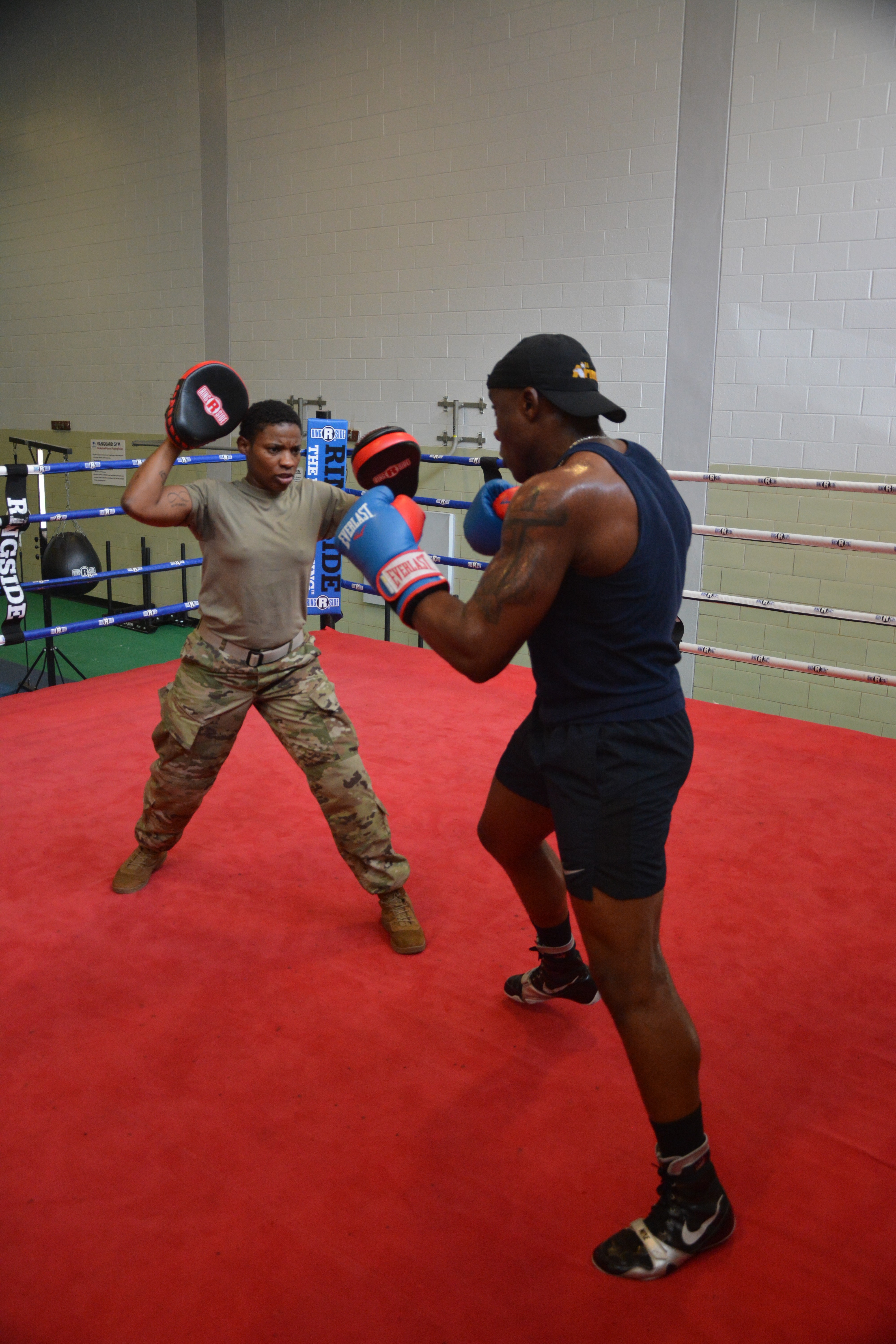
"No, I don't want to be punched in the face," said Staff Sgt. April Moreland, who spent a few years boxing before transitioning into her current role as a coach. "Of course not," she laughs. "Why mess this (face) up?"
Boxing is not everybody's idea of a good time, she admits. Her introduction to the sport was a whim. Looking for an activity to lose weight and get into shape, she settled on boxing. It's as strenuous an activity as a person can do, and she quickly discovered an aptitude for the sport.
"When I won my first two fights by demolishing this girl, I decided this was something I might like doing," she said.
"It's an adrenaline rush," said 1st Lt. Kendall Harris, executive officer for Bravo Company, 3rd Battalion, 34th Infantry Regiment, 165th Infantry Brigade, who is under Moreland's guidance. "A lot of people look at boxing and think it's a barbaric sport; it's really about trying to outsmart your opponent. When you look at it from that standpoint, it's really like a chess match.
"You can play a lot of sports, but you can't play boxing," he said.
Harris, 25, was among the 44 fighters taking part in the All-Army Boxing Trial Camp at Fort Huachuca, Arizona, in May. The heavyweight fighter took gold at the camp, and is headed next for the All Army national tournament this September in California.
It's Harris' second run at competing with the All Army team. The first, he said, did not go as planned.
"It's survival of the fittest," he said of the All Army Boxing camp. "It's a month-long camp. It's non-stop ... you're working out three days a week, sparring three or four times a week. The whole point to camp is to make it to fight night and championship night. The Army's trying to get the best team possible to go to the national tournament. Most people are weeded out in the first two weeks because they can't take the training."
Harris went the distance, but lost his final fight. While his confidence level was high, he said his training was probably inadequate for the camp.
"I was coming from South Korea," he said. "I had been training myself for a whole year. I didn't have a gym in Korea or anything like that. I went to All Army and thought I was going to take the whole thing."
Standing in his path, though, was Spc. Adrian Tillman, a prior national champion and the fighter he would have to defeat in order to secure a spot on the All Army team.
"I fell short on the championship fight against him," he said. "I told myself after that I wasn't going to let that happen again. I was glad to get the experience, but I was still upset that I lost."
He turned down a spot on the team because of the loss.
"I wanted to earn my spot on the team," he said. "Honestly, that loss was probably the best thing that could have happened to me. It gave me a realistic view of where I was at in comparison to where I needed to be."
Enter: Fort Jackson
Moreland had already put her own career as a fighter behind her when she arrived at Fort Jackson.
"I just got bored with being a boxer," said Moreland, now with the 17th Military Police Detachment. "It was a lot of pressure." Her coach was concerned that her talent would go to waste and encouraged her to migrate those skills to coaching. It took her a little time to come around to that way of thinking, though.
"I became a coach, certified USA boxing, and ran into these (fighters) when I was stationed here last year," she said. There was already a boxing program established on post, but the transient nature of military life soon promoted her to a management position. Today, she's coaching six fighters, with another 20 Soldiers and civilians involved in the program because of its health benefits.
Among those fighters is Harris, who told ''Coach Mo" about his plans to return to the All Army camp to finish what he started.
"She had competed there and knew how it worked," Harris said. "She was like, 'Let's work on those things that you lack. Lets's work on your speed, let's put those combinations together, and let's do everything you need to do in order to beat this guy when you see him again.' So, that's what we did. Our whole goal was redemption."
Harris said he expected to face off against Tillman again, but that fighter had moved on.
But there was another guy, Staff Sgt. William Ransom, the master instructor for combatives at Fort Benning," he said. "I knew it was going to be a tough match. It was him and I in the championship fight, and he was definitely a tough competitor. But I knew I wasn't going to lose."
Goals and expectations
Harris started fighting when he was 19 years old. It might have started earlier, he said, but his mother had different ideas.
"My mom would never let me compete," said Harris, originally from Killeen, Texas. "I remember back in fourth grade for Christmas I asked for boxing gloves and a punching bag, and I got it. But my mom wouldn't let me compete. She was too scared of me getting hurt, which I didn't understand back then but I definitely understand now."
As soon as he was out of the house, though, Harris started looking into the boxing programs available in his community.
"In my freshman year in college, I went to check out a boxing gym in downtown San Antonio," he said. "I just fell in love with it."
His training started slowly. For the first few weeks he had to learn how to throw basic punches and the value of footwork.
"From there, they threw me in the ring for my first sparring match," he said. "I knocked the dude out in like 15 or 20 seconds."
An ROTC cadet in college, Harris found the Army to be a bit more welcoming to the idea of boxing than his Family had been.
"The Army was real supportive of extracurricular activities like boxing," he said. "Even when I was in ROTC, they were open to me going to different tournaments and doing Golden Gloves. At the end of the day, it was an opportunity for them to say, 'We've got this guy in our battalion or our school.
He's representing the Army.' It shows the community that you can do more than just shoot a rifle."
Speaking of doing more, Moreland's training concept for Harris is to maintain his strengths while working to obliterate his weaknesses.
"I'm the type of coach that, if you come to me with a goal, we're going to meet and exceed it," Moreland said. "He's got a lot of energy, but I've got more. That's what pushes him."
Boxing takes place inside of a gym, so that's where Moreland focuses her training.
"We don't go outside to run," Moreland said. "To me, it's a waste of time and energy to hit the pavement. We do everything inside of the gym. We do running, we do sprints non stop, we do non-stop cardio in the ring ... everything is movement at a fast pace. You need to have that mentality that 'I'm tired, but can keep going.'
"I think he'll come back again with the gold," Moreland said.
Social Sharing